What you'll learn
- Which short quotations from Of Mice and Men are most useful to memorise.
- How to connect each quotation to character, theme, structure, and context.
- How to write about quotations precisely in Edexcel IGCSE English Literature.
- How to avoid “quote dumping” in a closed-book answer.
Why key quotes matter
Of Mice and Men is examined in Component 1: Poetry and Modern Prose, which is closed book. That means you will not have the text with you, so you need a small bank of accurate quotations you can use flexibly.
For this section, Edexcel mainly rewards AO1 — close knowledge, textual references, and a clear personal response — and AO4 — links to context. Even though AO2 is not separately assessed here, noticing Steinbeck’s methods still helps you write in a sharper, more literary way.
Key quotation
A key quotation is a short, accurately remembered phrase that opens up a larger idea about a character, theme, relationship, or moment in the text.
Small quotes, big ideas
You do not need to memorise long speeches. Learn short, exact fragments such as “We got a future”, “I get lonely”, or “the crash of the shot”, then practise explaining why they matter.
How to use a quote well
A strong quote is not just dropped into a paragraph. You should connect it to:
- Who says it or where it appears.
- What it reveals about character, theme, or plot.
- How Steinbeck presents the idea through language, structure, symbolism, or contrast.
- Why it matters in context, especially 1930s America, the Great Depression, migrant labour, racism, sexism, age, disability, and poverty.
Context
Context means the real-world background that shapes the text, such as 1930s economic hardship, racial segregation, gender expectations, and the insecurity of migrant ranch workers.
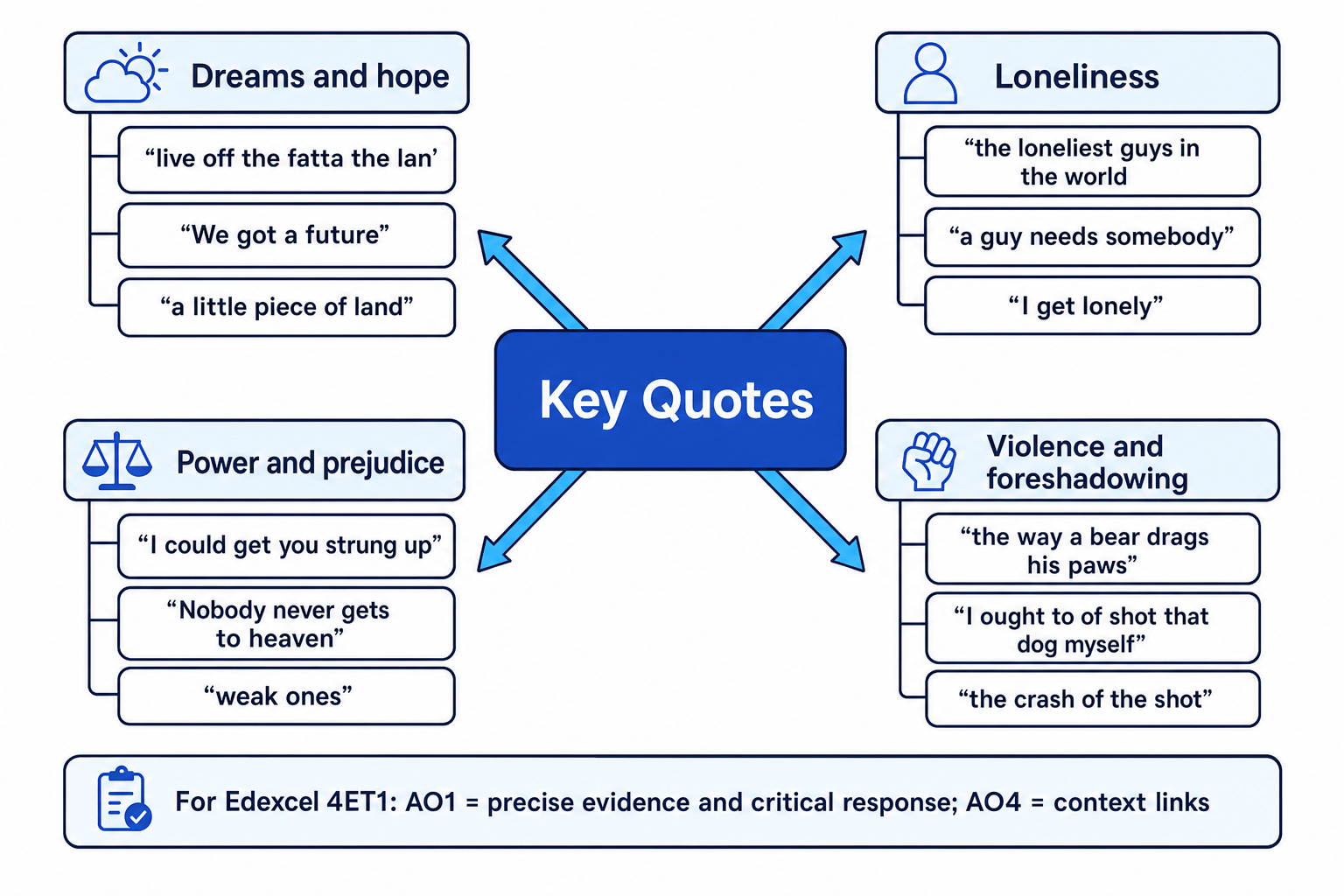
The diagram below shows how a small quote bank can be organised by theme, so the same quotation can work for more than one possible question.
Dreams and companionship
The dream of owning land is one of the most important repeated ideas in the novella. It gives George and Lennie hope, but Steinbeck gradually shows how fragile that hope is.
Motif
A motif is a repeated idea, image, phrase, or object that builds meaning across a text.
Quotes to know
| Quotation | Where it appears | Why it matters |
|---|---|---|
| “Guys like us, that work on ranches, are the loneliest guys in the world.” | George, Chapter 1 | Shows the normal life of migrant workers: isolated, rootless, and emotionally unsupported. |
| “With us it ain’t like that. We got a future.” | George, Chapter 1 | Presents George and Lennie’s friendship as unusual and hopeful. |
| “live off the fatta the lan’” | Lennie, repeated | Lennie’s childish excitement makes the dream sound comforting, almost like a bedtime story. |
| “a little piece of land in his head” | Crooks, Chapter 4 | Crooks suggests the dream is common among poor workers but rarely becomes real. |
The phrase “live off the fatta the lan’” is especially useful because it links to the American Dream: the belief that hard work can lead to independence and prosperity. Steinbeck questions this belief by showing that George, Lennie, Candy, and Crooks are trapped by poverty and social inequality.
Memorise the repeated phrase
If you only remember one dream quotation, remember “live off the fatta the lan’”. It works for questions on Lennie, George, friendship, dreams, poverty, and the ending.
Loneliness and exclusion
Loneliness affects nearly every major character. Steinbeck does not present it as just a personal feeling; he shows it as a social condition created by poverty, racism, sexism, age, and disability.
Quotes to know
| Quotation | Where it appears | Why it matters |
|---|---|---|
| “A guy needs somebody—to be near him.” | Crooks, Chapter 4 | Crooks states the basic human need for companionship. |
| “I tell ya a guy gets too lonely an’ he gets sick.” | Crooks, Chapter 4 | Shows loneliness as damaging, almost like an illness. |
| “I get lonely.” | Curley’s wife, Chapter 5 | A blunt, simple confession that makes her more sympathetic. |
| “They’ll can me purty soon.” | Candy, Chapter 3 | Shows fear of becoming useless in a harsh working world. |
| “Maybe ever’body in the whole damn world is scared of each other.” | Slim, Chapter 3 | Suggests loneliness comes partly from fear and mistrust. |
Crooks is one of the strongest examples of enforced loneliness. His line “S’pose you couldn’t go into the bunk house and play rummy ’cause you was black” connects personal isolation to racist segregation in 1930s America.
Curley’s wife is also isolated, but in a different way. When she says “I get lonely”, Steinbeck strips away the men’s judgement of her and lets the reader hear her own voice.
Reducing characters to one label
Do not write that Curley’s wife is “just dangerous” or Crooks is “just bitter”. Use quotes to show complexity: both characters are lonely, but they also respond to loneliness in flawed or harmful ways.
Power, prejudice, and vulnerability
Steinbeck often shows that characters with little power may still try to gain power over someone weaker. The ranch is a hierarchy: race, gender, physical strength, age, and usefulness all affect how people are treated.
Quotes to know
| Quotation | Where it appears | Why it matters |
|---|---|---|
| “They left all the weak ones here.” | Curley’s wife, Chapter 4 | She cruelly identifies Candy, Crooks, and Lennie as powerless outsiders. |
| “I could get you strung up on a tree so easy it ain’t even funny.” | Curley’s wife to Crooks, Chapter 4 | Reveals the violent racism of the society beyond the ranch. |
| “Nobody never gets to heaven, and nobody gets no land.” | Crooks, Chapter 4 | Crooks links religious hope and the land dream as equally unreachable. |
| “heavily made up” | Description of Curley’s wife, Chapter 2 | Shows how she is first presented through male judgement and appearance. |
Quoting racism responsibly
If you discuss racist language in the novella, do so only when it is necessary for analysis. Focus on Steinbeck’s exposure of racism and its effects, not on repeating offensive language for shock value.
Curley’s wife’s threat to Crooks is a crucial moment because it shows a painful contradiction: she is oppressed as a woman in a male-dominated world, but she can still exploit her racial power over Crooks.
Violence and foreshadowing
Steinbeck prepares the reader for the ending long before it happens. Small moments of violence build a pattern that makes Lennie’s death feel tragic but structurally inevitable.
Foreshadowing
Foreshadowing is when a writer plants hints earlier in a text that prepare the reader for later events.
Quotes to know
| Quotation | Where it appears | Why it matters |
|---|---|---|
| “the way a bear drags his paws” | Description of Lennie, Chapter 1 | Animal imagery suggests Lennie’s strength, innocence, and lack of control. |
| “I ought to of shot that dog myself.” | Candy, Chapter 3 | Foreshadows George’s decision to shoot Lennie himself. |
| “A shot sounded in the distance.” | Candy’s dog’s death, Chapter 3 | The offstage gunshot prepares for the final gunshot. |
| “The crash of the shot rolled up the hills and rolled down again.” | Lennie’s death, Chapter 6 | Gives the ending a huge, echoing finality. |
| “You hadda, George. I swear you hadda.” | Slim, Chapter 6 | Shows Slim’s understanding of George’s impossible choice. |
Cyclical structure
A cyclical structure is when a text ends in a way that echoes its beginning. Of Mice and Men begins and ends by the Salinas River, making the final scene feel fated.
The ending returns to the peaceful natural setting of Chapter 1, but the mood has changed. The same place that once held the dream now becomes the place where the dream is destroyed.
Analysing a foreshadowing quote
-
Choose the quotation “I ought to of shot that dog myself” and identify its immediate meaning: Candy regrets letting Carlson kill his old dog because it should have been his responsibility.
-
Connect the moment to structure: Candy’s regret prepares the reader for George’s later decision to kill Lennie himself rather than let Curley’s group do it brutally.
-
Link the method to effect: Steinbeck uses foreshadowing and parallel situations to make George’s action seem tragic rather than simply cruel.
-
Add context: in the harsh world of the ranch, those who are seen as weak, old, disabled, or no longer useful are easily discarded.
-
Shape it into analysis: Candy’s line “I ought to of shot that dog myself” foreshadows George’s final act, suggesting that in Steinbeck’s violent world even mercy can take a brutal form.
Setting and the natural world
The opening setting is calm and beautiful, but it also contains hidden danger. Steinbeck uses nature to suggest that violence is part of the world of the novella.
Quotes to know
| Quotation | Where it appears | Why it matters |
|---|---|---|
| “A few miles south of Soledad” | Opening line, Chapter 1 | “Soledad” means loneliness, subtly introducing a major theme. |
| “the Salinas River” | Opening and ending | The repeated setting links the beginning and ending. |
| “The rabbits hurried noiselessly for cover.” | Chapter 1 | Foreshadows how the dream of rabbits will be connected to fear and danger. |
The natural setting can seem peaceful, but Steinbeck often interrupts peace with movement, threat, or death. This helps prepare us for the novella’s violence.
Turning quotes into paragraphs
A strong paragraph should not just list quotations. It should develop an argument.
Building a paragraph on loneliness
-
Start with a clear point: Steinbeck presents loneliness as a shared condition of ranch life, not just an individual weakness.
-
Select a broad quotation first: George says ranch workers are “the loneliest guys in the world”, which makes loneliness seem typical of migrant labour.
-
Add a character-specific quotation: Crooks says “A guy needs somebody—to be near him”, showing the emotional damage caused by racial exclusion.
-
Link to context: Crooks’s isolation reflects segregation and racism in 1930s America, while George’s comment reflects the insecure lives of migrant workers during the Great Depression.
-
Finish with interpretation: together, the quotations suggest that companionship is not a luxury in the novella; it is a basic human need that society repeatedly denies.
Quote dumping
Do not write: “This is shown when George says ‘We got a future’.” Then stop. Always explain what the quote reveals, how Steinbeck presents it, and why it matters to the question.
A compact quote bank to memorise
If you want a manageable revision list, learn these ten first:
- “the loneliest guys in the world” — migrant workers and isolation.
- “We got a future” — George and Lennie’s hope.
- “live off the fatta the lan’” — the dream of land.
- “A guy needs somebody—to be near him” — Crooks and loneliness.
- “I get lonely” — Curley’s wife’s isolation.
- “They’ll can me purty soon” — Candy’s fear of uselessness.
- “I could get you strung up” — racism and power.
- “the way a bear drags his paws” — Lennie’s animal imagery.
- “I ought to of shot that dog myself” — foreshadowing and responsibility.
- “The crash of the shot” — the tragic final ending.
In the exam
- Choose short, accurate quotations you can embed smoothly into your own sentence.
- Link each quotation to the question, then add context only where it genuinely deepens your point.
- Aim for range: use quotations from different parts of the novella, especially the opening, middle, and ending.
Check yourself
- Which three quotations could you use for a question about loneliness?
- How does Candy’s dog foreshadow the ending of the novella?
- Which quotation best shows that the dream of land is both comforting and unrealistic?
