John Steinbeck’s Of Mice and Men is a tightly constructed masterpiece. Although it is a relatively short text, its impact relies heavily on its unique, deliberate structure. In your Edexcel IGCSE English Literature paper, Of Mice and Men is assessed in Component 1, Section C. Because this is a closed-book exam, you must develop a deep structural understanding of how specific chapters operate and build upon one another to convey key themes (AO1) and historical context (AO4).
What you'll learn
- How Steinbeck utilizes the unique play-novelette form to structure his narrative.
- Deep-dive analysis of three pivotal chapters: Chapter 1 (The Clearing), Chapter 4 (Crooks's Room), and Chapter 6 (The Return to the Clearing).
- How to trace themes, context, and structural parallelism across the novel to score highly in your essays.
The "Play-Novelette" Structure
Before looking at specific chapters, we must understand the overarching blueprint of the book. Steinbeck designed Of Mice and Men using a structural experiment he termed the "play-novelette."
Play-Novelette
A play-novelette is a work of fiction written with a novel's prose but structured physically and dramatically like a play. It features distinct, self-contained scenes (chapters) set in confined locations, relying heavily on dialogue, physical descriptions that read like stage directions, and dramatic entrances and exits.
The novel is split into six chapters, each acting as a distinct "scene" in a three-act dramatic structure:
- Act I (Chapters 1 & 2): Introduction to the natural safe haven (the brush) and the harsh reality of the ranch (the bunkhouse).
- Act II (Chapters 3 & 4): Escalating tension in the bunkhouse and the literal and social isolation of Crooks's room.
- Act III (Chapters 5 & 6): The tragic climax in the barn and the inevitable return to the safe haven, which has now become a place of execution.
The Circular Structure
The novel's structure is strictly cyclical. It begins and ends in the exact same natural setting—the clearing by the Salinas River. This circular movement reinforces the theme of inevitability: despite their struggles, the itinerant workers of 1930s America cannot escape their predetermined socio-economic fates.
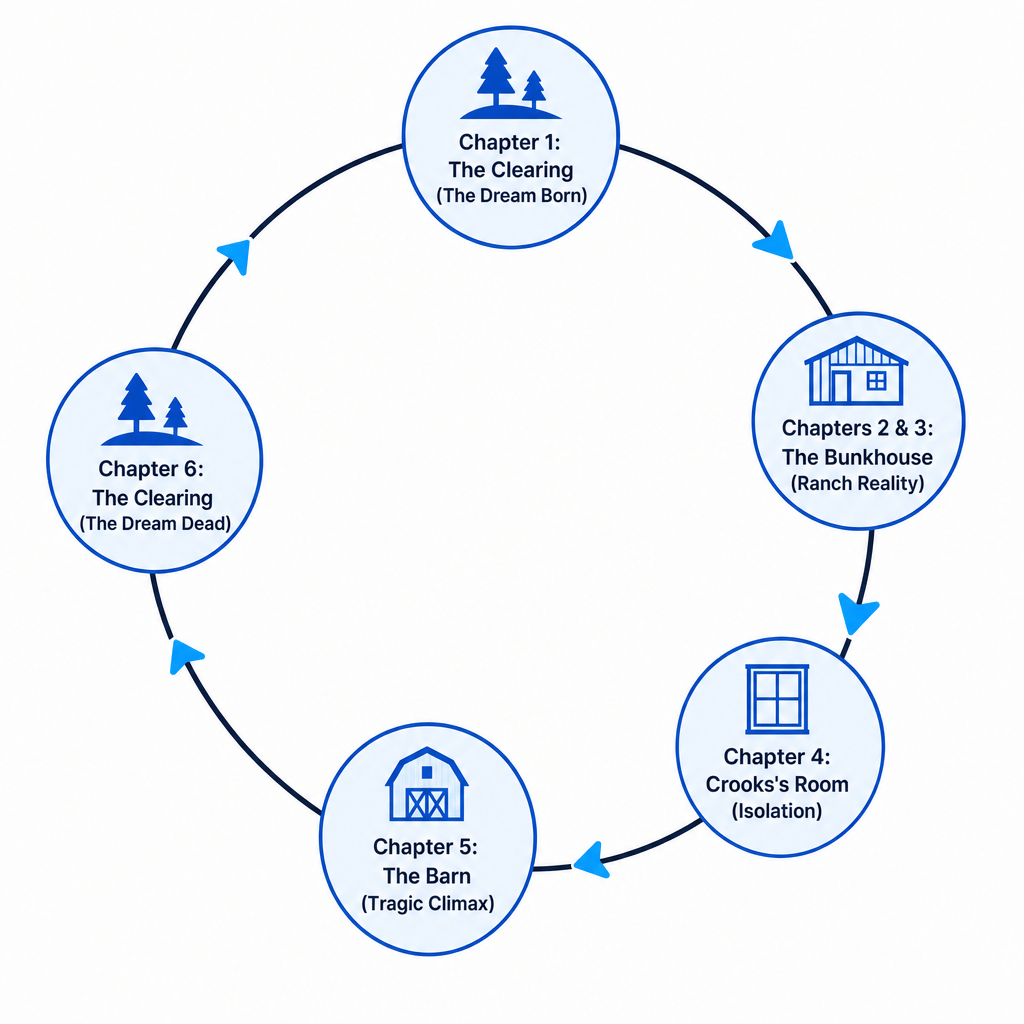
Chapter 1: The Clearing (The Exposition)
Chapter 1 introduces us to the natural world and establishes the central dynamic of the novel. It functions as a peaceful, Eden-like sanctuary before the characters enter the corrupting, competitive environment of the ranch.
Key Themes & Structural Function
- The Dream is Born: Steinbeck introduces the "Dream" of owning land. When George recites the vision of the future ("We're gonna have a little house and a couple of acres..."), it reads like a rhythmic, comforting ritual.
- Foreshadowing Danger: Lennie's physical power and obsession with soft things are immediately established. He carries a dead mouse in his pocket, and George references their flight from Weed because Lennie "wanted to feel that girl's dress."
Contextual Links (AO4)
This chapter highlights the extreme isolation of migrant agricultural workers during the Great Depression. George explicitly states: "Guys like us, that work on ranches, are the loneliest guys in the world." This encapsulates the nomadic lifestyle of the 1930s dust-bowl migrants, who lacked family, roots, or long-term employment.
Chapter 4: Crooks’s Room (The Microcosm)
Chapter 4 is a structural masterpiece. It is the only chapter that takes place away from the main ranch activities, set in the harness room of the stable buck, Crooks. This physical separation mirrors the social segregation of the era.
Key Themes & Structural Function
- A Microcosm of Society: This scene brings together the four most marginalized characters on the ranch: Crooks (isolated by race), Candy (isolated by age/disability), Lennie (isolated by intellectual disability), and Curley’s Wife (isolated by gender).
- The Cruelty of Power Hierarchies: Instead of finding solidarity in their shared suffering, the characters attack one another to assert dominance. When Crooks attempts to assert his dignity, Curley's Wife viciously attacks him: "I could get you strung up on a tree so easy it ain't even funny." This demonstrates how those with the least power in society often abuse what little authority they can find.
Ignoring the physical settings
Students often write about Crooks's room without analyzing how Steinbeck uses physical space. The room is "swept and fairly neat," filled with books (including a copy of the California Civil Code), showcasing Crooks’s intelligence and humanity. Do not just focus on dialogue; look at how the physical props and settings symbolize character traits.
Chapter 6: The Return to the Clearing (The Tragic Climax)
Chapter 6 mirrors Chapter 1 almost perfectly in terms of setting, but the atmosphere has darkened significantly. The natural world, once peaceful, is now fraught with predatory survival.
Key Themes & Structural Function
- Naturalism and Survival: At the start of the chapter, a water snake is eaten by a heron, only for another snake to swim into the same spot. This harsh image symbolizes the cold, uncaring natural cycle. Lennie, like the first snake, is doomed to be eliminated by forces he cannot comprehend.
- The Ultimate Act of Love and Mercy: George's shooting of Lennie is structured as a mercy killing. He forces Lennie to look across the river and visualize the dream ("Look acrost the river, Lennie, an' I'll tell you so you can almost see it") so that Lennie dies happy, spared from Curley’s brutal, vengeful wrath.
Context (AO4) integration
In your exam, link George’s tragic choice in Chapter 6 to the harsh reality of the 1930s. There were no social safety nets or psychiatric facilities capable of caring humanely for individuals like Lennie. George’s choice, while heartbreaking, represents the only protective action available to him in a ruthless, individualistic society.
Worked Example: Analysing Structural Parallelism
When writing your Edexcel IGCSE essay, you will gain significant marks for AO2 (Analysis of structure and language) by exploring how Steinbeck mirrors scenes.
Here is how you can systematically construct an analytical paragraph showing how Chapter 6 mirrors Chapter 1 to emphasize the death of the American Dream.
Analysing structural parallelism
- Identify the structural parallel and state the point clearly: Start by explaining how the setting of Chapter 6 acts as a dark reflection of Chapter 1. Example: "Steinbeck utilizes structural parallelism between Chapters 1 and 6 to emphasize the tragic impossibility of the American Dream, shifting the Salinas valley from a sanctuary to a site of inevitable slaughter."
- Select and analyze contrasting evidence from both chapters: Contrast the language used to describe the setting in both chapters to show how the atmosphere has changed. Example: In Chapter 1, the water is described as 'warm' and the leaves 'whisper.' In Chapter 6, however, the wind 'screams' and a water snake is abruptly 'clamped' by a heron. The transition from peaceful personification to violent, predatory verbs highlights that nature—and by extension, the capitalist society of 1930s America—is fundamentally hostile to the weak.
- Link to context (AO4) and the author's wider purpose: Explain why Steinbeck structures the novel this way and what it tells us about the historical context. Example: By returning the narrative to the exact clearing where it began, Steinbeck creates a claustrophobic, inescapable loop. This circular structure mirrors the economic trap of the Great Depression; just as Lennie cannot escape his fate, the migrant workers are trapped in an endless cycle of poverty and unfulfilled dreams, illustrating the ultimate failure of the American Dream.
In the exam
- Analyze the Opening Directions: If you are discussing a specific chapter, look closely at the first paragraph. Steinbeck always sets the scene with sensory language that establishes the mood and foreshadows the action.
- Trace the Evolution of Key Motifs: Be ready to show how symbols change across chapters. For instance, notice how the pup in Chapter 5 is a direct precursor to the death of Curley's Wife, and how Candy's dog's death in Chapter 3 structurally foreshadows Lennie's death in Chapter 6.
- Synthesize Text and Context: Always ground your chapter analysis in the 1930s historical reality. Whether it is segregation in Chapter 4 or the loneliness of the bunkhouse in Chapter 2, every setting reflects the socio-economic conditions of Depression-era America.
Check yourself
- How does the description of the water snake at the beginning of Chapter 6 differ from the natural descriptions in Chapter 1?
- Why is Chapter 4 (Crooks's Room) considered the structural "turning point" where the impossibility of the dream is first realized by all the characters?
- What specific details in the bunkhouse description (Chapter 2) emphasize the lack of permanence and privacy in the lives of migrant workers?
