What you'll learn
- What John Agard’s “Half-caste” is about, and why the title is deliberately provocative.
- How Agard uses voice, dialect, repetition, humour and imagery to challenge racism.
- How the poem’s structure builds from mock politeness to a powerful final demand.
- How to write about the poem for Edexcel IGCSE anthology comparison questions.
Big picture: what is the poem about?
John Agard’s “Half-caste” challenges the racist term “half-caste”, historically used to describe someone of mixed-race heritage. The speaker refuses to accept the idea that being “mixed” makes a person incomplete, inferior, or only “half” of something.
Instead, Agard turns the term back on the person using it. He asks what “half-caste” really means, then gives deliberately absurd examples: mixed paint in a Picasso painting, mixed light and shadow in the sky, and black and white keys in music. By the end, the speaker demands that the listener return with “de whole of yu eye”, “de whole of yu ear” and “de whole of yu mind” before hearing “de other half / of my story”.
Speaker
The speaker is the voice inside the poem. It is not always exactly the same as the poet, but in this poem the speaker strongly reflects Agard’s challenge to racist language and narrow ideas about identity.
Central message
Agard shows that mixed identity is not a weakness or a “halfness”. The real problem is the limited vision of the person who uses the label “half-caste”.
Context that matters
John Agard was born in Guyana and later moved to Britain. His poetry often celebrates Caribbean speech, performance and cultural mixture. In “Half-caste”, he uses Caribbean Creole and non-standard spellings such as “yu”, “wha” and “wid” to create a distinctive spoken voice.
The phrase “half-caste” comes from racist systems of classification, where people were labelled according to supposed racial “purity”. Today, it is widely recognised as offensive.
Dialect and Creole
A dialect is a variety of language linked to a region or community. A Creole is a stable language variety that developed through contact between different languages. Agard’s use of Caribbean Creole is deliberate and expressive, not “wrong English”.
Calling the language incorrect
Do not describe Agard’s dialect as “bad grammar” or “broken English”. In AO2 analysis, treat it as a deliberate method: it gives the speaker authority, identity and individuality.
Title: why “Half-caste” matters
The title uses the offensive label directly, forcing the reader to confront it. The word “half” suggests incompleteness. The word “caste” suggests rigid social ranking or inherited classification. Together, the phrase reduces a whole person to a category.
Agard’s poem dismantles that category. He does not politely avoid the term; he exposes how absurd it is.
Voice and direct address
The poem begins:
“Excuse me / standing on one leg / I’m half-caste”
The phrase “Excuse me” sounds polite, but the image of “standing on one leg” makes the label ridiculous. If the speaker is supposedly “half”, should he literally stand like half a person?
Irony
Irony is when the surface meaning and the deeper meaning differ. Here, “Excuse me” sounds polite, but the speaker is actually preparing a sharp challenge.
The speaker repeatedly addresses “yu”:
“Explain yuself / wha yu mean / when yu say half-caste”
This is direct address, meaning the speaker talks straight to another person. It makes the poem feel confrontational and immediate, as if the reader is being questioned too.
Rhetorical question
A rhetorical question is a question asked for effect rather than because the speaker expects a real answer. “wha yu mean” challenges the listener because there is no reasonable explanation for the racist term.
Analysing the repeated challenge
- Agard repeats “Explain yuself” and “wha yu mean”, so the burden shifts onto the person using the label: they must justify their language.
- The phrase “wha yu mean” is simple and direct, which makes the challenge harder to avoid. The speaker is not using abstract argument; he is demanding clarity.
- Because the listener cannot logically explain the term, the repetition exposes the label as thoughtless prejudice rather than truth.
- In an essay, you could link this to the poem’s wider message: racist language often survives because people repeat it without examining what it implies.
Form and structure
“Half-caste” is written in free verse.
Free verse
Free verse is poetry without a regular rhyme scheme or fixed metre. This gives the poem a more natural, speech-like rhythm.
The poem also works like a dramatic monologue.
Dramatic monologue
A dramatic monologue is a poem spoken by one voice to an implied listener. We learn about the speaker through what they say and how they say it.
The structure builds in four main movements:
- The speaker opens with mock politeness and the absurd image of being “half”.
- He gives examples from art, weather and music to show that mixture creates beauty.
- He applies “halfness” literally to his own body and senses, exposing how dehumanising the term is.
- He ends with an instruction: the listener must return with “de whole” of their perception and mind.
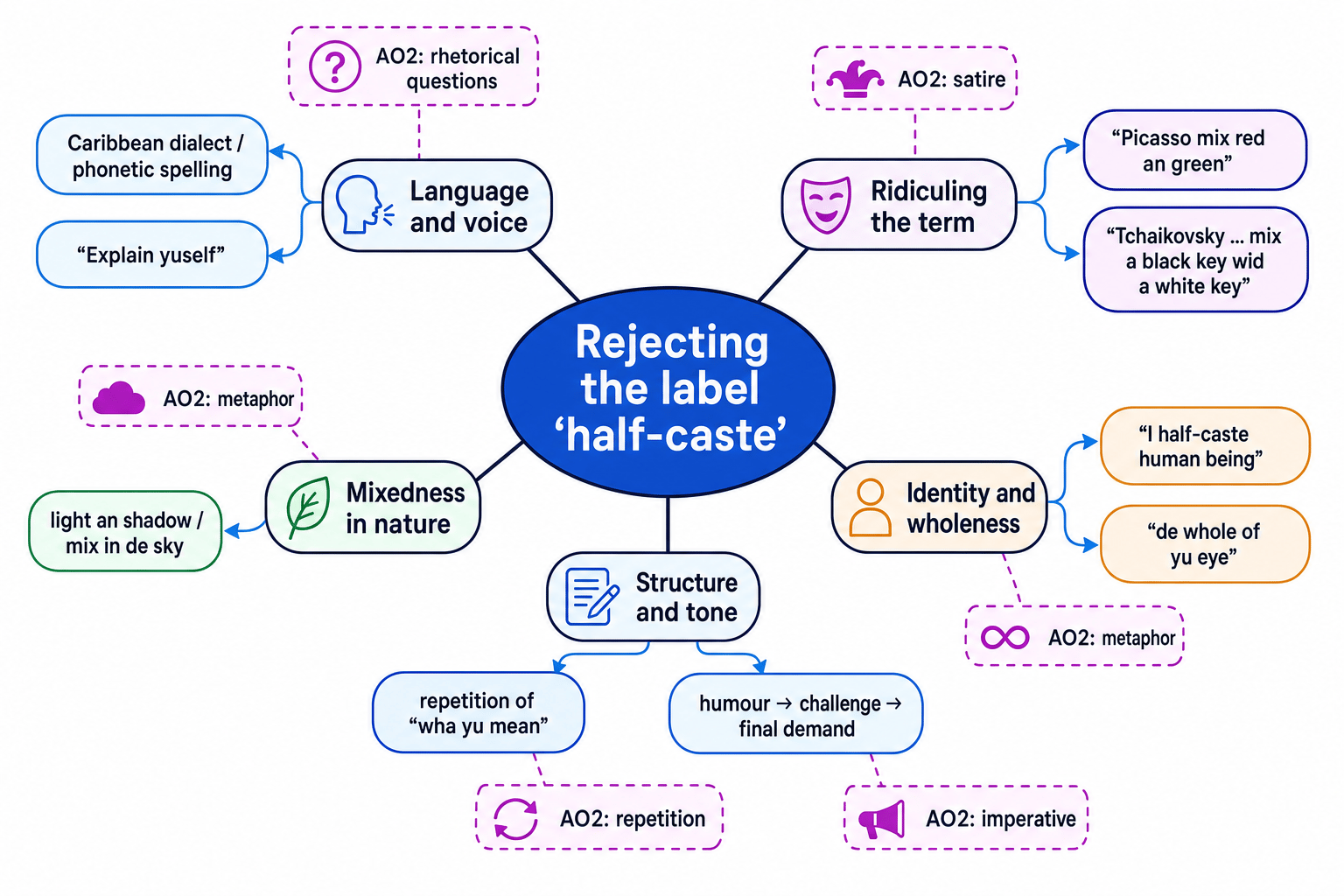
This concept map shows how Agard’s main methods connect to the poem’s message.
Structure as argument
The poem does not just describe prejudice; it argues against it. Each image makes the term “half-caste” seem more illogical, until the final lines demand a fuller way of seeing.
Language and imagery
Art: mixture as creativity
Agard asks whether, when “picasso / mix red an green”, the result is:
“a half-caste canvas”
This is deliberately silly. A painting with mixed colours is not half a painting; it is a complete artwork. By mentioning Picasso, Agard connects mixture with creativity and genius.
Satire
Satire uses humour, exaggeration or ridicule to expose foolishness or injustice. Agard satirises the term “half-caste” by applying it to things where it clearly makes no sense.
Weather: mixture as natural
The speaker then asks if “light an shadow / mix in de sky” creates:
“a half-caste weather”
This image suggests mixture is part of nature. Agard jokes that “england weather / nearly always half-caste”, because English weather is often cloudy, mixed and changeable.
He also describes clouds as:
“so spiteful dem dont want de sun pass”
Personification
Personification is when a writer gives human qualities to something non-human. Here, the clouds are described as “spiteful”, making the weather sound deliberately obstructive.
The humour matters because it makes the racist logic look petty and absurd. If nobody calls mixed weather inferior, why call a mixed-race person inferior?
Music: mixture as harmony
One of the strongest images is the piano:
“mix a black key / wid a white key”
The black and white keys are needed together to create music. The result is not a “half-caste symphony” in any negative sense; it is a full, rich piece of art.
Analysing the music image
- The words “black” and “white” connect the piano keys to racial categories, but the setting is music rather than biology or social status.
- By using “mix”, Agard repeats the idea of combination and shows that mixture can create beauty, complexity and harmony.
- The word “symphony” suggests something complete and impressive, so it contradicts the idea that being mixed makes something incomplete.
- The image therefore turns racist thinking upside down: separation would make the music poorer, while mixture makes it possible.
The body imagery: showing the cruelty of “half”
In the second half of the poem, Agard takes the word “half” literally:
“half of mih ear”
“half of mih eye”
“half-a-hand”
“half-a-dream”
“half-a-shadow”
These repeated body images create a semantic field of incompleteness.
Semantic field
A semantic field is a group of words or images connected by meaning. Here, the repeated “half” images build a pattern of fragmentation.
This section is funny, but it is also serious. The speaker imagines interacting with the listener using only half his body and half his senses. This shows how the label reduces a full human being into something partial.
The line:
“I half-caste human being / cast half-a-shadow”
is especially powerful. A shadow proves physical presence, but “half-a-shadow” suggests the speaker is being made less visible or less fully recognised by society.
Ending: “the whole” listener
The ending shifts from mockery to a firm demand:
“come back tomorrow / wid de whole of yu eye / an de whole of yu ear / an de whole of yu mind”
The repeated “whole” reverses the repeated “half”. The problem is not that the speaker is incomplete. The problem is that the listener is only half-looking, half-listening and half-thinking.
The final lines are:
“an I will tell yu / de other half / of my story”
This is not an admission that the speaker is only half a person. Instead, it suggests the listener has only heard half the truth because prejudice has limited their understanding.
A strong ending point
In analysis, link “de other half / of my story” to voice and power. The speaker controls when his full story will be told; the prejudiced listener must become more open first.
Tone
The tone changes across the poem.
Tone
Tone means the attitude or mood created by the writer’s language, voice and structure.
At first, the tone is mock-polite: “Excuse me”. Then it becomes comic and satirical through the absurd examples of art, weather and music. Later, the tone becomes more serious as the speaker imagines offering only “half-a-hand” and dreaming “half-a-dream”. By the end, the tone is commanding and dignified.
The phrase:
“ah rass”
marks a sharper emotional moment. It sounds like an outburst of irritation, showing that beneath the humour there is real anger at the insult.
Key quotations to remember
| Quotation | Method | Why it matters |
|---|---|---|
| “standing on one leg” | Absurd physical image | Makes the idea of being “half” look ridiculous. |
| “Explain yuself” | Direct address and repetition | Forces the user of the term to justify it. |
| “mix red an green” | Art imagery | Presents mixture as creative, not inferior. |
| “light an shadow / mix in de sky” | Natural imagery | Suggests mixture is normal and beautiful. |
| “mix a black key / wid a white key” | Music imagery and contrast | Shows that black and white together create harmony. |
| “half-a-dream” | Repetition and body/mind imagery | Shows how the label reduces human experience. |
| “de whole of yu mind” | Imperative demand | Challenges the listener to think fully and fairly. |
| “de other half / of my story” | Structural ending | Gives the speaker control over his identity and narrative. |
Comparing “Half-caste” with another anthology poem
For AO3, you need to compare how poets present ideas, not just list similarities. “Half-caste” often compares well with poems about identity, language, power or voice.
For example, with “Search for My Tongue”, you could compare how both poets connect language to identity. Agard uses Caribbean Creole confidently from the start, while Bhatt explores the struggle between a “mother tongue” and another language. Both poets show that language is not just communication; it is part of who you are.
You could also compare Agard’s direct, confrontational voice with a poem that uses a more reflective or controlled speaker. The key is to compare methods: form, voice, imagery, repetition and structure.
In the exam
- Remember that Component 1 is closed book, so memorise a small set of short, accurate quotations such as “Explain yuself”, “half-a-dream” and “de whole of yu mind”.
- For AO2, always connect method to meaning: do not just say “Agard uses repetition”; explain how repetition pressures the listener and exposes prejudice.
- For AO3, compare ideas and methods together: for example, how two poets use voice, language or structure to explore identity.
Check yourself
- How does Agard make the phrase “half-caste” seem absurd?
- Why is Caribbean Creole important to the speaker’s voice and authority?
- What changes between the opening “Excuse me” and the ending “de whole of yu mind”?
