What you'll learn
- How to recognise a theme in Macbeth, not just name a topic.
- The main ideas Shakespeare develops: ambition, guilt, kingship, appearance, gender, violence and the supernatural.
- How to connect each theme to short, accurate quotations and writer’s methods.
- How to shape theme analysis for Edexcel IGCSE Component 2, where Macbeth is open book.
What is a theme?
A theme is a repeated idea or concern in a text. In Macbeth, Shakespeare does not simply include “ambition” or “witches”; he explores what happens when ambition is detached from morality, and when people try to control the future by violent means.
Theme
A theme is a central idea that develops across a text. A strong theme point says what the writer suggests about that idea, not just that the idea appears.
So, instead of writing:
- “Ambition is a theme in Macbeth.”
You should aim for:
- “Shakespeare presents unchecked ambition as morally destructive because Macbeth gains power but loses peace, loyalty and humanity.”
That second version is much stronger because it makes an argument.
Themes are patterns
To write well about a theme, track a pattern: where it begins, how it changes, and what Shakespeare suggests by the end of the play.
Turning a topic into a theme argument
- Start with a topic: ambition.
- Ask what Shakespeare seems to suggest about it: Macbeth’s ambition is not automatically evil, but it becomes destructive when he chooses murder over moral restraint.
- Link that idea to evidence: in Act 1 Scene 7, Macbeth admits he has “no spur” except “vaulting ambition”, showing he understands that his desire for power has outrun any honourable reason for action.
Here is a quick map of the main themes and how they connect across the play.
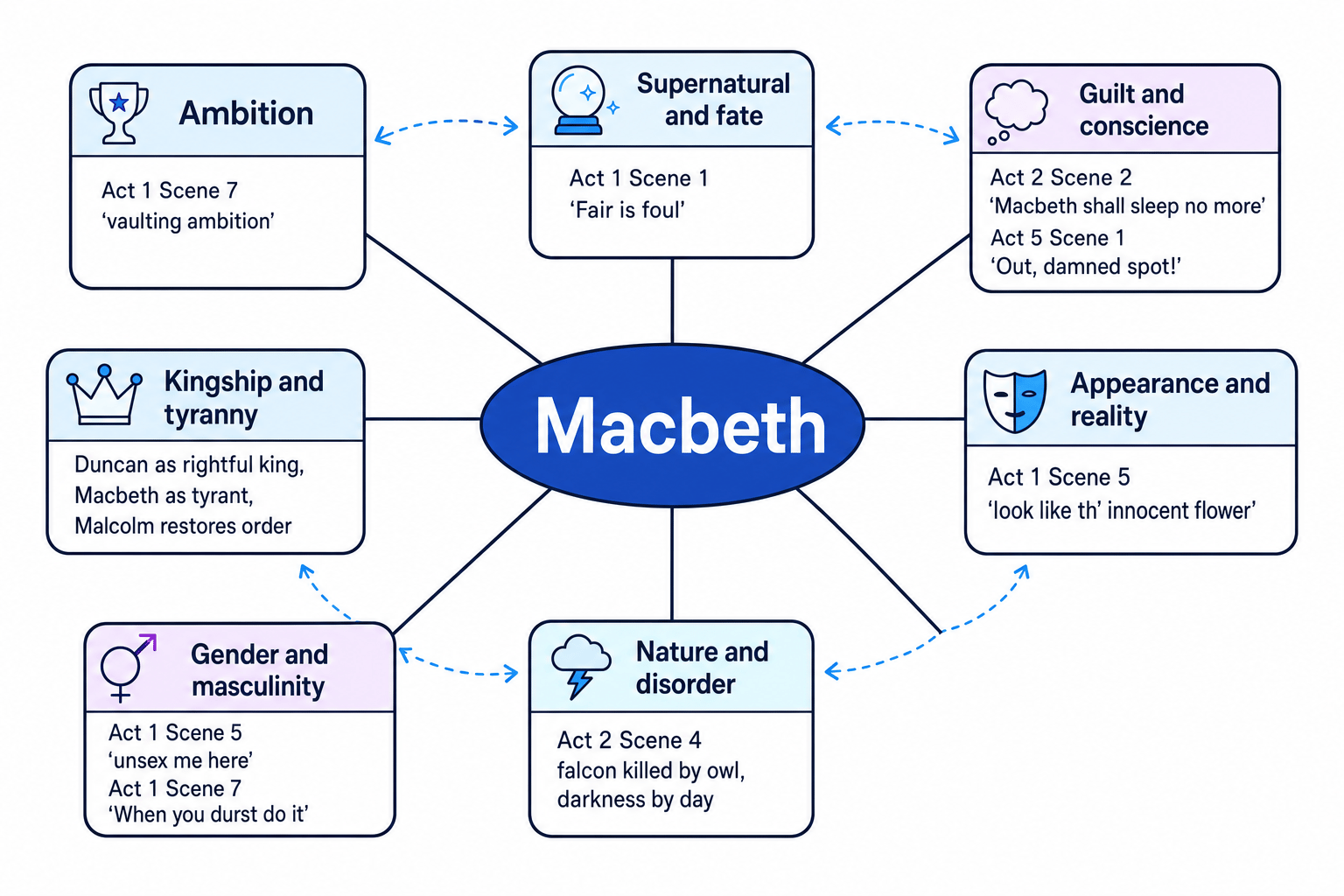
Ambition and moral choice
Ambition means a strong desire to achieve something, usually power, success or status. Shakespeare presents ambition as dangerous when it overpowers conscience.
At the start, Macbeth is praised as “brave Macbeth” in Act 1 Scene 2 because he fights loyally for Duncan. This matters: Shakespeare does not present him as evil from the beginning. His tragedy is that a good warrior becomes a tyrant through a series of choices.
In Act 1 Scene 7, Macbeth recognises his own motive: “I have no spur / To prick the sides of my intent, but only / Vaulting ambition”. A metaphor is a comparison that describes one thing as another. Here, ambition is imagined like a rider who jumps too high and falls. Macbeth knows his desire is excessive.
Analysing Macbeth’s ambition
- Choose the key evidence: Macbeth says his only motive is “vaulting ambition”.
- Identify the method: Shakespeare uses a metaphor, comparing ambition to overleaping a horse-riding jump.
- Explain the effect: this suggests Macbeth’s ambition is unstable and self-defeating; he is not driven by justice or necessity, but by a desire that will make him fall.
- Link to the theme: Shakespeare presents ambition as dangerous when it breaks free from moral limits.
Calling ambition Macbeth’s fate
Do not write as if Macbeth has no choice. The witches tempt him, but Macbeth decides to murder Duncan. The play is more interesting because ambition works together with free will.
The supernatural, fate and free will
The supernatural means forces beyond the natural world, such as witches, prophecies and visions. In Macbeth, the Weird Sisters create uncertainty: are they controlling Macbeth, predicting him, or manipulating his own desires?
The witches’ first chant, “Fair is foul, and foul is fair” in Act 1 Scene 1, introduces moral confusion. What looks good may be evil; what seems evil may be attractive. Macbeth echoes this language when he says, “So foul and fair a day I have not seen” in Act 1 Scene 3, linking him to the witches before he fully understands their danger.
A paradox is a statement that seems contradictory but reveals a truth. “Fair is foul” is paradoxical because it collapses opposites. Shakespeare uses this to create a world where moral boundaries blur.
Macbeth briefly considers letting fate act without him: “If chance will have me king, why, chance may crown me, / Without my stir.” Yet he does not remain passive. The prophecy awakens his “black and deep desires” in Act 1 Scene 4.
The witches tempt rather than force
Shakespeare makes the witches powerful, but Macbeth’s choices still matter. The tragedy comes from the way he turns prophecy into permission.
This theme also connects to Jacobean context. Jacobean refers to the period of King James I’s reign. James was interested in witchcraft and wrote Daemonologie, so Shakespeare’s original audience would likely have seen the witches as spiritually dangerous and politically disturbing.
Guilt and conscience
Conscience means a person’s inner sense of right and wrong. Guilt is one of the clearest ways Shakespeare shows that Macbeth and Lady Macbeth have violated moral order.
After Duncan’s murder, Macbeth hears a voice cry, “Sleep no more! / Macbeth does murder sleep” in Act 2 Scene 2. Sleep becomes a symbol: an object or idea that represents something larger. Here, sleep represents innocence, peace and spiritual rest. By murdering Duncan, Macbeth murders his own ability to be at peace.
Lady Macbeth initially dismisses guilt: “A little water clears us of this deed.” But later, in Act 5 Scene 1, she sleepwalks and cries, “Out, damned spot! out, I say!” The imagined blood has become impossible to wash away.
Tracing guilt from Act 2 to Act 5
- Compare Lady Macbeth’s early confidence with her later collapse: in Act 2, she believes “a little water” can remove guilt; in Act 5, she sees a “damned spot” that will not disappear.
- Identify the pattern: Shakespeare repeats the image of blood, making it a motif, which is a repeated image, word or idea that builds meaning.
- Explain the development: physical blood can be washed off, but moral guilt cannot. Lady Macbeth’s mind turns the crime into a permanent stain.
- Link to the theme: Shakespeare suggests that guilt is psychological and spiritual, not just practical or legal.
Appearance and reality
This theme is about the difference between what seems true and what is true. In a violent political world, characters must read faces, words and actions carefully.
Lady Macbeth advises Macbeth to “look like th’ innocent flower, / But be the serpent under’t” in Act 1 Scene 5. The image combines innocence and danger. The “flower” suggests beauty and harmlessness, while the “serpent” suggests biblical evil and hidden threat.
Macbeth later echoes this idea: “False face must hide what the false heart doth know” in Act 1 Scene 7. Shakespeare uses this line to show Macbeth choosing deception. The repeated “false” emphasises that he is splitting his outward appearance from his inward morality.
A useful term here is dramatic irony, which means the audience knows more than a character on stage. When Duncan arrives at Macbeth’s castle and says it has a “pleasant seat” in Act 1 Scene 6, the audience knows he is walking into danger. That makes the scene tense and tragic.
Link appearance to performance
Remember that Macbeth is a play. Deception is not only spoken about; it is performed on stage through faces, welcomes, feasts, costumes and public speeches.
Kingship, tyranny and order
Shakespeare contrasts rightful kingship with tyranny. Kingship means the qualities and responsibilities of a true king. Tyranny means cruel, selfish rule based on fear rather than justice.
Duncan is not a perfect politician, but Shakespeare presents him as a legitimate and generous king. Macbeth says Duncan has been “so clear in his great office” in Act 1 Scene 7. This makes the murder worse: Macbeth is not overthrowing a corrupt ruler but betraying a good one.
By contrast, Macbeth rules through fear. Scotland becomes a wounded country: Macduff cries, “Bleed, bleed, poor country!” in Act 4 Scene 3. The repeated image of bleeding turns the nation itself into a body injured by tyranny.
This theme links strongly to context. The Divine Right of Kings was the belief that monarchs were chosen by God. Killing a king was therefore not just a political crime but a spiritual attack on order. The Great Chain of Being was the belief that every creature and person had a fixed place in a God-given hierarchy. Duncan’s murder disrupts that hierarchy.
Connecting kingship to context
- Use the quotation “so clear in his great office” to show Duncan’s moral legitimacy.
- Connect the murder to Jacobean beliefs: if a king is God’s representative, regicide is an offence against divine order.
- Explain the dramatic result: unnatural events follow Duncan’s death, so Shakespeare presents political crime as something that infects the whole world of the play.
Gender and masculinity
Shakespeare explores how ideas about gender can be used to manipulate people. Masculinity means the qualities a society associates with being a man. In the play, characters often connect masculinity with courage, violence and emotional hardness — but Shakespeare questions this.
Lady Macbeth calls on spirits to “unsex me here” in Act 1 Scene 5. She wants to reject the softness and pity her society associates with femininity. Later, she attacks Macbeth’s manhood: “When you durst do it, then you were a man” in Act 1 Scene 7.
Macbeth gives an important reply: “I dare do all that may become a man; / Who dares do more is none.” At this moment, he understands that true manhood should have limits. To do “more” than is morally right is not heroic; it is inhuman.
Macduff later offers a healthier version of masculinity. When Malcolm tells him to “Dispute it like a man” after his family is murdered, Macduff answers, “I must also feel it as a man” in Act 4 Scene 3. Shakespeare suggests that feeling grief is not weakness.
Saying Lady Macbeth is simply unfeminine
It is more precise to say Shakespeare shows Lady Macbeth trying to reject pity and tenderness because she associates them with weakness. The play later exposes the psychological cost of that rejection.
Nature, violence and disorder
Shakespeare repeatedly links moral disorder with disorder in nature. A motif is a repeated image, word or idea, and Macbeth is full of motifs of blood, darkness, sleep, disease and unnatural weather.
After Duncan’s murder, nature seems to rebel. In Act 2 Scene 4, an Old Man describes a falcon killed by a “mousing owl”, and Ross says that darkness covers the earth when it should be day. These events mirror the unnatural act of Macbeth killing his king, guest and kinsman.
This is also an example of pathetic fallacy, where the natural world reflects human emotion or moral disturbance. Storms, darkness and strange animal behaviour make the murder feel cosmic, not merely personal.
Violence changes across the play. At first, Macbeth’s violence is praised in battle: he “unseam’d” the rebel Macdonwald in Act 1 Scene 2. By the middle of the play, violence has become private, paranoid and tyrannical: Banquo is murdered, Fleance is hunted, and Macduff’s family is slaughtered.
Violence loses honour
Shakespeare begins with violence used in defence of Scotland, then shows violence becoming a disease that destroys Scotland from within.
How to write about themes in Macbeth
For Edexcel IGCSE Literature, Macbeth sits in Component 2, which is open book: you may use a clean copy of the text. That does not mean you should copy long quotations. Instead, use the book to locate precise moments and embed short evidence.
Your best paragraphs will combine:
- AO1: a clear argument and accurate references.
- AO2: analysis of Shakespeare’s language, form and structure. Form means the type of text and its dramatic conventions; structure means how events, scenes and patterns are arranged.
- AO4: relevant context, such as Jacobean beliefs about kingship, witchcraft, gender and order.
A strong theme paragraph usually follows this movement:
- Make a point about what Shakespeare suggests.
- Embed a short quotation.
- Name a method only if you can analyse it.
- Explain the effect on the audience.
- Link back to the theme and, where useful, context.
Use tiny quotations
Short quotations like “vaulting ambition”, “Sleep no more”, “false face” and “Out, damned spot!” are easier to analyse than long chunks. Precision beats length.
In the exam
- Start each paragraph with an argument about Shakespeare’s message, not just a theme label.
- Track development across the play: early Macbeth, tyrant Macbeth, and the final restoration of order.
- Use the open book wisely: find brief evidence, then spend most of your time analysing method, effect and context.
Check yourself
- How does Shakespeare show that Macbeth is tempted by fate but still responsible for his choices?
- Which blood quotation best shows the difference between physical evidence and psychological guilt?
- How does Macduff’s “I must also feel it as a man” challenge Macbeth’s idea of masculinity?