What you'll learn
- How Shakespeare presents the main characters in Macbeth through speech, action, structure and stagecraft.
- How to write about character change without slipping into plot summary.
- How character contrasts — especially Macbeth/Banquo and Macbeth/Macduff — strengthen your AO2 analysis.
- How to bring in relevant Jacobean context for Edexcel IGCSE Component 2, where Macbeth is open book.
First: characters are Shakespeare’s construction
In a Macbeth essay, you are not just describing people as if they are real. You are analysing how Shakespeare constructs them for an audience: through what they say, what they do, how others describe them, and where they appear in the play’s structure.
Characterisation
Characterisation means the methods a writer uses to create and develop a character, including dialogue, imagery, stage action, contrast with other characters, and changes across the text.
Because Macbeth is a play, Shakespeare has no narrator explaining everything. Instead, the audience judges characters through dramatic methods: soliloquies, entrances and exits, reactions from others, and repeated images such as blood, darkness and disease.
Treating characters as real people only
Avoid writing “Macbeth is bad because he kills people” and stopping there. Stronger answers ask: how does Shakespeare make the audience see Macbeth’s moral collapse, and why does that matter in a tragedy?
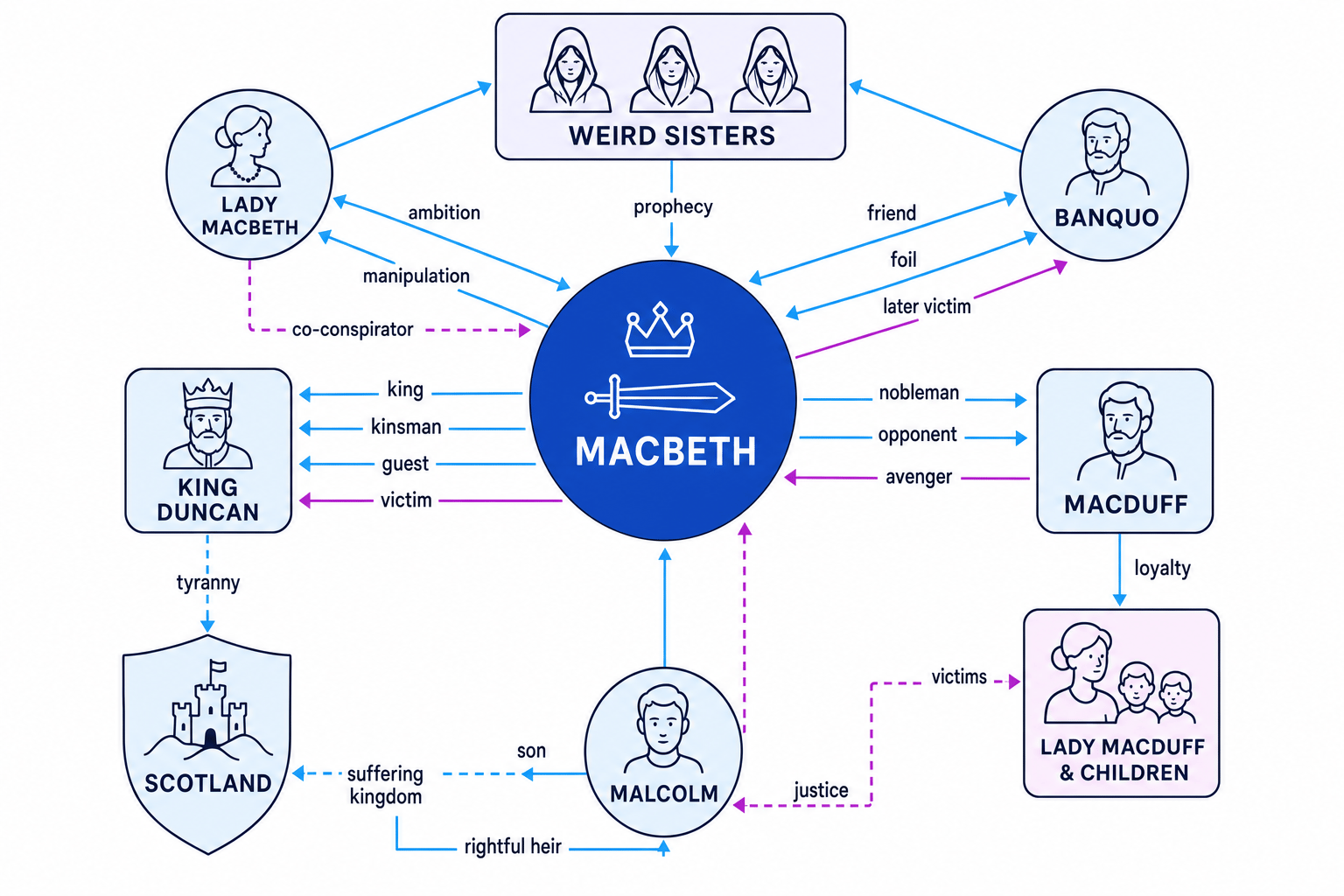
The map below shows the main character relationships you should keep in mind when planning essays.
Macbeth: from honoured soldier to isolated tyrant
Macbeth is the play’s central tragic figure. At the start, he is publicly celebrated: the Captain calls him “brave Macbeth” in Act 1 Scene 2, and Duncan praises him as “O valiant cousin! worthy gentleman!” This matters because Shakespeare first presents Macbeth as heroic, not naturally monstrous.
Tragic hero
A tragic hero is a high-status central character whose serious flaw or error helps bring about their downfall and causes suffering for others.
Macbeth’s flaw is often described as ambition, but you should make this precise. He is not ambitious in a simple, positive sense: his ambition becomes a desire to break moral, social and divine order. In Act 1 Scene 7, he admits, “I have no spur / To prick the sides of my intent, but only / Vaulting ambition.” The metaphor compares ambition to a rider overleaping on a horse, suggesting energy but also loss of control.
Shakespeare also gives Macbeth soliloquies, where he reveals his private thoughts directly to the audience. A soliloquy is a speech spoken by a character alone, or as if alone, exposing inner conflict. Macbeth’s soliloquies make him more complex: we watch him choose evil while understanding that he knows it is evil.
Reading Macbeth’s ambition
-
Start with Macbeth’s position in Act 1 Scene 7: he is considering Duncan’s murder but has not yet done it, so Shakespeare presents him at a moral crossroads.
-
Analyse the metaphor “spur”: Macbeth says he has no proper motive pushing him onwards — Duncan is his king, guest and kinsman — so the murder lacks moral justification.
-
Interpret “Vaulting ambition”: “vaulting” suggests overreaching, so Shakespeare presents ambition as excessive and self-destructive rather than admirable.
-
Link to the wider tragedy: Macbeth’s awareness of wrongdoing makes his downfall more disturbing, because he is not ignorant; he actively chooses to suppress his conscience.
As king, Macbeth becomes increasingly isolated. “O, full of scorpions is my mind” in Act 3 Scene 2 shows mental torment through violent animal imagery. Later, “From this moment / The very firstlings of my heart shall be / The firstlings of my hand” in Act 4 Scene 1 shows his development into impulsive tyranny: thought and action collapse into immediate violence.
Macbeth’s character arc
Macbeth changes from a praised warrior with a conscience into a tyrant who acts without moral reflection. That change is the engine of the tragedy.
Lady Macbeth: power, performance and collapse
Lady Macbeth is introduced as forceful, intelligent and frighteningly determined. After reading Macbeth’s letter, she fears he is “too full o’ th’ milk of human kindness” in Act 1 Scene 5. The phrase suggests she sees compassion as weakness, especially because “milk” links to nurture and motherhood.
Her famous command “unsex me here” asks spirits to strip away conventional femininity. For a Jacobean audience, this would be deeply unsettling because women were expected to be obedient, modest and maternal. Shakespeare presents her as rejecting those expectations in pursuit of power.
She also teaches Macbeth deception: “Look like th’ innocent flower, / But be the serpent under’t.” The simile of the “flower” suggests harmless appearance, while the “serpent” recalls biblical evil and temptation. She is not just ambitious; she understands performance.
However, Shakespeare later reverses her confidence. In Act 2 Scene 2 she claims, “A little water clears us of this deed,” but in the sleepwalking scene she cries, “Out, damned spot!” and says, “All the perfumes of Arabia will not sweeten this little hand” in Act 5 Scene 1. Blood becomes a repeated image of guilt that cannot be washed away.
Tracing Lady Macbeth’s change
-
Compare her early language with her later language: early Lady Macbeth uses commands such as “unsex me here,” while later she speaks in broken, anxious fragments like “Out, damned spot!”
-
Track the blood imagery: at first she treats blood as physical dirt removable by “water”; later it becomes psychological guilt that even “perfumes of Arabia” cannot remove.
-
Connect the change to structure: Shakespeare gives her power early in the play but removes her from the political action later, making her collapse feel like the hidden cost of the murder.
The Weird Sisters: catalysts and deceivers
The Weird Sisters open the play with “Fair is foul, and foul is fair” in Act 1 Scene 1. This paradox — a statement that seems self-contradictory but reveals a truth — establishes a world where appearances cannot be trusted.
They are best understood as catalysts: forces that trigger action, rather than characters who physically force Macbeth to murder Duncan. Their prophecies tempt Macbeth, but his choices still matter. Banquo hears prophecies too, yet responds more cautiously.
Equivocation
Equivocation is deliberately ambiguous language that misleads while seeming partly true. The Weird Sisters equivocate when they tell Macbeth that “none of woman born” shall harm him, hiding the truth about Macduff’s birth.
Their speech often sounds different from noble characters’ blank verse. Blank verse means unrhymed iambic pentameter: lines built around five rising beats. The Weird Sisters often use chant-like rhyme, as in “Double, double toil and trouble,” making them sound unnatural and separate from ordinary human society.
Fate versus choice
Do not argue that the Weird Sisters “make” Macbeth kill Duncan. A stronger interpretation is that they expose and encourage desires already present in him.
Banquo: Macbeth’s foil
Banquo is crucial because he shows another possible response to temptation.
Foil
A foil is a character who contrasts with another character, making that character’s qualities clearer.
Banquo hears the same supernatural predictions as Macbeth, but he warns that “the instruments of darkness tell us truths” in Act 1 Scene 3. This shows moral caution. Later, he admits “cursed thoughts” trouble him, but he asks “Merciful powers” to restrain them in Act 2 Scene 1. Shakespeare therefore presents Banquo as tempted but self-controlled.
Banquo also becomes threatening to Macbeth because of the prophecy that his descendants will be kings: “Thou shalt get kings, though thou be none.” His murder marks Macbeth’s shift from one terrible crime to a pattern of paranoid violence. Banquo’s ghost then becomes a stage image of Macbeth’s guilt and fear.
Using Banquo as a contrast
-
Set up the contrast: both Macbeth and Banquo encounter the Weird Sisters, so Shakespeare gives them a shared test.
-
Compare their responses: Macbeth quickly imagines “black and deep desires,” while Banquo warns that evil may use truths to “win us to our harm.”
-
Explain the effect: Banquo’s restraint makes Macbeth’s choices look more deliberate, so the audience cannot blame everything on fate.
Duncan and Malcolm: kingship and restoration
Duncan represents legitimate kingship, but Shakespeare also presents him as trusting. His line “There’s no art / To find the mind’s construction in the face” in Act 1 Scene 4 is dramatically ironic because he has just trusted the former Thane of Cawdor and will soon trust Macbeth.
Dramatic irony means the audience knows more than a character on stage. Here, the audience sees Duncan’s goodness but also his vulnerability.
Duncan’s murder is more than personal violence. In Jacobean context, many believed in the Divine Right of Kings, the idea that monarchs were appointed by God. This makes regicide — the killing of a king — a crime against divine and social order.
Malcolm, Duncan’s son, restores that order by the end. In Act 4 Scene 3, he tests Macduff’s loyalty before trusting him, showing he has learned caution. His final judgement of Macbeth and Lady Macbeth as “this dead butcher and his fiend-like queen” simplifies them publicly, but the audience has seen more complexity than that label allows.
Macduff: grief, justice and true manhood
Macduff becomes Macbeth’s main opponent and moral contrast. When Duncan’s body is discovered, Macduff cries, “O horror, horror, horror!” in Act 2 Scene 3. His repeated exclamation shows genuine shock at the destruction of order.
Later, Macbeth has Macduff’s wife and children murdered. Lady Macduff’s line “Whither should I fly? / I have done no harm” in Act 4 Scene 2 emphasises innocence and the human cost of tyranny. Shakespeare uses this domestic scene to show that Macbeth’s violence now spreads beyond political rivals.
Macduff’s response to his family’s death is especially important. Malcolm tells him to “Dispute it like a man,” but Macduff replies, “I shall do so; / But I must also feel it as a man” in Act 4 Scene 3. This challenges Macbeth’s brutal version of masculinity. For Macduff, true manhood includes grief, love and moral action.
Macduff’s role
Macduff is not just the man who kills Macbeth. He represents justice, emotional honesty and resistance to tyranny.
Quick character quotation bank
| Character | Useful quotation | What it helps you argue |
|---|---|---|
| Macbeth | “Stars, hide your fires; / Let not light see my black and deep desires” | He recognises his own immoral ambition. |
| Lady Macbeth | “Look like th’ innocent flower, / But be the serpent under’t” | She understands deception and appearance. |
| Banquo | “The instruments of darkness tell us truths” | He is cautious about supernatural temptation. |
| Duncan | “O valiant cousin! worthy gentleman!” | Macbeth begins with honour and public trust. |
| Macduff | “I must also feel it as a man” | Shakespeare challenges violent ideas of masculinity. |
| Weird Sisters | “Fair is foul, and foul is fair” | The play’s moral world is unstable and deceptive. |
Writing about characters in Edexcel answers
For Macbeth, Edexcel rewards precise knowledge, close analysis and relevant context. Since Component 2 is open book, you may use a clean copy of the text, but you still need to know the play well enough to find moments quickly and choose short evidence.
Open-book precision
Do not copy long speeches into your answer. Choose brief quotations, then analyse Shakespeare’s method: metaphor, contrast, soliloquy, stage action, imagery, rhythm, or structure.
A strong character paragraph usually follows this pattern: make a clear point, embed a short quotation, name the method, explain the effect on the audience, and link back to the question. For example, if asked about Macbeth’s ambition, you might focus on “Vaulting ambition” and explain how the metaphor presents ambition as overreaching and dangerous.
In the exam
-
Choose quotations that show change: early Macbeth as “brave” contrasts powerfully with later Macbeth as a “tyrant.”
-
Use character contrasts: Banquo, Macduff and Malcolm help reveal what Macbeth lacks — restraint, moral feeling and legitimate kingship.
-
Add context only when it sharpens the point: Divine Right, Jacobean gender expectations and beliefs about witchcraft should support your analysis, not replace it.
Check yourself
- How does Shakespeare make Macbeth seem both responsible for his actions and influenced by outside forces?
- In what ways does Lady Macbeth challenge and then suffer under ideas about gender?
- Why is Banquo such an effective foil to Macbeth?