What you'll learn
- What context means for Macbeth and why it matters for Edexcel IGCSE.
- How Jacobean beliefs about kingship, witchcraft, treason and gender shape the play.
- How to use context in analysis without writing a “history dump”.
- How to link context to Shakespeare’s language, form and structure for AO4.
Context: what it means in Macbeth essays
Before you learn the details, it is worth being clear about the skill. In Edexcel IGCSE English Literature, Macbeth is a Literary Heritage text in Component 2, Section B. This section is open book, so you may use a clean copy of the play, but you still need precise knowledge and fast quotation selection.
For Macbeth, context is assessed through AO4: the relationship between the text and the world in which it was written and received. However, context should not sit separately from your analysis. It should help you explain Shakespeare’s meanings.
Context
Context means the relevant historical, social, religious, political or literary background that helps explain a text. In Macbeth, this includes Jacobean beliefs about kings, witchcraft, treason, gender roles and tragedy.
A strong paragraph normally blends AO1 knowledge, AO2 method analysis and AO4 context. In other words: quotation first, method next, context only when it deepens the interpretation.
Context must explain the play
Do not add context as a separate fact. Use it to answer: why would this moment matter to Shakespeare’s audience, and how does it shape the meaning of the quotation?
Embedding context into close analysis
- Choose a precise quotation: when Macbeth says, “Stars, hide your fires; / Let not light see my black and deep desires” (Macbeth, 1.4), he admits that his ambition is morally corrupt before he kills Duncan.
- Identify Shakespeare’s method: the contrast between “light” and “black” creates a pattern of light and dark imagery, suggesting that Macbeth wants to hide his sinful thoughts from moral judgement.
- Add relevant context: in a Jacobean world where the king was believed to be God’s representative, plotting against Duncan is not just political ambition; it is a spiritual offence.
- Link back to meaning: Shakespeare presents Macbeth’s ambition as something secretive and unnatural, preparing the audience to see Duncan’s murder as a crime against both Scotland and divine order.
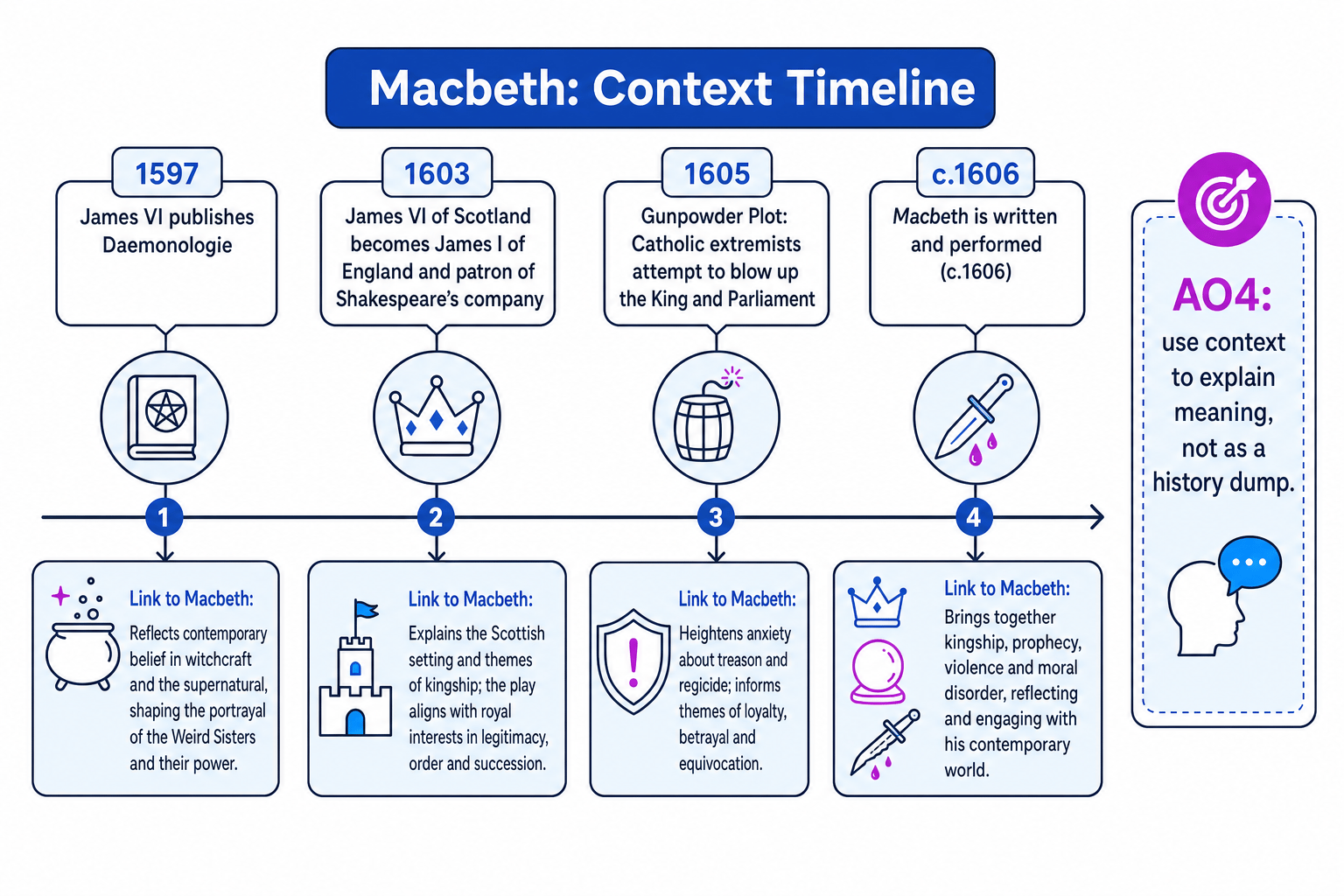
Here is a quick timeline of the most useful context. You do not need to memorise every date, but you should understand how each strand connects to the play.
Jacobean England and King James I
Jacobean
Jacobean means relating to the reign of King James I of England, from 1603 to 1625. The word comes from Jacobus, the Latin form of James.
Macbeth was probably written and first performed around 1606, early in James I’s reign. James had previously been James VI of Scotland, so Shakespeare’s Scottish setting would have had clear royal interest.
Shakespeare’s acting company was also known as the King’s Men because James became its patron. This does not mean Macbeth is simple propaganda, but it does mean Shakespeare was writing in a world where kingship, succession and loyalty were politically sensitive topics.
Banquo is especially important here. In Shakespeare’s source, Holinshed’s Chronicles, Banquo is less innocent than he is in the play. Shakespeare presents him more nobly, and the witches tell him, “Thou shalt get kings, though thou be none” (Witches, 1.3). This would have interested a Jacobean audience because James was believed to be descended from Banquo.
Use cautious phrasing
Instead of writing “Shakespeare wrote Macbeth to please James I”, write: “Shakespeare’s presentation of Banquo may have appealed to a Jacobean audience because James I was associated with Banquo’s line.” This sounds more precise and less simplistic.
Kingship, Divine Right and regicide
One of the most important contexts in Macbeth is the belief that a true king was appointed by God. This makes Duncan’s murder much more than a violent political act.
Divine Right of Kings
The Divine Right of Kings was the belief that monarchs received their authority from God, so rebellion against a rightful king was also rebellion against divine order.
Regicide
Regicide means the killing of a king. In Macbeth, Duncan’s murder is regicide because Macbeth kills Scotland’s rightful monarch.
Macbeth knows Duncan is a good king. In Act 1 Scene 7, he imagines Duncan’s “virtues / Will plead like angels, trumpet-tongued”. The simile comparing Duncan’s virtues to “angels” gives Duncan’s goodness a religious force. Shakespeare makes the murder feel sacrilegious, not merely criminal.
After Duncan’s death, nature itself seems disturbed. Ross says, “dark night strangles the travelling lamp” (2.4), even though it is daytime. This is pathetic fallacy, where the natural world reflects human emotion or moral disorder.
Linking regicide to unnatural imagery
- Start with the image: “dark night strangles the travelling lamp” (Ross, 2.4) presents darkness violently overpowering daylight.
- Name the method: Shakespeare uses personification, giving “dark night” the human action “strangles”, which makes the natural world seem aggressive and corrupted.
- Connect the context: for a Jacobean audience, killing a divinely appointed king would disrupt the proper order of the world.
- Explain the effect: the unnatural darkness suggests that Macbeth’s crime has infected Scotland itself; the murder is a public and spiritual catastrophe, not just a private act of ambition.
The history-dump paragraph
Avoid writing a whole paragraph about the Divine Right of Kings without analysing Shakespeare’s words. Context only earns marks when it is connected to a quotation, method and interpretation.
Witchcraft and the supernatural
The supernatural
The supernatural refers to forces beyond the ordinary natural world, such as witches, ghosts, visions and prophecies.
Many Jacobean people believed witchcraft was real and dangerous. James I was personally interested in the subject and wrote Daemonologie in 1597, a book about demons and witches. This helps explain why the Weird Sisters would have seemed frightening and morally suspicious to many early audiences.
The play opens with the witches’ paradox: “Fair is foul, and foul is fair” (Witches, 1.1). A paradox is a statement that appears self-contradictory but reveals a deeper truth. Here, Shakespeare introduces a world where moral categories are unstable: good looks evil, and evil looks good.
Macbeth’s first line echoes their language: “So foul and fair a day I have not seen” (Macbeth, 1.3). Structurally, this connects him to the witches before he fully understands them. Shakespeare suggests that Macbeth is already vulnerable to their twisted way of seeing the world.
Saying the witches force Macbeth
The witches tempt, predict and deceive, but they do not physically force Macbeth to murder Duncan. Shakespeare keeps Macbeth morally responsible for his choices.
Treason, the Gunpowder Plot and equivocation
Treason
Treason is betrayal of the monarch or state. In Jacobean England, it was one of the most serious crimes imaginable.
In 1605, the Gunpowder Plot attempted to blow up King James I and Parliament. Macbeth, written soon afterwards, reflects a culture deeply anxious about treason, hidden enemies and attacks on kingship.
The play also explores equivocation.
Equivocation
Equivocation means using deliberately ambiguous language to mislead someone while seeming to tell the truth.
The Porter jokes, “here’s an equivocator” (Porter, 2.3), but the idea is serious across the play. The witches’ prophecies sound reassuring, yet they mislead Macbeth. For example, the Apparition says, “none of woman born / Shall harm Macbeth” (4.1). Macbeth assumes this means no human can kill him. Later, Macduff reveals he “was from his mother’s womb / Untimely ripped” (Macduff, 5.8), meaning he was born by Caesarean birth.
Explaining equivocation in the prophecies
- Compare the wording with Macbeth’s assumption: “none of woman born” sounds like it includes every person, so Macbeth interprets it as a promise of safety.
- Notice the hidden loophole: Macduff was not born in the usual way, so the prophecy is technically true but deliberately misleading.
- Add the context: after the Gunpowder Plot, equivocation was associated with deception, secrecy and treason.
- Link to character: Shakespeare shows Macbeth clinging to language that flatters his ambition, so his downfall comes partly from trusting words that conceal the truth.
Gender, patriarchy and masculinity
Patriarchy
Patriarchy is a social system in which men hold most authority and women are expected to be subordinate, especially in public and political life.
Jacobean society had strict expectations about gender. Men were expected to be brave, honourable and politically active. Women were often idealised as obedient, gentle, chaste and maternal.
Lady Macbeth violently rejects these expectations when she calls on spirits to “unsex me here” and “take my milk for gall” (Lady Macbeth, 1.5). Imperative verbs are command words, and her commands sound shocking because she asks supernatural forces to strip away qualities associated with womanhood and motherhood.
A semantic field is a group of words linked by meaning. In this speech, Shakespeare creates a semantic field of the body and motherhood — “milk”, “blood”, “breasts” — but twists it into something poisonous and violent.
Using gender context carefully
- Select the evidence: Lady Macbeth’s “unsex me here” shows her desire to reject the gender identity expected of her.
- Analyse the method: the imperative verb “unsex” is forceful and unnatural, suggesting a violent attempt to remake the self.
- Apply context: to a Jacobean audience, a woman rejecting maternal gentleness and calling on spirits would seem deeply transgressive.
- Develop the interpretation: Shakespeare does not simply present Lady Macbeth as “strong”; he shows ambition distorting gender, morality and the natural order.
Macbeth also questions masculinity. When Lady Macbeth says, “When you durst do it, then you were a man” (1.7), she manipulates him by equating murder with manhood. Macbeth’s earlier response is more morally balanced: “I dare do all that may become a man; / Who dares do more is none” (1.7). He briefly understands that true masculinity has ethical limits.
Literary context: tragedy and moral order
Tragedy
A tragedy is a dramatic form in which a central character’s serious flaw or error leads to suffering, death and a final restoration of order.
Macbeth is a tragic protagonist: he is brave and respected at first, but his “vaulting ambition” (Macbeth, 1.7) drives him towards murder, tyranny and despair. The play’s tragic shape matters because Shakespeare does not just show evil succeeding. He shows moral disorder rising, spreading and finally being corrected.
By the end, Macbeth’s world has become empty: “Tomorrow, and tomorrow, and tomorrow” (Macbeth, 5.5) reduces life to meaningless repetition. Context helps here too. In a Christian moral universe, Macbeth’s rejection of loyalty, conscience and rightful order leaves him spiritually barren.
Context deepens tragedy
Context helps you see that Macbeth’s fall is personal, political and spiritual: he destroys himself, damages Scotland and violates the moral order his society believed in.
In the exam
- Use your clean copy efficiently: choose short, precise quotations, then analyse Shakespeare’s language or structure before adding context.
- Only include context that directly helps the question. If the question is about ambition, use kingship, sin, gender or tragedy — not every fact you know about James I.
- Build context into analysis: point → evidence → method → effect → context → link to the question.
- Use careful phrases such as “a Jacobean audience may have…” or “this would have evoked…” rather than claiming you know Shakespeare’s exact intention.
- Keep returning to meaning: context should explain how Shakespeare presents characters, themes and moral consequences.
Check yourself
- How does the Divine Right of Kings change the way a Jacobean audience might view Duncan’s murder?
- Why is it too simple to say “the witches made Macbeth do it”?
- Which quotation would you use to explain equivocation, and how would you link it to context?