What you'll learn
- How the story of Macbeth unfolds from Act 1 to Act 5.
- How Shakespeare structures Macbeth’s rise, tyranny, and fall.
- Which plot moments are the key turning points for exam answers.
- How to turn plot knowledge into useful AO1/AO2 analysis.
Why the plot matters
In Edexcel IGCSE English Literature, Macbeth is studied for Component 2: Modern Drama and Literary Heritage, which is open book. You may have a clean copy of the text, but you still need secure plot knowledge so you can find relevant moments quickly and write with confidence.
A strong plot summary is not just “what happens next”. You need to understand cause and effect: how one choice leads to another, and how Shakespeare builds Macbeth’s downfall.
Plot
The plot is the sequence of events in a text, especially the way those events are connected by cause and consequence.
The whole play in one sentence
Macbeth follows a brave Scottish warrior who is tempted by prophecy, chooses murder to gain the crown, becomes a tyrant through fear, and is finally destroyed as rightful order is restored.
The shape of the tragedy
Macbeth is a tragedy, a type of drama in which a high-status central character falls from greatness to ruin, often because of a serious flaw or destructive choice.
Tragic hero
A tragic hero is the main character in a tragedy whose fall creates pity, fear, and moral reflection. Macbeth begins as “brave Macbeth” but is destroyed by ambition, violence, and guilt.
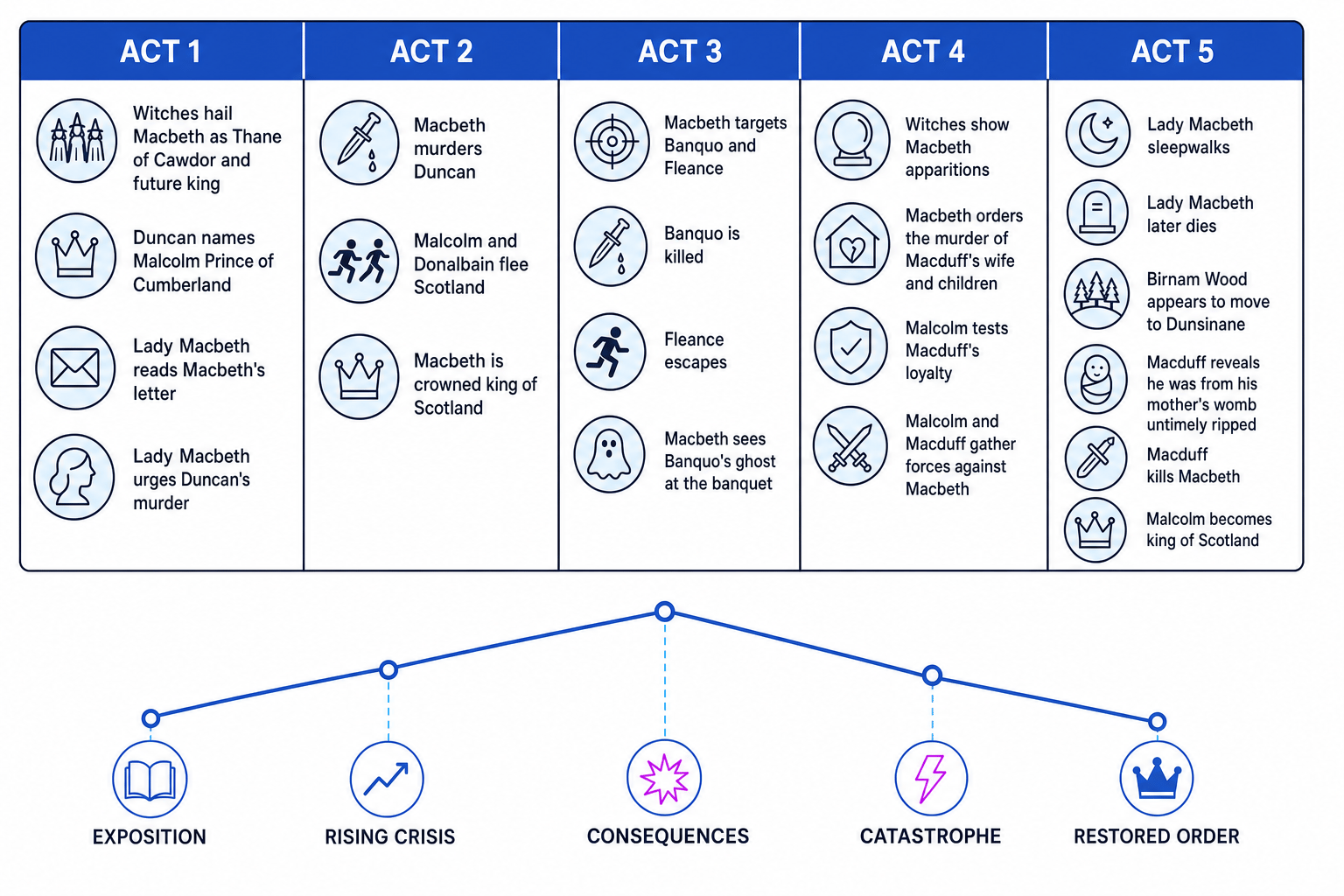
Shakespeare’s plot moves in a clear arc:
- Exposition: the opening situation is introduced.
- Rising action: tension grows as Macbeth moves towards and then beyond murder.
- Climax / turning point: Macbeth’s rule becomes unstable and openly tyrannical.
- Falling action: opposition gathers against him.
- Catastrophe: the tragic ending, where Macbeth dies and Scotland is restored.
Exposition
Exposition is the part of a play that introduces the setting, main characters, and first conflicts.
Catastrophe
In tragedy, the catastrophe is the final disaster or downfall, usually involving death and the collapse of the tragic hero’s power.
Here is the overall plot arc:
Quick memory chain
Remember the plot as: Prophecy → Murder → Crown → Tyranny → Rebellion → Death → Restoration.
Act 1: Prophecy and temptation
The play opens with the Witches, who create a world of confusion and moral disorder: “Fair is foul, and foul is fair.” This line immediately suggests that appearances will be deceptive.
Macbeth is first presented as a heroic soldier. The Captain calls him “brave Macbeth” after he fights loyally for King Duncan. However, when the Witches greet him as “Thane of Cawdor” and “king hereafter”, they plant the idea of kingship in his mind.
Soon afterwards, Ross confirms that Macbeth really has been made Thane of Cawdor. This makes the prophecy seem powerful and believable. Macbeth begins to imagine murder, although Duncan is still alive.
When Duncan names Malcolm as his heir, Macbeth sees Malcolm as an obstacle. In an aside, Macbeth admits, “Stars, hide your fires; / Let not light see my black and deep desires.”
Aside
An aside is a short speech spoken by a character to the audience, or privately to themselves, which other characters on stage do not hear.
Lady Macbeth then reads Macbeth’s letter about the Witches. She fears Macbeth is “too full o’ the milk of human kindness” to take the crown by force. When Duncan comes to Macbeth’s castle, she persuades Macbeth to murder him.
At the end of Act 1, Macbeth has not yet committed the crime, but he has chosen the path towards it.
The Witches do not force Macbeth
Do not write that the Witches “make” Macbeth kill Duncan. They predict and tempt, but Macbeth chooses to act. That choice is central to his tragedy.
Act 2: Duncan’s murder and Macbeth’s coronation
Act 2 contains the murder that changes everything. Before killing Duncan, Macbeth sees a vision of a dagger: “Is this a dagger which I see before me”. This happens in a soliloquy, where Macbeth speaks his thoughts aloud while alone on stage.
Soliloquy
A soliloquy is a speech in which a character, usually alone, reveals their private thoughts and feelings to the audience.
The murder itself happens off-stage, meaning the audience does not see it directly. This makes the aftermath more psychologically intense. Macbeth returns horrified, saying he thought he heard a voice cry, “Macbeth does murder sleep.” Sleep becomes linked with innocence and peace, both of which Macbeth has destroyed.
Lady Macbeth tries to stay practical. She takes the daggers back to Duncan’s room and smears the guards with blood so they will be blamed. However, the couple are already mentally divided: Macbeth is shaken by guilt, while Lady Macbeth appears controlled.
In the morning, Macduff discovers Duncan’s body. Macbeth kills the guards, claiming rage and loyalty as his motives, but this looks suspicious. Duncan’s sons, Malcolm and Donalbain, flee Scotland because they fear they may be murdered next. Their flight makes them look guilty, so Macbeth is crowned king.
Act 2 changes Macbeth’s position
By the end of Act 2, Macbeth has gained the crown, but he has not gained security. The murder creates fear, guilt, and suspicion.
Linking cause and consequence
- Macbeth wants the crown after hearing the Witches call him “king hereafter”, but Duncan is still alive and Malcolm has been named heir.
- Macbeth chooses regicide — the murder of a king — because ambition overcomes loyalty and moral hesitation.
- Duncan’s sons flee, which allows Macbeth to be crowned, but their flight also leaves Scotland politically unstable.
- Shakespeare therefore makes Macbeth’s “success” immediately dangerous: the crown brings power, but also guilt and fear.
Act 3: Insecurity and tyranny
Now king, Macbeth feels threatened rather than satisfied. He remembers that the Witches promised Banquo would “get kings”, meaning Banquo’s descendants will inherit the throne. Macbeth admits that his fears about Banquo “stick deep”.
Macbeth hires murderers to kill Banquo and Fleance. Banquo is murdered, but Fleance escapes. This matters because the threat of Banquo’s line continues.
At the royal banquet, Macbeth sees Banquo’s ghost sitting in his place. This is a public crisis: Macbeth’s guilt breaks through in front of the nobles. Lady Macbeth tries to excuse him, but his behaviour damages his authority.
Turning point
A turning point is a moment when the direction of the plot changes significantly.
The banquet scene is a major turning point because Macbeth can no longer hide the instability behind his kingship. After this, he decides to return to the Witches. He is becoming dependent on evil and violence.
Do not forget Fleance
Banquo dies, but Fleance escapes. This detail is important because it keeps the Witches’ prophecy about Banquo’s descendants alive.
Act 4: False confidence and greater cruelty
Macbeth visits the Witches again. They show him apparitions, which are supernatural visions. The apparitions warn him to “Beware Macduff”, but also tell him that “none of woman born / Shall harm Macbeth” and that he will not be defeated until “Great Birnam Wood” comes to Dunsinane.
Macbeth misunderstands these prophecies. He thinks they mean he is almost invincible. This is an example of equivocation, where language is deliberately misleading or double-edged.
Equivocation
Equivocation is the use of ambiguous language that hides the truth or allows more than one meaning.
Macbeth then orders the murder of Macduff’s wife and children. This is a crucial sign that he has become a tyrant: the violence is no longer aimed only at political rivals, but at innocent people.
Meanwhile, Macduff has gone to England to join Malcolm. Malcolm tests Macduff’s loyalty, then reveals he is ready to fight for Scotland. When Macduff hears that his family has been slaughtered, his grief turns into a personal and patriotic desire for justice.
Act 4 shows Macbeth’s moral collapse
Macbeth’s violence becomes wider, colder, and more pointless. Shakespeare shows that tyranny spreads suffering beyond the ruler himself.
Act 5: Collapse, death, and restored order
Act 5 shows the consequences of Macbeth and Lady Macbeth’s choices. Lady Macbeth sleepwalks, trying to wash imaginary blood from her hands: “Out, damned spot!” Her guilt, which she once dismissed, now overwhelms her.
The forces against Macbeth advance towards Dunsinane. Soldiers cut branches from Birnam Wood to disguise their numbers, making it appear as if the wood is moving. Macbeth realises too late that the prophecy was misleading.
When Macbeth hears that Lady Macbeth has died, he speaks the bleak “Tomorrow, and tomorrow, and tomorrow” soliloquy. Life seems meaningless to him, “a tale / Told by an idiot”. This shows how empty his ambition has become.
Macduff then confronts Macbeth and reveals that he was “from his mother’s womb / Untimely ripped” — born by caesarean section, not “of woman born” in the usual way. Macbeth finally understands the trap in the Witches’ words. Macduff kills him.
At the end, Malcolm becomes king. Scotland’s rightful order is restored, but the ending is not simply happy: the country has suffered through murder, tyranny, and civil war.
Restoration
Restoration means the return of rightful political and moral order after chaos. In Macbeth, Malcolm’s coronation restores lawful kingship.
Do not call the ending purely happy
Macbeth is defeated and order returns, but the play ends after huge suffering. A better word is restoration, not simple happiness.
Using plot in your writing
In an essay, avoid retelling the whole story. Instead, choose the plot moment that best supports your point.
For AO1, you need secure knowledge of what happens and relevant references. For AO2, you should connect plot moments to Shakespeare’s methods, such as soliloquy, dramatic irony, symbolism, or structure.
Dramatic irony
Dramatic irony happens when the audience knows something that one or more characters do not. For example, Duncan trusts Macbeth’s castle even though the audience knows Macbeth and Lady Macbeth are planning his murder.
Turning plot summary into analysis
- Start with the event: Duncan arrives at Macbeth’s castle, believing Macbeth is loyal.
- Add what the audience knows: Macbeth and Lady Macbeth have already discussed murdering him, so Duncan’s trust creates dramatic irony.
- Link to effect: Shakespeare makes Duncan seem innocent and vulnerable, which makes Macbeth’s betrayal feel more shocking.
- Connect to the wider plot: this moment prepares the audience for the regicide that begins Macbeth’s moral and political downfall.
The essential act-by-act summary
If you need the shortest possible revision version, use this:
- Act 1: Macbeth hears the prophecy, becomes Thane of Cawdor, and is persuaded to murder Duncan.
- Act 2: Macbeth kills Duncan, Duncan’s sons flee, and Macbeth becomes king.
- Act 3: Macbeth has Banquo killed, Fleance escapes, and Macbeth’s guilt appears through Banquo’s ghost.
- Act 4: Macbeth trusts the Witches’ misleading prophecies and orders the murder of Macduff’s family.
- Act 5: Lady Macbeth dies, Birnam Wood comes to Dunsinane, Macduff kills Macbeth, and Malcolm becomes king.
In the exam
- Use plot knowledge selectively: choose the moment that proves your point rather than retelling several scenes.
- Anchor your answer with short quotations, such as “king hereafter”, “Macbeth does murder sleep”, or “Out, damned spot!”
- Link events through cause and effect: show how prophecy leads to ambition, ambition to murder, murder to tyranny, and tyranny to collapse.
Check yourself
- What are the three prophecies or warnings Macbeth receives in Act 4?
- Why is Fleance’s escape important to the plot?
- How does Shakespeare show that Macbeth gains the crown but loses peace of mind?