What you'll learn
- How to turn a Macbeth question into a focused argument rather than a plot summary.
- How to build a clear essay plan using thesis, paragraphs, evidence, methods and context.
- How to choose short, flexible quotations for common Macbeth themes and characters.
- How to use your open-book text efficiently in Edexcel IGCSE Component 2.
Why essay plans matter for Macbeth
A strong Macbeth essay is not just “everything I know about Macbeth”. It is a shaped answer to one precise question.
Because Macbeth is a tragedy full of change — Macbeth moves from “brave Macbeth” to “dead butcher” — your plan should usually track development across the play. The best essays show how Shakespeare presents an idea at the beginning, complicates it in the middle, and judges it by the end.
Essay plan
An essay plan is a brief map of your argument: your main judgement, your paragraph points, your evidence, the methods you will analyse, and the context you will connect.
For Edexcel IGCSE English Literature, Macbeth appears in Component 2, Section B: Literary Heritage. This paper is open book, so you may use a clean copy of the play. However, open book does not mean “no revision”: you still need to know the play well enough to find moments quickly and write confidently.
Plan the argument, not the plot
A plot plan says, “Macbeth meets the witches, kills Duncan, becomes king, dies.” An essay plan says, “Shakespeare presents ambition as tempting, morally corrupting, and finally self-destroying.”
What the examiner wants to see
For Macbeth, your essay mainly needs to show three things.
AO1 means you understand the play and can write a clear, personal argument using textual references. In practice, this means your essay has a line of thought, not random quotations.
AO2 means you analyse Shakespeare’s methods: language, form and structure. A method is a deliberate writer’s choice, such as metaphor, soliloquy, dramatic irony, symbolism, motif, imagery, iambic pentameter or stage action.
AO4 means you connect the play to context: the beliefs, anxieties and ideas of Shakespeare’s world, such as kingship, the Divine Right of Kings, witchcraft, patriarchy and tragedy.
You do not need AO3 for Macbeth because AO3 is for anthology-poetry comparison.
Treating open book as no-revision
Do not waste exam time searching for quotations from scratch. Learn your key scenes and short quotations before the exam, then use the clean copy to check wording and choose extra detail.
The basic Macbeth planning route
A reliable plan moves from the question focus to a thesis, then into three developed paragraphs. Each paragraph should contain a point, short evidence, method, effect and a link back to the question.
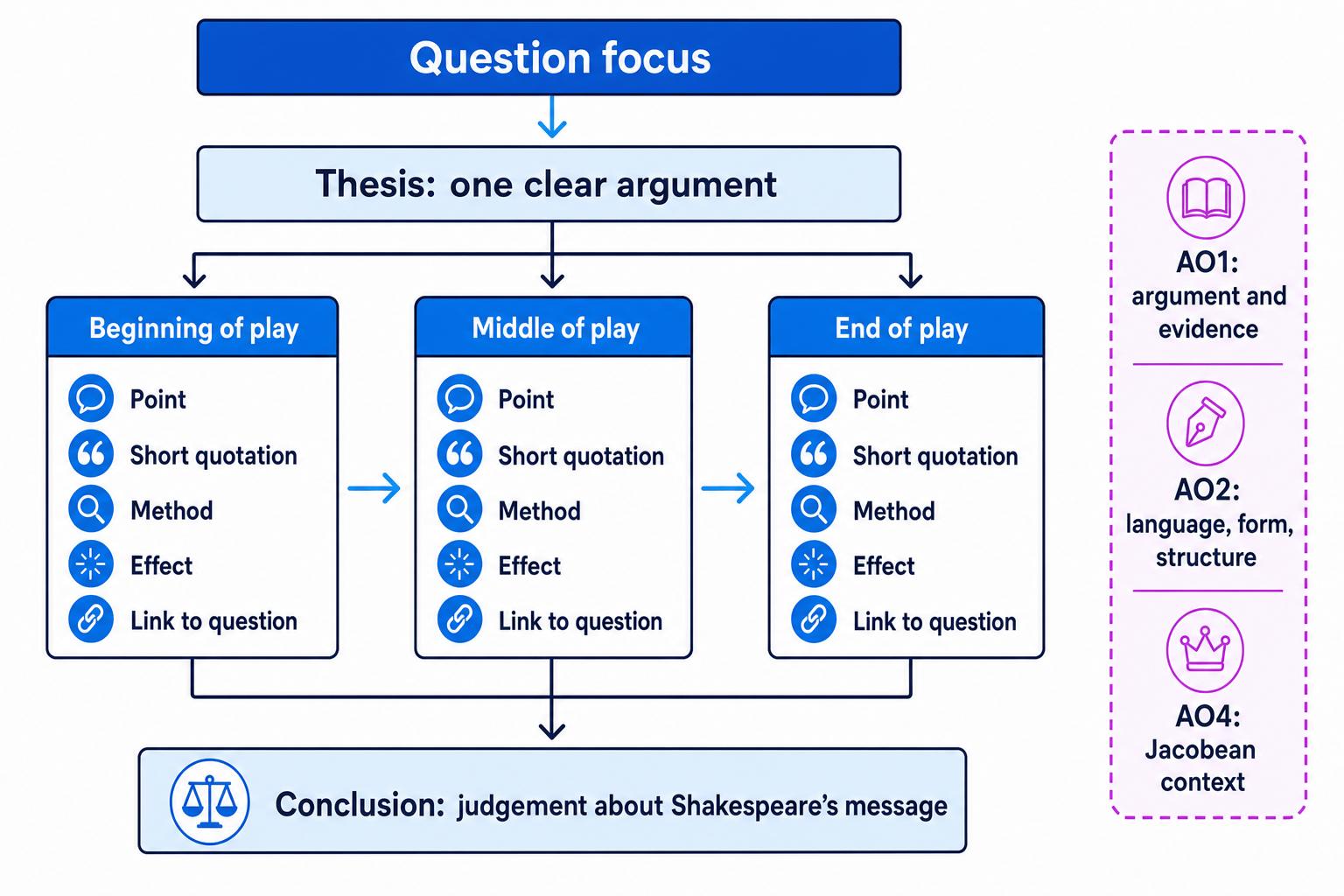
Step 1: Decode the question
Most Macbeth questions ask how Shakespeare presents a character, theme or relationship. The word presents is important: it reminds you to discuss Shakespeare’s choices, not just what happens in the story.
Look carefully for the exact focus. A question about “ambition” is different from a question about “the destructive effects of ambition”. A question about “Lady Macbeth’s power” is different from a question about “Lady Macbeth’s change”.
Decoding an ambition question
Imagine the question is: Explore how Shakespeare presents the destructive effects of ambition in Macbeth.
-
Narrow the focus. “Destructive effects” means you should show damage caused by ambition: moral corruption, guilt, tyranny, disorder in Scotland, and Macbeth’s loss of meaning.
-
Create a line of argument. A strong argument could be: Shakespeare presents ambition as tempting at first, but once Macbeth acts on it, it destroys his conscience, his kingship and finally his humanity.
-
Choose moments that show development. Use Act 1 for temptation, such as “Stars, hide your fires”; Act 2 for guilt, such as “Will all great Neptune’s ocean wash this blood / Clean from my hand?”; and Acts 3–5 for tyranny and emptiness, such as “To be thus is nothing” or “Tomorrow, and tomorrow, and tomorrow”.
-
Attach methods to the moments. Light and dark imagery shows secrecy, blood imagery symbolises guilt, and the tragic structure shows Macbeth’s rise turning into collapse.
Step 2: Write a thesis
Thesis
A thesis is your controlling argument: the main judgement your whole essay will prove.
A weak thesis is too obvious: “Shakespeare presents Macbeth as ambitious.” That is true, but it does not give your essay a direction.
A stronger thesis makes a judgement: “Shakespeare presents Macbeth’s ambition as a hidden desire that grows into violent tyranny, showing how the rejection of moral and divine order destroys both the individual and the nation.”
That stronger version gives you several paragraph routes: hidden desire, violent action, tyranny, destruction, context.
Improving a thesis about Lady Macbeth
-
Start with the basic idea. “Lady Macbeth is powerful” is relevant, but it is too simple because it ignores her later collapse.
-
Add change across the play. A better thesis might argue that Shakespeare first presents Lady Macbeth as forceful and transgressive, but later exposes the psychological cost of suppressing guilt.
-
Add methods and context. The thesis becomes sharper if it mentions her imperatives in “unsex me here”, the blood motif in “Out, damned spot!”, and Jacobean expectations about gender and sin.
Step 3: Build paragraphs around change
A useful Macbeth essay often follows the play’s dramatic structure. Structure means how the text is organised: the order of events, contrasts, turning points, repetitions and endings.
For many questions, three paragraphs work well:
| Paragraph | Job in the essay | Example for Macbeth |
|---|---|---|
| Beginning | Show the first presentation of the idea | Macbeth is tempted by the witches and hides his “black and deep desires” |
| Middle | Show development or conflict | Macbeth murders Duncan and becomes trapped by guilt and fear |
| End | Show consequence or final judgement | Macbeth becomes isolated, nihilistic and finally destroyed |
This does not mean every essay must discuss the whole play equally. If the question focuses on one character or moment, you may spend more time where that focus is strongest. But you should still show awareness of development.
Planning the plot
Do not write paragraph points like “Macbeth meets the witches” or “Macbeth kills Duncan”. Turn events into arguments: “The witches awaken Macbeth’s ambition” or “Duncan’s murder marks the point where ambition becomes moral corruption.”
Step 4: Build each paragraph properly
Each paragraph should do analytical work. A helpful structure is:
Point → Evidence → Method → Effect → Link
A textual reference is a quotation or a close reference to a moment in the play. In Macbeth, short quotations are usually better than long ones because you can analyse individual words closely.
An effect is what Shakespeare’s choice does: how it shapes the audience’s response, develops a theme, reveals character, or supports the play’s wider message.
Planning a paragraph on guilt
-
Make a focused point. After Duncan’s murder, Shakespeare presents guilt as overwhelming and impossible for Macbeth to control.
-
Choose short evidence. Macbeth asks, “Will all great Neptune’s ocean wash this blood / Clean from my hand?” after killing Duncan.
-
Analyse method. The rhetorical question suggests panic, while the allusion to “Neptune’s ocean” uses vast scale to show that ordinary cleansing is not enough. The blood motif symbolises moral guilt.
-
Explain effect and link. Shakespeare makes Macbeth’s guilt seem spiritually permanent, which would be especially disturbing in a Jacobean context where regicide was seen as a sin against God’s order.
Use method terms only when they help
Do not just label a device and move on. “This is a metaphor” is not analysis. Better: “The metaphor of ‘vaulting ambition’ makes ambition seem reckless and self-defeating, foreshadowing Macbeth’s fall.”
Choosing quotations that work hard
You do not need dozens of quotations. You need a small set of accurate, flexible ones that can be adapted to different questions.
| Essay focus | Useful short quotations | Method angles |
|---|---|---|
| Ambition | “Stars, hide your fires”; “vaulting ambition”; “To be thus is nothing” | Light/dark imagery, metaphor, soliloquy, tragic structure |
| Guilt | “Macbeth shall sleep no more”; “Neptune’s ocean”; “Out, damned spot!” | Blood and sleep motifs, symbolism, rhetorical question, fragmented speech |
| Supernatural | “Fair is foul, and foul is fair”; “All hail, Macbeth”; “none of woman born” | Paradox, equivocation, prophecy, dramatic irony |
| Lady Macbeth | “unsex me here”; “Look like th’innocent flower”; “Out, damned spot!” | Imperatives, gender imagery, biblical allusion, structural reversal |
| Kingship and tyranny | “his virtues / Will plead like angels”; “O, full of scorpions is my mind”; “dead butcher” | Religious imagery, animal imagery, contrast between rightful rule and tyranny |
Make quotations multitask
A quotation like “Stars, hide your fires” can support essays on ambition, appearance and reality, darkness, secrecy, evil, and Macbeth’s inner conflict. Flexible quotations are worth learning well.
Using context without bolting it on
Context means the relationship between the play and the world it was written and performed in. For Macbeth, useful context includes Jacobean beliefs about kingship, the Divine Right of Kings, witchcraft, gender expectations and tragedy.
But context should not feel like a separate history paragraph. It should help explain Shakespeare’s meaning.
Linking context to kingship
-
Start with Shakespeare’s presentation. Macbeth recognises Duncan’s goodness before murdering him, saying Duncan’s “virtues / Will plead like angels”.
-
Analyse the method. The religious simile presents Duncan as almost sacred, making the thought of killing him seem morally horrifying.
-
Connect context. In Jacobean belief, a rightful king was understood as part of a God-ordered hierarchy, so regicide was not just political violence but a spiritual violation.
-
Link back to the question. This makes Macbeth’s ambition appear especially destructive because it attacks both personal morality and national order.
Ready-to-use skeleton plans
Use these as flexible frameworks. Do not memorise them as full essays; adapt them to the exact wording of the question.
Plan A: ambition and downfall
Thesis: Shakespeare presents ambition as a dangerous force that begins as private desire, develops into violent tyranny, and ends in spiritual emptiness.
- Paragraph 1: Macbeth’s ambition begins as secret temptation. Use “Stars, hide your fires; / Let not light see my black and deep desires.” Analyse light/dark imagery and the aside or soliloquy form, which reveals hidden conflict.
- Paragraph 2: Ambition becomes action and guilt. Use “vaulting ambition” and “Will all great Neptune’s ocean wash this blood / Clean from my hand?” Analyse metaphor, blood symbolism and the idea of regicide.
- Paragraph 3: Ambition destroys meaning. Use “To be thus is nothing” or “Tomorrow, and tomorrow, and tomorrow.” Analyse repetition, nihilistic tone and tragic structure.
Plan B: Lady Macbeth and power
Thesis: Shakespeare presents Lady Macbeth as apparently powerful because she rejects conventional femininity, but he later shows that her power is unstable because guilt cannot be controlled.
- Paragraph 1: She calls on spirits to “unsex me here”. Analyse imperatives and gendered language, linking to Jacobean expectations of women.
- Paragraph 2: She teaches Macbeth deception: “Look like th’innocent flower, / But be the serpent under’t.” Analyse the biblical allusion to the serpent and the theme of appearance versus reality.
- Paragraph 3: Her collapse is shown in “Out, damned spot!” Analyse the blood motif and fragmented speech to show psychological punishment.
Plan C: the supernatural
Thesis: Shakespeare presents the supernatural as a corrupting force that confuses moral boundaries, but Macbeth remains responsible because he chooses to act on the prophecies.
- Paragraph 1: The witches create disorder from the opening: “Fair is foul, and foul is fair.” Analyse paradox and the unsettling atmosphere.
- Paragraph 2: The prophecy “All hail, Macbeth, that shalt be king hereafter!” awakens Macbeth’s ambition. Link this to Macbeth’s own “black and deep desires”.
- Paragraph 3: The later prophecy “none of woman born / Shall harm Macbeth” gives Macbeth false confidence. Analyse equivocation and dramatic irony, ending with Macbeth’s recognition of “juggling fiends”.
Turning a plan into a paragraph
Here is how one planned point might become analytical writing:
Shakespeare first presents Macbeth’s ambition as a secret moral corruption rather than simple bravery. After Malcolm is named heir, Macbeth asks, “Stars, hide your fires; / Let not light see my black and deep desires.” The contrast between “Stars” and “black” creates light and dark imagery, suggesting that Macbeth knows his desire is shameful and must be hidden from moral judgement. Because this line is spoken privately, Shakespeare allows the audience to witness Macbeth’s divided conscience before he has committed any crime. This makes his later downfall more tragic, as the audience sees that ambition does not simply appear after Duncan’s murder; it is already growing inside him.
Notice the pattern: point, quotation, method, effect, link to the wider argument.
In the exam
- Spend the first few minutes planning your thesis and three paragraph points before you start writing.
- Keep returning to the exact wording of the question, especially key words like “power”, “change”, “destructive” or “responsibility”.
- Use the clean copy to check short quotations, but do not let searching replace thinking.
- Analyse Shakespeare’s methods in every paragraph, and connect context only when it genuinely deepens your point.
- End with a judgement about Shakespeare’s overall message, not a repeat of the plot.
Check yourself
- Can you turn a plot event from Macbeth into an argumentative paragraph point?
- Can you plan three paragraphs for a question on ambition, guilt or the supernatural?
- Can you explain how one short quotation links to method, effect and context?