What you'll learn
- How to tell the difference between language, form and structure in Macbeth.
- How Shakespeare uses tragedy, verse, soliloquies and stagecraft to shape the audience’s response.
- How recurring images such as blood, sleep, darkness and disease develop across the play.
- How to turn terminology into precise AO2 analysis, rather than just spotting devices.
The basics: what do “language”, “form” and “structure” mean?
In Macbeth, language, form and structure are not three separate boxes. They work together. A strong analysis often begins with one method, then shows how it connects to the whole play.
Language, form and structure
- Language means Shakespeare’s choice of words and literary techniques, such as metaphor, imagery, symbolism, imperatives and rhetorical questions.
- Form means the type of text and its dramatic conventions: Macbeth is a play, a tragedy, and a performance text written largely in verse.
- Structure means how the play is organised: the order of events, turning points, contrasts between scenes, repeated motifs and the pace of the action.
For Edexcel IGCSE, Macbeth is assessed in Component 2, which is open book: you may use a clean copy of the play. However, open book does not mean “search for quotes for ages”. The best answers use short, accurate references and explain how Shakespeare’s methods create meaning.
The main goal
AO2 is not about naming as many devices as possible. It is about explaining how Shakespeare’s choices affect the audience and develop ideas such as ambition, guilt, kingship, disorder and appearance versus reality.
Language: Shakespeare’s word choices
Imagery, symbols and motifs
Imagery means descriptive language that creates pictures or sensations in the audience’s mind. A symbol is an object, colour, action or image that stands for a bigger idea. A motif is a repeated image or idea across a text.
Blood is the clearest motif in Macbeth. At first, blood is linked to heroic violence: Macbeth is praised for his bravery in battle. After Duncan’s murder, it becomes a symbol of guilt. Macbeth asks, “Will all great Neptune’s ocean wash this blood / Clean from my hand?” in Act 2 Scene 2. The blood is literal, but Shakespeare makes it feel psychological and spiritual too.
Sleep is another important motif. After the murder, Macbeth imagines a voice crying, “Sleep no more! / Macbeth does murder sleep” in Act 2 Scene 2. This is personification, where something non-human is given human qualities: sleep is treated as something Macbeth can “murder”. The effect is that Macbeth has destroyed his own peace as well as Duncan’s life.
Darkness also matters. When Macbeth says, “Stars, hide your fires; / Let not light see my black and deep desires” in Act 1 Scene 4, light and dark imagery reveals that he already knows his ambition is morally wrong.
Analysing blood imagery
-
Choose a precise quotation: Macbeth’s question, “Will all great Neptune’s ocean wash this blood / Clean from my hand?”, is stronger than just writing “blood imagery” because it gives you a method to analyse.
-
Identify the methods doing the work: the rhetorical question is asked for effect rather than for an answer; the hyperbole, or exaggeration, makes Macbeth’s guilt seem too huge for even an ocean to cleanse; the allusion, a reference to another belief or story, to Neptune links Macbeth’s guilt to a vast mythological scale.
-
Connect the quotation to the play’s structure: this comes immediately after Duncan’s murder, so blood changes from physical evidence into a symbol of inescapable guilt.
-
Link forward: Lady Macbeth later cries, “Out, damned spot!” in Act 5 Scene 1, so Shakespeare structurally returns to the blood motif to show that guilt cannot simply be washed away.
Paradox and equivocation
A paradox is a statement that seems contradictory but reveals a truth. The witches’ line “Fair is foul, and foul is fair” in Act 1 Scene 1 is a paradox because it suggests that good and evil will become confused.
Equivocation means using ambiguous language to mislead while still seeming truthful. The witches’ prophecies equivocate. For example, “none of woman born / Shall harm Macbeth” in Act 4 Scene 1 sounds impossible to defeat, but it hides the truth about Macduff’s birth. Shakespeare makes language itself feel dangerous: words can tempt, twist and trap.
Macbeth echoes the witches when he says, “So foul and fair a day I have not seen” in Act 1 Scene 3. Structurally, this links him to them before he fully understands their influence.
Do not remove Macbeth’s responsibility
The witches influence Macbeth, but they do not force him to murder Duncan. Strong answers show the tension between supernatural temptation and Macbeth’s own “black and deep desires”.
Commands, questions and violent verbs
An imperative is a command. Lady Macbeth uses imperatives when she calls, “Come, you spirits / That tend on mortal thoughts, unsex me here” in Act 1 Scene 5. The commanding verb “Come” makes her sound forceful and transgressive, while “unsex me” suggests she wants to reject expected ideas of femininity and compassion.
Macbeth often uses questions when he is uncertain. “Is this a dagger which I see before me, / The handle toward my hand?” in Act 2 Scene 1 turns his inner conflict into a frightening stage image. The question form shows hesitation, but the imagined dagger also seems to pull him towards murder.
Device spotting
Avoid writing sentences like “Shakespeare uses imagery and rhetorical questions” and stopping there. Always add what the method suggests, how it affects the audience, and why it matters at that point in the play.
Form: Macbeth as a tragedy and performance text
Tragedy and the tragic hero
A tragedy is a dramatic form in which a central character falls from greatness into suffering or death. A tragic hero is the important central figure whose strengths and flaws help cause that fall. Hamartia means a tragic flaw or serious error of judgement.
Macbeth begins as “brave Macbeth” in Act 1 Scene 2, a respected warrior. By the end, Malcolm calls him “this dead butcher”. The tragic form depends on that fall: Shakespeare makes the audience watch a heroic soldier become a tyrant.
Macbeth’s own language identifies ambition as a danger. In Act 1 Scene 7, he admits he has “no spur” except “Vaulting ambition”. This metaphor compares ambition to a rider who jumps too far and falls. Shakespeare presents ambition as energetic but self-destructive.
Verse, prose and rhythm
Blank verse is unrhymed iambic pentameter. An iamb is a rhythm made of an unstressed syllable followed by a stressed syllable, and pentameter means there are five of these beats in a line. Much of Macbeth is written in blank verse, especially for noble characters.
Prose is ordinary speech without a regular verse rhythm. The Porter speaks in prose after Duncan’s murder, creating comic relief, a brief moment of humour after intense tension. Yet his jokes about “hell-gate” also make Macbeth’s castle feel morally hellish.
Lady Macbeth’s sleepwalking in Act 5 Scene 1 is also in fragmented prose: “Out, damned spot! out, I say!” The broken form reflects her broken mind.
The witches often speak in rhyme and chant-like rhythm, as in “Double, double toil and trouble” in Act 4 Scene 1. Their sound is memorable, unnatural and spell-like, separating them from the human world of the court.
Soliloquies and asides
A soliloquy is a speech where a character speaks their thoughts aloud, often while alone on stage. An aside is a shorter comment heard by the audience but not by other characters on stage.
Soliloquies are crucial in Macbeth because they let the audience witness private temptation. Macbeth’s “Is this a dagger” speech does not just tell us he is frightened; it stages his imagination as if murder is already taking visible shape.
Analysing a soliloquy
-
Start with the dramatic form: because Macbeth is alone, the soliloquy gives the audience direct access to thoughts he hides from other characters.
-
Analyse the language: the question “Is this a dagger” suggests uncertainty, while “The handle toward my hand” makes the imagined weapon seem inviting, as though temptation is physically reaching towards him.
-
Place it structurally: the soliloquy comes immediately before Duncan’s murder, so Shakespeare slows the action and makes the audience focus on Macbeth’s moral choice.
-
Link to tragedy: Macbeth is not simply a fearless villain here; he is a man crossing a line while understanding that the act is terrible.
Structure: how Shakespeare controls the play’s movement
The structure of Macbeth can be seen as a tragic movement from order to disorder and then to partial restoration. Exposition is the opening that introduces conflict, rising action is the build-up of complications, a turning point changes the direction of the play, and catastrophe is the final disaster.
This timeline shows one useful way to track how Shakespeare builds the tragedy through events, repeated motifs and changes in pace.
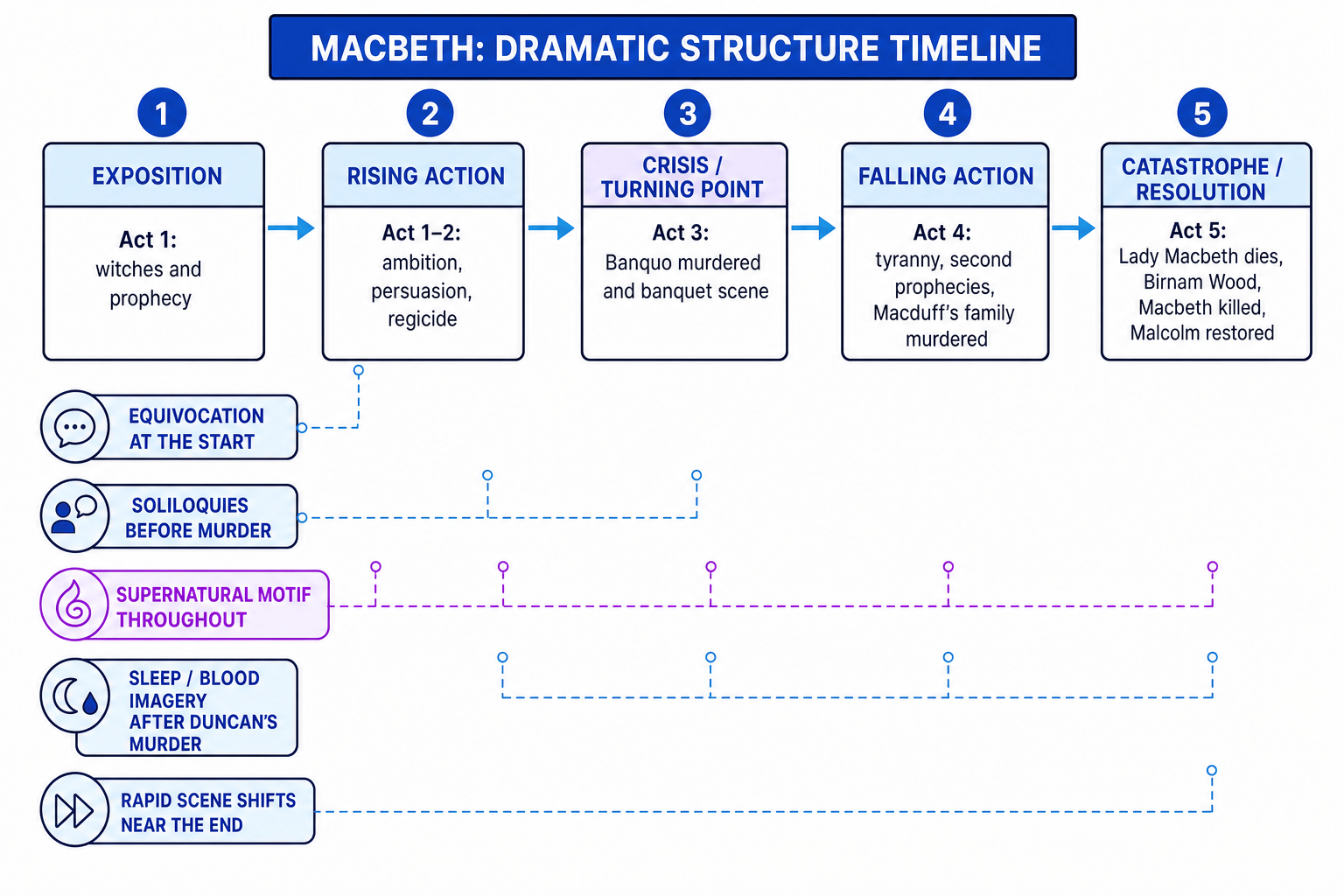
Opening with the witches
Shakespeare begins not with Macbeth, but with “Thunder and lightning” and the witches. A stage direction is an instruction in the play text for action, setting or sound. This opening stage direction creates pathetic fallacy, where weather reflects mood or moral disorder.
The audience meets a world where nature is disturbed before they meet the hero. This structurally prepares us for a play where moral boundaries will blur.
Dramatic irony and juxtaposition
Dramatic irony happens when the audience knows more than a character. When Duncan says Macbeth’s castle has a “pleasant seat” in Act 1 Scene 6, the audience already knows Lady Macbeth is planning his murder. The polite language becomes disturbing because we understand the danger he cannot see.
Juxtaposition means placing two things side by side to highlight contrast. Shakespeare often places calm public scenes next to violent private intentions. This supports the theme of appearance versus reality: characters speak politely while hiding “false” hearts.
Repetition and structural echoes
A structural echo is when a word, image or situation returns later in a changed form. Shakespeare uses echoes to show consequences.
Tracing a structural echo
-
Compare Lady Macbeth’s early confidence: after Duncan’s murder, she says, “A little water clears us of this deed”, treating guilt as a practical problem.
-
Move to the later echo: in Act 5 Scene 1, she cries, “Out, damned spot!”, imagining blood that cannot be removed.
-
Analyse the change: the “water” solution has failed; the repeated blood image returns as psychological torment.
-
Explain the effect: Shakespeare structures Lady Macbeth’s collapse so that her earlier denial is answered by later guilt.
Bringing language, form and structure together
The strongest paragraphs often combine the three. For example, you might argue that Shakespeare presents guilt as inescapable through the language of blood, the form of soliloquy and sleepwalking, and the structure of repeated images returning after the murder.
A useful sentence pattern
Try: “At this point in the play, Shakespeare uses [method] in ‘[short quotation]’ to suggest [meaning], which affects the audience by [effect] and links to [theme or later moment].”
In the exam
-
Begin paragraphs with an idea about meaning, not a device: for example, “Shakespeare presents guilt as something that grows more powerful over time.”
-
Use short quotations from your clean copy, then zoom in on one or two words rather than copying long chunks.
-
When analysing structure, use phrases such as “at the start”, “immediately after Duncan’s murder”, “later in Act 5” and “Shakespeare returns to this image”.
-
Mention form when it genuinely matters: soliloquy, stage directions, offstage murder, verse, prose, rhyme and tragedy all shape how the audience experiences the play.
Check yourself
- How does the blood motif change between Act 2 and Act 5?
- Why is it important that Shakespeare opens the play with the witches before Macbeth appears?
- What is the difference between a soliloquy and an aside, and how can each affect the audience?