What you'll learn
- How to choose short, flexible quotations for Macbeth.
- How to connect each quote to method, meaning, and effect.
- Which quotations work best for major ideas such as ambition, guilt, tyranny, gender, and the supernatural.
- How to use quotes effectively in Edexcel IGCSE Literature responses.
Why key quotes matter in Macbeth
For Edexcel International GCSE English Literature, Macbeth appears in Component 2, Section B: Literary Heritage. This section is open book, which means you may use a clean copy of the play in the exam. However, you still need to know your key quotes well.
If you already know where the important quotations are, you can spend less time searching and more time writing a strong argument. Good quotation knowledge helps you meet AO1 by showing secure knowledge of the play, AO2 by analysing Shakespeare’s language, form and structure, and AO4 by linking ideas to context where relevant.
This timeline shows how useful quotations trace Macbeth’s movement from honour to temptation, murder, guilt, tyranny, and downfall.
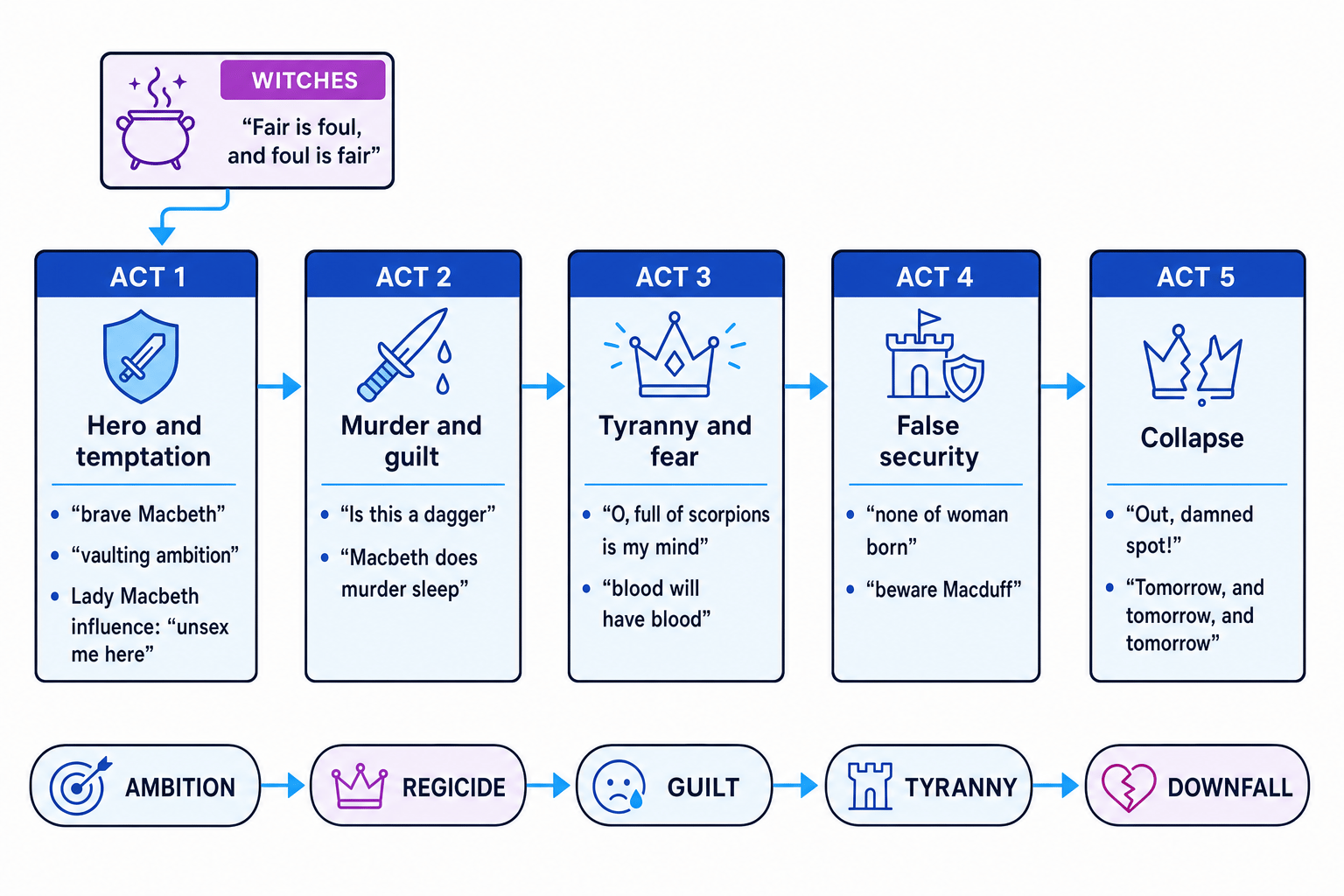
Key quotation
A key quotation is a short piece of evidence that can support several different arguments. The best ones are brief, accurate, easy to analyse, and linked to major themes or character changes.
The basic method: quote → method → effect → link
Do not just drop a quotation into a paragraph and move on. You need to explain how it works.
Method
A method is a deliberate choice made by the writer. In Macbeth, this might be a metaphor, soliloquy, motif, symbol, semantic field, stage direction, rhyme, rhythm, contrast, dramatic irony, or structural turning point.
A strong analysis usually follows this chain:
- Point — what your argument is.
- Evidence — the short quotation.
- Method — what Shakespeare is doing.
- Effect — how it shapes the audience’s understanding.
- Link — how it answers the question and connects to the play’s wider ideas.
Analysing “vaulting ambition”
-
Macbeth admits he has “no spur” except “vaulting ambition” in Act 1 Scene 7, so the quote shows that he understands his motive is not justice, loyalty, or necessity, but personal desire.
-
The metaphor compares ambition to a rider who jumps too high and falls. This suggests Macbeth’s desire for power is energetic but unstable, making his downfall feel built into the image itself.
-
Because Macbeth recognises the danger before he kills Duncan, Shakespeare presents him as morally aware rather than simply evil. This makes his choice more tragic because he knowingly goes against his conscience.
-
In a paragraph, you could write: Shakespeare presents Macbeth’s ambition as self-destructive when he describes it as “vaulting ambition”. The riding metaphor suggests a force that overreaches and “falls”, foreshadowing Macbeth’s later collapse after he commits regicide.
Quote dumping
Do not write a long quotation and then simply say “this shows ambition”. A short quote with precise analysis is much stronger than a long quote with little explanation.
Supernatural and deception quotes
The Witches open the play with “Fair is foul, and foul is fair” in Act 1 Scene 1.
This is one of the most useful quotes in the whole play. The line uses paradox, where a statement seems contradictory but reveals a deeper truth. It suggests that moral boundaries will become confused: good will look evil, evil will look good, and appearances cannot be trusted.
Macbeth later echoes the Witches when he says, “So foul and fair a day I have not seen” in Act 1 Scene 3. This creates a structural link between Macbeth and the supernatural before he has even spoken to them properly.
The Witches’ role
The Witches do not physically force Macbeth to murder Duncan. Instead, Shakespeare presents them as tempters who awaken desires that already exist inside him.
Useful supernatural quotations:
| Quote | Speaker / moment | Best used for |
|---|---|---|
| “Fair is foul, and foul is fair” | Witches, Act 1 Scene 1 | Moral confusion, deception, unnatural disorder |
| “All hail, Macbeth, that shalt be king hereafter!” | Witches, Act 1 Scene 3 | Prophecy, temptation, ambition |
| “Double, double toil and trouble” | Witches, Act 4 Scene 1 | Chaos, evil, ritual, supernatural power |
| “none of woman born / Shall harm Macbeth” | Apparition, Act 4 Scene 1 | Equivocation, false security, deception |
| “Something wicked this way comes” | Second Witch, Act 4 Scene 1 | Macbeth’s transformation into evil |
Equivocation
Equivocation means using language that is deliberately misleading because it can be interpreted in more than one way. The Witches’ prophecies sound comforting to Macbeth, but their wording hides the truth.
Ambition and moral conflict quotes
At the start, Macbeth is called “brave Macbeth” by the Captain in Act 1 Scene 2. This matters because Shakespeare first presents him as a loyal warrior. His fall therefore feels dramatic: he is not introduced as a villain, but as someone capable of greatness.
Macbeth’s ambition becomes visible in Act 1 Scene 4: “Stars, hide your fires; / Let not light see my black and deep desires.” The contrast between “light” and “black” creates imagery of concealment and evil. Macbeth knows his desires are morally wrong, so he wants darkness to hide them.
Another excellent quote is “False face must hide what the false heart doth know” in Act 1 Scene 7. The repetition of “false” shows Macbeth accepting deception as part of his plan. It links closely to appearance versus reality.
Best ambition cluster
For an essay on ambition, learn these three in order: “brave Macbeth” → “black and deep desires” → “vaulting ambition”. Together, they show Macbeth’s movement from honour to secret desire to self-destructive overreaching.
Lady Macbeth, gender, and power quotes
Lady Macbeth’s most famous quotation is “unsex me here” in Act 1 Scene 5. She asks spirits to remove qualities associated with femininity, such as pity and gentleness, because she believes they will prevent her from pursuing power.
This links to Jacobean ideas about gender. Shakespeare’s audience would likely have seen her rejection of expected female behaviour as disturbing and unnatural. However, she is also presented as intelligent and forceful, especially when manipulating Macbeth.
When she tells Macbeth, “When you durst do it, then you were a man” in Act 1 Scene 7, she attacks his masculinity. Shakespeare shows how ideas of manhood can be twisted into violence.
Her advice, “Look like th’ innocent flower, / But be the serpent under’t”, is also extremely useful. The simile of the “innocent flower” suggests harmless beauty, while the “serpent” alludes to evil and temptation. This connects Lady Macbeth to deception and perhaps to the biblical story of the Fall.
By Act 5, Lady Macbeth’s power has collapsed. In her sleepwalking scene, she cries, “Out, damned spot!” The “spot” symbolises blood-guilt. Earlier, she claimed “A little water clears us of this deed”, but now guilt cannot be washed away.
Blood, guilt, and the mind
Blood is one of the play’s most important motifs.
Motif
A motif is a repeated image, idea, or symbol that develops meaning across a text. In Macbeth, blood begins as a sign of bravery in battle but becomes a sign of guilt, murder, and moral corruption.
After Duncan’s murder, Macbeth asks, “Will all great Neptune’s ocean wash this blood / Clean from my hand?” in Act 2 Scene 2. The hyperbole makes his guilt seem enormous: even the god of the sea could not wash it away.
Macbeth also hears, “Macbeth does murder sleep.” Sleep symbolises innocence, peace, and natural order. By murdering Duncan in his sleep, Macbeth destroys his own ability to rest.
Later, his mind becomes increasingly tortured. In Act 3 Scene 2, he says, “O, full of scorpions is my mind, dear wife!” The metaphor suggests his thoughts are poisonous, painful, and uncontrollable.
Tracking the blood motif
-
In Act 2, Macbeth sees Duncan’s blood on his hands and asks whether “Neptune’s ocean” can wash it away, so blood first becomes a symbol of immediate guilt.
-
In Act 3, he says “blood will have blood”, which turns blood into a pattern of revenge: one murder creates the need for more violence.
-
In Act 5, Lady Macbeth’s “damned spot” shows that guilt has moved from physical evidence to psychological torment, because there is no real blood on her hands during the sleepwalking scene.
-
This development lets you argue that Shakespeare uses the blood motif structurally: it grows from one murder into a permanent moral stain.
Kingship, tyranny, and disorder
Because Duncan is king, Macbeth’s murder is not just personal betrayal. It is regicide, meaning the killing of a king. In Shakespeare’s context, kingship was often associated with divine order, so killing a rightful king would be seen as a terrible violation of the natural and political world.
After Macbeth becomes king, he is not secure. He admits, “To be thus is nothing, / But to be safely thus” in Act 3 Scene 1. The repetition of “thus” shows that having the crown is meaningless unless he feels safe. Power brings fear, not peace.
His image of “a fruitless crown” and “barren sceptre” shows anxiety about Banquo’s descendants becoming kings. The words “fruitless” and “barren” suggest sterility and failure, undermining the idea that kingship has fulfilled him.
By Act 4, Macbeth has become openly tyrannical. Malcolm calls him “this tyrant, whose sole name blisters our tongues” in Act 4 Scene 3. The violent verb “blisters” suggests Macbeth’s name itself causes pain.
Useful kingship and tyranny quotations:
| Quote | Speaker / moment | Best used for |
|---|---|---|
| “There’s daggers in men’s smiles” | Donalbain, Act 2 Scene 3 | Deception, danger, political distrust |
| “fruitless crown” | Macbeth, Act 3 Scene 1 | Insecurity, legacy, fear of Banquo |
| “blood will have blood” | Macbeth, Act 3 Scene 4 | Violence creating more violence |
| “this tyrant” | Malcolm, Act 4 Scene 3 | Corrupt kingship, Scotland’s suffering |
| “Turn, hell-hound, turn!” | Macduff, Act 5 Scene 8 | Macbeth as demonic, justice, revenge |
Downfall and despair quotes
By Act 5, Macbeth has lost the emotional depth he once had. When Lady Macbeth dies, he responds with “Tomorrow, and tomorrow, and tomorrow” in Act 5 Scene 5. The repetition makes time sound slow, empty, and meaningless.
He then says, “Life’s but a walking shadow.” This metaphor presents human life as insubstantial and temporary. The word “shadow” suggests that Macbeth’s ambition has led him not to greatness, but to emptiness.
“Out, out, brief candle!” is another compact quote for mortality. The candle image suggests life can be extinguished suddenly. It also contrasts with earlier light imagery, such as “Stars, hide your fires”.
Macbeth’s tragic arc
Macbeth begins as “brave Macbeth”, becomes dominated by “vaulting ambition”, and ends seeing life as “a walking shadow”. His tragedy is not only that he dies, but that he spiritually empties himself before death.
How to revise key quotes efficiently
You do not need to memorise huge speeches. Instead, learn short micro-quotes.
Micro-quote
A micro-quote is a very short quotation, often one to four words, that you embed smoothly into your sentence, such as “vaulting ambition”, “fruitless crown”, or “damned spot”.
Micro-quotes help your writing sound fluent. For example:
Shakespeare presents Macbeth’s kingship as insecure through the image of a “fruitless crown”, suggesting that power without legacy brings him no satisfaction.
That is much better than copying a long speech without analysing it.
Open book advantage
Even though the exam is open book, memorise around 12–15 flexible micro-quotes. Then use your clean copy to check wording, find nearby moments, and add a second supporting reference if needed.
In the exam
-
Choose quotations that answer the question directly, not just quotes you happen to remember.
-
Keep evidence short and accurate, then spend more time analysing Shakespeare’s method and its effect.
-
Link quotations across the play to show development, such as Macbeth moving from “brave Macbeth” to “Something wicked this way comes” to “Life’s but a walking shadow”.
Check yourself
-
Which three quotations best show Macbeth’s ambition developing across the play?
-
How does the blood motif change from Act 2 to Act 5?
-
Which quotation would you use to show that the Witches mislead Macbeth through equivocation?