When preparing for your Edexcel IGCSE English Literature exam on Macbeth, understanding individual characters and themes is only half the battle. You must also understand how Shakespeare structures his play.
By looking closely at Key Scenes, you will see how Shakespeare manipulates dramatic tension, develops his central themes, and guides his characters toward their inevitable fates.
Tragic Structure
A classical tragedy follows a specific five-act structure (often mapped using Freytag's Pyramid) that details the rise and fall of a protagonist. The drama hinges on a hamartia (a fatal flaw) that leads to a peripeteia (a sudden turning point or reversal of fortune) and ends in a catastrophe (the final, inevitable ruin of the protagonist).
What You'll Learn
- How to identify and analyse the critical structural turning points of Macbeth.
- How to link language techniques (AO2) inside specific scenes to the broader Jacobean context (AO4).
- How to write a cohesive, top-grade essay by treating the play as a dynamic piece of theatre rather than a static text.
The Dramatic Arc of Macbeth
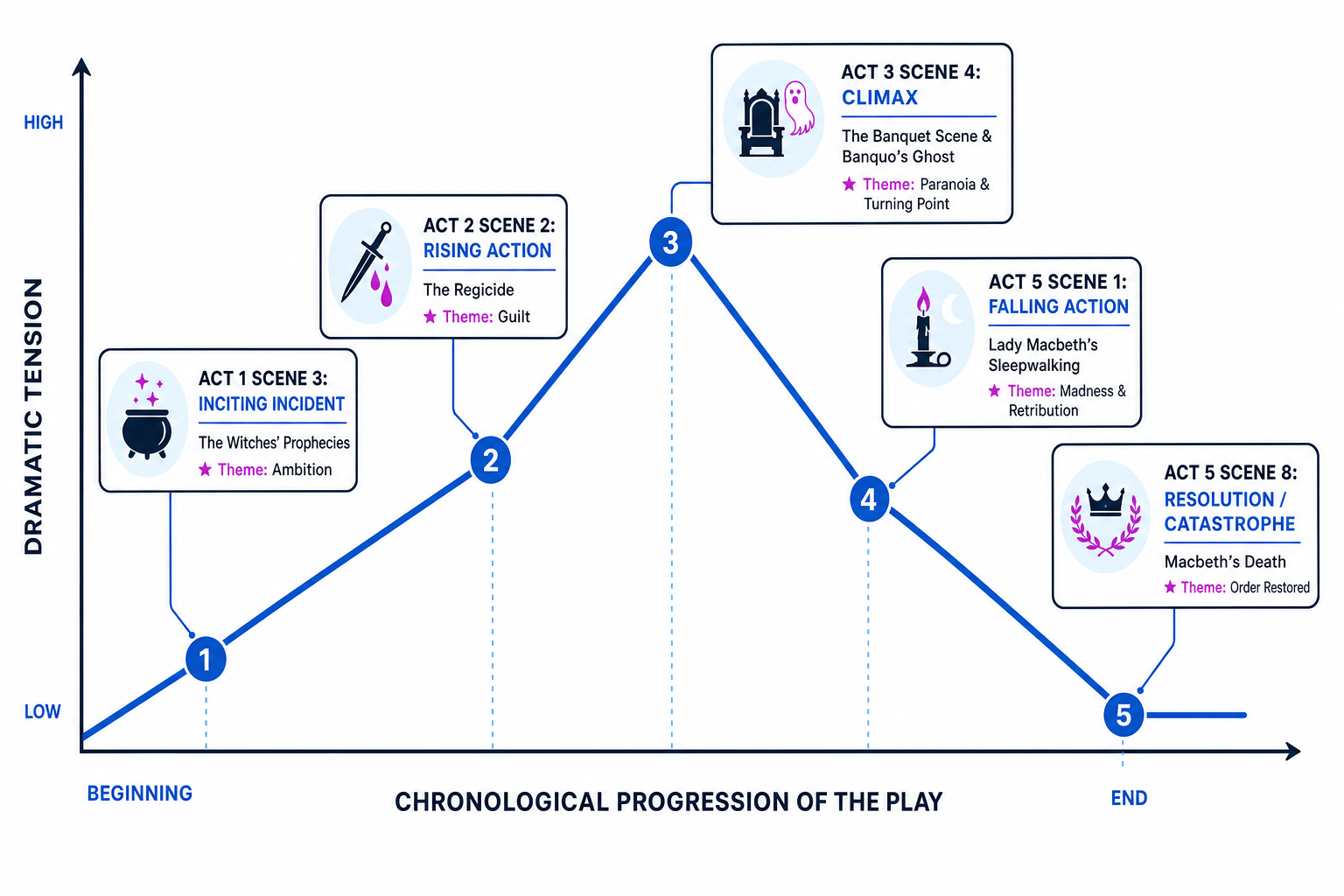
Rather than viewing Macbeth as a sequence of random events, you should view it as a carefully constructed curve of rising and falling tension.
Because Component 2 is an open-book exam, you do not need to memorise every line, but you must know exactly where the major structural shifts occur so you can locate evidence quickly.
Structure is Meaning
In Shakespearean tragedy, structure is a physical manifestation of morality. The rising action represents Macbeth’s defiance of God's natural order (the Divine Right of Kings). The climax is the peak of his power, which immediately collapses into chaotic falling action and psychological torment, proving that usurping the throne is fundamentally unsustainable.
Deep-Dive Analysis of 4 Key Scenes
Let's explore four of the most critical scenes in the play, focusing on how Shakespeare uses language, dramatic devices, and structure to convey his themes.
1. Act 1, Scene 3: The Witches' Prophecies (The Inciting Incident)
In this scene, Macbeth and Banquo encounter the Weird Sisters on the heath. It is the catalyst for the entire plot.
- The Contrast in Reactions: While Banquo is highly skeptical of the Witches, warning that "instruments of darkness tell us truths... to betray's in deepest consequence", Macbeth is immediately transfixed.
- The Soliloquy: Left with his thoughts, Macbeth speaks in a soliloquy (a dramatic speech revealing a character's innermost thoughts to the audience). He admits to "horrid image[s]" of murder that make his "seated heart knock at [his] ribs".
- AO4 Connection: King James I of England was fascinated by and terrified of witchcraft, even writing a book on it called Daemonologie (1597). Shakespeare’s audience would have viewed the Witches not as theatrical novelties, but as literal, active agents of the Devil. Macbeth’s willingness to listen to them instantly flags his moral vulnerability to a Jacobean audience.
2. Act 2, Scene 2: The Regicide (The Rising Action)
This scene takes place immediately after Macbeth murders King Duncan. Crucially, Shakespeare keeps the murder itself offstage.
-
Offstage Action: By choosing not to show the murder of Duncan directly, Shakespeare focuses entirely on the psychological fallout. It also avoids showing regicide (killing a king) on stage, which would have been highly controversial and offensive to King James I.
-
Stichomythia: When Macbeth returns to Lady Macbeth, their dialogue is written in stichomythia—short, rapid, alternating lines of dialogue:
Macbeth: I have done the deed. Didst thou not hear a noise? Lady Macbeth: I heard the owl scream and the crickets cry. Did not you speak? Macbeth: When? Lady Macbeth: Now.
This structural technique creates a frantic, breathless pace, reflecting their extreme panic and guilt.
-
The Motif of Water and Blood: Macbeth looks at his bloody hands and asks, "Will all great Neptune's ocean wash this blood / Clean from my hand?", concluding that his hands will instead turn the green sea red ("incarnadine"). In contrast, Lady Macbeth remarks dismissively, "A little water clears us of this deed". This dramatic irony prepares the audience for her ultimate mental breakdown in Act 5.
Missing the Stagecraft
Do not treat the play like a novel. When discussing Act 2, Scene 2, always mention that the murder happens offstage. Explain the effect: it heightens the sensory atmosphere (the focus on sounds like knocking, owls, and whispers) and forces the audience to focus on the immediate psychological fracturing of the couple.
3. Act 3, Scene 4: The Banquet Scene (The Climax / Peripeteia)
This is the ultimate turning point of the play. Macbeth has secured the crown and ordered Banquo's murder, but Banquo's ghost appears at his royal feast.
- The Disruption of Order: The banquet is a symbol of social order, hospitality, and royal harmony. By bringing a bloody ghost to the table, Shakespeare visually demonstrates how Macbeth’s crimes have shattered the natural order of Scotland.
- Loss of Control: Macbeth's public breakdown ("Thou canst not say I did it; never shake / Thy gory locks at me!") reveals his mental instability to his lords. Lady Macbeth tries to salvage the situation by telling the guests that Macbeth has a temporary illness, but she is ultimately forced to dismiss them: "Stand not upon the order of your going, / But go at once." This line structurally mirrors the collapse of order in the kingdom.
- No Turning Back: After the guests leave, Macbeth utters a chilling realization: "I am in blood / Stepped in so far that, should I wade no more, / Returning were as tedious as go o'er." This is his transition from a reluctant criminal to a desperate, tyrannical monster.
4. Act 5, Scene 1: Lady Macbeth’s Sleepwalking (The Falling Action)
We see a complete reversal of Lady Macbeth’s earlier composure. Observed by a Doctor and a Gentlewoman, she walks in her sleep, obsessively trying to wash invisible blood from her hands.
- The Shift to Prose: Throughout the play, noble characters speak in blank verse (unrhymed iambic pentameter). However, in this scene, Lady Macbeth speaks in fragmented, erratic prose: "Out, damned spot! out, I say!—One: two: why, then, 'tis time to do't." This structural shift signals her loss of reason, control, and social status.
- The Reversal of the Water Motif: Her delusion that she cannot clean her hands ("All the perfumes of Arabia will not sweeten this little hand") directly echoes Macbeth's earlier fears about "Neptune's ocean", proving that her guilt has caught up to her.
Worked Example: Analysing a Key Scene
Let's walk through how to construct a high-scoring analytical paragraph on Act 5, Scene 1 (The Sleepwalking Scene), focusing on how Shakespeare uses language and structure to convey Lady Macbeth's guilt.
Analysing structural shift and language in Act 5, Scene 1
Analyze how Shakespeare presents Lady Macbeth's mental state in Act 5, Scene 1.
-
Establish the structural context (AO1) Begin by identifying where the scene sits in the play's overall structure and its psychological contrast to earlier scenes. Example: In Act 5, Scene 1, Shakespeare presents the complete collapse of Lady Macbeth’s mental stability, structurally reversing her earlier role as the cold, rational architect of Duncan’s murder.
-
Select and integrate precise textual evidence (AO1) Embed brief, powerful quotes that showcase her distress. Example: This mental fracturing is made clear when she desperately tries to wash her hands, crying, "Out, damned spot! out, I say!" and lamenting that "all the perfumes of Arabia will not sweeten this little hand."
-
Identify and analyse Shakespeare's dramatic and linguistic methods (AO2) Examine the change in form (verse to prose) and the specific imagery used. Example: Shakespeare masterfully shifts Lady Macbeth's speech from her customary authoritative blank verse to fragmented, disjointed prose. This structural breakdown mirrors her fractured psyche. The sensory imagery of "perfumes of Arabia" contrasting with the smell of "blood" highlights the overwhelming, permanent nature of her guilt. Her imperative command, "Out, damned spot!", is directed at her own mind, exposing her total loss of control.
-
Link the analysis to Jacobean context (AO4) Explain why this psychological downfall would resonate with a Jacobean audience. Example: To a Jacobean audience, this cognitive decay is the inevitable consequence of violating the Divine Right of Kings. By attempting to usurp God’s appointed monarch, Lady Macbeth has invited demonic ruin upon herself. Her sleepwalking—a state suspended between life and death—renders her tormented spirit a warning against treason.
Use Your Clean Copy Wisely
Because Component 2 is open-book, you don't need to panic about forgetting quotes. However, do not spend minutes flipping through the book during the exam. Instead, memorise the Act and Scene numbers for your main points (like Act 5, Scene 1 for Lady Macbeth's madness) so you can turn directly to the exact page if you need to check a word.
In the exam
- Focus on structural relationships: When writing about a scene, always explain its relationship to what came before and after. For example: “This moment of confidence in Act 4 directly contrasts with Macbeth’s desperate isolation in Act 5.”
- Weave context (AO4) into your analysis: Do not write a separate "context paragraph" at the end. Instead, link historical factors (like the Gunpowder Plot of 1605, King James's fear of regicide, or beliefs about the supernatural) directly to the specific words characters say in your key scenes.
- Analyse structural form, not just words: Don't just look for metaphors. Look for changes in dialogue speed (stichomythia), shifts from verse to prose, soliloquies, and onstage visual actions (like the physical presence of Banquo's ghost).
Check yourself
- Why does Shakespeare choose to have the murder of King Duncan happen offstage in Act 2, Scene 2?
- How does the structural transition from blank verse to prose in Act 5, Scene 1 reflect Lady Macbeth's psychological descent?
- What makes Act 3, Scene 4 (The Banquet Scene) the peripeteia (turning point) of the entire tragedy?