What you'll learn
- How to turn a broad topic like identity into a focused thematic argument.
- The main themes in Kindertransport: identity, motherhood, memory, fear, survival, and cultural loss.
- How Diane Samuels develops themes through structure, props, doubling, and symbolism.
- How to write about themes in the Edexcel IGCSE open-book modern drama exam.
Starting point: what is a theme?
A theme is a big idea explored across a text. It is not just a topic word such as “family” or “fear”. A strong theme statement explains what the writer seems to suggest about that topic.
For example, in Kindertransport, the topic is not simply “identity”. Samuels explores how identity can be changed by exile, fear and survival — but also how the past continues to press back into the present.
Theme
A theme is a recurring idea or concern in a text, developed through characters, events, language, structure and dramatic methods.
Turning a topic into a theme
- Start with a topic: identity.
- Connect it to the play’s situation: Eva is sent from Germany to England and later becomes Evelyn.
- Add the tension: becoming “Evelyn” helps her survive, but it also cuts her off from Eva, her family and her Jewish-German past.
- Turn it into a theme statement: Samuels presents identity as something people may reshape in order to survive, but this reshaping can create pain, secrecy and self-division.
Here is a quick overview of how the major themes connect. Notice that they overlap: in a good essay, you often write about more than one theme at once.
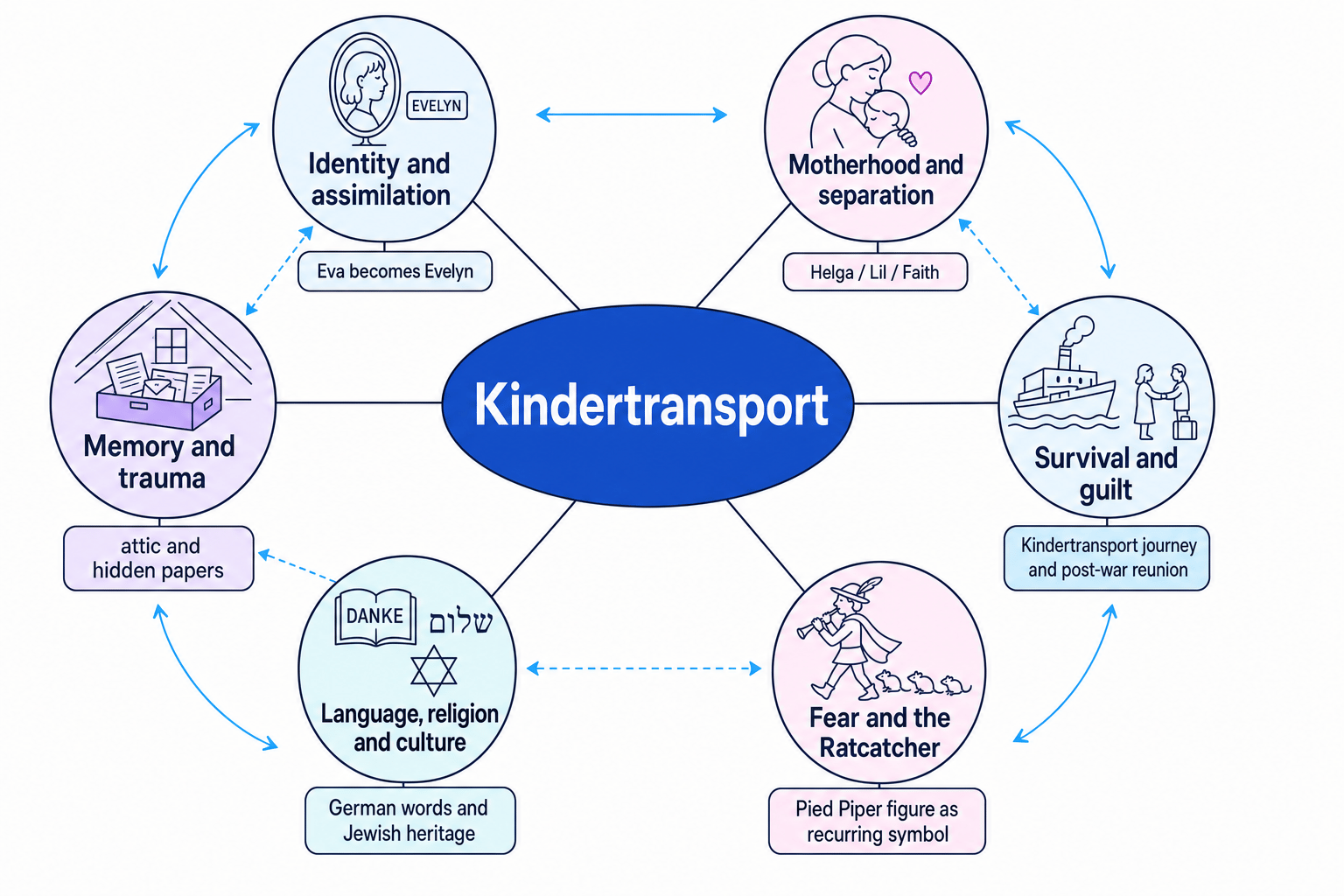
Identity and assimilation
Assimilation
Assimilation means adapting to fit into a different society or culture, often by changing language, behaviour, beliefs or even name.
The clearest identity shift in the play is from Eva Schlesinger to Evelyn. As a child, Eva’s name marks her German-Jewish identity. As an adult, “Evelyn” sounds English and controlled. The contrast between the two names becomes a dramatic shorthand for her divided self.
A key moment is adult Evelyn’s insistence: “My name is Evelyn.” The simple declarative sentence sounds firm, but it also feels defensive. She is not merely stating a name; she is trying to shut down the past.
Samuels makes this theme dramatic rather than abstract. Eva and Evelyn can exist in the same stage space through the play’s split time structure, so the audience sees the child she was and the adult she has become. That makes identity feel layered, not fixed.
Identity is both protection and loss
Evelyn’s English identity protects her from the terror attached to Eva’s past, but it also depends on denial: she survives by burying parts of herself.
Analysing the name change
- Choose the evidence: adult Evelyn says, “My name is Evelyn.”
- Identify the method: Samuels uses a short declarative sentence, making Evelyn sound certain and controlled.
- Look beneath the surface: because the audience knows she was Eva Schlesinger, the certainty feels unstable; her words try to erase a history that the stage keeps bringing back.
- Link to theme: the name change shows assimilation as emotionally complicated — it is a survival strategy, but also a form of self-erasure.
Calling Evelyn simply disloyal
Avoid saying Evelyn “betrays” her past as if her choice is easy. Samuels presents her identity shift as shaped by trauma, fear and the need to survive.
Motherhood, separation and protection
The play presents motherhood as loving, painful and morally difficult. Helga sends Eva away on the Kindertransport because she wants her child to live. Yet from Eva’s point of view, that protection feels like abandonment.
This is one of Samuels’ most important tensions: the same action can be both an act of love and a wound. Helga loses her child in order to save her. Eva survives, but separation becomes part of her emotional pattern.
Lil complicates the theme further. She is not Eva’s birth mother, but she gives Eva safety and a home in England. The play does not make motherhood purely biological. Instead, it asks what makes someone a mother: birth, love, daily care, memory, sacrifice, or truth?
Faith’s relationship with Evelyn shows how the damage passes into the next generation. Evelyn hides her past from Faith, partly because remembering is painful. But secrecy prevents Faith from understanding her own family history.
Generational trauma
Generational trauma is pain or damage that is passed from one generation to the next, even when the younger generation did not experience the original event directly.
In Kindertransport, Faith has not lived through Nazi Germany or evacuation, but Evelyn’s silence affects her identity. Faith’s discovery of the past turns private history into present conflict.
Memory, secrecy and the past
The play’s structure is non-linear, meaning events are not presented in simple chronological order from beginning to end. Instead, Samuels moves between the 1930s and the 1980s. This structure is perfect for a play about memory because trauma does not return neatly or politely — it interrupts.
Non-linear structure
A non-linear structure presents events out of chronological order, often moving between different times to show memory, comparison or cause and effect.
The attic is central to this theme. It is a physical place where old objects are stored, but it also symbolises Evelyn’s hidden past. When Faith searches through boxes and papers, she is not just tidying; she is uncovering a buried identity.
Symbol
A symbol is an object, place, character or image that represents a larger idea.
The attic symbolises secrecy, memory and repression. Evelyn has tried to keep the past boxed away, but the stage action shows that hidden things can still shape the present.
Linking setting to theme
- Start with the setting: much of the present-day action centres on the attic and stored belongings.
- Identify the method: Samuels uses the attic as a symbolic stage space, where physical objects carry emotional history.
- Explain the effect: when Faith finds evidence of Eva’s past, the audience sees memory becoming unavoidable.
- Link to theme: the past in Kindertransport is not dead or finished; it remains stored inside families until someone confronts it.
Use stage directions as evidence
Because this is Component 2 Section A, you have a clean copy in the exam. Do not rely only on spoken quotations: stage directions, props, entrances and actor doubling are also evidence.
Fear, trauma and the Ratcatcher
Motif
A motif is a repeated image, object, sound, phrase or idea that helps develop a theme.
The Ratcatcher is one of the play’s most important motifs. He draws on the Pied Piper story, where a mysterious figure leads children away. In Samuels’ play, this becomes deeply unsettling because Eva is also a child taken away from home.
The Ratcatcher is not just “a villain”. He represents Eva’s fear, the threat of Nazi authority, and the nightmare logic of childhood trauma. The figure appears in different forms, and this doubling makes him feel inescapable.
Doubling
Doubling is when one actor plays more than one role. In drama, this can create symbolic links between characters or ideas.
When the same threatening presence seems to reappear through different authority figures, Samuels suggests that Eva’s fear is not attached to one person only. It becomes a whole pattern of power: officials, borders, transport, documents and adult decisions.
Reducing the Ratcatcher to the Nazis only
The Ratcatcher is linked to Nazi threat, but he also symbolises broader fears: separation, betrayal, childhood helplessness and the terrifying power adults have over children’s lives.
Survival, guilt and moral complexity
The title Kindertransport refers to the rescue operation that brought many Jewish children from Nazi-occupied Europe to Britain. Historically, it saved lives. But Samuels does not present rescue as simple happiness. Survival comes with loss.
Eva survives because she leaves. That means survival is tied to separation from Helga, loss of home, loss of language and loss of childhood security. Later, Evelyn’s guarded personality suggests that survival has required emotional hardening.
Survivor's guilt
Survivor’s guilt is the guilt felt by someone who has lived through a disaster or persecution when others suffered, died or were left behind.
This theme is especially powerful because the play avoids easy moral judgements. Helga’s decision is loving but devastating. Lil’s care is generous but cannot erase Eva’s first family. Evelyn’s secrecy is damaging, but it grows from pain.
For Edexcel, this is where your personal response can become more mature. Instead of labelling characters as simply right or wrong, explore the impossible pressures they face.
Language, religion and cultural inheritance
Language is closely tied to identity in the play. Eva’s movement from German-speaking childhood into English life is not just practical; it changes how she belongs. A new language can offer safety, but it can also create distance from family and memory.
Religion and culture matter too. Eva’s Jewish identity places her in danger in Nazi Germany, but hiding or losing that identity creates another kind of wound. Samuels shows that persecution does not only threaten bodies; it also attacks names, customs, stories and belonging.
Faith’s name is also suggestive. It can imply trust, belief and inheritance — all things damaged by Evelyn’s secrecy. Faith wants to know where she comes from, but Evelyn has built her adult life on not looking back.
How to connect themes in an essay
Strong essays do not treat themes as separate boxes. In Kindertransport, identity links to memory; memory links to motherhood; motherhood links to survival; survival links to guilt.
A useful paragraph shape is:
- Point: make a clear argument about the theme.
- Evidence: use a short quotation or precise dramatic moment.
- Method: name what Samuels is doing as a playwright.
- Effect: explain how the audience responds or what they understand.
- Link: return to the question and the theme.
Model analytical paragraph
Samuels presents identity as something Evelyn has constructed in order to protect herself from trauma. When she insists, “My name is Evelyn,” the short declarative sentence creates a tone of control, as though she can fix her identity through language. However, the audience knows that she was once Eva Schlesinger, so the statement also reveals denial. Samuels’ non-linear structure places past and present beside each other, meaning Evelyn cannot fully escape the child she once was. This makes the theme of identity painful and divided: Evelyn’s new self is a survival mechanism, but it depends on suppressing memory, family and cultural inheritance.
In the exam
- Use the question’s theme word as a lens: show how Samuels develops the idea across the play, not just in one scene.
- Since Component 2 is open book, choose short, exact quotations and stage directions from your clean copy; analyse methods such as symbolism, doubling, props and non-linear structure.
- Link past and present: the best answers often connect Eva’s childhood experiences with Evelyn and Faith in the 1980s.
- Avoid simple character judgement. Write about pressure, trauma and dramatic complexity.
Check yourself
- How does the change from Eva Schlesinger to Evelyn develop the theme of identity?
- Why is the Ratcatcher more than just a frightening character?
- Which two scenes would you connect in an essay about motherhood and separation?