What you'll learn
- What the real Kindertransport was, and why it matters to the play.
- How Nazi persecution, British refuge, assimilation and trauma shape Eva/Evelyn’s identity.
- How Samuels uses context through dramatic methods, not just historical facts.
- How to use context in an Edexcel IGCSE essay without bolting it on awkwardly.
What “context” means
Context
Context means the circumstances surrounding a text: the historical events, social attitudes, beliefs, places and literary influences that help us understand why the writer presents ideas in a particular way.
For Pearson Edexcel International GCSE English Literature, Kindertransport is studied as a modern drama text in Component 2, which is open book: you may use a clean copy of the play in the exam. You are mainly rewarded for close knowledge and analysis of Samuels’ dramatic choices, so context should support your interpretation rather than replace it.
The main rule
Never write a “history paragraph” and then leave the play behind. The strongest answers show how context helps explain what Samuels makes the audience see, hear and feel on stage.
The historical Kindertransport
Kindertransport
The Kindertransport was a rescue movement that brought around 10,000 mostly Jewish children from Nazi-controlled Europe to Britain between December 1938 and September 1939. The children usually travelled without their parents.
The word is German: Kinder means children, and Transport means transport. Samuels’ title immediately places the play inside a real historical rescue — but the play is not simply a celebration of rescue. It asks what survival costs when a child is separated from family, language, religion and home.
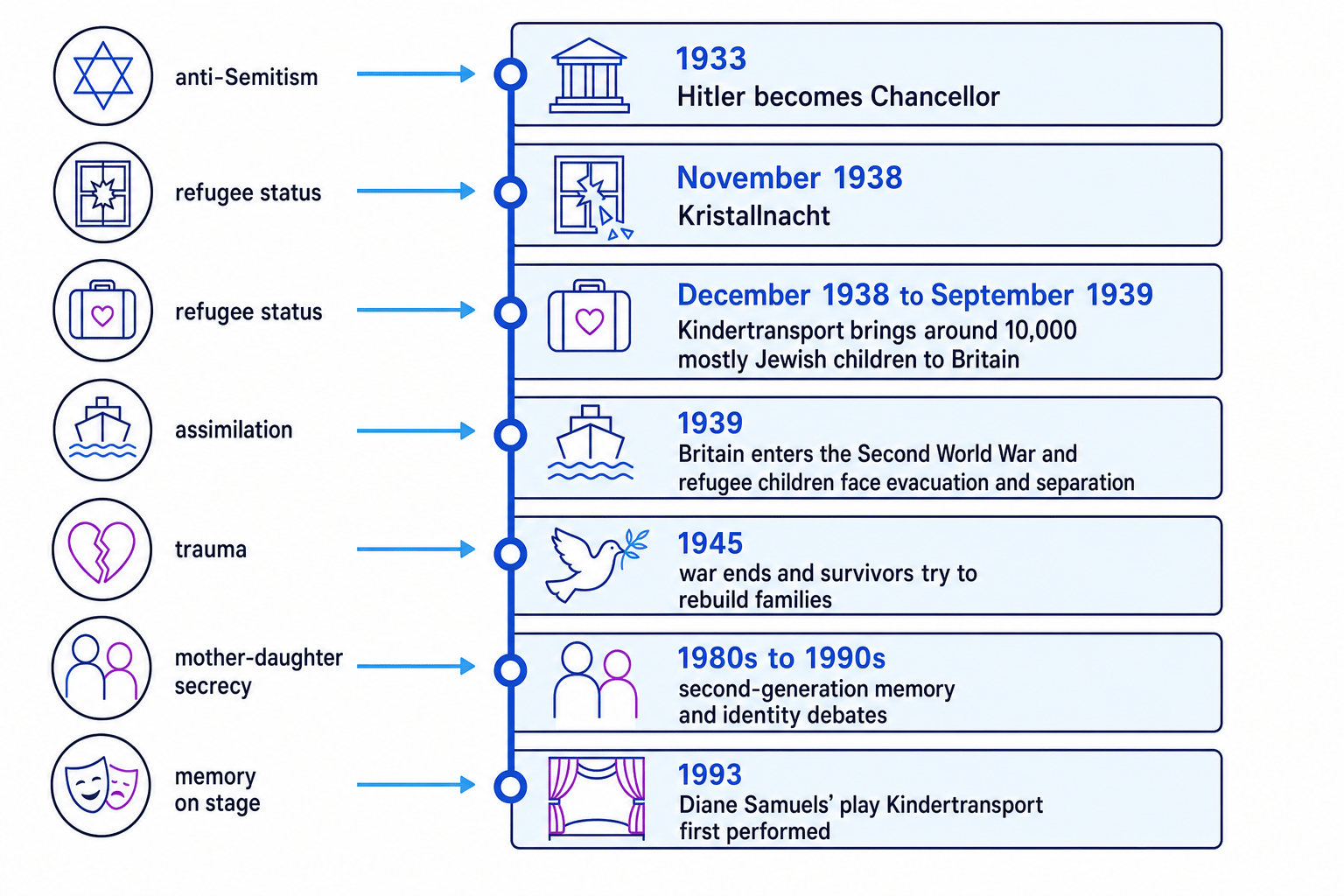
The British government allowed unaccompanied children to enter, but not usually their parents. Families had to make unbearable choices: sending a child away could save their life, but it could also feel like abandonment to the child.
Nazi persecution and antisemitism
Antisemitism
Antisemitism is prejudice, hatred or discrimination against Jewish people. In Nazi Germany, antisemitism became state policy: Jewish people were excluded, humiliated, robbed, imprisoned and murdered.
The Nazis came to power in Germany in 1933. Their persecution intensified through laws such as the Nuremberg Laws of 1935, which stripped Jewish people of citizenship and rights. In November 1938, Kristallnacht — the “Night of Broken Glass” — saw attacks on Jewish homes, businesses and synagogues. This helped push Britain into allowing the Kindertransport.
In the play, Eva’s childhood is shaped by this danger. Samuels makes the historical threat personal: we do not just learn about persecution as a fact; we see a young girl forced to leave home and carry fear with her.
How this affects Eva
Eva is not choosing a new life freely. She is a refugee, meaning someone forced to leave their country because they are in danger. This matters because her later desire to reject parts of herself is not childish silliness; it is a survival response.
Linking persecution to Eva’s identity
-
Start from Eva’s line: “I don’t want to be Jewish any more.” This is not just a comment about religion; it is about identity under pressure.
-
Notice the method: the simple declarative sentence makes the wish sound blunt and desperate. The phrase “be Jewish” treats identity as something Eva imagines she can remove.
-
Connect the context carefully: because Nazi antisemitism has made Jewish identity dangerous, Eva internalises the belief that being Jewish causes suffering.
-
Link back to the play’s meaning: Samuels shows that the Kindertransport saves Eva physically, but it also begins a painful split between survival and self-acceptance.
Britain as refuge — but not a simple “happy ending”
Britain offered safety to thousands of children, but Samuels avoids making Britain seem perfect. Refugee children often arrived unable to speak much English, carrying labels, documents and a small number of possessions. Some were warmly welcomed; others experienced loneliness, cultural confusion or pressure to fit in.
Assimilation
Assimilation is the process of adapting to the dominant culture around you. It can be protective, but it can also mean suppressing your original language, religion, name or memories.
Eva’s movement towards becoming Evelyn is one of the play’s central contextual ideas. A name change can look practical and harmless, but in the play it becomes symbolic of a deeper erasure. The adult Evelyn has survived by becoming English, but Samuels asks whether that survival has required her to bury too much.
Making Britain too simple
Avoid writing that “Britain saved the children, so the play is about kindness.” That is only partly true. Samuels presents rescue as morally complex: Britain gives Eva safety, but separation and assimilation also damage her sense of self.
Jewish identity, language and religion
Eva’s Jewishness is not just a background detail. It affects family life, food, language, memory and belonging. When she arrives in Britain, she enters a home that is not the same culturally or religiously as the one she has left.
Language is especially important. German is Eva’s first language, but it becomes connected with danger, loss and the Nazi world she has escaped. English becomes the language of safety and acceptance — but also the language through which Eva becomes Evelyn.
A strong context link
If you write about Eva becoming Evelyn, do not just say “she changes her name.” Explain what the change represents: assimilation, survival, repression and the painful attempt to separate from the past.
Mothers, separation and impossible choices
The Kindertransport forced parents into a terrible moral situation. Many parents sent their children away because it was the best chance of survival. Yet for the child, that same act could feel like rejection.
This is crucial for understanding Helga. Samuels does not present her simply as cruel or cold. Context helps us see that Helga’s decision is shaped by historical emergency. She acts within a world where normal motherhood has been made impossible by persecution.
The play’s mother-daughter relationships also stretch across generations. Eva/Evelyn’s unresolved past affects Faith, who has inherited silence rather than clear family history.
Transgenerational trauma
Transgenerational trauma means the effects of trauma being passed from one generation to the next, often through silence, fear, secrecy or damaged relationships.
Faith’s discoveries matter because the past has not disappeared. It has been hidden. Samuels suggests that secrets can protect people temporarily, but they can also damage trust.
Trauma and memory
Trauma
Trauma is a lasting psychological wound caused by deeply frightening or distressing experiences. In literature, trauma often appears through silence, repetition, flashback or fragmented memory.
Adult Evelyn’s behaviour can seem harsh, controlling or emotionally distant, but context helps you interpret it more thoughtfully. She has built a life by controlling what can be remembered and what must stay hidden.
Samuels’ structure reflects this. The play moves between past and present rather than telling the story in a simple chronological order. This makes the audience experience memory as something active and intrusive.
Memory play
A memory play is a drama in which past events are staged as memories, often overlapping with the present. This structure shows how the past continues to shape the characters’ current lives.
The attic setting is important here. An attic stores objects that are no longer part of daily life but have not been thrown away. In the same way, Evelyn’s past has been pushed out of sight but still remains in the house.
The Ratcatcher and fairy-tale context
Samuels uses the German story Der Rattenfänger, meaning The Ratcatcher or Pied Piper of Hamelin. This is an allusion, meaning a reference to another story, myth, text or cultural idea.
Motif and symbolism
A motif is a repeated image, object, sound or idea in a text. Symbolism is when something represents a deeper meaning beyond itself.
The Ratcatcher works as a sinister motif. In the original tale, a piper leads children away after adults fail to keep their promise. In Samuels’ play, the figure becomes connected with fear, removal and the stealing of childhood. It also blurs fantasy and reality, showing how Eva’s trauma turns cultural stories into personal nightmares.
Connecting the Ratcatcher to context
-
Identify the repeated figure: Samuels returns to the “Ratcatcher” and the German story “Der Rattenfänger”, so it is not just a decorative fairy tale.
-
Link it to Eva’s historical situation: the Kindertransport removes children from home, while Nazi persecution turns childhood into a place of danger rather than safety.
-
Analyse the dramatic effect: because the Ratcatcher can appear as a staged presence, the audience sees fear embodied, not merely described.
-
Connect to meaning: Samuels suggests that trauma reshapes imagination; stories meant for children become symbols of threat, separation and betrayal.
Diane Samuels’ own writing context
Diane Samuels’ play was first performed in 1993, decades after the Kindertransport itself. This matters because the play looks back from a later generation. It is interested not only in what happened in 1938–39, but also in what survivors and their children do with memory afterwards.
By the late twentieth century, public discussion of Holocaust testimony, survivor memory and second-generation identity had become increasingly visible. Samuels writes into that atmosphere. The play asks: what happens when a survivor tries to live by forgetting, while the next generation needs to know?
Do not overclaim biography
You can mention that Samuels is writing long after the historical Kindertransport, but avoid guessing that every detail is autobiographical. Focus on the play’s choices and effects.
Using context in paragraphs
A strong paragraph usually moves like this:
- Make a point about Samuels’ presentation of identity, memory, separation or survival.
- Embed a short quotation or precise stage reference.
- Analyse a dramatic method: structure, motif, symbolism, dialogue, staging or contrast.
- Add context only where it sharpens the interpretation.
- Link back to the question.
For example, if the question is about identity, you might argue that Eva’s wish not to be Jewish shows how persecution damages the self. The context of Nazi antisemitism explains the pressure behind the line, but the analysis still depends on Samuels’ language and dramatic presentation.
In the exam
-
Use context as a lens, not a replacement for analysis: always connect history to a quotation, stage direction or dramatic method.
-
Keep contextual facts precise: Kindertransport, Nazi antisemitism, separation from parents, assimilation, trauma and memory are the most useful areas.
-
Remember this is open book: use your clean copy to check exact wording, then analyse how Samuels shapes the audience’s response.
Check yourself
- How does the real Kindertransport make Helga’s decision more morally complex?
- Why is Eva becoming Evelyn an example of both survival and loss?
- How does the Ratcatcher motif connect fairy tale, fear and historical trauma?