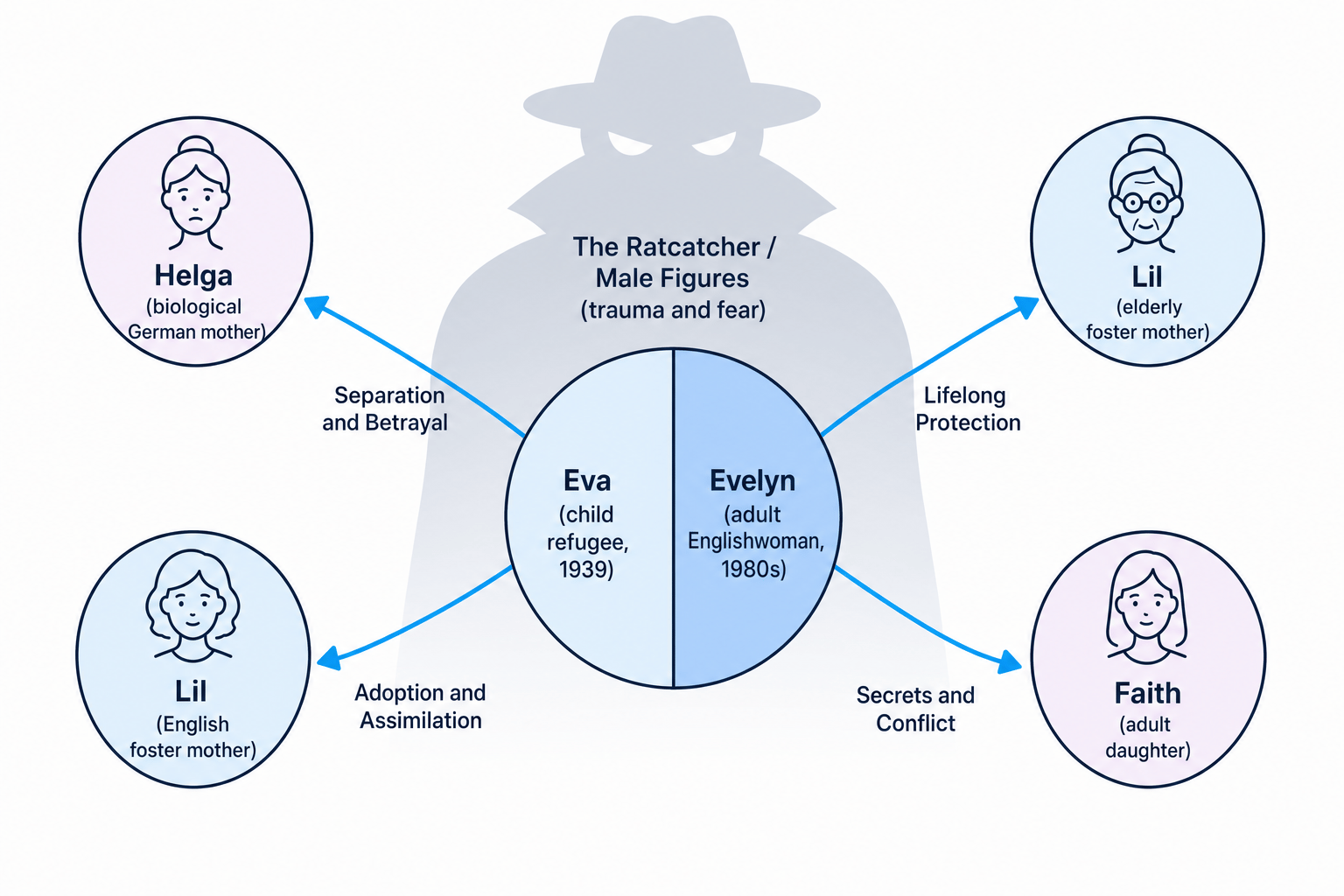
1. Eva and Evelyn: The Split Self
The most important dramatic technique Samuels uses is splitting the central protagonist into two characters played by two different actors: Eva (the young German Jewish child sent away on the Kindertransport) and Evelyn (the middle-aged, thoroughly assimilated Englishwoman living in the 1980s).
Dissociation
In psychological terms, dissociation is a mental process where a person disconnects from their thoughts, feelings, memories, or sense of identity to cope with severe trauma. Evelyn practices extreme dissociation by actively trying to "kill off" her past self, Eva.
Young Eva: The Trauma of Displacement
At the start of the play, Eva is a young, compliant German Jewish girl. Her journey is one of forced, rapid maturity and gradual cultural erasure:
- The Train Journey: Eva’s initial fears are tied to the storybook monster, the Ratcatcher. When she leaves Germany, her fear manifests in physical and linguistic displacement.
- Assimilation: In England, to survive and fit in, she must quickly discard her Jewish-German heritage. She stops speaking German and demands to be called "Jane" or "Evelyn". This is not a natural maturation, but a desperate survival mechanism.
- The Ultimate Betrayal: When her mother, Helga, survives the camps and comes to claim her after the war, Eva refuses to go with her. She perceives her mother's decision to send her away on the train as an act of rejection: "You threw me into a sea of strangers."
Adult Evelyn: The Fortified Wall
Evelyn is hyper-organized, obsessed with cleanliness, and deeply protective of her secrets. She has built a life designed to bury her childhood trauma:
- Obsessive Control: Evelyn’s obsession with scrubbing glasses and keeping her house pristine is a physical manifestation of her desire to "cleanse" her dirty, painful past.
- The Attack on Faith's Independence: Evelyn is overprotective of her daughter, Faith. She struggles to let Faith leave home because any form of separation triggers her deep-seated abandonment anxiety.
- The Breakthrough: When Faith discovers the old suitcase in the attic containing Eva’s papers, Evelyn’s carefully constructed facade collapses.
The Co-presence of past and present
By having both Eva and Evelyn on stage simultaneously—sometimes moving through the same physical space or speaking lines that mirror each other—Samuels shows that Evelyn can never truly escape Eva. The past is always physically and emotionally "present" on stage.
Treating Eva and Evelyn as separate people
Do not write about Eva and Evelyn as if they are two different characters who happen to have a strong connection. They are the same person at different stages of life. Your analysis must focus on how Samuels uses this split staging to show the fragmentation of a single traumatised psyche.
2. Mother-Daughter Dynasties
The play contains three distinct mother-daughter dyads, representing the transmission of trauma, guilt, and love across generations.
Helga and Eva: Separation as Betrayal
Helga is Eva’s biological mother. She represents the tragic self-sacrifice of Jewish parents who sent their children away to save their lives.
- The Sewing Scene: Early on, Helga teaches Eva how to sew buttons onto her coat, hiding jewelry inside. This is a practical preparation for survival, but also a metaphor for the burden and secrets Helga is sewing into Eva's identity.
- Linguistic Separation: Helga calls Eva "meine Schlange" (my little snake). While meant as an endearment, it connects to the myth of the Ratcatcher and foreshadows Eva's eventual "betrayal" of her mother when she sheds her German identity.
- The Post-War Reunion: When Helga returns, she is a hollowed-out survivor of Auschwitz. She expects her daughter to return to her. However, Eva’s pain has hardened into resentment. The generational rift is irreparable.
Lil and Eva/Evelyn: Practical Love and Assimilation
Lil Miller, Eva's English foster mother, is pragmatic, warm-hearted, and uncomplicated.
- A New Life: Lil provides Eva with physical safety and a stable, albeit culturally alien, home. She helps Eva learn English and encourages her assimilation because she believes it is in the child's best interest.
- Complicity in Silence: Lil becomes an accomplice in Evelyn’s self-reinvention. By helping Evelyn hide her documents in the attic and keeping the secret from Faith, Lil helps build the wall of denial that eventually damages the family.
Evelyn and Faith: The Legacy of Secrets
Faith represents the third generation. She has grown up feeling an unexplained, oppressive anxiety in her household, which she finally understands when she uncovers her mother’s hidden past.
- The Attic as a Mind: The attic where Faith finds the suitcase represents Evelyn’s subconscious. It is a locked container of repressed memories.
- The Climax: Faith’s discovery leads to a fierce confrontation. Faith is furious at being denied her heritage, shouting: "I have a right to know my background!"
3. The Shadow of the Ratcatcher and the Male Figures
An essential theatrical aspect of Kindertransport is that one actor plays all the male roles in the play:
- The Ratcatcher (the mythical shadow-man from the German storybook)
- Der Postorganisator (The German postal organizer who checks Eva's papers)
- The English Station Officer (who processes Eva on arrival)
- The Border Control Officer (Grenzer)
- The English Post Organiser
Double-casting as a dramatic device
In your exam, always link the form of the play to its meaning. The double-casting of the male roles is a deliberate choice by Samuels to show how Eva/Evelyn perceives the world. To her, all authority figures and change-agents are versions of the same menacing threat.
The Ratcatcher as a Symbol of Trauma
The Ratcatcher is a terrifying German fairy-tale figure (based on the Pied Piper of Hamelin) who abducts children when their parents fail to pay him.
- The Internalised Threat: The Ratcatcher represents the fear of separation, death, and the unknown. He looms over Eva as she boards the train, but he also lives inside adult Evelyn as her internalised trauma.
- The Hooked Fingers: The recurring motif of the Ratcatcher's "hooks for fingers" represents the inescapable grasp of the past.
Worked Example: Analysing a Character's Language
Let's look at how to construct a top-tier paragraph analyzing Evelyn's psychological state during her climax in Act 2, Scene 2.
Analysing Evelyn's trauma through symbolic language
Prompt: How does Samuels use language to present Evelyn’s psychological trauma in Act 2, Scene 2?
- Point (Conceptual Focus): Samuels uses highly charged symbolic language and frantic syntax to present Evelyn as a character who is utterly consumed by her repressed childhood trauma, demonstrating that her past identity cannot be kept buried.
- Evidence (Textual Reference): During her confrontation with Faith and Lil, Evelyn breaks down, crying out: "He’s got hooks for fingers... He is inside me... The Ratcatcher... I can’t let go of it. It’s too heavy."
- Method (Analysis of Language and Structure): The metaphor of the Ratcatcher having "hooks for fingers" highlights the inescapable, painful grip of her past. By declaring "He is inside me", Evelyn shifts the Ratcatcher from an external fairytale monster to an internalised psychological demon. The fragmented syntax and short sentences reveal her loss of control, directly contrasting with her typical highly controlled, articulate demeanor.
- Effect and Context (AO4/AO2 Link): Through this linguistic breakdown, Samuels illustrates the psychological cost of the Kindertransport on its survivors. While the children were physically saved from the Holocaust, they were left with a permanent, internalised fear of abandonment and death. The "heavy" burden she cannot let go of is her survivor’s guilt, showing that assimilation could never fully heal her wounds.
Exam Strategy & Pitfalls
Do not forget it is a play
In an open-book exam, it is easy to treat the play like a novel. Always refer to "the audience" rather than "the reader," and discuss "stage directions," "staging," and "casting choices" alongside language.
In the exam
- Focus on Staging and Structure: When writing about Eva/Evelyn, comment on the split-stage. Mention how the visual of young Eva playing on one side of the stage while adult Evelyn cleans on the other creates dramatic irony and highlights the constant presence of trauma.
- Weave Context (AO4) Naturally: Do not just dump historical facts about the Kindertransport. Instead, connect the historical reality (the requirement of assimilation, the loss of entire families in the death camps) directly to the characters' behavior (Evelyn's insistence on being English, Helga's skeletal appearance and psychological distance upon her return).
- Analyse the Symbolic Male Figures: If a question on identity, fear, or conflict arises, write a paragraph on the multi-role male actor. Showing the examiner that you understand this non-naturalistic dramatic technique will instantly elevate your mark for AO2.
Check Yourself
Check yourself
- Why did young Eva decide to change her name to Evelyn and reject her German identity?
- What does the suitcase in the attic symbolize, and how does its discovery drive the plot?
- How does the double-casting of the male roles affect the audience’s understanding of Eva's experiences?