What you'll learn
- The main events of Kindertransport in clear chronological order.
- How Diane Samuels uses two time periods at once: Eva’s past and Faith’s present.
- Why the plot is not just a rescue story, but a story about hidden identity and inherited pain.
- How to turn plot knowledge into useful Edexcel Component 2 analysis.
First: plot is more than “what happens”
Plot
Plot means the way a writer arranges events for the audience. It is not only the storyline; it is also the order, pace, contrasts, secrets and revelations the writer chooses.
In Kindertransport, the basic story is about a Jewish German child, Eva Schlesinger, who is sent to England to escape Nazi persecution and later becomes Evelyn. But Samuels does not tell that story in a simple straight line.
Instead, the play moves between Eva’s childhood and Evelyn’s adult life. The audience gradually discovers how the child “Eva” became the adult “Evelyn”, and why Evelyn has hidden that past from her daughter, Faith.
The main plot movement
The play moves from concealment to exposure: Evelyn has buried her past, but Faith’s discovery forces the hidden story of “Eva Schlesinger” back into the open.
The historical starting point
Kindertransport
The Kindertransport was a rescue operation between 1938 and 1939 which brought about 10,000 mostly Jewish children from Nazi-controlled Europe to Britain. Most travelled without their parents.
Samuels uses this real historical background, but the play focuses on one fictional child’s emotional experience. Eva is saved physically, but the plot asks what that survival costs her psychologically: language, family, religion, name and memory all become unstable.
The title therefore has two meanings. It refers to the historical rescue trains, but it also suggests a lifelong “transporting” of trauma from one generation to the next: from Helga to Eva/Evelyn, and then to Faith.
Two interwoven time strands
Kindertransport has a non-linear structure, which means the events are not presented in simple chronological order. Samuels cuts between the past and the present, so the audience sees how earlier events shape later family conflict.
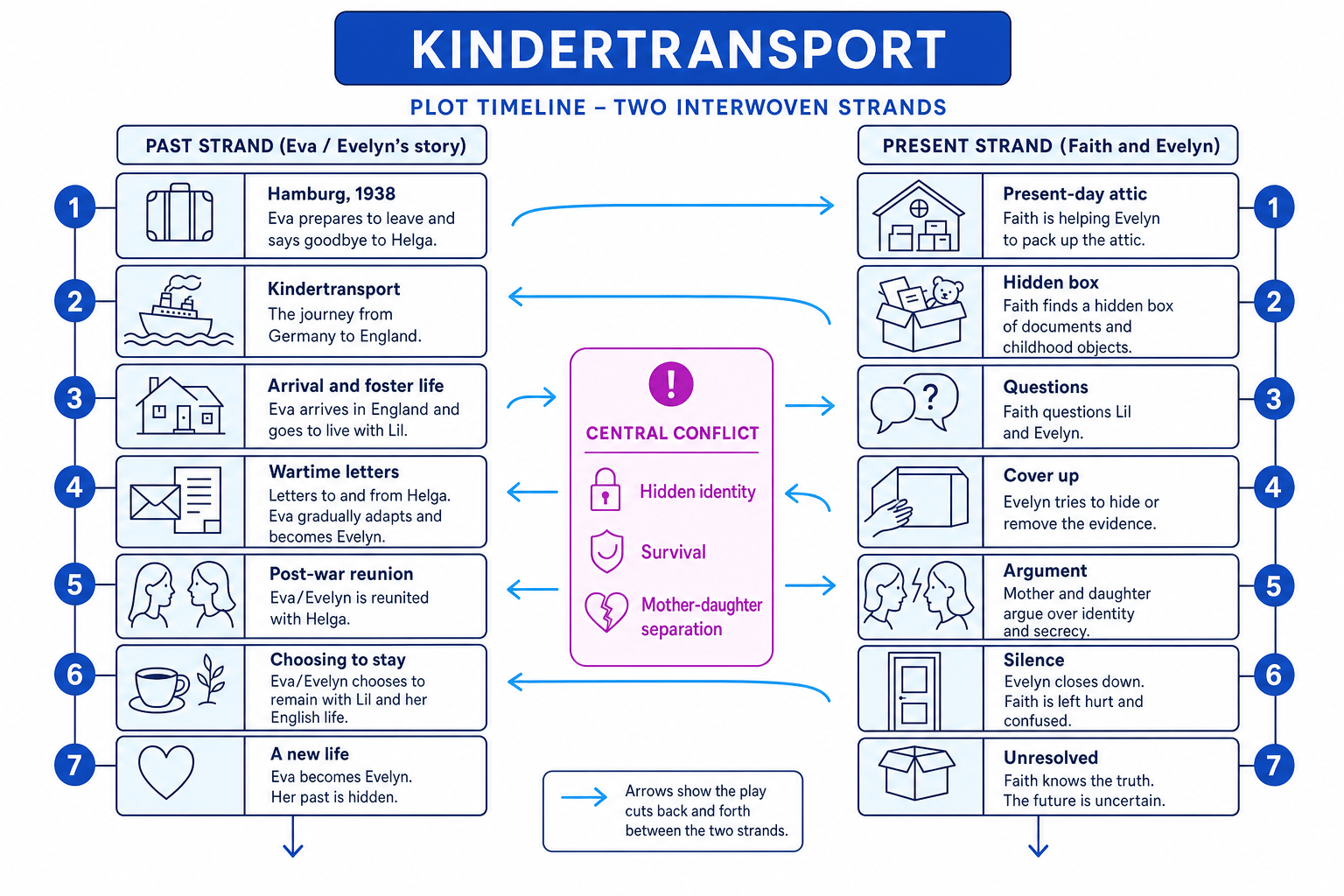
The present-day strand centres on Faith helping Evelyn sort through stored possessions. A hidden box of documents and childhood objects leads Faith towards the truth. The past strand shows Eva’s journey from Germany to England, her life with Lil, and her painful post-war reunion with Helga.
This structure matters because the past is not treated as “finished”. It keeps interrupting the present.
Linking the hidden box to structure
-
Identify the plot event: Faith finds hidden evidence connected to “Eva Schlesinger”, a name she has not been taught to connect with her mother.
-
Connect it to Samuels’ method: The box works as a stage prop, meaning a physical object used in performance. It triggers the play’s movement between present-day questioning and past memories.
-
Explain the effect: The audience sees that Evelyn’s past has not disappeared; it has only been stored away. The discovery turns private trauma into open family conflict.
The chronological story, step by step
If you “straighten out” the story, the plot runs like this.
1. Eva prepares to leave Germany
Eva Schlesinger is a Jewish child in Hamburg during Nazi persecution. Her mother, Helga, prepares her to leave on the Kindertransport. This is an act of love, but to Eva it feels like abandonment and terror.
The repeated figure of the “Ratcatcher” enters Eva’s imagination through the fairy-tale world of the Pied Piper. He becomes linked with fear, threat and the adults who control children’s lives.
2. Eva travels to England
Eva leaves Germany without her mother. The journey saves her life, but Samuels presents it as frightening and isolating. Eva is a child being pushed into adult danger before she can understand it.
This is important: the Kindertransport is not presented as a neat happy ending. It is the beginning of Eva’s survival, but also the beginning of her separation from her first family and identity.
3. Eva begins life with Lil
In England, Eva goes to live with Lil, who becomes her foster mother. Their relationship is practical, imperfect and deeply important. Lil gives Eva food, shelter and emotional protection.
There are cultural and language differences. Eva must learn English habits, English speech and English ways of behaving. These details show that survival involves adaptation, not just arrival.
Assimilation
Assimilation means adapting to a new culture until you appear to belong within it. In the play, Eva’s assimilation into English life protects her, but it also helps bury parts of her original identity.
4. Eva gradually becomes Evelyn
As time passes, Eva changes. The shift from “Eva” to “Evelyn” is one of the clearest plot markers in the play. It is not just a new name; it signals a new identity built around Englishness, safety and emotional self-protection.
Letters and memories connect Eva to Helga, but the longer Eva remains in England, the harder it becomes to return to the child she was. Samuels shows identity as something shaped by pressure, fear and loss.
5. Helga returns after the war
The post-war reunion with Helga is one of the play’s key turning points. You might expect reunion to repair the separation, but Samuels makes it painful. Helga wants connection with her daughter, while Eva/Evelyn has already built a new life with Lil.
The conflict is not simply “good mother versus bad mother”. Helga sent Eva away to save her; Lil cared for Eva when Helga could not; Eva/Evelyn survives by refusing to go back emotionally.
Why the reunion with Helga is a climax
-
Compare Eva’s situation before the reunion: She has survived by becoming Evelyn and attaching herself to Lil’s English home, so Helga’s return threatens the identity that has kept her safe.
-
Read the name conflict carefully: The contrast between “Eva” and “Evelyn” makes the inner conflict visible on stage: one name belongs to the lost German-Jewish child, the other to the adult survivor.
-
Link it to the wider structure: Eva/Evelyn’s choice to remain with Lil does not end the story; it creates the secret that later damages her relationship with Faith.
6. Faith discovers the hidden past
In the present-day plot, Faith discovers that her mother has concealed a major part of her life. This discovery changes Faith’s understanding of her family history and of herself.
Evelyn tries to avoid, control or remove the evidence. Her reaction shows that the past is still painful and threatening to her. Faith, however, wants truth. The mother-daughter conflict in the present mirrors the earlier mother-daughter conflict between Helga and Eva.
7. The ending remains unresolved
The play does not end with a neat reconciliation. Faith knows more than she did before, but knowledge does not automatically heal the family. Evelyn’s silence and pain remain powerful.
This unresolved ending is important. Samuels suggests that trauma can survive across decades, especially when it is hidden rather than spoken about.
Why the plot feels tense
Motif
A motif is a repeated image, object or figure that gathers meaning each time it appears. In Kindertransport, the “Ratcatcher”, the hidden box and the name change from “Eva” to “Evelyn” all work as motifs.
Samuels creates tension by delaying full revelation. Faith discovers fragments first: objects, names, documents and half-answers. The audience pieces the story together with her.
The play also uses parallel scenes, where two situations echo each other. Helga losing Eva in the past is echoed by Evelyn’s fear of losing control over Faith in the present. This makes the plot feel tightly connected rather than random.
| Plot moment | Why it matters | Method to mention |
|---|---|---|
| Eva leaves Germany | Survival begins with separation | historical setting; stage tension |
| Eva lives with Lil | Safety brings cultural change | dialogue; contrast; domestic setting |
| Eva becomes Evelyn | Identity is reshaped by trauma | naming motif; structure |
| Helga returns | Reunion becomes conflict, not healing | climax; parallel mother-daughter conflict |
| Faith finds the box | The hidden past enters the present | prop; revelation; non-linear structure |
| The ending stays unresolved | Trauma is not easily closed | open ending; cyclical effect |
Treating it as a simple rescue story
Do not summarise the play as “Eva escapes and is safe”. A stronger reading sees that rescue and loss happen together: Eva survives, but Evelyn spends her adult life hiding the cost of that survival.
Using plot knowledge in your Edexcel answer
For Edexcel International GCSE English Literature, Kindertransport appears in Component 2 Section A: Modern Drama. This is open book, so you will have a clean copy of the play in the exam. However, you still need strong plot knowledge so that you can find the right moments quickly.
Good plot summary supports AO1, because it shows secure knowledge of the text. But you should always move beyond retelling. To reach stronger analysis, connect plot moments to AO2: Samuels’ structure, stagecraft, motifs and contrasts.
A useful sentence shape is:
At this point in the play, Samuels shows… This matters because… Structurally, it links to…
For example, instead of writing, “Faith finds a box and argues with Evelyn,” you could write: “Faith’s discovery of the hidden box turns Evelyn’s private past into a public family crisis, allowing Samuels to connect the present-day domestic setting with Eva’s traumatic childhood.”
Quick plot memory chain
Remember the plot as a chain of consequences: separation → survival → assimilation → rejection → secrecy → discovery → unresolved conflict.
In the exam
-
Choose two or three plot moments that answer the question, rather than retelling the whole play.
-
Use your clean copy to find short, exact references quickly, especially around names, objects and confrontations.
-
Always link “what happens” to “how Samuels presents it”: structure, motifs, stage props, parallels and the open ending.
Check yourself
- What does Faith discover, and why does it change her understanding of Evelyn?
- Why is Helga’s return after the war a turning point rather than a simple happy reunion?
- How does the shift from “Eva” to “Evelyn” shape the whole plot?