Writing an outstanding essay on Diane Samuels’ Kindertransport for your Edexcel IGCSE English Literature exam requires more than just knowing what happens in the play. Because Component 2, Section A is an open-book exam, examiners are not looking for simple plot recall. Instead, they want to see a sophisticated, critical exploration of how Samuels uses the unique mechanics of theatre—language, stagecraft, and structure—to convey her themes.
This guide will show you how to construct high-scoring essays that balance close textual analysis with a deep understanding of dramatic form.
What you'll learn
- How to balance the specific Assessment Objectives (AO1 and AO2) required for Modern Drama.
- How to analyze the play's unique dual-timeline structure and expressionistic devices.
- How to transform a basic point into a top-band analytical paragraph using a step-by-step method.
Understanding the Exam Requirements
Before putting pen to paper, you must understand exactly how you are being marked. For Component 2, Section A (Modern Drama), your essay is assessed on two key Assessment Objectives:
- AO1: Demonstrate a close knowledge and understanding of the text, maintaining a critical style and presenting an informed personal response with precise textual references.
- AO2: Analyze how language, form, and structure are used by the writer to create meanings and effects, using correct literary and dramatic terminology.
The Context Trap
Unlike other areas of your IGCSE, AO4 (Context) is not assessed in the Modern Drama section. While historical knowledge of the Kindertransport is useful background, do not waste precious exam time writing "history essays" about World War II. Every point you make must focus strictly on how Samuels presents these ideas on stage (AO1) and the dramatic methods she uses to do so (AO2).
The Engine of the Play: Analyzing Structure and Form
To achieve the highest marks in AO2, you must write about Kindertransport as a piece of live theatre, not just a book of words. The most powerful way to do this is to analyze Samuels' use of form and structure.
Samuels abandons a simple chronological narrative in favor of a complex, non-linear design. The play features two parallel worlds existing on the stage at the same time: pre-war Germany/wartime Britain (featuring young Eva) and 1980s England (featuring adult Evelyn and her daughter Faith).
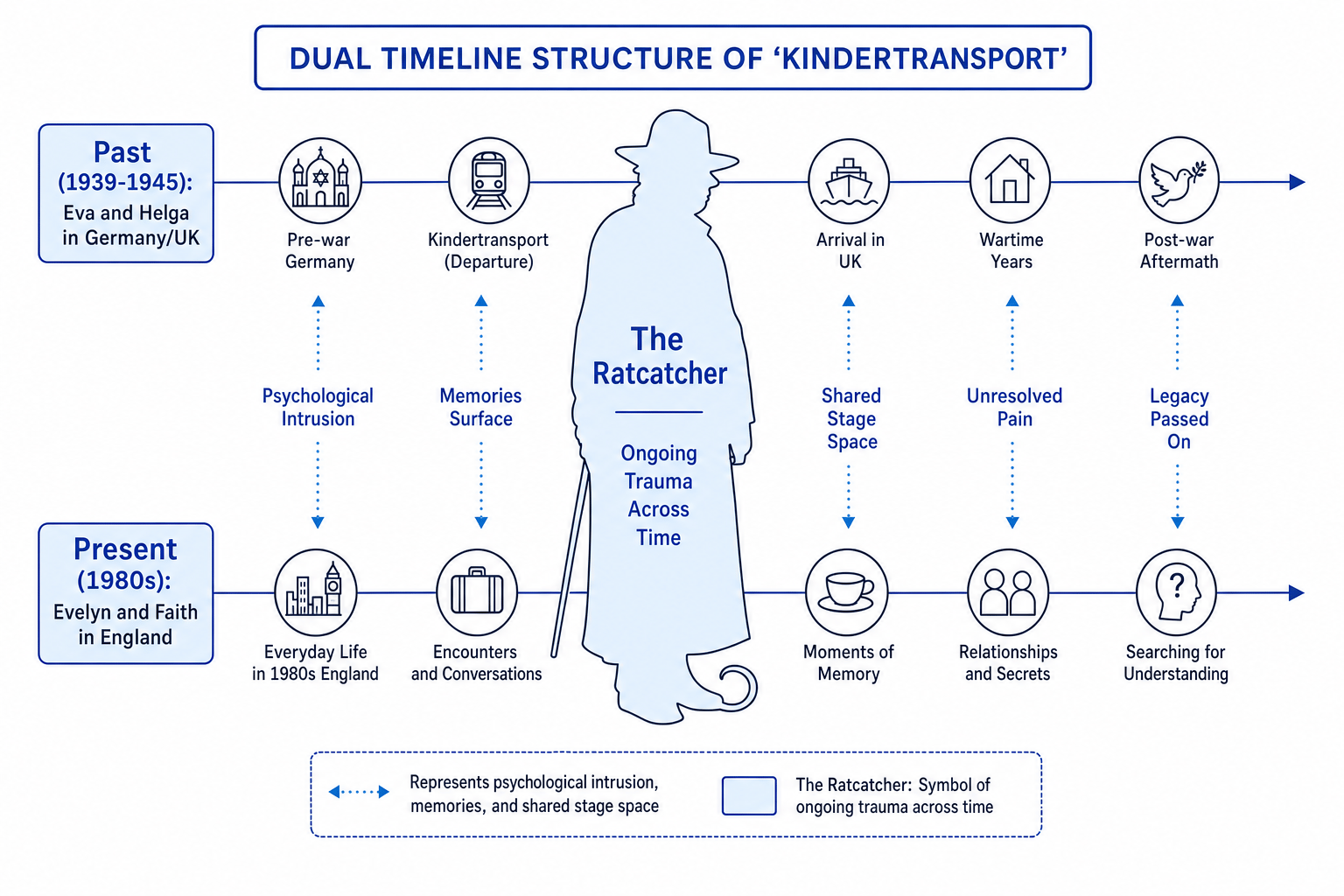
This visual mapping illustrates how Samuels structured the play to show that the past is never truly in the past. The physical stage space is shared, allowing memories to literally "bleed" into the present day.
Expressionism
Expressionism is a dramatic style where a playwright presents the internal, subjective psychological state of a character on stage through external, highly stylized theatrical elements rather than realistic action.
In Kindertransport, the most prominent expressionistic device is The Ratcatcher (Der Rattenfänger). He is not a real person; he is a shadow, a fairy-tale monster, a German station guard, and an English postman. He represents the terrifying, inescapable psychological trauma of abandonment that haunts Evelyn throughout her life.
Stagecraft as Structure
When writing about structure, do not just say "the play moves between past and present." Instead, analyze how Samuels uses transitional stage directions (such as lighting shifts, overlapping dialogue, or physical props like the suitcase) to demonstrate that Evelyn's trauma is actively intruding on her present-day reality.
Crafting an Analytical Paragraph
A top-grade essay does not list literary devices; it weaves analysis naturally into a clear argument. Every paragraph should follow a logical progression:
- Thesis / Point: A clear thematic statement that directly answers the essay prompt.
- Evidence: A integrated, precise quotation or a specific reference to a stage direction.
- Method (AO2): Identification of the dramatic, linguistic, or structural device Samuels uses.
- Effect & Analysis (AO2): Deep analysis of how this method works, what it tells us about the character's psychology, and how it impacts the audience.
- Synthesis / Link: A concluding sentence connecting the analysis back to your overall thesis.
Upgrading an analytical paragraph
This example walks through how to transform a basic, plot-heavy response into a sophisticated, high-level analysis of Evelyn's psychological trauma.
Basic Student Paragraph (Level 2/3): "Samuels shows that Evelyn is still traumatized by her past because she is obsessed with cleaning. She does not want her daughter Faith to find her old things in the attic. When Faith looks through the boxes, Evelyn gets very defensive. This shows she is trying to wipe away her past identity as Eva."
Let's upgrade this to a top-band (Level 5) analytical paragraph by focusing on dramatic form and terminology:
-
Formulate a thematic point (AO1): Start by framing Evelyn's cleaning not just as an "obsession," but as a desperate survival mechanism of self-erasure.
Drafting: "Samuels presents Evelyn's obsessive domestic order not merely as a personality trait, but as a pathological defense mechanism designed to suppress the chaotic trauma of her past."
-
Integrate precise, functional evidence: Instead of just summarizing the action, weave in a short, powerful quotation or stage direction.
Drafting: "This is manifested in her physical actions on stage, particularly her compulsive need to polish glass and 'wipe' away imaginary dirt, culminating in her declaration to Faith that 'the past is a old coat' that must be discarded."
-
Identify and analyze the writer's methods (AO2): Focus on the symbolic meaning of these actions and the metaphor used in the dialogue.
Drafting: "Here, Samuels utilizes the domestic setting of the attic as a spatial metaphor for Evelyn's subconscious mind, where her repressed memories are literally boxed up. The metaphor of the 'old coat' highlights her futile attempt to treat her identity as something disposable. Her obsessive cleaning becomes a physical ritual of erasure—by wiping down the physical world around her, she attempts to cleanse her internal psyche of the guilt of survival."
-
Examine the dramatic impact on the audience: Explain how the split-timeline structure enhances this effect.
Drafting: "This psychological desperation is heightened for the audience through the structural juxtaposition of the dual timelines. As adult Evelyn frantically tries to maintain order in the present, the audience simultaneously witnesses young Eva's world unraveling in the past, creating a poignant dramatic irony. We realize, even if Evelyn cannot admit it, that her meticulous order is a fragile shield against the terrifying, chaotic figure of the Ratcatcher."
Quotation Integration
Always keep your quotations short and grammatically integrated into your own sentences. Instead of writing: Helga says, "You must be brave." This shows..., write: Helga's command that young Eva "must be brave" instantly shifts the maternal dynamic from protection to pragmatism...
In the exam
To ensure your essay reaches the highest bands on exam day, use this checklist as you plan and write:
- Spend 5 minutes planning: Do not just start writing. Write down a brief outline of your 3–4 main arguments and note down which key scenes, structural devices, and quotations you will use for each.
- Structure by theme, not chronology: Do not write "retelling" essays that start at Act 1 and end at Act 2. Instead, structure your paragraphs around thematic ideas (e.g., Paragraph 1: Maternal abandonment; Paragraph 2: Physical symbols of trauma; Paragraph 3: The cyclical nature of guilt).
- Use the text in your hands: Because it is an open-book exam, take a moment to look up the exact wording of stage directions. Analyzing Samuels' stage directions (colors, sounds, lighting, movement) is one of the easiest ways to secure high marks for AO2.
- Anchor your analysis to the audience: Remember that a play is meant to be performed. Regularly use phrases like "Samuels makes the audience feel...", "This structural juxtaposition creates dramatic irony for the spectator...", or "The auditory motif of the train whistle evokes a sense of panic in the theatre..."
Check yourself
Use these questions to self-assess your analytical skills before writing your next essay:
- Can you identify three distinct moments in the play where the past and present timelines directly overlap, and explain the dramatic effect of these overlaps?
- How does Samuels use physical objects—such as the toy train, the jewelry, the suitcase, or the book of Der Rattenfänger—as symbolic shorthand for Evelyn's trauma?
- If asked a question on the relationship between mothers and daughters, how would you compare Helga and Eva's relationship with Evelyn and Faith's relationship?