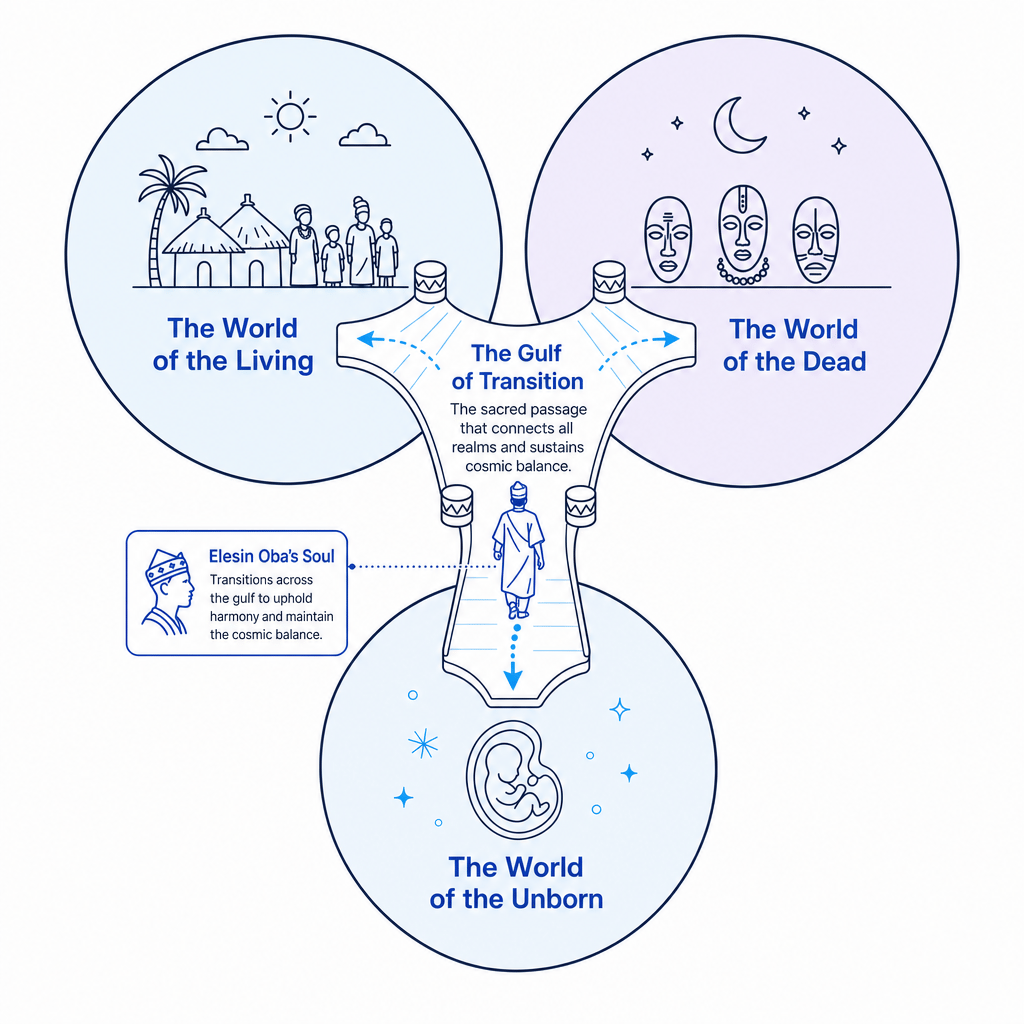
The Structural Design: Contrast and Juxtaposition
Soyinka structures the play brilliantly. Rather than a linear, single-setting drama, he uses spatial and cultural juxtaposition to highlight the profound division between the two worlds. The play is divided into five scenes that alternate between the vibrant Yoruba community and the clinical, superficial British colonial world.
The Five-Scene Structure
- Scene One (Yoruba World): Set in the bustling Oba market. We meet Elesin Oba, surrounded by praise-singers and market women. The scene is filled with poetry, music, rich Yoruba proverbs, and drumming. It establishes Elesin's vitality, his connection to the community, and his ultimate spiritual duty.
- Scene Two (Colonial World): Set on the veranda of the British District Officer's bungalow. We meet Simon and Jane Pilkings. They are playing tango music on a gramophone and wearing confiscated Yoruba sacred egungun masquerade costumes as fancy dress. The contrast in sound, language, and respect for the sacred is immediate and jarring.
- Scene Three (Yoruba World): Back in the market. Elesin enters a deep, hypnotic trance as he begins his transition to the spirit world. The language reaches its highest poetic heights through the Olesee (the ritual chant).
- Scene Four (Colonial World): Set at the local British Residency during a masquerade ball held in honour of the visiting Prince of Wales. This scene features Olunde, Elesin's eldest son, who has returned from medical school in England. Olunde’s sharp, intellectual debate with Jane Pilkings exposes the hypocrisy of Western "civilisation".
- Scene Five (The Clashing Convergence): Set in a makeshift prison cell at the Residency. Elesin has been arrested by Pilkings, stopping the ritual. The community is devastated. The climax occurs when Olunde sacrifices himself in his father's place to save the cosmic balance, leaving Elesin to commit a desperate, un-ritualistic suicide in his chains out of sheer grief and shame.
Structural Juxtaposition
By constantly swinging the audience between the sensory, spiritually rich Yoruba market and the sterile, culturally tone-deaf British residency, Soyinka structures the play to make the colonial intervention feel like an unnatural, violent interruption of a sacred, organic process.
Understanding the Tragedy: It's Not Just a "Clash of Cultures"
A common mistake made by many students is summarizing the play as a simple story of "white colonisers vs. native Africans." Soyinka himself strongly warned against this in his famous Author's Note, stating that such a reading is "facile" (simplistic) and reduces a profound metaphysical drama to a mere historical dispute.
To gain top marks in your IGCSE exam, you must look deeper. The tragedy is not just caused by Simon Pilkings' intervention; it is also caused by Elesin’s own internal weakness.
Elesin's Hamartia
In classical tragedy, a hero's downfall is driven by their hamartia (a fatal flaw). Elesin is a man who loves the physical world too much. He is deeply attached to the pleasures of the flesh: beautiful clothes, rich food, and women.
Hamartia
A Greek tragedy term referring to the protagonist's fatal flaw or error in judgment that leads directly to their tragic downfall.
Even on the night he is supposed to die, Elesin insists on marrying a young, beautiful girl he spots in the market (the Fiancée), consummating the marriage just hours before his scheduled transition. By binding himself so tightly to the world of the living at the very moment he should be letting it go, Elesin weakens his spiritual resolve. This hesitation makes him vulnerable to Pilkings’ physical arrest. He blames the white colonialist, but Iyaloja (the mother of the market) reminds him that his own feet "were held in a world of clay."
Over-simplifying the conflict
Do not write that Simon Pilkings is the sole villain of the play. While Pilkings is culturally insensitive, patronising, and arrogant, Elesin's own earthly desires and hesitation play an equal, if not greater, role in his failure to complete the ritual. Soyinka's tragedy is metaphysical and internal, not just political.
Applying Your Knowledge: Writing an Analytical Paragraph
When writing about Death and the King's Horseman, you must balance close language analysis (AO2) with an understanding of ideas, themes, and dramatic context (AO1).
Let's look at a step-by-step example of how to build an analytical paragraph in response to a typical IGCSE question.
Analysing dramatic juxtaposition in Scene Two
Question: Explore how Soyinka presents the contrast between Yoruba and British attitudes to the sacred in Scene Two.
Here is how you should construct your response:
- Formulate a precise, thesis-driven point: State how the contrast is established through physical action and dramatic irony.
- Drafting: "In Scene Two, Soyinka uses dramatic irony and offensive physical action to highlight the British colonial administration's complete lack of spiritual sensitivity compared to the Yoruba reverence for the sacred."
- Introduce and integrate precise textual evidence: Select a key moment where the physical props reflect this clash.
- Drafting: "This is visually represented when Simon and Jane Pilkings choose to wear the confiscated egungun costumes as 'fancy dress' for a social ball. When the native police officer, Amusa, is visibly shocked, Pilkings dismisses his terror, telling him to stop being 'superstitious' and demanding, 'What is this rubbish?'"
- Perform close language and dramatic analysis (AO2): Deconstruct the key words and dramatic choices.
- Drafting: "The term 'fancy dress' reduces a sacred garment designed to channel ancestor spirits to a mere costume, revealing the superficiality of the colonial mindset. Furthermore, the noun 'rubbish' demonstrates Pilkings’ aggressive refusal to understand the local faith. The dramatic irony lies in the fact that while Pilkings believes he is demonstrating rational, modern superiority, the audience recognizes that his sacrilegious actions are paving the way for a cosmic catastrophe."
- Link to structural and thematic context (AO1): Connect this specific moment to the broader themes of the play.
- Drafting: "This local insensitivity mirrors the broader colonial project, which attempts to overwrite indigenous spiritual systems with administrative laws. By presenting the British characters as spiritually blind and reliant on administrative force, Soyinka structurally prepares the audience for the tragic collision in the final scenes of the play."
In the exam
Since this is an open-book exam, use these strategies to maximise your marks:
- Do not waste time reading large chunks of the play. You should know the text well enough to flip directly to the scene you need. Tab your book beforehand (if permitted by your center's exam regulations) or memorise key scene locations.
- Focus on stage directions. Soyinka’s stage directions are incredibly detailed, particularly regarding music, drumming, and costumes. They are rich with literary devices and are just as valuable to analyze as the dialogue.
- Analyse the poetry vs. the prose. Notice how the Yoruba characters speak in rich, poetic proverbs (metaphors, animal imagery, call-and-response), while the British characters speak in flat, administrative, or colloquial prose. Pointing out this linguistic contrast is a fantastic way to secure high AO2 marks. </1. … 2. … 3. …>
Check yourself
Before moving on to the detailed Character or Theme sections, make sure you can answer these foundational questions:
- What is the spiritual purpose of Elesin's ritual suicide, and why is it vital to the Yoruba people of Oyo?
- Why did Wole Soyinka warn readers against viewing the play simply as a "clash of cultures"?
- How does the physical contrast between the Market (Scenes One and Three) and the Residency/Bungalow (Scenes Two and Four) reinforce the play's themes?