What you'll learn
- How to build a clear essay plan for Diane Samuels’ Kindertransport.
- How to turn a question into a sharp argument, not just a list of moments.
- How to organise paragraphs around dramatic methods such as structure, motif, symbolism and dialogue.
- How to use the open-book exam wisely without wasting time hunting for quotations.
Why essay plans matter for Kindertransport
In Edexcel IGCSE English Literature, Kindertransport appears in Component 2: Modern Drama, which is open book. That means you may use a clean copy of the play, but it does not mean you have time to search randomly through the text.
A strong essay plan helps you decide:
- what your overall argument is
- which scenes you will use
- which short quotations you will embed
- which dramatic methods Samuels uses
- how each paragraph links back to the question
Essay plan
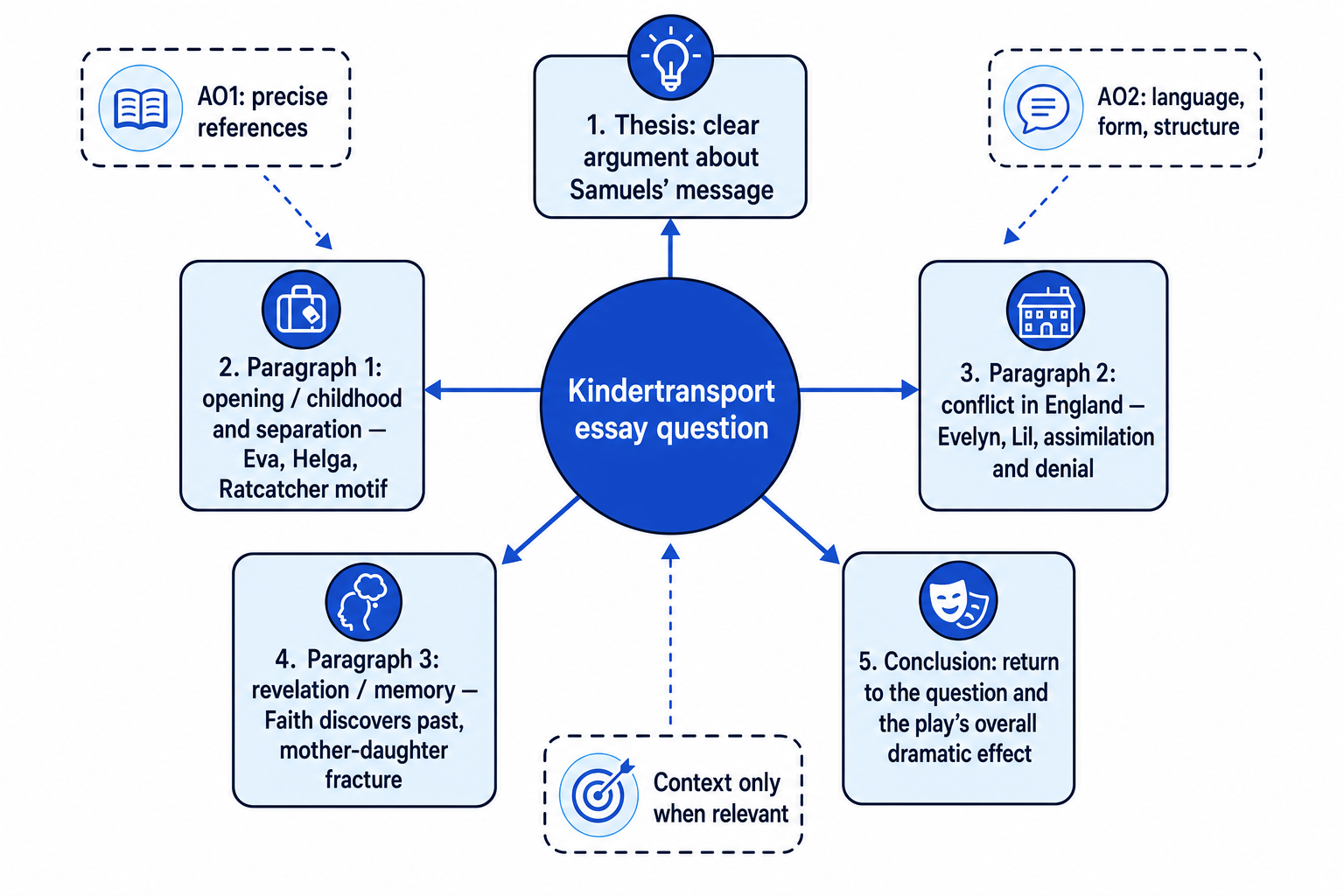
An essay plan is a short outline of your argument before you write. It usually includes a thesis, three main paragraph ideas, key references or quotations, and a final link back to the question.
A good plan acts like a route map: it stops you retelling the story and keeps every paragraph moving towards your answer.
Start with the question, not the plot
Many Kindertransport essays ask you to explore how Samuels presents an idea, character or relationship. Common focus areas include:
- identity
- memory and the past
- mothers and daughters
- trauma
- the Ratcatcher
- belonging and displacement
- secrets and discovery
The key is to avoid writing everything you know. You are not being rewarded for summarising the whole play. You are being rewarded for a focused, personal response supported by close textual reference.
Thesis
A thesis is your main argument in one or two sentences. It answers the question directly and gives your essay a clear direction.
For Kindertransport, a strong thesis often notices that Samuels presents characters as emotionally divided. Eva/Evelyn is not simply “saved” by the Kindertransport; she survives, but survival comes with loss, secrecy and damage.
Turning a question into a thesis
Question: Explore how Samuels presents identity in Kindertransport.
-
Decide the key tension in the question. Identity in the play is not stable: Eva becomes Evelyn, German-Jewish childhood is replaced by English adulthood, and the past returns through Faith’s discoveries.
-
Choose a precise argument. Instead of saying “identity is important”, argue that Samuels presents identity as something reshaped by trauma and pressure.
-
Add a dramatic angle. The split between past and present on stage allows the audience to see Eva and Evelyn almost side by side, making her divided identity visible.
-
Shape the thesis: Samuels presents identity as fractured by displacement: Eva’s transformation into Evelyn allows her to survive in England, but the play’s non-linear structure shows that the rejected past continues to disturb her adult life.
Build paragraphs around methods
A method is a writer’s choice. In drama, this includes not only language, but also staging, structure, props, motifs, entrances, exits and overlapping scenes.
Dramatic method
A dramatic method is a technique used in a play to create meaning for an audience, such as dialogue, stage directions, symbolism, motif, contrast, dramatic irony or non-linear structure.
In Kindertransport, you should often write about how the play works on stage. For example:
- the attic setting allows hidden objects to reveal hidden history
- the split time frame connects Eva’s childhood with Evelyn’s adulthood
- the Ratcatcher appears as a recurring symbolic figure
- props such as letters, toys and documents carry memory
- the name change from “Eva” to “Evelyn” dramatises assimilation
Plan by method, not just event
A strong paragraph should not simply say what happens. It should explain how Samuels uses drama to make the audience think or feel something.
The basic three-paragraph plan
For most exam essays, three developed paragraphs are better than five rushed ones. Each paragraph should have a clear job.
A helpful structure is:
- Beginning / origin of the issue — how Samuels introduces the theme or relationship.
- Development / conflict — how the issue becomes more complicated.
- Revelation / consequence — what the audience finally understands.
This works especially well for Kindertransport because the play itself moves between past and present, gradually uncovering what Evelyn has tried to suppress.
Plan 1: Identity
Possible question: Explore how Samuels presents identity in Kindertransport.
Thesis
Samuels presents identity as something painfully divided by migration, trauma and secrecy. Eva’s transformation into Evelyn appears to offer safety, but the play shows that cutting off the past damages both Evelyn and Faith.
Paragraph 1: Eva’s original identity is tied to family, language and Jewish-German childhood
Use the early scenes between Eva and Helga. Eva begins as a child attached to her mother and home. Words such as “Mutti” are useful because they instantly show intimacy, childhood and German-Jewish identity.
Analyse how Samuels makes separation emotionally painful through domestic details: packing, clothing, food, documents and instructions. These ordinary objects make the historical crisis feel personal.
Paragraph 2: Evelyn’s English identity is a survival strategy
Move to adult Evelyn. Her new name, “Evelyn”, marks assimilation into English life. The contrast between “Eva” and “Evelyn” is one of the simplest and most powerful pieces of evidence in the play.
You could argue that Samuels uses the name change as a symbol of survival and self-erasure. Evelyn has built a respectable English life, but it depends on silence.
Paragraph 3: Faith’s discoveries show identity cannot be sealed away
Faith’s search through the attic reveals that identity passes between generations. The past is not only Evelyn’s private story; it affects Faith’s sense of who she is.
Link to structure: because the audience sees past and present together, Samuels suggests that identity is layered rather than linear. Eva has not disappeared; she remains inside Evelyn.
Writing a biography of Eva
Do not write a paragraph that simply tracks Eva becoming Evelyn. Keep asking: what is Samuels suggesting about identity, and how does the drama show it?
Plan 2: Mothers and daughters
Possible question: Explore how Samuels presents mother-daughter relationships in Kindertransport.
Thesis
Samuels presents mother-daughter love as intense but damaged by history. Helga’s decision to send Eva away is an act of protection, yet Eva/Evelyn experiences it as abandonment, and this unresolved pain shapes her relationship with Faith.
Paragraph 1: Helga’s love is practical and sacrificial
The packing scenes show Helga’s love through action rather than sentimental speech. She prepares Eva for survival. This makes the audience understand the cruelty of the historical situation: a mother protects her child by letting her go.
Use brief references to Helga’s instructions and Eva’s childlike dependence on “Mutti”. The contrast makes the separation painful.
Paragraph 2: Evelyn’s relationship with Helga becomes defined by resentment and silence
When Helga returns later, Evelyn cannot simply resume being Eva. Samuels presents reunion as emotionally complicated, not comforting. This challenges any simple idea that survival automatically heals trauma.
Analyse the structure: the adult confrontation gains power because the audience has already seen the earlier separation. We understand both women, which creates dramatic tension.
Paragraph 3: Evelyn repeats damage with Faith
Faith wants knowledge and openness, while Evelyn tries to control the past. Their conflict shows inherited trauma: Evelyn’s silence, meant to protect herself, harms her daughter.
The attic is important here. It becomes a physical symbol of buried memory. Faith’s discoveries force private history into the open.
Building a paragraph on mothers and daughters
-
Make a point that answers the question: Samuels shows Helga’s love as protective but painful because she must send Eva away to save her.
-
Select evidence from a relevant scene: use the early packing sequence, where Helga prepares Eva’s belongings and gives instructions for the journey.
-
Analyse the method: the domestic stage action makes political persecution visible through ordinary objects, so the audience sees history invading family life.
-
Explain the effect: this makes Helga’s motherhood tragic because her care looks, to Eva, like rejection.
-
Link back: therefore, Samuels presents mother-daughter love as powerful, but distorted by the pressures of Nazi persecution and exile.
Plan 3: The Ratcatcher
Possible question: Explore the significance of the Ratcatcher in Kindertransport.
Thesis
The Ratcatcher is a recurring motif through which Samuels dramatises Eva/Evelyn’s fear, guilt and trauma. He connects childhood imagination with historical horror, turning private memory into something theatrical and haunting.
Motif
A motif is a recurring image, object, phrase or idea that gains meaning each time it appears.
Paragraph 1: The Ratcatcher begins in childhood fear
The “Ratcatcher” comes from a children’s story, but Samuels makes it disturbing. Because Eva is young, fear enters through fairy-tale language and nightmare imagery.
This matters because the audience sees persecution partly through a child’s imagination. The historical threat becomes psychologically vivid.
Paragraph 2: The Ratcatcher symbolises predatory power
The Ratcatcher can be linked to forces that take children away: Nazi persecution, border officials, trains, and even the Kindertransport itself. He is not a simple one-to-one symbol. His meaning shifts.
Symbolism
Symbolism is when a person, object or image represents a larger idea. In drama, a symbol can appear visually on stage as well as through language.
This flexibility makes him frightening. He represents the feeling of being hunted, removed and powerless.
Paragraph 3: The Ratcatcher shows trauma returning
When the Ratcatcher reappears, Samuels suggests that Evelyn’s past has not been resolved. The motif makes memory theatrical: trauma walks back onto the stage.
Link to AO2 by discussing staging. The audience does not only hear about fear; they see it embodied.
Writing about the Ratcatcher
Avoid saying “the Ratcatcher equals Hitler” and stopping there. It is stronger to say he is a shifting symbol of fear, separation and traumatic memory.
Planning introductions and conclusions
Your introduction should be short. Do not begin with a biography of Diane Samuels or a long history of the Kindertransport.
A good introduction should include:
- the name of the writer and text
- a direct answer to the question
- a hint of your main argument
For example:
In Kindertransport, Diane Samuels presents memory as both necessary and painful. Through the contrast between Eva’s childhood and Evelyn’s adulthood, Samuels shows that the past can be suppressed but not destroyed.
Your conclusion should not repeat every paragraph. Instead, return to Samuels’ overall message and the audience’s final understanding.
Context
Context means the relevant circumstances surrounding a text, such as historical events, social attitudes or the writer’s dramatic purpose. For Kindertransport, context includes Nazi persecution of Jewish families, the Kindertransport rescue programme, exile and post-war memory.
Use context carefully. The exam rewards you for linking context to interpretation, not for adding a history paragraph.
Bolting on context
Do not write: “The Kindertransport happened in 1938 and 1939” and leave it there. Instead, connect context to meaning: Samuels shows that being rescued from Nazi persecution could still involve grief, displacement and lasting trauma.
A quick planning grid
Before you write, spend a few minutes making a grid like this:
| Paragraph | Main idea | Scene / evidence | Method | Link to question |
|---|---|---|---|---|
| 1 | Introduces the issue | Early Eva and Helga scenes | Dialogue, props, stage action | Shows separation beginning |
| 2 | Develops conflict | Evelyn in England / conflict with past | Contrast, name change, structure | Shows survival and denial |
| 3 | Reveals consequence | Faith’s discoveries / adult confrontation | Attic symbolism, non-linear structure | Shows the past returning |
You can adapt this grid to almost any Kindertransport question.
In the exam
-
Spend about 5 minutes planning: write your thesis, three paragraph ideas, and page references for short quotations.
-
Use the open book actively but quickly: find brief evidence such as “Mutti”, “Ratcatcher”, or the contrast between “Eva” and “Evelyn”, then analyse rather than copying long lines.
-
In every paragraph, move from point → evidence → method → effect → link to the question.
Check yourself
- Can you turn a theme question into a one-sentence thesis without retelling the plot?
- Can you name at least three dramatic methods Samuels uses in Kindertransport?
- Can you explain why “Eva” becoming “Evelyn” matters to the play’s wider ideas?