What you'll learn
- How the most important scenes in Kindertransport shape the audience’s understanding of Eva/Evelyn.
- How Samuels uses structure, stagecraft, and motifs to connect past and present.
- Which scenes are especially useful for essays on identity, trauma, motherhood, and memory.
- How to write about key scenes in the Edexcel IGCSE Component 2 open-book exam.
Why “key scenes” matter
A key scene is not just a scene where “something happens”. In drama, a key scene is a moment where the writer changes the audience’s understanding of a character, theme, or conflict.
In Kindertransport, Diane Samuels does not tell Eva’s story in a simple beginning-to-end order. Instead, she moves between Eva’s childhood in Nazi Germany and Evelyn’s adult life in England. This means a scene can be “key” because of how it connects with another scene, not only because of what happens inside it.
Non-linear structure
A non-linear structure tells events out of chronological order. In Kindertransport, Samuels shifts between Eva’s past and Evelyn’s present so that memory feels active, unfinished, and difficult to control.
The key scenes below are especially useful because they help you discuss AO1 and AO2 together: you show close knowledge of the play, then analyse how Samuels’ dramatic methods create meaning.
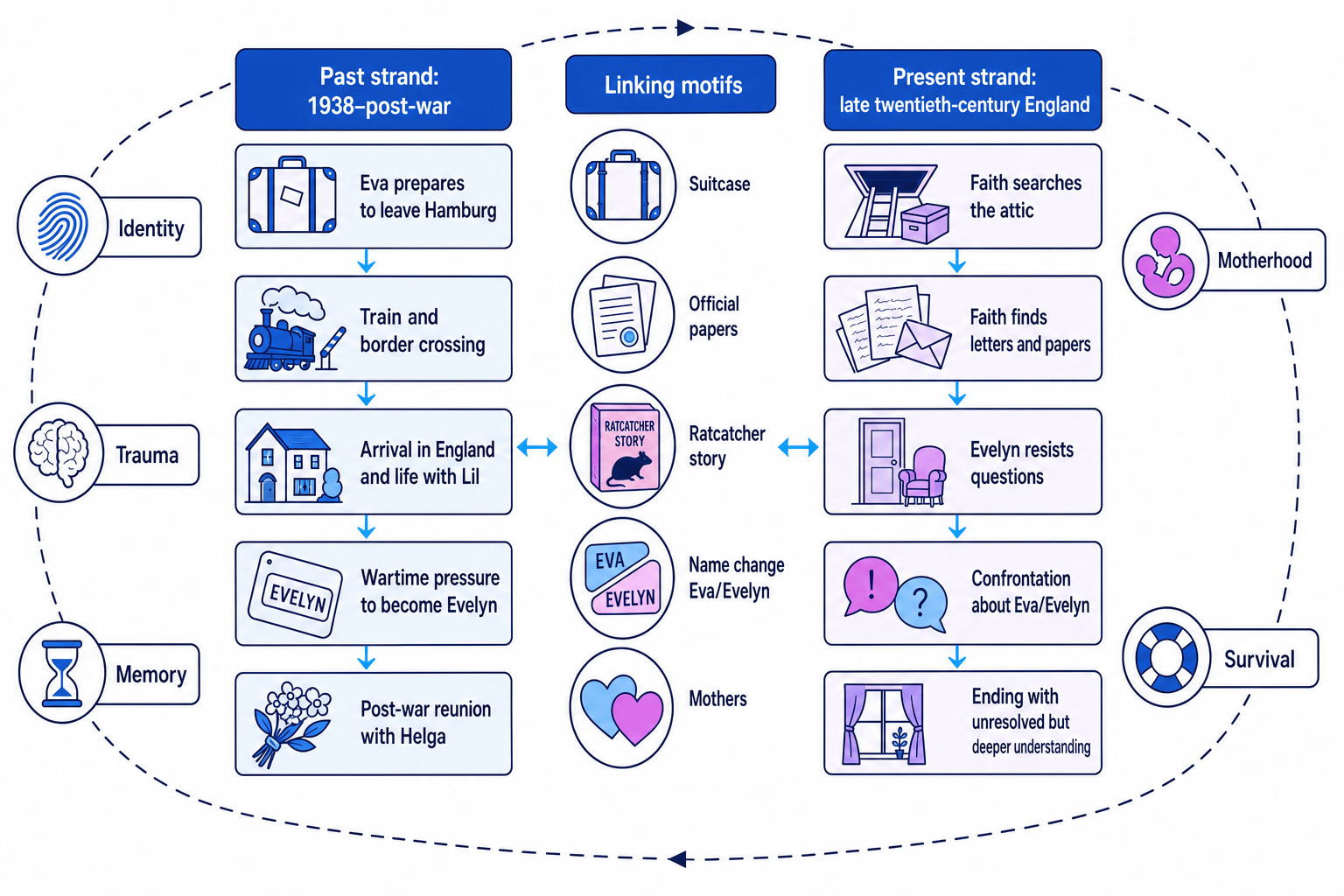
Scene 1: Faith searches the attic
The present-day attic scenes frame the play. Faith’s discovery of documents, letters, and hidden objects turns private family history into dramatic action. The attic is important because it is both a realistic storage space and a symbolic place where buried memories are kept.
Symbolism
Symbolism is when an object, place, or action represents a larger idea. The attic symbolises hidden memory: Evelyn has put the past away, but it has not disappeared.
Faith’s discovery of the name “Eva Schlesinger” is a turning point because it opens a gap between the mother Faith thinks she knows and the child Evelyn once was. Samuels makes this dramatically effective by turning research into confrontation: Faith does not simply learn facts; she challenges Evelyn’s identity.
The attic also introduces the play’s central tension: Evelyn wants control over the past, while Faith wants truth. This makes the scene useful for essays on memory, secrecy, and inherited trauma.
The attic is more than a setting
The attic makes memory visible on stage. Boxes, papers, and old objects show that Evelyn’s past has been stored away physically, but not emotionally resolved.
Scene 2: Eva prepares to leave Hamburg
The departure scenes between Eva and Helga are central because they show love under unbearable pressure. Helga’s actions can seem strict, even harsh, but Samuels presents this as a desperate form of protection. She must prepare Eva to survive separation.
Dramatic irony
Dramatic irony happens when the audience knows more than a character. In Kindertransport, the audience knows the historical danger facing Jewish families in Nazi Europe, so Helga’s promises and Eva’s hopes feel painfully uncertain.
This scene is key for motherhood. Helga’s love is not shown through comfort alone; it is shown through discipline, instructions, and preparation. She has to make Eva independent before Eva is emotionally ready to be independent.
The scene also begins the identity conflict. Eva is being sent away to live in a new country, use a new language, and later take on a new name: “Evelyn”. The shift from “Eva” to “Evelyn” becomes one of the play’s most important signs of survival and loss.
Calling Helga simply cold
Do not write that Helga is just cruel or uncaring. A stronger answer explains the contradiction: her firmness is part of her love because she is trying to give Eva the best chance of survival.
Scene 3: The train and border crossing
The train journey is a key scene because it makes the Kindertransport both a rescue and a frightening separation. Eva is physically moving towards safety, but she is also moving away from language, home, parents, and childhood certainty.
Samuels uses authority figures, official checks, and the pressure of “papers” to create fear. The border crossing shows how a child’s identity can be reduced to documents and permissions. This is powerful on stage because the audience sees Eva’s vulnerability in real time.
Stagecraft
Stagecraft means the practical dramatic methods used on stage, such as movement, lighting, sound, props, costume, entrances, exits, and how actors are positioned.
The Ratcatcher motif often connects with these scenes. A motif is a repeated image, phrase, object, or idea that gains meaning each time it appears. The Ratcatcher links the children’s journey with a darker fairy-tale pattern: children being led away by a powerful figure.
Motif
A motif is a repeated element in a text. In Kindertransport, the Ratcatcher motif repeats to suggest fear, pursuit, manipulation, and childhood nightmares.
The journey is therefore not presented as simple escape. It is emotionally complicated: rescue and abandonment are felt at the same time.
Linking the train scene to trauma
- Start with the dramatic situation: Eva is travelling towards safety, but she is alone and dependent on adults, officials, and documents.
- Connect that situation to Samuels’ method: the train and border crossing create tension through movement, interruption, and official control.
- Interpret the effect: the audience sees that trauma begins before Eva reaches England, because separation itself is frightening and disorientating.
- Link to the wider play: adult Evelyn’s secrecy becomes more understandable because her past is not one single memory but a chain of frightening moments.
Scene 4: Eva arrives in England and meets Lil
Eva’s arrival in England is key because it begins her second life. Lil offers practical care and emotional warmth, but Eva’s new home also requires adjustment. She has to learn different customs, language, and expectations.
This scene matters because Samuels avoids making rescue look simple. England is a place of safety, but it is not automatically a place of belonging. Eva has survived, but survival comes with cultural displacement.
Juxtaposition
Juxtaposition means placing two things close together so the audience compares them. Samuels juxtaposes Eva’s past with her new English life, encouraging us to compare Helga and Lil, Germany and England, Eva and Evelyn.
Lil is especially important in these scenes because she complicates the idea of motherhood. Helga is Eva’s birth mother; Lil becomes her foster mother. The play does not ask you to choose one as “real”. Instead, it explores how both women shape Eva/Evelyn.
A useful comparison
When writing about motherhood, compare what Helga and Lil do rather than simply judging who is “better”. Helga protects by sending Eva away; Lil protects by helping her settle and survive.
Scene 5: Eva becomes Evelyn
The transformation from “Eva” into “Evelyn” is one of the most important developments in the play. It is not a single neat moment; it happens gradually through language, school, religion, family life, and emotional self-protection.
The name change is dramatically powerful because names carry identity. “Eva” connects to Jewish German childhood and Helga. “Evelyn” connects to English adulthood, survival, and the life she builds with Lil.
Survival has a cost
Samuels presents assimilation as both protective and damaging. Becoming “Evelyn” helps Eva survive, but it also creates distance from her origins and from parts of herself.
This is an excellent area for AO2 because you can analyse structure. The audience meets Evelyn as an adult before fully understanding Eva’s childhood. This means we gradually discover that Evelyn’s controlled personality is built on buried fear and loss.
Treating Eva and Evelyn as two separate people
Eva and Evelyn are the same person. The point is not that she has literally become someone else, but that trauma and assimilation have split how she sees herself.
Scene 6: Helga returns after the war
The post-war reunion between Eva/Evelyn and Helga is one of the play’s emotional climaxes. A climax is the point of highest tension or emotional intensity in a dramatic structure.
This scene is painful because the reunion does not simply repair the damage of separation. Helga wants to reclaim her daughter, but Eva has changed. She has formed attachments in England, especially with Lil, and she has developed a new identity.
The audience is forced to recognise a tragic truth: Helga’s decision saved Eva’s life, but it also helped create the conditions in which Eva could no longer fully return to being Helga’s child in the same way.
Climax
A climax is the most intense turning point in a drama. In Kindertransport, the reunion with Helga is climactic because love, guilt, survival, and identity collide.
This scene is useful for essays on guilt. Helga may feel the pain of being rejected; Eva may feel trapped between loyalty and self-preservation. Samuels does not make either character simply right or wrong.
Scene 7: Faith confronts Evelyn
Faith’s confrontation with Evelyn is key because the past finally breaks into the present openly. Faith wants answers about “Eva Schlesinger”, while Evelyn wants to protect herself from being emotionally overwhelmed.
This scene shows how trauma can pass between generations. Faith did not experience the Kindertransport, but she has grown up inside the silence it created. Her anger comes partly from love: she feels excluded from her own family history.
Inherited trauma
Inherited trauma is emotional damage passed from one generation to another, not because the later generation experienced the original event directly, but because secrecy, fear, or pain shapes family relationships.
Samuels makes the confrontation dramatic by giving both characters understandable motives. Faith’s desire for truth is reasonable. Evelyn’s resistance is also understandable because remembering means reopening wounds she has spent decades controlling.
Turning the confrontation into an analytical paragraph
- Choose a focused point: Faith’s confrontation forces Evelyn’s hidden identity into the open.
- Select precise evidence from the scene: use the contrast between the names “Eva Schlesinger” and “Evelyn” to show the conflict between past and present selves.
- Analyse Samuels’ method: the non-linear structure means the audience already understands more of Eva’s suffering than Faith does, so the confrontation feels tense and painful rather than simply rebellious.
- Explain the audience effect: we sympathise with Faith’s need for honesty, but we also understand why Evelyn experiences memory as threatening.
- Link back to theme: the scene shows that suppressed trauma does not vanish; it reshapes family relationships until it is confronted.
Scene 8: The ending
The ending is important because Samuels does not offer a neat solution. There is greater understanding, but not complete healing. This is appropriate for a play about historical trauma: the past can be acknowledged, but it cannot be undone.
Resolution
A resolution is the way a drama’s conflicts are settled or left at the end. Kindertransport has a partial resolution because some truths are faced, but many emotional wounds remain.
The ending encourages a thoughtful personal response. You might feel relief that Faith knows more, sadness that Evelyn has suffered for so long, or frustration that silence has damaged the family. All of these responses can be valid if you support them with close reference to the play.
Do not force a happy ending
The ending is not a simple reconciliation. For a stronger answer, describe it as unresolved, partial, or emotionally complex.
How to choose scenes in an essay
Because Component 2 is open book, you can use a clean copy of the play. However, you still need to know where the key moments are and why they matter. Do not waste time hunting randomly for quotations.
A strong essay usually selects two or three key scenes and tracks a development. For example:
- Identity: attic discovery → name change from “Eva” to “Evelyn” → Faith’s confrontation.
- Motherhood: Helga’s departure scene → Eva’s life with Lil → post-war reunion.
- Trauma and memory: train/border crossing → Ratcatcher motif → present-day confrontation.
- Survival: leaving Germany → assimilation in England → emotional cost in adulthood.
Think in scene chains
Instead of analysing one scene in isolation, link scenes together. Samuels’ structure is built on echoes between past and present, so scene chains often create the strongest essays.
In the exam
- Start with the scene’s dramatic function: explain what changes for the audience, the character, or the theme.
- Use the open-book text efficiently: choose short, exact quotations such as names, repeated motifs, or key phrases, then analyse Samuels’ methods.
- Keep linking past and present: the best answers show how Samuels’ non-linear structure makes Eva’s childhood and Evelyn’s adulthood speak to each other.
Check yourself
- Which scene best shows that being rescued does not mean Eva is emotionally safe?
- How does the attic setting help Samuels turn memory into something visible on stage?
- Why is the name change from “Eva” to “Evelyn” so important for the play’s ideas about identity?