What you'll learn
- How to analyse language, form and structure in Kindertransport without just listing techniques.
- How Samuels uses names, objects, German/English words and the Ratcatcher motif to explore identity and trauma.
- How the play’s split time-frame shapes the audience’s understanding of Eva/Evelyn.
- How to write about dramatic methods for Edexcel IGCSE Component 2, where Kindertransport is studied as modern drama.
The three basics: language, form and structure
Before looking closely at Kindertransport, make sure the three key terms are clear.
Language, form and structure
Language means the writer’s choice of words, images, sounds and patterns of speech. Form means the type of text and its conventions — here, a modern stage play. Structure means how the text is organised: the order of events, contrasts, repetitions, scene changes and ending.
In drama, these three often overlap. A repeated word may be a language choice, but if it returns across the whole play it also becomes part of the structure. A prop, such as a suitcase or document, is part of the play’s form because it is physically seen on stage, but it can also carry symbolic meaning.
The big method
In Kindertransport, Samuels does not simply tell us that the past affects the present. She structures the play so the audience sees the past interrupting the present.
The title: official language versus private pain
The title Kindertransport is a German compound noun: Kinder means children, and Transport means transport. A compound noun is a noun made by joining two or more words together.
The title sounds official and historical. It names a real rescue scheme that brought Jewish children from Nazi-occupied Europe to Britain. But the word also feels impersonal: “transport” can suggest cargo, movement and paperwork rather than a child’s emotional life.
Samuels uses that tension throughout the play. The public historical label, Kindertransport, is narrowed down into the private story of one child: “Eva”, who later becomes “Evelyn”.
Analysing the title
-
The German title links the play to the historical Kindertransport, so the audience begins with a sense of real political context rather than a purely invented story.
-
The word “transport” sounds bureaucratic and practical, which contrasts with the fear and emotional damage involved in sending a child away from her mother.
-
Samuels then focuses on “Eva” as an individual, so the title’s large-scale history is made personal: the audience is asked to think about what rescue costs emotionally.
Language of names and identity
Names matter hugely in Kindertransport. The movement from “Eva” to “Evelyn” is not just a change in sound. It shows a change in identity, nationality and emotional survival.
“Eva” belongs to her German Jewish childhood. “Evelyn” belongs to her adult English life. The name change suggests assimilation, which means adapting to fit into a new culture. It also suggests repression, which means pushing painful memories down so they do not have to be faced.
Assimilation
Assimilation is the process of becoming absorbed into a different culture, often by changing language, behaviour, customs or identity.
Samuels also uses German family words such as “Mutti” and “Vati”. These words make Eva’s early family life feel intimate and specific. When English begins to replace German, language becomes a sign of survival — but also a sign of loss.
Analysing Eva and Evelyn
-
Start with the contrast: “Eva” is the child’s original name, while “Evelyn” is the adult identity she uses in England.
-
The change in name suggests that survival has required self-invention. Evelyn has not merely moved country; she has rebuilt herself through Englishness.
-
When the past name resurfaces, it threatens the adult identity Evelyn has constructed, so Samuels uses naming to dramatise inner conflict.
Do not treat the name change as simple
Avoid writing that Eva “just becomes English”. Samuels presents Englishness as both protective and damaging: it helps Evelyn live, but it also helps her hide from her past.
Code-switching: German and English together
Code-switching means moving between languages, dialects or forms of speech. In Kindertransport, the mixture of German and English shows Eva caught between two worlds.
German can suggest family, childhood and origin. English can suggest safety, adaptation and distance from trauma. This is especially important because the play is about a child who survives by entering another language and another home.
The audience hears identity changing through speech. That is a dramatic method: because this is a play, language is not just read silently but spoken aloud on stage.
Writing about language
When you mention German words such as “Mutti” or the title “Der Rattenfänger”, do not just translate them. Explain what their presence does: they make Eva’s lost world audible on stage.
The Ratcatcher motif
One of the most important repeated images in the play is the Ratcatcher, linked to the German story “Der Rattenfänger”, or the Pied Piper.
Motif and symbolism
A motif is a repeated image, object, sound or idea that gains meaning each time it appears. Symbolism is when something concrete represents a larger idea, feeling or concept.
The Ratcatcher is not only a character from a children’s story. In performance, he becomes a nightmare figure who crosses between childhood imagination, Nazi threat, separation and memory. He can suggest the way children are led away, the danger of authority, and the frightening power of the past.
Importantly, the Ratcatcher is not a simple one-to-one symbol. He is not only “Hitler” or only “death” or only “fear”. Samuels makes him unstable, which is why he is so disturbing.
Analysing the Ratcatcher motif
-
Identify the repeated image: the Ratcatcher comes from “Der Rattenfänger”, a story associated with children being led away.
-
Connect the image to Eva’s experience: Eva is also a child taken away from home, supposedly for safety, but the journey still involves terror and loss.
-
Explain the effect of the motif: the audience experiences the Kindertransport as both rescue and haunting, because the fairy-tale figure turns historical events into recurring nightmare imagery.
Do not flatten the Ratcatcher
Do not write “the Ratcatcher represents the Nazis” and stop there. A stronger answer says he is a shifting symbol of fear, separation, authority and traumatic memory.
Form: Kindertransport as modern drama
Kindertransport is a modern drama, so Samuels writes for actors, stage space, sound, lighting, props and audience response. There is no narrator explaining everyone’s feelings. Instead, meaning is created through dialogue, silence, movement and staging.
Stagecraft
Stagecraft means the practical dramatic methods used in performance, such as stage directions, lighting, sound, props, entrances, exits, positioning and actor movement.
This matters for AO2 because you should analyse the play as a play. For example, an attic box is not only “mentioned”; it can be physically opened in front of the audience. Documents, letters and objects make hidden history visible.
The attic setting is especially important. An attic is a place where families store what they do not use every day but cannot quite throw away. Structurally, it becomes a space where buried memory returns.
Analysing the attic as staging
-
Samuels places much of the present-day action in an attic, a space associated with stored objects and hidden family history.
-
When Faith searches through boxes and papers, private memory becomes physically visible on stage rather than remaining abstract.
-
This makes the audience watch the past being uncovered in real time, so the form of drama turns investigation into action.
Split staging and the memory play form
Kindertransport can be understood as a memory play. A memory play is a drama where past events are not simply reported; they are staged, replayed and re-experienced.
The play moves between two time periods: Eva’s childhood journey from Germany to England, and the later present-day conflict involving Evelyn, Faith, Lil and Helga. These time periods are not kept neatly separate. Samuels often places them beside each other so the audience can see connections that the characters may resist.
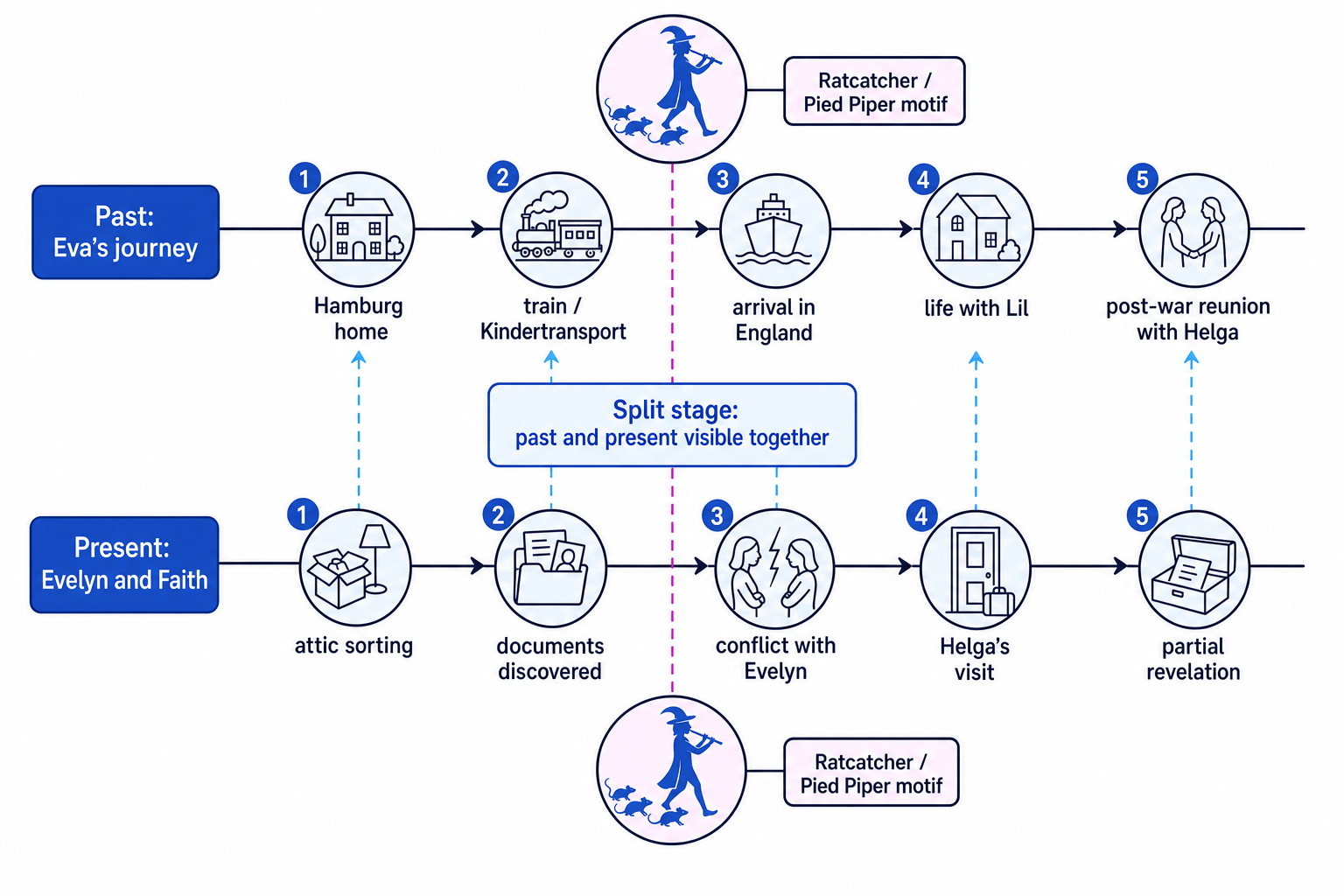
Juxtaposition
Juxtaposition is when a writer places two things side by side so the audience notices their similarities, differences or tensions.
The juxtaposition of Eva’s past and Evelyn’s present shows that trauma does not stay safely in the past. Faith’s discoveries in the attic trigger the audience’s understanding of Eva’s earlier life. The structure therefore mirrors the experience of memory: it is fragmented, sudden and emotionally intrusive.
Writing about split-stage structure
-
Begin with the structural method: Samuels uses a non-linear structure, moving between Eva’s childhood and Evelyn’s adult present.
-
Explain the connection: the present-day discoveries do not merely interrupt the past; they reveal that Evelyn’s adult identity has been shaped by what happened to Eva.
-
Link to audience effect: because the audience sees both time periods, we understand the emotional causes behind Evelyn’s evasions more fully than Faith does at first.
Doubling and authority figures
In performance, the Ratcatcher figure can be associated with several authority roles. This technique is called doubling, where one actor plays more than one role.
Doubling
Doubling is a theatrical technique where the same actor performs multiple parts, often to suggest a connection between characters, ideas or forms of power.
Doubling can make ordinary officials feel unsettling. A border official, organiser or other male authority figure may seem to carry the same threatening energy as the Ratcatcher. This does not mean every authority figure is identical, but it does suggest that Eva experiences systems of power as frightening and unpredictable.
This is a form choice, not just a casting convenience. It helps Samuels stage trauma: the same threatening presence seems to return in different shapes.
Structure: fragments, repetitions and delayed revelation
The play is not structured as a simple beginning-to-end biography. Instead, it uses fragmentation, meaning the story is broken into pieces and assembled gradually.
This suits the subject matter. Trauma is often remembered in fragments: a voice, an object, a phrase, a document, a story. Samuels’ structure makes the audience piece together Evelyn’s past alongside Faith.
Repetition is also important. Mother-child separation repeats across generations: Helga loses Eva; Lil becomes Eva’s English mother; Evelyn struggles with Faith’s need for truth. These parallels make the play feel cyclical, as though unresolved pain is passed down.
Structure mirrors trauma
The broken structure is not confusing for no reason. It reflects the way buried trauma returns in fragments, often when someone tries to uncover the truth.
Dialogue: questions, evasions and silence
Samuels often creates tension through dialogue that does not fully answer questions. Faith wants knowledge; Evelyn often resists disclosure. This produces conflict not through action scenes, but through gaps in speech.
A pause or silence in drama can be as meaningful as a spoken line. It may suggest fear, anger, grief, or a memory too painful to express.
In Kindertransport, evasive dialogue shows that the past is not simply unknown; it is being actively controlled. Evelyn’s reluctance to speak is part of her survival strategy, but it also damages her relationship with Faith.
Analyse silence as a method
If you write about a pause, interruption or refusal to answer, treat it as Samuels’ choice. Ask: what emotion is being hidden, and what does the audience understand because of that silence?
Props and paperwork: identity made official
The play repeatedly draws attention to objects connected with identity: documents, letters, labels, boxes, photographs and possessions. A prop is an object used on stage by actors.
These objects matter because the Kindertransport depended on paperwork, official permission and proof of identity. Samuels shows that identity is both deeply personal and controlled by external systems. A child’s name, religion and nationality can become something stamped, checked or hidden.
The audience sees how fragile identity is. A document can preserve the past, but it can also expose what Evelyn has tried to bury.
Do not ignore props
Students sometimes focus only on spoken quotations. In drama, props are evidence too. You can analyse an object if you explain how it works on stage and what it reveals.
Ending and lack of neat resolution
The play does not offer a simple emotional cure. Its structure moves towards revelation, but revelation does not erase pain. This is important: Samuels is not writing a comforting rescue story where all suffering is solved.
Instead, the ending leaves the audience thinking about what can and cannot be repaired. The past can be uncovered, but it cannot be undone. That unresolved quality is part of the play’s seriousness.
In the exam
-
Write about Kindertransport as drama: include stagecraft, props, split staging, dialogue and audience effect, not just character feelings.
-
Use short, precise references such as “Eva”, “Evelyn”, “Mutti”, “Der Rattenfänger” and the Ratcatcher motif, then analyse how Samuels’ method shapes meaning.
-
For Edexcel Component 2, you have a clean copy of the text, so use it actively: find exact stage directions and brief quotations, then link them to identity, memory, trauma and context.
Check yourself
- How does the change from “Eva” to “Evelyn” show both survival and loss?
- Why is the Ratcatcher more complex than a simple symbol of the Nazis?
- How does the play’s non-linear structure affect the audience’s understanding of Evelyn?