What you'll learn
- How to turn a broad topic like class into a clear theme argument.
- The main themes in Great Expectations and where they appear in the novel.
- How Dickens uses language, form and structure to develop themes.
- How to write about themes in the Edexcel IGCSE exam using precise quotations and context.
What is a theme?
A theme is not just “what happens”. It is the larger idea Dickens explores through characters, settings, repeated images and plot developments.
Theme
A theme is a central idea or message in a text. In an essay, it is usually best to express it as a sentence, not a single word: for example, not just class, but Dickens shows that chasing social status can damage Pip’s loyalty and self-respect.
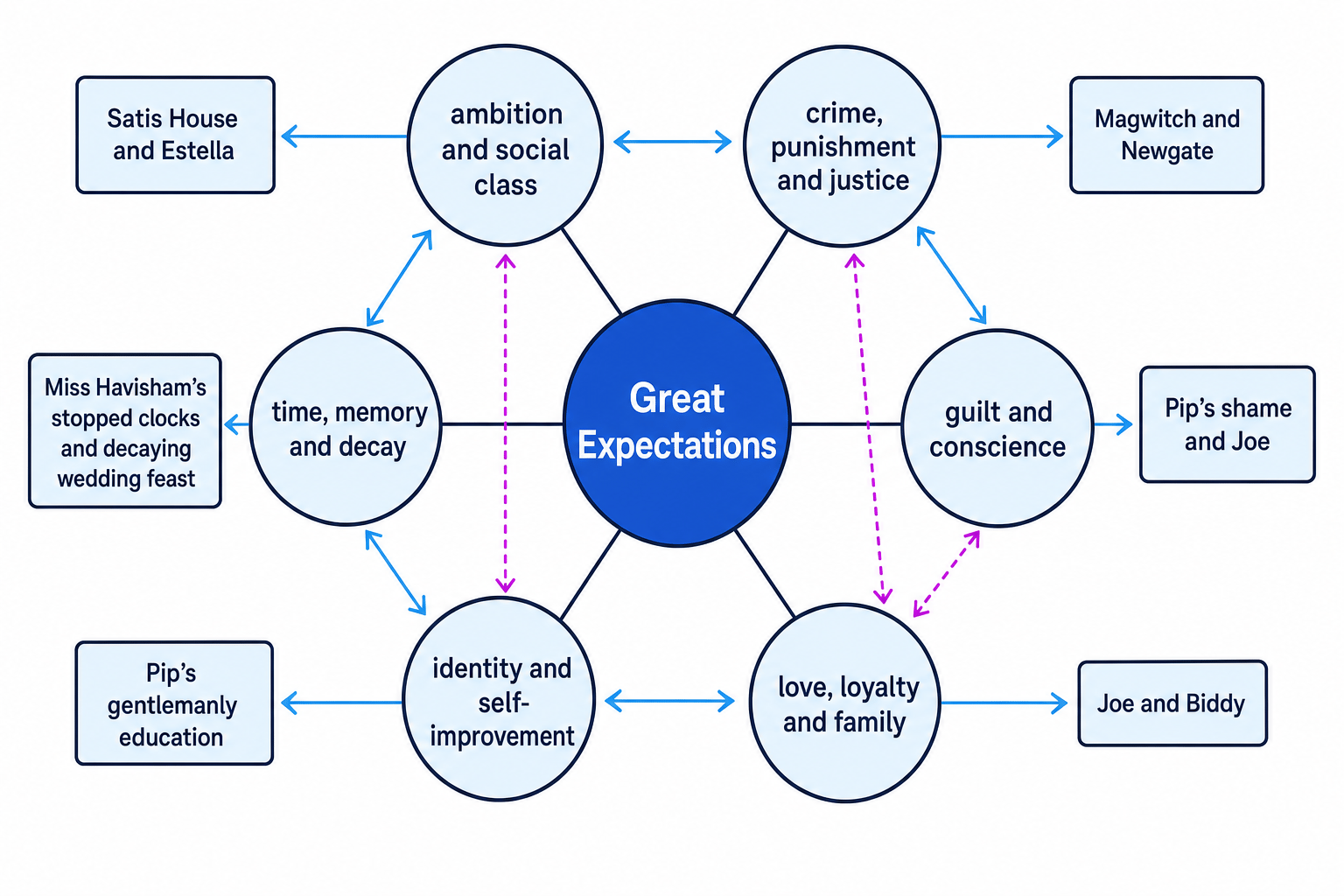
For Great Expectations, the most important themes overlap. Pip’s ambition is linked to class; class is linked to justice; guilt is linked to love and loyalty. Strong answers do not treat themes as separate boxes — they show how Dickens connects them.
Use this map to see the main themes and their links before studying them in detail.
The core technique: from topic to argument
In your essay, you need more than “Dickens presents class”. You need to say what Dickens suggests about class.
A method is a writer’s deliberate choice. This can include language choices such as adjectives and imagery, form choices such as first-person narration, and structure choices such as when a revelation happens.
In Great Expectations, Dickens uses a retrospective first-person narrator: older Pip tells the story of his younger self. This means Pip can describe childish feelings while also judging them with adult regret.
Turning class into an argument
-
Start with the topic: class and social ambition.
-
Choose a precise moment: when Estella humiliates Pip at Satis House, she mocks his “coarse hands” and “thick boots” in Chapter 8.
-
Analyse the method: Dickens uses physical details — “hands” and “boots” — to show that Pip is judged by signs of labour and poverty. The adjectives “coarse” and “thick” make Estella’s judgement sound harsh and snobbish.
-
Turn it into a theme statement: Dickens suggests that class prejudice can make people internalise shame; Pip begins to see himself through Estella’s cruel standards.
One-word themes
Do not write, “The theme is ambition.” Instead, write an argument: Dickens presents ambition as dangerous when it is based on shame and the desire to escape loyal people like Joe.
Ambition, social class and the false idea of being a “gentleman”
Pip’s “great expectations” seem, at first, to mean money, education and entry into a higher social class. Dickens makes this tempting: Pip wants to become a gentleman partly because he loves Estella and partly because he feels ashamed of being “common”.
After meeting Estella, Pip admits, “I wished Joe had been rather more genteelly brought up, and then I should have been so too” in Chapter 8. This is painful because Joe is morally kind, but Pip begins to measure him by social polish.
Dickens uses irony, a gap between what a character believes and what the reader understands. Pip believes becoming a gentleman will make him better. The reader gradually sees that Joe, the blacksmith, is far more gentlemanly in his kindness than many socially “respectable” people.
Class and moral worth
Dickens separates social rank from moral value. Pip rises socially, but his real improvement happens only when he learns humility, gratitude and compassion.
A very useful quotation is Pip’s reflection in Chapter 14: “It is a most miserable thing to feel ashamed of home.” The word “miserable” shows that shame damages Pip from inside; Dickens makes snobbery emotionally destructive, not glamorous.
Crime, punishment and justice
The novel opens with fear and criminality. Magwitch is introduced as “a fearful man, all in coarse grey, with a great iron on his leg” in Chapter 1. The “iron” immediately connects him to punishment and imprisonment.
At first, Pip and the reader see Magwitch as frightening. Later, Dickens changes our judgement. Magwitch becomes more human, more loyal and more emotionally generous. This structural shift matters: Dickens encourages readers to question quick moral labels like “criminal” and “gentleman”.
The contrast between Magwitch and Compeyson is especially important. Compeyson appears more gentlemanly, so the legal system treats him more favourably, while Magwitch receives the heavier punishment. Through this, Dickens criticises a society where class affects justice.
Context matters here. Context means the social, historical or cultural circumstances that shape a text’s meanings. Dickens was writing in Victorian Britain, where poverty, prisons, transportation and class inequality were major public concerns. You should link context to Dickens’s ideas, not bolt it on randomly.
Linking crime to class
-
Compare the characters: Magwitch is rough, poor and openly criminal; Compeyson is polished and socially convincing.
-
Notice the structural contrast: Dickens reveals later that the supposedly “lower” man is capable of deep loyalty, while the more gentlemanly Compeyson is morally corrupt.
-
Link to theme and context: Dickens suggests that Victorian justice can be distorted by class prejudice; respectability is not the same as goodness.
Magwitch’s line, “Dear boy, I made a gentleman on you!” in Chapter 39 is a major turning point. Pip’s gentlemanly identity has been funded by a transported convict. Dickens makes Pip — and the reader — confront the uncomfortable connection between wealth, crime and social respectability.
Guilt, conscience and moral education
Pip’s guilt begins in childhood when he steals food and a file for Magwitch. At first, guilt is linked to fear of being caught. As he grows older, it becomes more moral: he feels guilt for rejecting Joe, becoming snobbish and misjudging Magwitch.
This is why Great Expectations can be called a Bildungsroman, a novel about a character’s growth from childhood towards maturity. But Dickens complicates the form: Pip’s “education” is not just books, manners and money. His real education is learning to judge people with compassion.
When Pip discovers Magwitch is his benefactor, he initially feels horror and disgust. Yet by Chapter 56, he cares for Magwitch tenderly and tells him that Estella “is living now” and “I love her!” This moment shows Pip’s moral growth: he no longer sees Magwitch only as a criminal but as a suffering human being.
Guilt becomes growth
Pip’s guilt is painful, but it also becomes the force that pushes him towards self-knowledge and moral responsibility.
Love, loyalty and damaged affection
Dickens contrasts loyal love with selfish or controlling love. Joe’s love for Pip is steady and forgiving. Biddy’s affection is honest and practical. Herbert’s friendship is generous. These relationships show love as service, patience and loyalty.
By contrast, Miss Havisham turns love into revenge. She trains Estella to hurt men, urging her to “Break their hearts, my pride and hope, break their hearts and have no mercy!” The repeated command “break” makes love sound violent and destructive.
Estella is both cruel and damaged. When she tells Miss Havisham, “I am what you have made me” in Chapter 38, Dickens shows that emotional cruelty is taught. Estella’s coldness is not simply personal wickedness; it is the result of Miss Havisham’s manipulation.
Pip’s romantic love for Estella is also flawed because he idealises her. He often loves the image he has created rather than the real person. Dickens questions whether love based on fantasy, class desire and suffering can truly be healthy.
Time, memory and decay
Satis House is one of Dickens’s clearest theme settings. A symbol is an object, place or character that represents a larger idea. A motif is a repeated image or detail that develops a theme across a text.
Miss Havisham’s stopped clocks, fixed at “twenty minutes to nine”, symbolise her refusal to move beyond betrayal. Her decaying wedding feast shows that frozen time does not preserve happiness; it turns it rotten.
Dickens describes Miss Havisham as “withered like the dress” in Chapter 8. A simile is a comparison using “like” or “as”. Here, the simile links the person and the object: Miss Havisham’s identity has decayed alongside the wedding dress.
Reading Satis House as a symbol
-
Identify the literal detail: the clocks are stopped and the wedding objects are left to decay.
-
Connect detail to character: Miss Havisham has frozen her life at the moment of betrayal.
-
Analyse the effect: Dickens makes the setting reflect emotional damage; the house becomes a physical version of Miss Havisham’s memory.
-
Link to theme: the novel suggests that living entirely in the past harms both the self and others, especially Estella and Pip.
Identity and self-improvement
Pip’s identity is unstable from the beginning. His full name, Philip Pirrip, becomes “Pip” because that is what he can pronounce as a child. This small detail introduces a major concern of the novel: identity is shaped by language, family, memory and social judgement.
Many characters try to “make” Pip into something. Estella makes him ashamed. Miss Havisham allows him to believe she is shaping his future. Magwitch actually funds his rise and says, “I made a gentleman on you!” Dickens uses Magwitch’s dialect — a written representation of speech patterns — to challenge class prejudice. Magwitch may speak non-standard English, but he shows loyalty and sacrifice.
Pip’s true self-improvement comes when he stops worshipping status. His better actions — helping Herbert, caring for Magwitch, returning humbly to Joe and Biddy — matter more than his clothes, money or manners.
Best theme links
For high-level analysis, connect themes together. For example, Pip’s class ambition creates guilt, Magwitch’s crime exposes false ideas of being a gentleman, and Miss Havisham’s frozen memory damages love.
Writing about themes in Component 2
Great Expectations is assessed in Component 2, Section B: Literary Heritage. This is open book, so you may use a clean copy of the text. However, open book does not mean you should copy long passages. Examiners reward a focused argument, accurate references, and analysis of Dickens’s methods.
For this text, your strongest answers combine AO1, AO2 and AO4: a clear personal argument, close analysis of Dickens’s language/form/structure, and relevant context about Victorian class, justice, poverty or family.
In the exam
-
Make the theme into an argument: write what Dickens suggests, not just the theme word.
-
Use short embedded quotations: phrases like “coarse hands”, “thick boots” or “withered like the dress” are easier to analyse than long copied chunks.
-
Name the method and explain the effect: connect Dickens’s choices to the reader’s response and to the wider theme.
-
Use context only when it sharpens the point: link Victorian class prejudice, punishment or gender expectations directly to the moment you are analysing.
-
Connect themes across the novel: show how class, guilt, justice, love and identity influence one another.
Check yourself
- Can you turn the topic “ambition” into a full theme statement about Pip?
- Which two moments show that Pip’s moral growth matters more than becoming a gentleman?
- How does Satis House symbolise Miss Havisham’s relationship with time and memory?