Charles Dickens's Great Expectations is a masterpiece of characterisation. Rather than presenting static, one-dimensional figures, Dickens crafts characters who are deeply intertwined with the novel’s themes of social class, ambition, and moral redemption.
In this guide, you will explore how Dickens uses characterisation to construct his social critique of Victorian England.
What you'll learn
- How to analyse Pip’s dual narrative voice as a tool for moral self-reflection.
- How to evaluate Dickens's use of character foils to contrast moral integrity with social ambition.
- How to link Victorian social contexts to the presentation of the "true gentleman" through Abel Magwitch and Bentley Drummle.
Pip’s Journey: The Dual Narrative Voice
To understand Pip, you must first understand the structure of the novel. Great Expectations is a Bildungsroman.
Bildungsroman
A Bildungsroman is a novel that traces the psychological, moral, and social growth of a protagonist from youth to adulthood. Typically, the protagonist undergoes a painful transition from innocence, through corruption, to a final state of self-awareness and maturity.
Dickens writes the novel in the first person, but he employs a crucial technique: narrative distance.
Narrative Distance
Narrative distance is the cognitive and temporal gap between the character experiencing the events (the young, naive "experiencing self") and the character narrating them (the older, wiser "narrating self").
This dual perspective allows Dickens to accomplish two things at once:
- Immediate Empathy: We experience young Pip's terror in the churchyard with Magwitch, or his acute shame at Satis House, with the raw intensity of childhood.
- Moral Condemnation: The older Pip frequently reflects on his past behaviour with deep regret, guiding the reader to judge his younger self's snobbery.
For example, when young Pip grows ashamed of his home and the humble blacksmith Joe Gargery, the older narrator steps in to observe: "It is a most miserable thing to feel ashamed of home." The adult narrator provides the moral frame that the child narrator is too blinded by ambition to see.
The Spheres of Influence: Structural Foils
Dickens structures Pip's world into two distinct geographic and moral spheres. The characters within these spheres act as foils to one another.
Foil
A foil is a character who contrasts sharply with another character, thereby highlighting and emphasizing specific traits, virtues, or flaws in that character.
The diagram below maps how Pip is pulled between these opposing forces, illustrating how his character arc is defined by their competing influences.
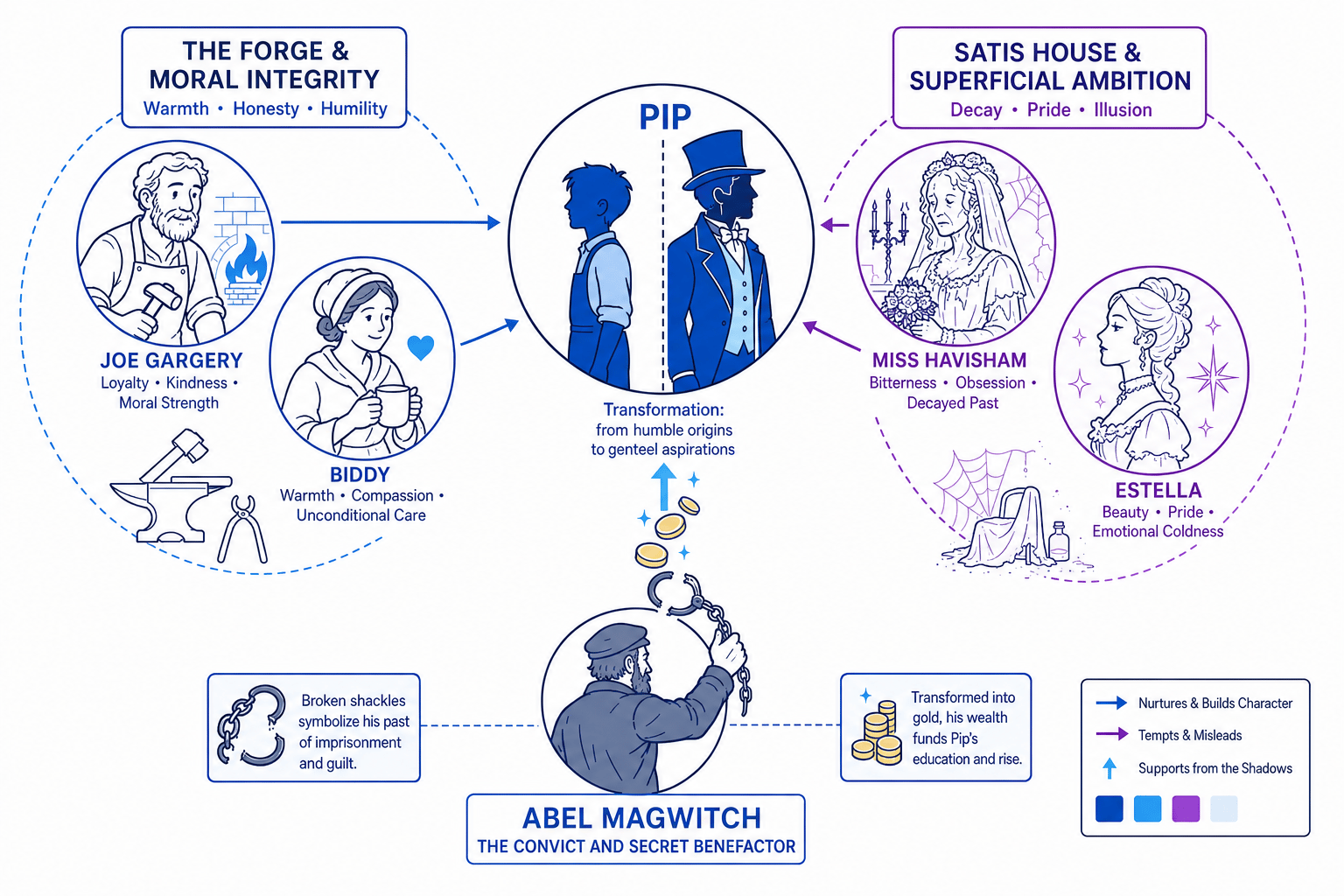
The Forge: Joe Gargery and Biddy
The Forge represents moral purity, domestic warmth, and emotional honesty.
- Joe Gargery: Joe is Pip’s ultimate moral compass. He speaks in a simple, non-standard dialect ("you and me is always friends") which reflects his lack of social polish, but his actions are consistently noble. He loves Pip unconditionally, refusing to accept money for visiting Pip in London because he values human connection over commercial transaction.
- Biddy: Biddy is intelligent, emotionally mature, and self-sufficient. She contrasts directly with Estella. While Estella uses her education to wound, Biddy uses hers to heal and teach.
Satis House: Miss Havisham and Estella
Satis House (meaning "Enough House," a bitter piece of irony) represents decay, social pretension, and emotional death.
- Miss Havisham: A frozen Gothic figure, Miss Havisham is physically decaying in her yellowed wedding dress amidst cobwebs and a rotting wedding cake. She represents the destructive nature of revenge. She uses Estella as a weapon to "wreak revenge on all the male sex."
- Estella: Estella is raised by Miss Havisham to be cold and unattainable. Her name means "star," highlighting her cold, distant, and beautiful nature. Estella warns Pip directly: "I have no softness there, no sympathy, sentiment, nonsense."
The Moral Geography of Great Expectations
Pip's physical movement from the marsh country (the Forge) to high-society London corresponds directly with his moral decline. True nobility is found in the dirt of the Forge, while moral rot is dressed in the silk and lace of Satis House.
The Definition of a "Gentleman"
In the Victorian era, a "gentleman" was traditionally defined by birth, wealth, and social standing. Dickens uses his characters to challenge this definition, asserting that true gentility is a matter of moral character, not social class.
Abel Magwitch: The True Benefactor
When Pip discovers that his fortune does not come from the aristocratic Miss Havisham, but from the escaped convict Abel Magwitch, his world is shattered. Pip’s reaction is one of absolute horror: "The ship in which I had sailed was wrecked."
However, Magwitch is arguably the most noble character in the novel:
- He risks death by returning to England from Australia just to see the "gentleman" he has made.
- His love for Pip is selfless and paternal: "I'm your second father. You're my son."
- Through Magwitch, Dickens attacks a Victorian legal system that punishes the poor (like Magwitch, who stole to survive) while letting wealthy criminals (like Compeyson, the gentleman fraudster) off lightly.
Bentley Drummle: The Aristocratic Beast
In contrast to Magwitch, Bentley Drummle is born into the highest social tier. Yet, Jaggers refers to him as "the Spider," and he is presented as brutal, arrogant, and sluggish. Drummle eventually marries Estella and abuses her, demonstrating that a high-born "gentleman" can be a literal monster.
Confusing Wealth with Morality
In your essays, never equate a character's wealth with their virtue. Dickens goes to great lengths to show that those who seem "common" (Joe, Magwitch, Biddy) possess "uncommon" moral goodness, whereas the wealthy elite (Drummle, Miss Havisham) are often morally bankrupted.
Analysing Characterisation in an Essay
When writing about a character in your exam, you must not simply list what they do. You must analyse how Dickens presents them (using linguistic, structural, and literary techniques) and why he presents them that way (thematic intent and social context).
Let's walk through an analytical process for writing a high-level response on Miss Havisham.
Analysing Miss Havisham's Gothic Presentation
- Focus on the Writer's Method: Identify a key quote that establishes Miss Havisham’s character and isolate her physical/symbolic traits.
- Selection: In Chapter 8, Pip describes her wedding dress: "I saw that everything within my view which ought to be white, had been white long ago, and had lost its lustre, and was faded and yellow."
- Analyse the Language and Symbolism (AO2): Deconstruct the key images.
- Analysis: The repetition of "white" contrasted with "faded and yellow" symbolises her frozen state. She is a living corpse, trapped in the moment of her betrayal. The wedding dress, designed to celebrate life and union, has become a shroud of decay and isolation. Dickens uses Gothic tropes to present her as a ghost haunting Satis House, emphasizing how bitterness eats away at the human soul.
- Link to Context and the Novel's Broader Message (AO1/AO4): Explain what Dickens is warning his Victorian audience about.
- Synthesis: Through Miss Havisham's physical deterioration, Dickens critiques the Victorian obsession with social status and revenge. She was betrayed by Compeyson because of her money and her blind class-based trust in him. By freezing her life at that moment, she wastes her wealth and humanity on vengeance, proving that class privilege without moral purpose leads to spiritual ruin.
Using the Open Book Format to Your Advantage
Since Component 2 is an open-book exam, you do not need to memorise hundreds of quotes. Instead, focus on memorising key page/chapter markers so you can quickly locate highly symbolic passages (like Pip's first meeting with Estella, or Magwitch's reveal). Use your clean copy of the text to pull out highly precise words for close-word analysis.
In the exam
- Name the narrative perspective: Always make reference to the older Pip looking back on his younger self. This dual narrative voice is a vital structural method (AO2).
- Anchor your character analysis to theme: If you are asked to write about Joe Gargery, your essay should actually be about the theme of integrity versus social ambition. If you write about Estella, it should be about the destructive nature of emotional repression.
- Weave context seamlessly: Do not just "dump" Victorian history. Link Dickens’s characterisation directly to Victorian social issues—such as the poor laws, the rigid class structure, or the treatment of orphans.
Check yourself
- Why is it significant that Estella’s name means "star"? What does this tell us about Pip’s pursuit of her?
- How does Biddy act as a foil to Estella, both in terms of social class and emotional capacity?
- In what ways does Abel Magwitch prove to be a better "father" to Pip than his biological or societal guardians?