What you'll learn
- What context means for Great Expectations and how it links to AO4.
- The key Victorian contexts: class, poverty, crime, empire, gender, and serial publication.
- How to use context in analysis without turning your essay into a history lesson.
- How to connect context to Dickens’s methods and the reader’s response.
What “context” means
In Edexcel IGCSE English Literature, context is not just background information. It is the relationship between the world of the text and the meanings Dickens creates.
For Great Expectations, context matters because Dickens is writing about a society where class, money, education, gender, and criminal justice strongly shape people’s lives. Pip’s “great expectations” are personal, but they are also social: he has learned to measure himself by Victorian ideas of success.
Context / AO4
Context means the historical, social, cultural, literary, and biographical circumstances that help shape a text. For Great Expectations, AO4 asks you to explore how these circumstances connect to Dickens’s ideas, characters, and methods.
Context is a lens, not a paragraph
The best context in an essay is attached to a quotation or moment in the novel. You should show how context changes what we understand about Dickens’s choices.
The big picture: Dickens and Victorian England
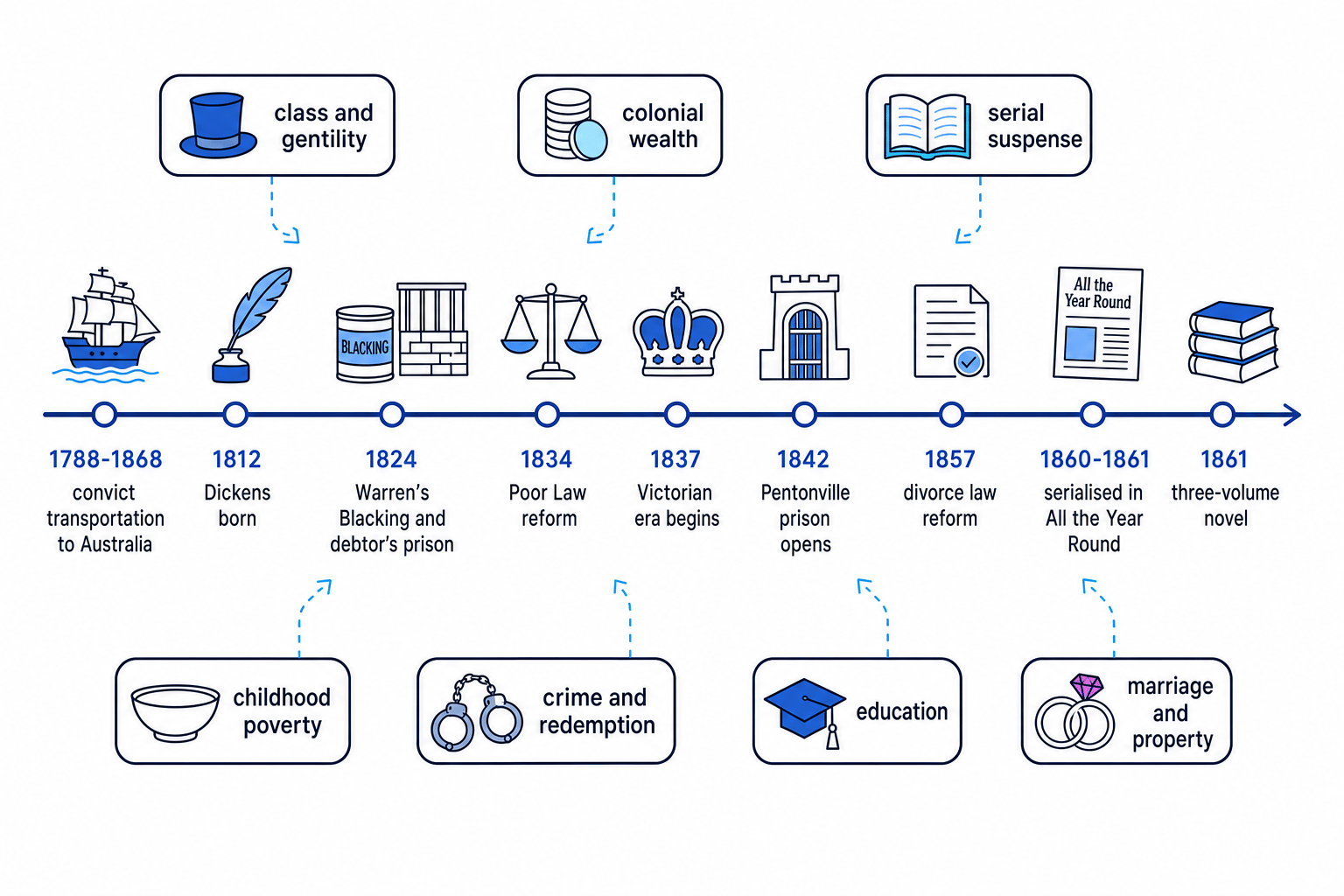
Great Expectations was serialised in Dickens’s magazine All the Year Round in 1860–1861, then published as a three-volume novel in 1861. However, the story is set earlier in the nineteenth century, in a world of marshes, blacksmiths, prison ships, apprenticeships, lawyers, and new fortunes.
That means Dickens is looking back at an earlier period while writing for Victorian readers who were still deeply concerned with poverty, respectability, crime, education, and social mobility.
Class, gentility, and social mobility
One of the most important contexts in the novel is the Victorian obsession with becoming a gentleman.
Gentility
Gentility means the social status, manners, education, and appearance associated with being a “gentleman” or “lady”. In Victorian society, gentility was linked to class, wealth, speech, clothing, and behaviour.
Pip begins as a blacksmith’s apprentice, which is honest working-class labour. But after visiting Satis House, he becomes ashamed of Joe and of himself. Estella’s insults — “coarse hands” and “thick boots” — make him see his body and background through upper-class eyes.
When Pip tells Biddy, “I want to be a gentleman,” Dickens shows how deeply social values have entered Pip’s imagination. The sentence sounds simple, but the word “gentleman” carries a whole class system inside it.
Dickens does not simply say ambition is bad. Instead, he questions a society where Pip thinks moral worth depends on polish, money, and status. Joe is socially “common” but morally generous; Compeyson looks like a gentleman but behaves corruptly. Dickens separates true goodness from social rank.
Linking class context to a quotation
-
Start with the quotation: Pip says, “I want to be a gentleman.” The verb “want” shows desire, but also dissatisfaction with his current identity.
-
Connect the key word to context: in Victorian society, a “gentleman” suggested education, manners, wealth, and freedom from manual labour. Pip is not just wishing for money; he is wishing for a different social self.
-
Link to Dickens’s criticism: because Pip’s desire begins after Estella humiliates him, Dickens suggests that class ambition can grow out of shame rather than wisdom.
-
Tie it to effect: the reader may sympathise with Pip’s insecurity, but also recognise the danger of valuing appearance above loyalty, especially in his treatment of Joe.
Bolted-on context
Avoid writing a whole sentence like “Victorian society was class-conscious” and then moving on. Instead, attach that idea to a specific word, image, character, or contrast in the novel.
Childhood poverty, education, and self-improvement
Dickens knew childhood shame and insecurity personally. In 1824, when he was twelve, he worked at Warren’s Blacking warehouse after his father was imprisoned for debt. You should not reduce the novel to Dickens’s biography, but this background helps explain his repeated interest in vulnerable children, social shame, and the desire to rise.
Education was also unequal. Before compulsory state education developed later in the nineteenth century, poor children often received patchy schooling. Pip’s early education is comic but also sad: he says he “struggled through the alphabet as if it had been a bramble-bush”. The simile makes learning feel painful and obstructive, as if each letter scratches him.
This matters because Pip’s ambition is partly intellectual. He wants refinement, books, manners, and speech. But Dickens questions whether education without humility makes Pip better. Pip’s social “improvement” initially damages his kindness.
A strong context link
For education, connect context to Pip’s changing language. Adult Pip narrates elegantly, but young Pip is confused, frightened, and ashamed. That contrast shows both his growth and his painful self-judgement.
Crime, punishment, and the law
The opening of Great Expectations is shaped by the harsh world of nineteenth-century punishment. Magwitch appears as “a fearful man, all in coarse grey, with a great iron on his leg”. The “iron” immediately marks him as a convict, and the graveyard setting makes him seem almost ghostly or monstrous.
Transportation and prison hulks
Transportation was the punishment of sending convicted criminals to colonies such as Australia. Prison hulks were old ships used as floating prisons, often in harsh conditions.
Victorian readers would have recognised the fear surrounding convicts, prisons, and the law. But Dickens complicates that fear. Magwitch is frightening at first, yet he later becomes Pip’s secret benefactor. Meanwhile, Compeyson receives more favourable treatment because he appears socially respectable.
This exposes a major injustice: the legal system claims to judge crime, but class can influence how guilt is perceived. Jaggers’s world of evidence, clients, and performance shows law as powerful but morally limited. His rule, “Take nothing on its looks; take everything on evidence,” sounds rational, yet the novel repeatedly shows how appearances still distort judgement.
Reading Magwitch through punishment context
-
Begin with Dickens’s description: Magwitch is “all in coarse grey” with “a great iron on his leg”. The visual details make him seem dehumanised by prison clothing and chains.
-
Bring in context: nineteenth-century punishment often branded criminals physically and socially. The leg iron makes Magwitch’s criminal status visible before the reader knows his story.
-
Notice the structural twist: when Magwitch is revealed as Pip’s benefactor, Dickens forces the reader to reassess the “convict” they may have feared or judged.
-
Link to meaning: Dickens criticises a society that treats criminals as fixed monsters, while also showing that moral value cannot be read from class, clothing, or reputation.
Australia, empire, and uncomfortable wealth
Australia is mostly offstage in the novel, but it is crucial. Magwitch makes his money after being transported, and that money funds Pip’s transformation. His declaration, “I’ve made a gentleman on you!” is shocking because Pip’s gentility comes from the very criminal world he wants to escape.
This context makes Pip’s expectations morally unstable. Victorian Britain was connected to empire, trade, migration, and colonial wealth. Dickens uses Magwitch’s fortune to challenge the idea that wealth is automatically respectable. Money can buy clothes, rooms, and manners, but it cannot guarantee moral maturity.
Do not oversimplify Australia
Do not claim Dickens simply presents Australia as “good” or “bad”. In the novel, it represents opportunity, exile, punishment, labour, and the hidden origins of English wealth.
Gender, marriage, and property
Victorian women had fewer legal and economic freedoms than men, especially within marriage. Divorce was difficult and socially damaging, and women’s property rights were limited for much of the period.
This context helps us understand Miss Havisham and Estella. Miss Havisham is wealthy, but her life is frozen by betrayal and by the social importance placed on marriage. Her stopped clocks at “twenty minutes to nine” symbolise a life trapped at the moment of emotional and social humiliation.
Estella is also shaped by a system that turns women into objects of display and exchange. Miss Havisham tells her, “Break their hearts, my pride and hope,” treating Estella almost as a weapon against men. Later, Estella’s statement “I am what you have made me” shows the damage caused by this training.
Dickens is not simply presenting cruel women. He is showing how a society obsessed with marriage, status, and control can deform emotional life.
Literary context: serial fiction, realism, and the Gothic
Great Expectations was first published in instalments, so Dickens had to keep readers returning. This helps explain the novel’s secrets, reversals, and dramatic revelations, especially the return of Magwitch.
Serialisation
Serialisation means publishing a story in separate instalments, often weekly or monthly, before it appears as a complete book.
The novel also belongs to the bildungsroman tradition: a story of a young person’s growth into adulthood. However, Dickens makes Pip’s growth painful rather than straightforward. Pip has to unlearn false values before he can understand loyalty, guilt, and forgiveness.
Bildungsroman
A bildungsroman is a coming-of-age novel that follows a character’s moral, emotional, and social development.
Dickens also uses Gothic elements: graveyards, darkness, decay, secrets, and imprisonment. Satis House, with its stopped clocks and decaying wedding feast, turns Miss Havisham’s emotional wound into a physical setting. This is context and method working together: Victorian realism shows society, while Gothic imagery reveals psychological damage.
How to make context sound analytical
A useful pattern is:
Point → evidence → method → context → effect → link to question
For example, you might write:
Dickens presents Pip’s ambition as socially conditioned rather than purely selfish. When Pip says, “I want to be a gentleman,” the loaded noun “gentleman” reflects Victorian ideas about class, education, and respectability. Because this desire grows after Estella mocks his “coarse hands” and “thick boots”, Dickens suggests that class prejudice teaches Pip to feel ashamed of honest labour. The reader is encouraged to question a society where appearance and status can seem more valuable than Joe’s loyalty and kindness.
In the exam
-
Use context only when it sharpens your interpretation of a quotation or moment. Do not write a separate history paragraph.
-
Remember that Great Expectations is in Component 2 Section B, so the exam is open book and you may use a clean copy. Still, choose short quotations precisely.
-
For AO4, focus on relationships: how Victorian class, law, gender, education, empire, or serial publication helps Dickens shape meaning and reader response.
Check yourself
- How does Dickens make the word “gentleman” seem both attractive and morally dangerous?
- Why is Magwitch’s role as Pip’s benefactor so important for the novel’s view of crime and class?
- How does Satis House reflect Victorian ideas about marriage, status, and female suffering?