Understanding the plot of Great Expectations is about much more than memorising what happens to Pip. Charles Dickens designed the novel with a rigorous, symmetrical architecture.
In your Pearson Edexcel International GCSE English Literature exam (Component 2, Section B), you are permitted to take a clean copy of the prescribed text into the exam room. Therefore, you do not need to memorise every minor plot detail. Instead, you must master the structure, transitions, and thematic significance of the narrative arc to write a sophisticated, high-level essay.
What you'll learn
- How Dickens uses a three-part structure to chart Pip's psychological and moral development.
- The critical turning points (inciting incidents and reversals) that drive the narrative.
- How to link structural shifts directly to Dickens's social critique of Victorian class and justice.
The Structural Architecture of the Novel
Dickens originally published Great Expectations in weekly instalments in his literary periodical All the Year Round between December 1860 and August 1861. This method of publication required him to keep readers hooked with regular cliffhangers, but it also forced him to plan his overarching narrative with extreme precision.
Serialisation
Serialisation is the practice of publishing a novel in sequential, separate instalments (such as weekly or monthly parts) rather than as a single, bound volume. This Victorian publishing format shaped the pacing, chapter structures, and cliffhanger endings of 19th-century literature.
To organize this sprawling story, Dickens divided the novel into three distinct "Stages" of Pip's expectations. This tripartite structure aligns perfectly with the genre of the Bildungsroman.
Bildungsroman
A Bildungsroman is a novel of formation or education. It focuses on the psychological, moral, and social growth of the protagonist from youth to adulthood. Crucially, the protagonist must undergo a moral journey, often realizing that the worldly success they sought is empty compared to genuine emotional and spiritual values.
Let's examine how Pip’s moral status fluctuates across these three key stages:
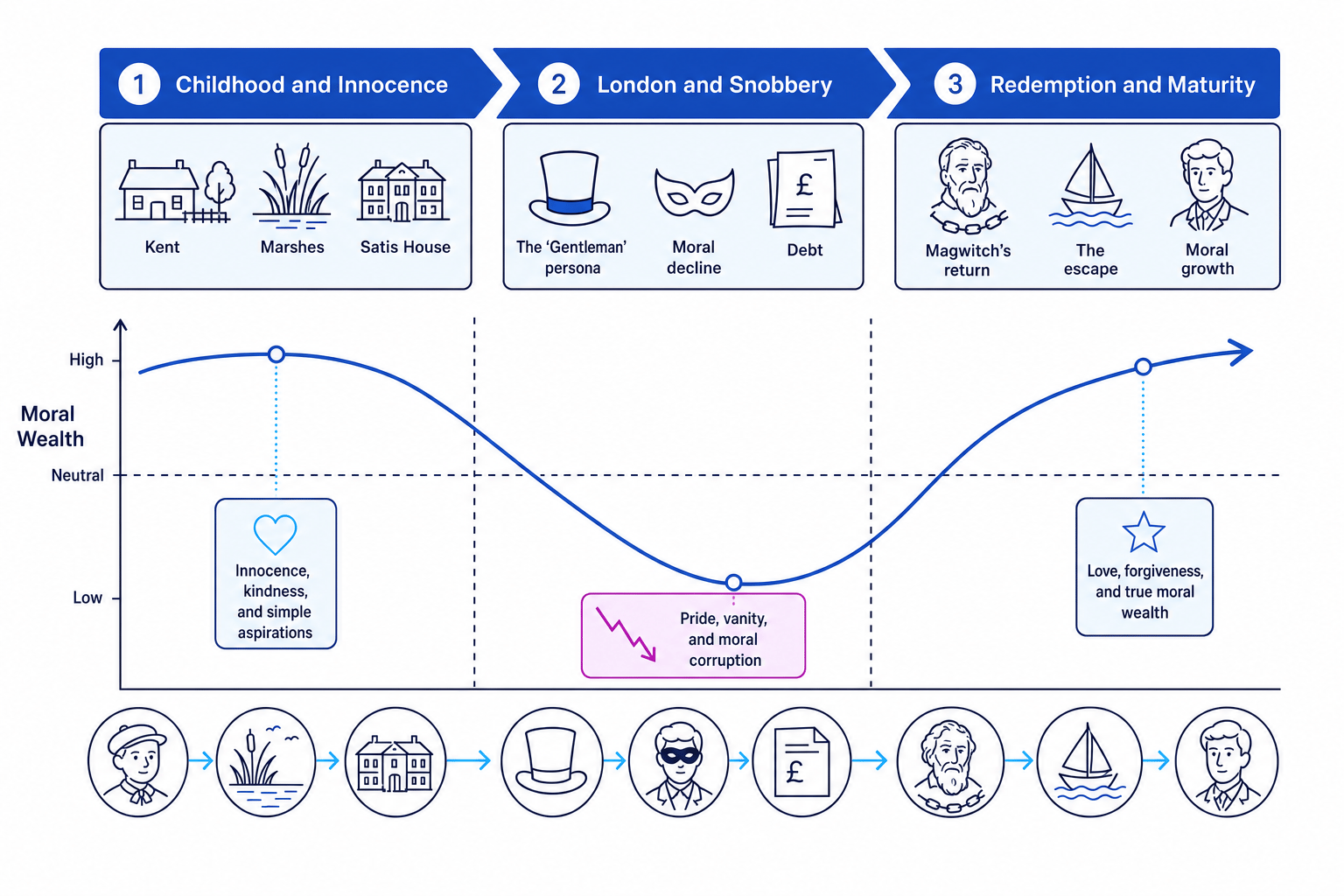
The Three Stages of Pip's Expectations
Stage 1 (Chapters 1 to 19): Childhood, Innocence, and the Seeds of Ambition
The novel begins on the bleak Kent marshes. Pip is a vulnerable orphan raised "by hand" by his abusive sister, Mrs. Joe, and protected only by her warm-hearted blacksmith husband, Joe Gargery. Two massive disruptions shatter Pip's simple world:
- The Meeting on the Marshes: Pip encounters the escaped convict Abel Magwitch and is terrified into stealing food (a pork pie) and a file from Joe's forge. This early association with criminality instils a deep-seated, subconscious sense of guilt in Pip.
- The Invitation to Satis House: Pip is sent to play at the decaying mansion of the eccentric heiress Miss Havisham. There, he falls deeply in love with her cold, adopted daughter, Estella. Estella mocks his rough hands and his thick boots, calling him a "common labouring-boy."
These events trigger Pip's intense dissatisfaction with his working-class life. He rejects his blacksmith apprenticeship, viewing the forge as a prison of "coarse and common" labor. At the end of Stage 1, the London lawyer Mr. Jaggers arrives to announce that Pip has "great expectations"—he is to inherit a vast fortune from an anonymous benefactor and be educated as a London gentleman. Believing Miss Havisham is his secret patron, Pip departs for London, arrogantly turning his back on Joe and his loyal friend Biddy.
Stage 2 (Chapters 20 to 39): London, Snobbery, and Moral Decay
In London, Pip enters high society but undergoes a severe moral decline. He learns the superficial manners of a gentleman, moves in with the amiable Herbert Pocket, and joins an expensive, useless social club ("The Finches of the Grove").
As Pip’s social status rises, his moral worth plummets:
- He accumulates massive debts.
- He treats the simple, loving Joe with ashamed snobbery when Joe visits him in London, wishing "Joe had been rather more genteelly brought up."
- He passively watches his friend Herbert fall into financial ruin alongside him.
- He nurtures the illusion that he is destined for Estella, ignoring the emotional coldness she warns him about.
The climax of this stage—and the entire novel—occurs in Chapter 39. On a dark, stormy night, a rough, aging man climbs the stairs to Pip's London chambers. It is Abel Magwitch, the convict from the marshes. Pip is horrified to discover that this outcast of society—not the aristocratic Miss Havisham—is the source of his wealth.
The Paradox of Pip's Rise and Fall
The primary structural irony of the novel is that Pip’s social elevation is funded by the lowest member of Victorian society (a convict). His rise to the status of a "gentleman" is entirely dependent on criminal labor, utterly dismantling the Victorian myth that wealth and high social class are markers of moral superiority.
Stage 3 (Chapters 40 to 59): Redemption, Maturation, and Real Wealth
The final stage details Pip’s painful journey toward moral rehabilitation. Now that he knows his fortune comes from a wanted criminal, Pip can no longer accept Magwitch's money. He resolves to help Magwitch escape the country to save him from execution.
During this stage of redemption:
- Pip learns selflessness: He secretly uses his remaining resources to secure a business partnership for Herbert, performing his first truly noble deed.
- He discovers the truth of Estella’s parentage: In a brilliant narrative twist, Pip realizes Estella is the daughter of Magwitch and Jaggers's maid, Molly. This destroys the remaining illusions of class superiority; the cold, aristocratic Estella is actually the child of two criminals.
- The tragic climax: The escape attempt on the River Thames fails. Magwitch is injured, captured, and sentenced to death, though he dies peacefully in prison with a loving Pip by his side.
- The return to humility: Ill and deeply in debt, Pip is nursed back to health by Joe, who pays off his debts. Pip finally recognizes Joe's absolute moral worth, begging for his forgiveness.
Pip ends the novel without his fortune or his pride, but with his humanity fully restored. He spends eleven years working hard as a clerk in Egypt with Herbert, finally earning his living through honest work rather than unearned "expectations."
The Two Endings
Dickens originally wrote a quiet, bittersweet ending where Pip and Estella meet briefly in London and part forever. His friend Edward Bulwer-Lytton persuaded him to write a more hopeful ending where they meet in the ruined garden of Satis House, and Pip sees "no shadow of another parting from her." Be prepared to discuss how these different endings alter our interpretation of Pip's ultimate resolution!
Analysing Narrative Pivots (AO2 & AO4)
To achieve top marks, you must show the examiners how Dickens uses specific plot events to construct his social critique (AO4) and how he uses language and structural devices to do so (AO2). Let us walk through how to unpack a pivotal plot moment.
Tracking Structural Shifts: Magwitch's Return
Suppose you are answering an exam question on how Dickens uses structure to convey the theme of social class. Here is how you can systematically unpack the dramatic structural pivot of Magwitch's return in Chapter 39.
- Locate the turning point within the tripartite structure: Identify that this scene represents the exact midpoint of the novel, transitioning Pip from the snobbery of Stage 2 to the redemption of Stage 3. This is the moment of peripeteia (a sudden reversal of fortune).
- Examine the atmospheric preparation (Pathetic Fallacy): Notice how Dickens uses the weather to foreshadow the structural shift. Pip describes the weather as "wet and windy" and the wind "rushing charged with rain." This echoes the wet marshes of his childhood, showing that his past is literally blowing back into his sterile, urban life.
- Analyse the language of Pip's initial reaction: When Magwitch reveals himself, Pip reacts with visceral horror, describing Magwitch as "a dreadful beast" and demanding he "keep off." Use this to demonstrate Pip’s internalized Victorian class prejudice; he sees the criminal as subhuman, despite having lived off his money.
- Evaluate the thematic resolution of the scene: Note the contrast between Magwitch's pride in having "made a gentleman" and Pip's sudden realization that his "expectations" are built on crime. Connect this to Dickens's critique of Victorian society: the wealth of the upper classes is built on the exploitation and suffering of the underclass.
Confusing Pip the Narrator with Pip the Character
Students often write that "Pip is a shallow snob throughout the novel." Remember that Great Expectations is written in the first person by an older, retrospective narrator. The older Pip is deeply ashamed of his younger self's snobbery and frequently uses self-deprecating language to judge his past actions. Always distinguish between the immature young Pip experiencing the plot and the wise older Pip narrating it.
In the exam
- Never just retell the plot: The examiner knows what happens. Instead of writing "then Pip went to London," write "Dickens structures Pip’s transition to London to highlight his growing moral detachment from his pastoral roots."
- Anchor plot points to structure: Use terms like tripartite structure, foreshadowing, climax, peripeteia, and retrospective narrative voice to demonstrate your mastery of structural analysis (AO2).
- Link plot to Victorian context (AO4): Remember that every plot event serves Dickens's wider social purpose. For example, the legal machinations of Jaggers's office mock the cold, bureaucratic Victorian justice system that values property over human life.
- Track character development: Show how key characters (especially Pip, Estella, and Miss Havisham) change across the three stages. Their personal transformations mirror the overarching narrative arc.
Check yourself
- Why did Dickens split the novel into exactly three distinct "Stages"? How does this structural division reflect Pip's moral development?
- How does the weather and gothic atmosphere of Satis House foreshadow the tragic fates of Miss Havisham and Estella?
- Contrast Pip's feelings toward Magwitch at the end of Stage 2 with his feelings at the end of Stage 3. What does this change reveal about Pip's definition of a "gentleman"?