Planning is the single most important step in writing a successful literature essay. In the high-pressure environment of the Edexcel IGCSE English Literature exam, a clear, logical plan acts as your roadmap. It ensures you remain focused on the question, budget your time effectively, and balance all the assessment objectives required for a top grade.
This guide will show you how to construct highly effective essay plans specifically for Charles Dickens’s Great Expectations, helping you move away from simple plot summaries toward sophisticated, thematic arguments.
What you'll learn
- How to deconstruct an Edexcel IGCSE essay prompt to identify its core demands.
- How to design a thesis statement that guides your entire response.
- How to balance analysis of Dickens's methods (AO2) and Victorian social context (AO4) within a structured outline.
- A step-by-step method for planning high-scoring responses under exam conditions.
The Edexcel IGCSE Essay Blueprint
Before putting pen to paper, you must understand exactly how your essay is assessed. For Great Expectations (Component 2, Section B: Literary Heritage), your writing must balance three key Assessment Objectives (AOs):
- AO1: Close knowledge and understanding of the text, demonstrated through a cohesive, critical argument and precise textual reference.
- AO2: Analysis of how the writer uses language, form, and structure to create meaning and effects, using appropriate literary terminology.
- AO4: Exploration of the relationships between the text and the context in which it was written (Victorian society, class systems, and industrialisation).
Thesis Statement
A thesis statement is a one- or two-sentence summary of your main argument. It directly answers the exam prompt and provides a conceptual roadmap for the rest of your essay, moving beyond simple plot facts to explore Dickens's deeper authorial intent.
To achieve high marks, these three components must work together in every paragraph. The visual flowchart below outlines how you should structure your ideas in a planned paragraph:
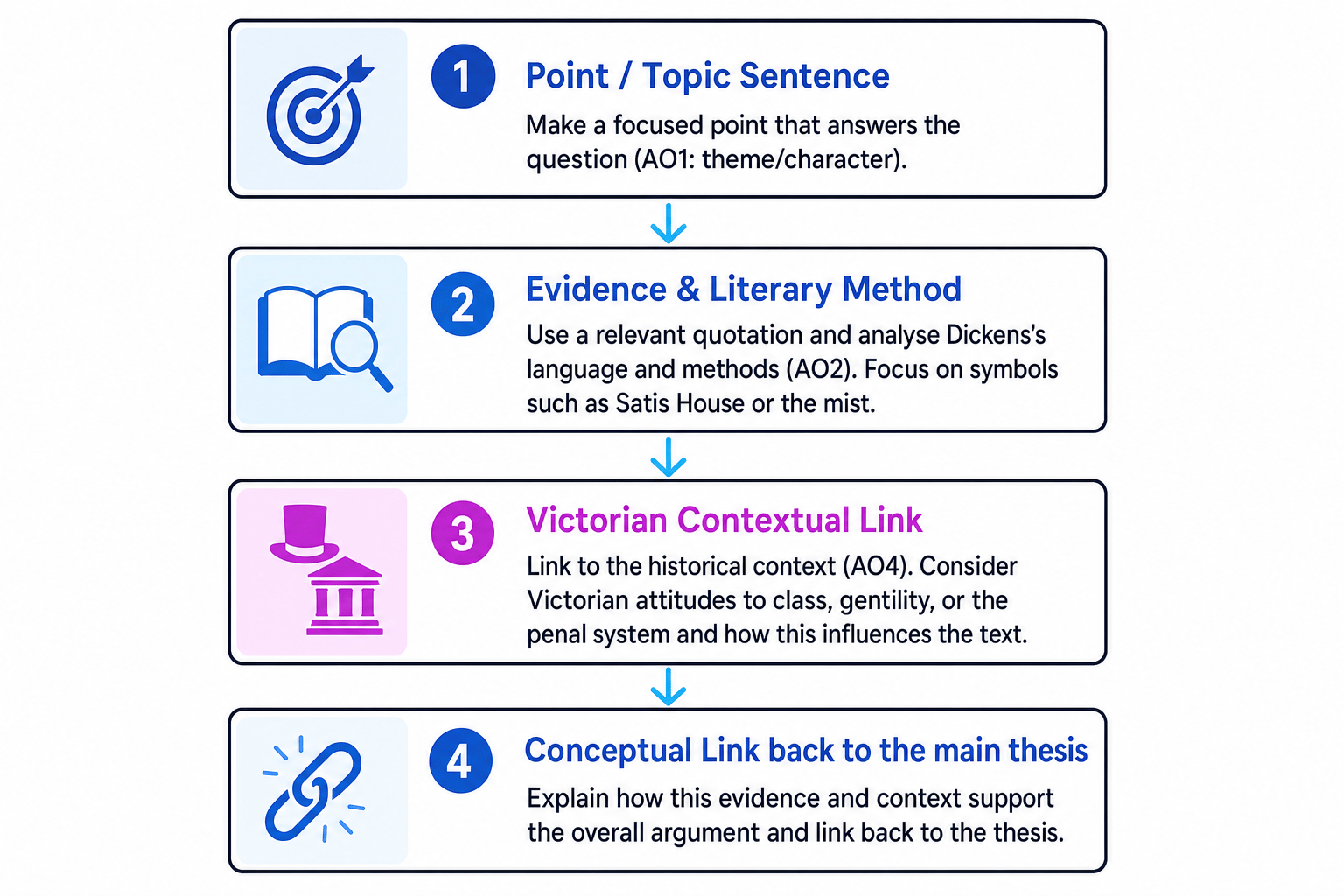
The Open-Book Trap
Component 2, Section B is an open-book exam. This means you are allowed to take a clean copy of Great Expectations into the examination room. While this is a valuable safety net, it can also be a dangerous trap.
The Open-Book Illusion
Many students fail to plan because they believe they can "find the quotes as they write." This leads to aimless flipping through pages, lost time, and disjointed essays that read like summaries rather than arguments. Use the text to double-check quote accuracy and page references, not to discover your argument on the fly.
By planning before you open your text, you define the evidence you need in advance. This allows you to find your target passages quickly, keeping your analysis precise and your timing on track.
Deconstructing the Exam Prompt
Every IGCSE essay question contains "keywords" that signal what you need to focus on. Most prompts will ask you to explore a theme (e.g., social class, ambition, guilt) or a character/relationship (e.g., Estella, Magwitch, the relationship between Pip and Joe).
To deconstruct a prompt, you must look for:
- The Core Subject: Which character, relationship, or theme is the focus?
- The Operational Directive: Words like explore, how does, or to what extent which demand a analytical perspective rather than just description.
- The Conceptual Angle: The deeper moral or social message Dickens conveys through this subject.
The 'Why' Factor
Whenever you write an essay plan, always ask: Why did Dickens write this? If the question is about Joe Gargery, the answer isn't just "to show a nice blacksmith." It is to challenge the Victorian assumption that social status equates to moral superiority. This is your conceptual angle.
Planning a Thematic Essay
Let's look at how to construct a comprehensive essay plan from scratch. We will walk through the planning process using a core theme: social class and gentility.
Planning an essay on the presentation of social class
Prompt: Explore how Dickens presents the theme of social class and gentility in Great Expectations.
Here is how you can build a high-scoring essay plan in four structured steps.
- Formulate your thesis statement: Create a central argument that directly addresses the Victorian context (AO4) and Dickens's purpose (AO1).
- Drafting: "Dickens challenges the Victorian equation of high social class with moral superiority. Through Pip’s journey, he presents true 'gentility' not as a product of wealth or status, but as an internal quality of moral integrity and love."
- Map out a three-part conceptual structure: Divide Pip's journey into three logical, chronological phases that show the development of this theme.
- Paragraph 1: The Forge as a site of moral purity despite low social class (Joe Gargery).
- Paragraph 2: Satis House and London as sites of moral decay despite high social status (Miss Havisham, Bentley Drummle).
- Paragraph 3: Pip’s redemption through Magwitch, proving that true gentility is found in selflessness and loyalty, not social elevation.
- Select key evidence and literary methods (AO2) for each section:
- For Paragraph 1: Joe is described as "a worthy worthy man." Contrast this with Pip’s growing shame at his "coarse hands" and "thick boots" (sensory imagery of class shame).
- For Paragraph 2: Satis House is described as "gilded and festering" (metaphor for the corrupting nature of inherited wealth); Bentley Drummle is characterized as an "idle, proud, miserly" brute, exposing the moral emptiness of high society.
- For Paragraph 3: Pip’s realization about Magwitch: "I only saw in him a much better man than I had been to Joe" (juxtaposition, syntax of remorse).
- Integrate Victorian contextual links (AO4) for each point:
- Forge Context: The Victorian class system valued industrialism and social climbing, often looking down on the rural working class. Dickens subverts this.
- Satis/London Context: Satirises the idle upper class and the Victorian obsession with superficial "gentlemanly" behavior, which was often funded by colonial exploitation or corrupt systems.
- Magwitch Context: The harsh Victorian penal system and treatment of convicts as irredeemable. Dickens uses Magwitch to criticize the hypocrisy of a society that outlaws the poor and elevates corrupt wealthy men.
Feature Spotting without Purpose
When planning your AO2 analysis, do not just list literary devices (e.g., "Dickens uses a metaphor here"). Your plan must link the device directly to its effect. For example: "The decaying setting of Satis House reflects the moral decay of the aristocratic class."
The "Golden Thread" Technique
To achieve the highest marks in AO1, your essay must be a cohesive argument, not a list of disconnected observations. We call this the Golden Thread.
The Golden Thread
Every single paragraph of your essay must refer back to your central thesis statement. When writing your plan, write your thesis at the very top of your page in bold, and draw lines from each paragraph point back to it to ensure your argument never wanders off course.
When planning, use transitional phrases at the start of your paragraph outlines to show how your ideas build on one another:
- In contrast to the moral purity of the forge...
- This corruption is further manifested in...
- Ultimately, Dickens resolves this tension by...
In the exam
- Spend 5–7 minutes planning. Do not skip this step to start writing immediately. A well-planned essay is always faster to write and more coherent.
- Write down your thesis statement first. This ensures your entire essay has a clear, singular direction from the very first sentence.
- Select 2-3 precise quotations per paragraph. Write these abbreviations in your plan so you can quickly locate them in your clean copy of the text.
- Annotate your plan with AO markers. Write (AO2) and (AO4) next to your paragraph points to ensure you have a balanced, complete response.
Check yourself
- Can you explain why relying entirely on an open-book text during the exam can harm your timing and structure?
- Look at the character of Estella. What thesis statement could you write to argue that she is a victim of social class rather than a villain?
- Which specific Victorian contextual factors (AO4) would you include in an essay plan focusing on Magwitch and the justice system?