What you'll learn
- How to tell the difference between language, form and structure in Great Expectations.
- How Dickens uses Pip’s retrospective narration to create sympathy, humour and irony.
- How recurring images — mist, chains, hands, fire and decay — build meaning across the novel.
- How the novel’s three-stage structure turns Pip’s “great expectations” into a moral education.
Start with the basics
In Edexcel IGCSE English Literature, Great Expectations is studied in Component 2, Section B, so the exam is open book: you may use a clean copy of the text. That helps with exact quotations, but you still need to know where Dickens’s methods matter and why they are effective.
Language, form and structure
- Language means Dickens’s choice of words and sentences: imagery, dialogue, symbolism, sentence length, repetition and figurative language.
- Form means the type of text and the conventions Dickens uses: a Victorian novel, a first-person life story, a bildungsroman and a serialised mystery.
- Structure means how the text is arranged: order of events, turning points, contrasts, repetitions, foreshadowing, chapter endings and the overall shape of Pip’s journey.
The big idea
Dickens does not just tell us that Pip changes. He makes us experience that change through an older Pip looking back, through repeated images of guilt and ambition, and through a plot that overturns Pip’s assumptions.
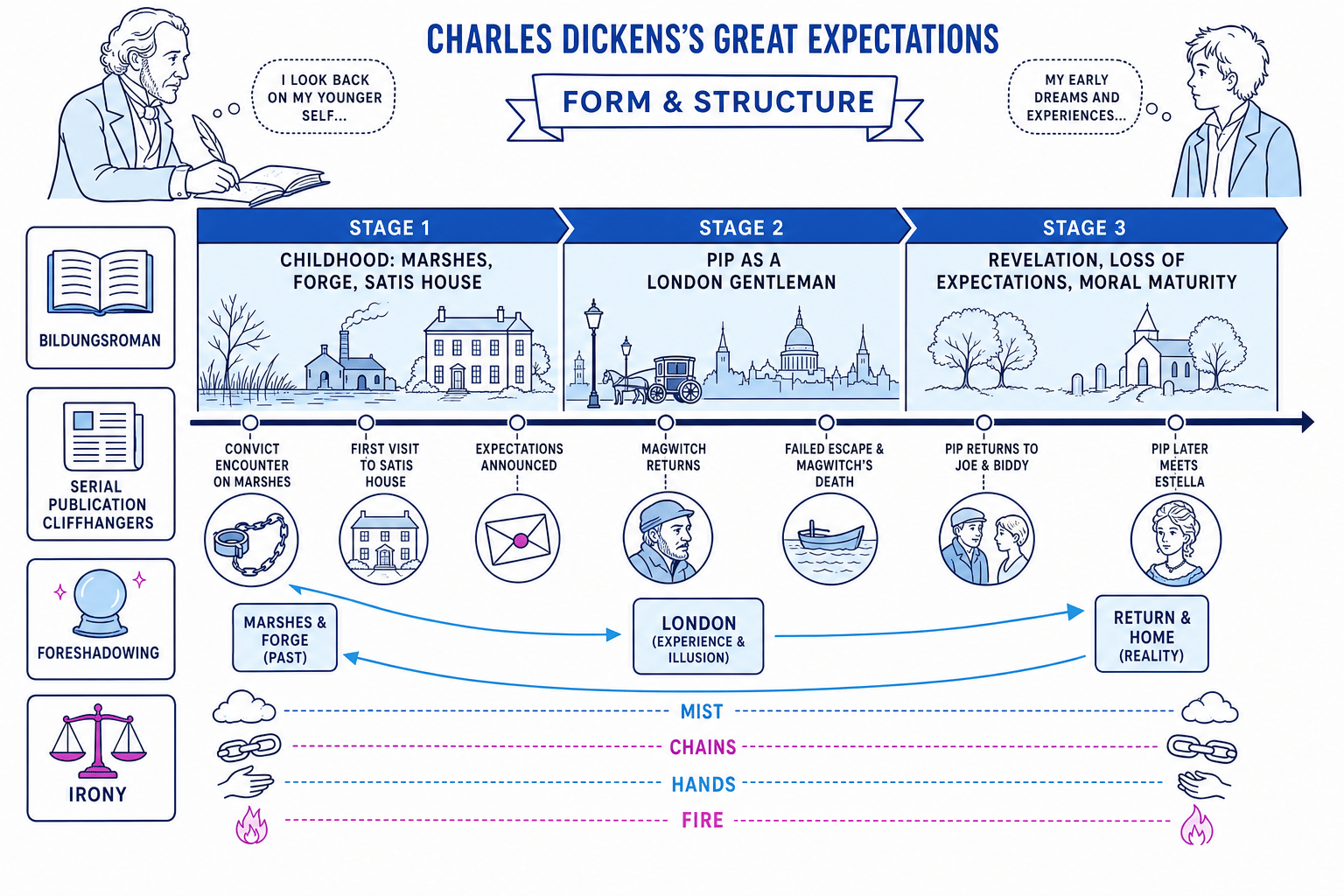
The novel’s design is easiest to see as Pip looking back over three stages: childhood, London “expectations”, then revelation and moral revaluation.
Language: Dickens’s words and sentences
Narrative voice: older Pip tells younger Pip’s story
A first-person narrator tells the story using “I”. A retrospective narrator tells events after they have happened, looking back with later knowledge. In Great Expectations, Pip is both the frightened child in the story and the older adult shaping the story.
The opening shows this clearly: “My father’s family name being Pirrip, and my Christian name Philip, my infant tongue could make of both names nothing longer or more explicit than Pip” (Chapter 1). The phrase “infant tongue” makes Pip sound small and vulnerable, but the neat adult phrasing reminds us that this is memory being carefully narrated.
This creates irony, which means a gap between what someone understands and what the reader or narrator understands. Younger Pip often misreads events; older Pip can show us his mistakes without needing to explain everything bluntly.
Imagery, symbols and motifs
Imagery is descriptive language that creates a mental picture. A symbol is an object, place or action that carries a wider meaning. A motif is a repeated image or idea that gathers meaning each time it appears. A semantic field is a group of words linked by meaning.
Dickens’s imagery often makes Pip’s inner life visible. In Chapter 1, Magwitch appears as “a fearful man, all in coarse grey, with a great iron on his leg”. The “great iron” is literal, but it also begins a wider pattern of chains, guilt and imprisonment. Pip is not a criminal, yet he quickly feels trapped by fear and secrecy.
Satis House is another key symbolic setting. When Pip first enters, “No glimpse of daylight was to be seen in it”, and everything that “ought to be white” has “lost its lustre” and become “faded and yellow” (Chapter 8). The language of blocked light and decay turns wealth into something unhealthy and deathly.
Analysing Satis House imagery
-
Start with the precise words: “No glimpse of daylight” suggests enclosure, secrecy and unnatural darkness, while “faded and yellow” suggests age, decay and corruption.
-
Name the method and pattern: Dickens uses a semantic field of decay to make Satis House feel less like a rich home and more like a tomb or prison.
-
Connect the effect to Pip: because Pip enters this setting before becoming ashamed of his “coarse hands” and “thick boots”, the house becomes the place where his innocent identity is damaged by class ambition.
Device spotting
Do not write, “Dickens uses imagery” and stop there. Always add what the image suggests, how it affects the reader, and how it links to Pip’s changing understanding.
Dialogue and idiolect
Dialogue is speech between characters. Idiolect means a character’s distinctive way of speaking. Dickens uses idiolect to reveal class, power and personality.
Joe’s warm, awkward speech — “ever the best of friends; ain’t us, Pip?” — shows loyalty rather than polish. Magwitch’s dialect in “I’ve made a gentleman on you!” is grammatically non-standard, but emotionally powerful. Wemmick’s repeated phrase “portable property” makes him sound practical and divided between work and home. Jaggers’s legal language — “Take nothing on its looks; take everything on evidence” — makes him sound controlled, suspicious and professional.
This matters because Dickens challenges the idea that “gentlemanly” speech equals moral worth. Some polished characters are cruel or empty; some rough-speaking characters are deeply generous.
Syntax, repetition and weather
Syntax means the arrangement of words and sentences. Dickens often uses long, winding sentences for reflection, and sharp repeated phrases for pressure or panic.
A key example comes when Magwitch returns in Chapter 39: “It was wretched weather; stormy and wet, stormy and wet; and mud, mud, mud.” This is pathetic fallacy, where weather or setting reflects mood or events. The repeated “stormy” and “mud” make London feel morally and physically filthy just as Pip’s fantasy of gentlemanly success is about to collapse.
Form: what kind of novel is this?
A bildungsroman is a novel about a character’s growth or formation. Great Expectations follows Pip from childhood to adulthood, but Dickens makes the “education” moral rather than simply social. Pip does gain money, clothes and status, but those things do not make him better.
The novel also mixes several forms:
- It is a Victorian social novel, exposing class prejudice, crime, money and respectability.
- It uses Gothic elements: darkness, decay, imprisonment, secrets and haunted spaces such as Satis House.
- It works like a mystery novel, delaying the truth about Pip’s benefactor and Estella’s parentage.
- It was published in weekly serial parts in All the Year Round in 1860–61, so Dickens often uses suspense, coincidences and strong chapter endings.
Reading Pip’s growth as a bildungsroman
-
Compare Pip’s early possibilities: the forge is described as a “glowing road to manhood and independence”, suggesting honest work could have led to a healthy future.
-
Notice the false lesson Pip learns at Satis House: Estella’s insults about his “coarse hands” and “thick boots” make him confuse social refinement with personal value.
-
Link this to the form: as a bildungsroman, the novel makes Pip unlearn this false lesson, so his real growth comes through shame, gratitude and compassion rather than wealth.
Structure: how Dickens arranges the journey
The novel has a clear three-part movement. In Chapters 1–19, Pip grows up on the marshes and receives his expectations. In Chapters 20–39, he lives as a London gentleman. In Chapters 40–59, the truth about Magwitch forces him to reassess everything.
A major structural technique is foreshadowing, where the writer plants hints about later events. After Pip’s first visit to Satis House, older Pip tells us: “Pause you who read this, and think for a moment of the long chain of iron or gold, of thorns or flowers” (Chapter 9). The “chain” metaphor suggests that one moment can bind a whole life. It also echoes Magwitch’s literal chain, linking Pip’s class ambition to guilt and crime.
Dickens also uses reversal, sometimes called peripeteia, meaning a sudden change in fortune or understanding. The greatest reversal is Magwitch’s return in Chapter 39. Pip has assumed Miss Havisham is his secret benefactor and that Estella is his intended reward. Magwitch’s line, “Yes, Pip, dear boy, I’ve made a gentleman on you!”, destroys that fantasy.
Tracing the Magwitch reversal
-
Establish Pip’s earlier assumption: the Satis House plot encourages him to imagine that wealth, Miss Havisham and Estella are all connected to his future.
-
Identify the structural turning point: when Magwitch says, “I’ve made a gentleman on you!”, Dickens reveals that Pip’s status comes from the convict he once feared and rejected.
-
Explain the effect: the reader shares Pip’s shock, but also sees the moral irony — Pip’s “gentlemanly” identity depends on a man society calls criminal, forcing the novel to question what true gentility means.
Circular structure and the ending
The novel is partly circular: Pip begins in the marshes, escapes towards London, then has to return emotionally and morally to Joe, Biddy and the values he once rejected. This does not mean nothing has changed. A circular structure can show growth because the character comes back with a different understanding.
The ending is deliberately open. In the revised ending, Pip sees Estella again and says, “I saw no shadow of another parting from her.” The phrase is hopeful but not a definite marriage promise. The “shadow” image keeps some uncertainty, which suits a novel about illusion, disappointment and hard-earned maturity.
The ending
There are two historical endings to Great Expectations. In the exam, use the ending printed in your clean copy. If you discuss the revised ending, avoid claiming too confidently that Pip and Estella definitely marry.
Bringing language, form and structure together
The strongest paragraphs do not treat language, form and structure as separate checklists. Try to show how they work together.
For example, Satis House is not just a setting. Its decayed imagery creates a Gothic atmosphere; its position early in the novel makes it a turning point in Pip’s development; and its effect on Pip fits the bildungsroman form because it begins his false education in class shame.
A useful sentence pattern
Try: “At this point in the novel, Dickens uses [method] to present [idea], so that the reader sees [effect on Pip / theme / reader].” This keeps your analysis focused on meaning, not just terminology.
In the exam
-
Use your clean copy to check exact wording, but revise key locations in advance: Chapter 1, Satis House, Pip’s expectations, Magwitch’s return, Magwitch’s death, and the ending.
-
For AO2, always name the method and explain its effect: word choice, imagery, motif, narrative voice, genre, foreshadowing or reversal.
-
For AO4, link context to Dickens’s choices: Victorian class anxiety, criminal justice, serial publication and ideas of gentility should support your analysis, not sit in a separate paragraph.
Check yourself
- How does older Pip’s narration change the way we judge younger Pip’s mistakes?
- Which repeated motif — mist, chains, hands, fire or decay — could you track across three moments in the novel?
- Why is Magwitch’s return such an important structural reversal?