What you'll learn
- How to choose short, flexible quotations from Great Expectations.
- How key quotations connect to Pip’s development, class, guilt, love, crime and redemption.
- How to analyse Dickens’s language, form and structure for AO2.
- How to use quotations effectively in an Edexcel IGCSE Literature essay.
Why “key quotes” matter
In Edexcel IGCSE English Literature, Great Expectations appears in Component 2, Section B: Literary Heritage. This section is open book, so you may use a clean copy of the text in the exam.
That does not mean quotations are unimportant. You still need to know which moments matter, where to find them, and how to use brief evidence accurately.
Key quotation
A key quotation is a short piece of textual evidence that is flexible enough to support analysis of several themes, characters or turning points.
A strong quote is usually:
- short enough to embed smoothly in a sentence
- accurate enough to show close knowledge
- rich enough to analyse for method and meaning
- flexible enough to use for more than one possible question
For example, Estella’s insult, “what coarse hands he has! And what thick boots!” is useful for class, shame, Pip’s identity, Estella’s cruelty and Satis House.
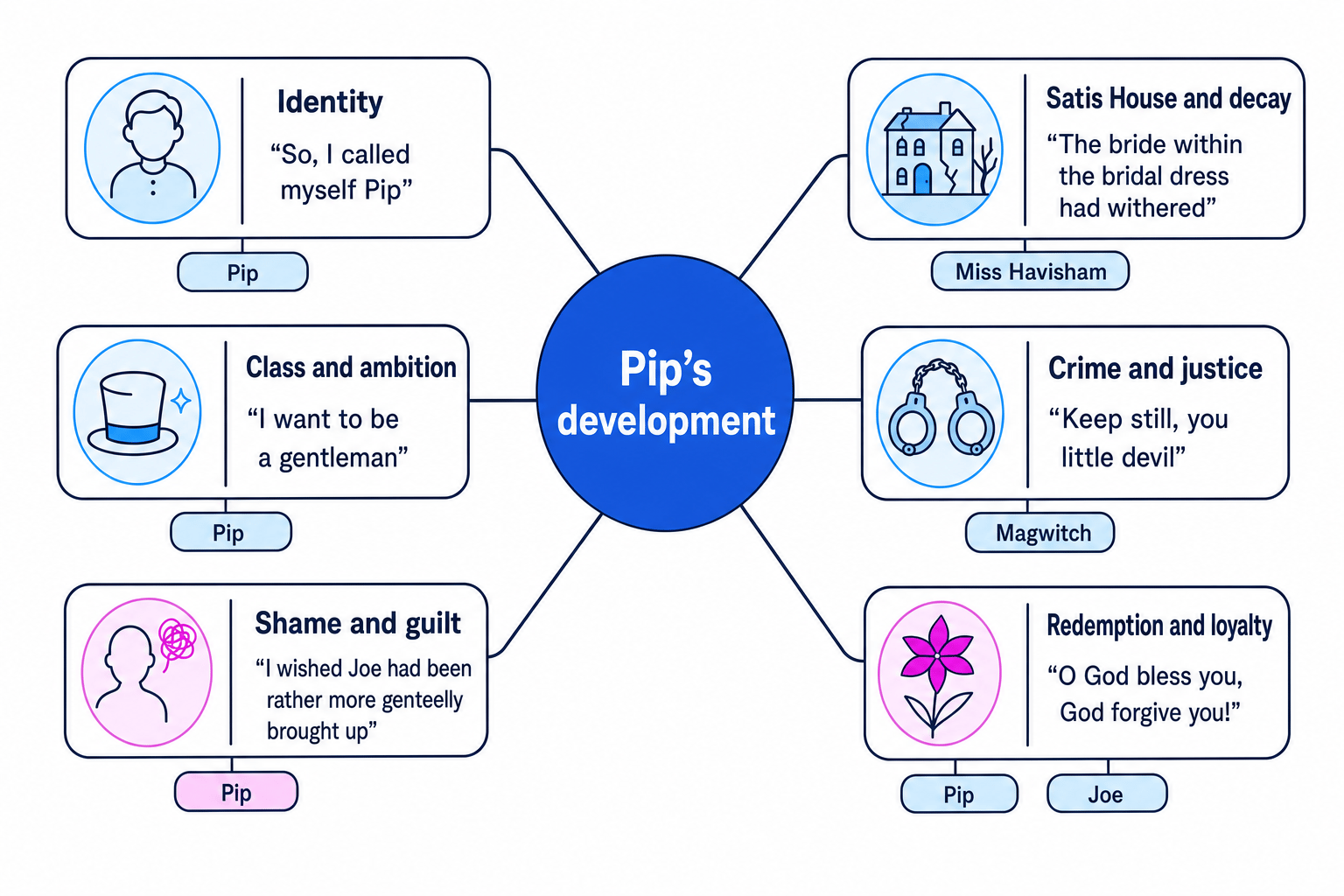
The big picture: quotes that track Pip’s development
Dickens structures Great Expectations as Pip’s journey from frightened child, to ashamed young man, to a more morally mature adult. The best quotations help you trace that journey.
Bildungsroman
A Bildungsroman is a coming-of-age novel that follows a young person’s moral, emotional and social development. Great Expectations is a Bildungsroman because Pip learns painful lessons about class, loyalty, guilt and love.
Quote journeys
Try not to learn quotations as isolated “nice lines”. Learn them as part of Pip’s moral journey: innocence → shame → ambition → disillusionment → repentance → maturity.
1. Identity and childhood
“So, I called myself Pip, and came to be called Pip.” — Pip, Chapter 1
This opening quotation introduces the novel’s first-person narrative.
First-person narrative
A first-person narrative is told using “I”. In Great Expectations, Pip narrates his own life story, looking back as an adult on his childhood and youth.
The quote seems simple, but it is very important. Pip’s name is self-created: he cannot pronounce “Philip Pirrip”, so he becomes “Pip”. Dickens immediately links identity to language, childhood and memory.
You could use this quote for:
- Pip’s childhood innocence
- identity and self-invention
- the reflective adult narrator
- the idea that Pip’s life story is shaped by memory
“a small bundle of shivers” — Pip, Chapter 1
This description of young Pip in the churchyard presents him as tiny, vulnerable and frightened.
The noun “bundle” makes him seem like an object rather than a powerful person. The plural noun “shivers” turns his fear into something physical. Dickens encourages the reader to pity Pip before Magwitch even appears.
Retrospective narration
Retrospective narration means a narrator tells events after they have happened. Adult Pip looks back on his younger self, so the novel often combines childish fear with adult understanding.
2. Crime, fear and guilt
“Keep still, you little devil, or I’ll cut your throat!” — Magwitch, Chapter 1
Magwitch’s first words are violent and threatening. The command “Keep still” creates immediate danger, while “little devil” sounds brutal and dehumanising.
However, Dickens later complicates our first judgement. Magwitch is frightening, but he is also desperate, starving and socially rejected. This is typical of Dickens: characters are often more morally complex than they first appear.
“Conscience is a dreadful thing when it accuses man or boy” — Pip, Chapter 5
This is one of the clearest quotations for Pip’s guilt. His conscience punishes him before the law does.
Conscience
A conscience is a person’s inner sense of right and wrong. In the novel, Pip often suffers because he knows he has behaved badly even before anyone else judges him.
The phrase “man or boy” is important because it links childhood and adulthood. Dickens suggests guilt is not childish or trivial; it is a deep human experience.
Using a guilt quotation
- Choose a quotation that shows Pip’s inner conflict: “Conscience is a dreadful thing”.
- Identify the key word. “Dreadful” suggests fear, heaviness and emotional punishment.
- Link it to character development. Pip is not simply a naughty child; he is morally sensitive and already capable of shame.
- Connect it to the wider novel. Later, Pip’s guilt grows when he becomes ashamed of Joe and neglects the people who love him.
3. Joe, home and moral goodness
“If you can’t get to be oncommon through going straight, you’ll never get to do it through going crooked.” — Joe, Chapter 9
Joe’s dialect is non-standard, but his moral judgement is extremely clear.
Dialect
Dialect is a form of language associated with a particular region, class or community. Dickens uses Joe’s dialect to show his working-class background, but not to make him morally inferior.
The contrast between “straight” and “crooked” creates a simple moral pattern. Joe believes goodness matters more than social advancement. This makes him a moral centre in the novel.
Confusing education with morality
Do not write as if Joe is foolish just because his grammar is imperfect. Dickens often shows that Joe’s emotional intelligence and moral honesty are greater than Pip’s.
“It is a most miserable thing to feel ashamed of home.” — Pip, Chapter 14
This is one of the best quotations for Pip’s guilt and class anxiety. The adjective “miserable” shows that Pip understands the pain and wrongness of his own shame.
The phrase “ashamed of home” is especially powerful because “home” should suggest comfort and belonging. Pip’s ambition damages the very relationships that once protected him.
4. Satis House, Estella and social shame
“What coarse hands he has! And what thick boots!” — Estella, Chapter 8
Estella’s insult changes Pip’s self-image. Before this moment, he does not think of himself as “common” in the same painful way.
The adjectives “coarse” and “thick” reduce Pip to physical signs of class. His hands and boots become symbols of labour, poverty and social inferiority.
Symbolism
Symbolism is when an object, person or detail represents a larger idea. Pip’s “hands” and “boots” symbolise his working-class background and the shame Estella teaches him to feel.
“Her contempt for me was so strong, that it became infectious, and I caught it.” — Pip, Chapter 8
This is a brilliant quotation for showing how Estella changes Pip. The metaphor of infection suggests that shame spreads like a disease.
Metaphor
A metaphor describes one thing as if it is another. Here, Pip describes Estella’s contempt as though it were an illness he can “catch”.
Pip does not just notice Estella’s contempt; he absorbs it. Dickens shows how class prejudice can become internalised, meaning Pip starts to judge himself through Estella’s cruel standards.
Turning a class quote into analysis
- Start with the point: Dickens shows that Pip’s ambition begins in humiliation rather than wisdom.
- Use evidence: Estella mocks “coarse hands” and “thick boots”.
- Analyse the method: these physical symbols reduce Pip’s identity to visible class markers.
- Explain the effect: the reader sees how quickly Pip learns to despise the honest labour that connects him to Joe.
- Link to the wider novel: this shame later drives Pip’s desire to become a gentleman and his neglect of home.
5. Miss Havisham and decay
“The bride within the bridal-dress had withered like the dress, and like the flowers” — Pip, Chapter 8
Miss Havisham is introduced through images of age, decay and frozen time. The simile “like the dress, and like the flowers” makes her seem part of the rotting wedding setting.
Gothic imagery
Gothic imagery uses darkness, decay, confinement, ghosts or ruined settings to create fear and unease. Satis House is Gothic because it is shut away, decaying and psychologically disturbing.
The wedding dress should symbolise happiness and new life, but here it becomes a symbol of emotional death. Miss Havisham has allowed one betrayal to dominate her whole identity.
“I stole her heart away and put ice in its place.” — Miss Havisham, Chapter 49
This later confession shows Miss Havisham’s guilt over Estella. The verb “stole” suggests moral crime, while “ice” symbolises emotional coldness.
Dickens presents Miss Havisham not only as a victim, but also as someone who damages others. Her suffering does not excuse her manipulation of Estella and Pip.
6. Estella, emotional damage and self-knowledge
“I have no heart” — Estella, Chapter 29
Estella’s statement is not simply cruelty. It reveals how Miss Havisham has trained her to suppress tenderness.
The “heart” is a symbol of emotional warmth and moral feeling. By claiming she has “no heart”, Estella shows the damage caused by being raised as an instrument of revenge.
“I am what you have made me.” — Estella to Miss Havisham, Chapter 38
This is one of Estella’s most important moments. She directly confronts Miss Havisham with the consequences of her upbringing.
The sentence is short and balanced. Estella refuses to accept all the blame for her coldness. Dickens explores how people are shaped by their environment, especially by the adults who control them.
“Suffering has been stronger than all other teaching” — Estella, Chapter 59
Near the end, Estella recognises that pain has changed her. The abstract noun “Suffering” is personified as a teacher.
Personification
Personification gives human qualities to something non-human or abstract. Here, “Suffering” is treated as if it can teach Estella.
This quote is useful for the ending, redemption and Dickens’s belief that moral understanding can come through pain.
7. Ambition and “great expectations”
“I want to be a gentleman.” — Pip, Chapter 17
This simple sentence captures Pip’s ambition. However, it is also painfully naive.
Gentleman
In the context of the novel, a gentleman is someone with higher social status, education, wealth and manners. Dickens questions whether being a gentleman is about class or character.
Pip thinks becoming a gentleman will make him worthy of Estella. Dickens gradually shows that wealth and manners do not automatically create goodness.
“a young fellow of great expectations” — Jaggers, Chapter 18
Jaggers’s announcement gives the novel its title. The phrase “great expectations” sounds exciting, but it is also uncertain. Expectations can mean hopes, social prospects or predicted inheritance.
Title quotation
When you use “great expectations”, remember the phrase is ironic. Pip’s expectations seem “great”, but they bring disappointment, snobbery and moral confusion before they bring wisdom.
“I wished Joe had been rather more genteelly brought up” — Pip, Chapter 8
This is a painful early sign of Pip’s snobbery. The adverb “genteelly” shows Pip has started measuring Joe by upper-class manners rather than love or loyalty.
Dickens makes the reader uncomfortable here because we understand what Pip does not: Joe’s goodness matters far more than gentility.
8. Magwitch and redemption
“Yes, Pip, dear boy, I’ve made a gentleman on you!” — Magwitch, Chapter 39
This revelation overturns Pip’s fantasy. Pip assumed Miss Havisham was his benefactor, but his wealth actually comes from Magwitch.
The phrase “dear boy” is unexpectedly affectionate. Magwitch’s grammar, “on you”, marks his class background, but his love for Pip is sincere. Dickens forces Pip, and the reader, to reconsider what real generosity looks like.
Dramatic irony
Dramatic irony happens when the reader or audience understands something a character does not. Much of Pip’s life as a gentleman is ironic because he misunderstands the source and meaning of his fortune.
“She is living now. She is a lady and very beautiful. And I love her!” — Pip to Magwitch, Chapter 56
Pip tells the dying Magwitch that his lost daughter, Estella, is alive. This is one of Pip’s most compassionate actions.
The short sentences create emotional directness. Pip no longer sees Magwitch mainly as a criminal or social embarrassment. He gives him comfort, dignity and love at the end of his life.
True gentility
By the end of the novel, Dickens suggests that a true gentleman is defined by compassion, loyalty and moral courage, not by money, accent or social rank.
9. The ending and maturity
“I saw no shadow of another parting from her.” — Pip, Chapter 59
This final line comes from the revised ending of the novel. It is deliberately ambiguous.
The word “shadow” suggests uncertainty as well as hope. Pip and Estella may remain together, but Dickens does not give a simple fairy-tale ending. What matters is that both characters have changed through suffering.
Do not overstate the ending
Avoid claiming that Pip and Estella definitely marry. The ending suggests possible reconciliation, but it remains open and emotionally restrained.
How to use key quotes in a paragraph
A good literature paragraph does not just drop in evidence. It moves from idea to method to effect.
Use this pattern:
- Point — answer the question directly.
- Evidence — embed a short quotation.
- Method — identify Dickens’s language, form or structure.
- Effect — explain what the reader understands or feels.
- Link — connect back to the theme, character or context.
Building a paragraph from one quote
- Make a focused point: Dickens presents Pip’s shame as something learned from Estella and the class system she represents.
- Embed evidence: after Estella mocks his “coarse hands” and “thick boots”, Pip becomes painfully aware of his working-class identity.
- Analyse method: the physical symbols of hands and boots reduce Pip to visible signs of labour and poverty.
- Explain effect: the reader sees that Pip’s ambition is rooted in humiliation, not simply self-improvement.
- Link to the novel: Dickens criticises a society in which class prejudice can make a loving home seem shameful.
Quick quotation bank
| Theme / character | Quotation | Use it for |
|---|---|---|
| Pip’s identity | “So, I called myself Pip” | childhood, self-invention, narration |
| Fear and crime | “Keep still, you little devil” | Magwitch, violence, first impressions |
| Guilt | “Conscience is a dreadful thing” | morality, childhood, inner punishment |
| Joe’s goodness | “going straight” / “going crooked” | honesty, morality, contrast with ambition |
| Shame | “ashamed of home” | class, guilt, Pip’s moral failure |
| Estella’s cruelty | “coarse hands” / “thick boots” | class prejudice, humiliation |
| Miss Havisham | “withered like the dress” | decay, Gothic setting, frozen time |
| Ambition | “I want to be a gentleman” | class, desire, naivety |
| Expectations | “a young fellow of great expectations” | title, irony, social mobility |
| Magwitch | “I’ve made a gentleman on you” | revelation, class, gratitude |
| Estella’s damage | “I am what you have made me” | upbringing, blame, emotional coldness |
| Ending | “no shadow of another parting” | ambiguity, maturity, reconciliation |
In the exam
- Use short quotations and analyse individual words rather than copying long passages from your clean text.
- Track Pip’s development across the novel: early fear, class shame, false expectations, painful recognition, then moral growth.
- Always connect Dickens’s methods to meaning: for example, explain how symbolism, Gothic imagery or narrative voice shapes the reader’s view.
- Remember that context matters for AO4: Dickens is questioning Victorian ideas about class, crime, respectability, childhood and social mobility.
Check yourself
- Which quotation best shows that Pip’s shame is learned from Estella?
- How could you use “I’ve made a gentleman on you” to discuss class and generosity?
- Why is the final quotation, “no shadow of another parting”, not a simple happy ending?