What you'll learn
- Which chapters are most useful as revision anchors for Great Expectations.
- How Dickens uses key chapters to develop Pip’s guilt, ambition, shame, love, and moral growth.
- How to connect chapters across the whole novel for AO1, AO2, and AO4.
- How to avoid retelling the plot and instead build analytical exam paragraphs.
How to use “key chapters”
A key chapter is not just “an important bit of the story”. It is a chapter that helps you unlock a theme, a character change, a structural turning point, or one of Dickens’s methods.
Key chapter
A key chapter is a section of the novel you can return to in essays because it gives you strong evidence for character, theme, structure, language, and context.
For Edexcel IGCSE, Great Expectations appears in Component 2, Section B: Literary Heritage, which is open book. You are allowed a clean copy of the text. However, open book does not mean “search randomly for quotes”. You need to know where the powerful moments are, so you can find evidence quickly and write with confidence.
Think in chapter chains
Strong answers often move through a chapter chain: one early moment, one middle development, and one later turning point. This shows AO1 knowledge of the whole novel, not just one scene.
The big structure: Pip’s journey
Great Expectations is a bildungsroman, a novel about a character’s growth from childhood towards maturity. Dickens also uses a retrospective narrator: adult Pip tells the story of his younger self, so he can judge his own past mistakes.
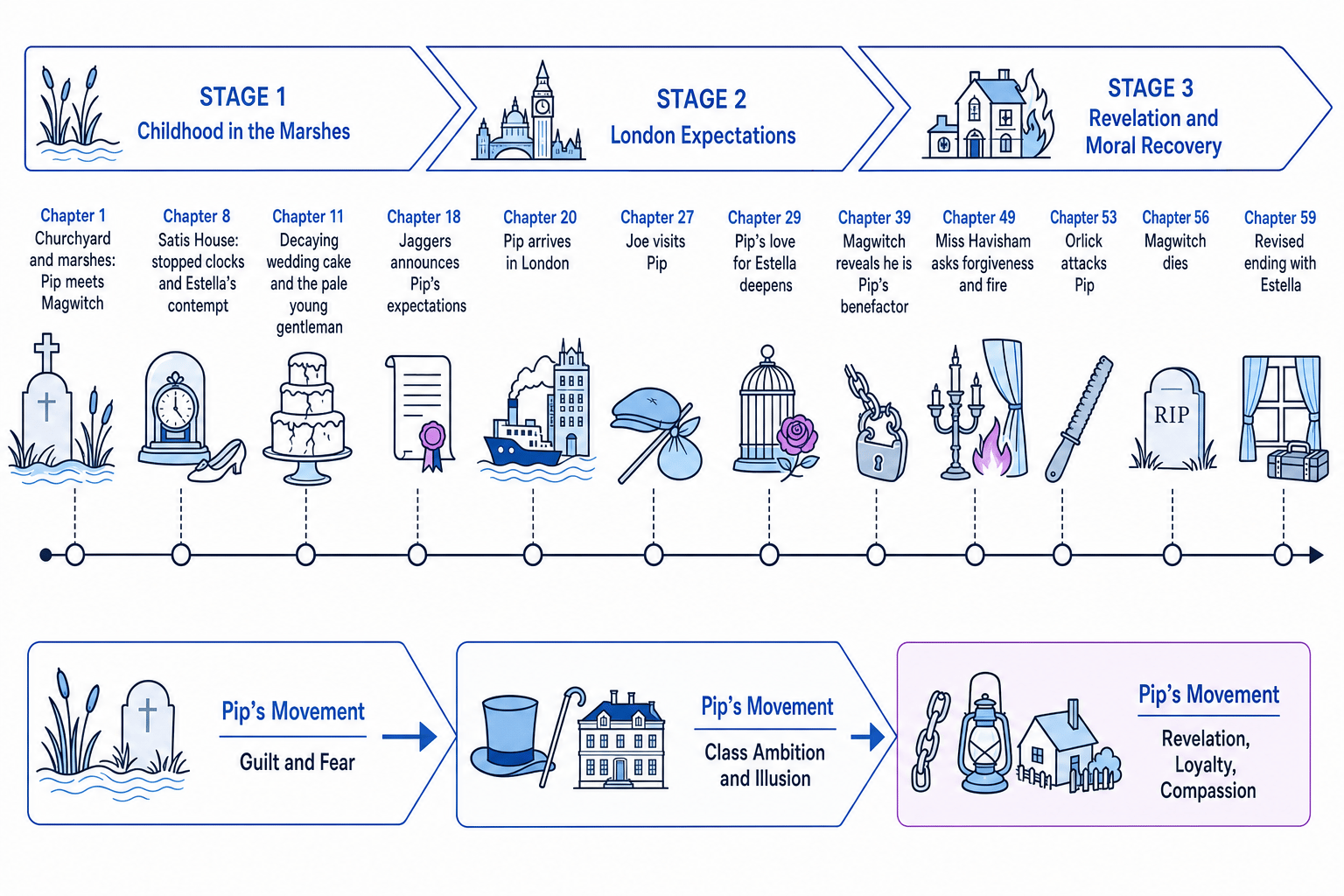
The timeline below gives you a visual route through the chapters that matter most for Pip’s movement from fear, to ambition, to compassion.
Choosing chapters for social class
-
Start with Chapter 8, because Estella’s insults about Pip’s “coarse hands” and “common boots” create his class shame. Dickens uses insulting adjectives to show how quickly Pip internalises upper-class contempt.
-
Move to Chapter 27, where Joe visits London and Pip admits, “If I could have kept him away by paying money, I certainly would have paid money.” This shows shame becoming cruel behaviour.
-
Finish with Chapter 39, where Magwitch reveals, “I’ve made a gentleman on you!” The structural reversal exposes Pip’s false assumptions about gentility.
-
Link to Victorian context: Dickens challenges the idea that a “gentleman” is defined by wealth, accent, or social position rather than loyalty and moral feeling.
Stage 1: childhood, guilt, and the first “expectations”
Chapter 1 — The churchyard and Magwitch
The opening chapter is essential because Dickens establishes Pip as vulnerable, frightened, and morally impressionable. Pip is alone in the churchyard, trying to understand his dead family from their gravestones. This immediately links identity with loss.
Dickens uses pathetic fallacy, where weather or setting reflects emotion, through the bleak marshes and threatening landscape. Pip describes himself as “a small bundle of shivers”, making him seem physically tiny and emotionally overwhelmed. Magwitch’s sudden command, “Hold your noise!” introduces violence, crime, and fear.
This chapter also plants later plot connections. Magwitch is not just a terrifying convict: he becomes the hidden source of Pip’s fortune. Dickens therefore turns the opening terror into later irony and moral complexity.
Chapters 8 and 11 — Satis House, Estella, and Miss Havisham
Satis House is one of the novel’s most important settings. Symbolism means using an object, place, or image to represent a deeper idea. Satis House symbolises wealth, decay, emotional damage, and false dreams.
In Chapter 8, Estella mocks Pip’s “coarse hands” and “common boots”. Pip says they had “never troubled” him before, but now they trouble him as “vulgar appendages”. This is the birth of his class shame. Dickens shows that Pip’s desire to become a gentleman is not simple greed: it grows from humiliation.
Miss Havisham’s stopped clocks and decaying bridal imagery show a life frozen by betrayal. In Chapter 11, the ruined wedding feast and cake deepen the Gothic atmosphere. Gothic writing uses darkness, decay, imprisonment, and fear to explore hidden trauma. Satis House looks grand, but it is spiritually rotten.
Analysing Satis House as a symbol
-
Choose a concrete detail: the stopped clocks and decaying wedding objects show that Miss Havisham’s life has stopped at the moment of betrayal.
-
Apply the method: Dickens uses symbolism because the house is not just a building; it represents emotional paralysis and corrupt wealth.
-
Connect to Pip: the same house that makes Pip ashamed also appears diseased and unnatural, so Dickens makes gentility both attractive and dangerous.
-
Link to the wider novel: Pip’s “expectations” seem glamorous at first, but Satis House foreshadows that social ambition may damage his values.
Chapters 17 and 18 — Pip wants to be a gentleman
Chapter 17 is useful because Pip openly tells Biddy, “I want to be a gentleman.” This matters because Biddy represents honesty, education, and moral steadiness. Pip’s confession shows he is already dissatisfied with the forge and with Joe, even before he receives money.
Chapter 18 is the official beginning of Pip’s “great expectations”. Jaggers announces that Pip “will come into a handsome property”, but the benefactor must remain secret. The condition that Pip must “always bear the name of Pip” is important: he gains a new social identity while being forced to keep the name of his childhood self.
Assuming Miss Havisham is the truth
Pip assumes Miss Havisham is his benefactor, but the novel later proves this wrong. In essays, treat this as Dickens’s structural misdirection: the plot encourages Pip’s false reading so that Chapter 39 becomes a powerful reversal.
Stage 2: London, shame, and false gentility
Chapter 20 — Pip arrives in London
Pip expects London to confirm his rise, but Dickens presents the city as morally dirty and connected to crime, law, and money. Jaggers’s world is full of clients, deals, fear, and performance. This is important contextually because Victorian London was often associated with opportunity, but also poverty, courts, prisons, and social inequality.
London does not make Pip better. It gives him polish, but it also increases his distance from Joe, Biddy, and the forge.
Chapter 27 — Joe visits Pip
This is one of the best chapters for Pip’s snobbery and self-awareness. Pip confesses that Joe’s visit brings “considerable disturbance” and “some mortification”. His harshest admission is: “If I could have kept him away by paying money, I certainly would have paid money.”
Dickens uses contrast. Joe’s awkward manners make him socially uncomfortable in London, but his kindness is far greater than Pip’s. Joe’s phrase, “life is made of ever so many partings welded together”, uses the language of the forge to express emotional wisdom. He may not speak like a gentleman, but he understands loyalty and love.
Chapters 29 and 38 — Estella and impossible love
Pip’s love for Estella is one of the strongest examples of destructive desire in the novel. Adult Pip reflects, “I loved her against reason, against promise, against peace, against hope, against happiness.” The repeated “against” shows that he knows the love is irrational and painful.
Miss Havisham encourages this damage with the repeated command, “Love her, love her, love her!” Dickens makes the repetition sound obsessive, almost like a spell. Estella’s later statement, “I have no heart”, shows that she too is a victim of Miss Havisham’s revenge project.
Chapter 34 — debt and empty gentlemanliness
Chapter 34 is useful for showing the hollowness of Pip’s new life. Pip and Herbert live beyond their means: “We spent as much money as we could, and got as little for it as people could make up their minds to give us.” The comic phrasing hides serious criticism. Dickens suggests that being a gentleman can become wasteful performance rather than moral improvement.
Stage 3: revelation, danger, and moral recovery
Chapter 39 — Magwitch returns
Chapter 39 is the central turning point. A turning point is a moment when the direction or meaning of the story changes. Magwitch arrives during stormy weather, and the atmosphere reflects Pip’s shock.
Magwitch tells Pip, “I’ve made a gentleman on you!” This sentence destroys Pip’s fantasy. His money has not come from Miss Havisham, and Estella was never “meant” for him. Even more painfully, his status has been funded by the convict he once feared.
This chapter forces Pip to rethink what a gentleman is. At first he feels horror and disgust, but the later chapters show him learning loyalty, gratitude, and compassion.
Chapters 44 and 49 — Miss Havisham’s guilt
Chapter 44 is important because Pip’s romantic illusion collapses further. Estella is to marry Drummle, and Pip’s declaration — “You are part of my existence, part of myself” — reveals how deeply he has built his identity around her.
Chapter 49 then gives Miss Havisham’s moral awakening. Her cry, “What have I done!” shows recognition of guilt. When she asks Pip to write “I forgive her”, Dickens presents forgiveness as more powerful than revenge. The fire that injures her is dramatic, but it also symbolises the destructive consequences of a life consumed by bitterness.
Chapters 53–56 — Orlick, Magwitch, and Pip’s compassion
Chapter 53, where Orlick attacks Pip, brings back the violence and guilt of Pip’s childhood world. Orlick is connected to the forge, Mrs Joe’s attack, and Pip’s buried fears. The chapter is useful because it shows the past physically returning to threaten Pip.
Chapters 54–56 are crucial for Pip’s moral recovery. Pip tries to help Magwitch escape, and when the plan fails, he stays loyal to him. In Chapter 56, Pip comforts the dying Magwitch by telling him that his daughter lives: “She is a lady and very beautiful. And I love her!” This is one of Pip’s most compassionate acts. He gives Magwitch peace, even though Magwitch can no longer give him money.
Chapters 57 and 59 — forgiveness and the ending
Chapter 57 completes Pip’s humbling. Joe nurses him through illness and pays his debts. This reverses Pip’s earlier shame: the person he looked down on becomes his rescuer.
Chapter 59 gives the revised ending with Estella. Estella says, “I have been bent and broken, but—I hope—into a better shape.” The final line, “I saw no shadow of another parting from her”, sounds hopeful, but it is not a simple fairy-tale marriage ending. The word “shadow” keeps the ending slightly uncertain.
The ending is deliberately ambiguous
Do not write that Dickens gives Pip a completely happy ending. The revised ending suggests reconciliation with Estella, but its wording leaves room for uncertainty and reflection.
In the exam
-
Use the open-book text strategically: know your key chapter locations before the exam, then select short quotations rather than hunting for long passages.
-
Build chapter chains: for a theme like class, guilt, love, or redemption, move from an early chapter to a middle chapter to a later turning point.
-
Analyse Dickens’s methods every time: connect events to narrative voice, setting, symbolism, contrast, repetition, dialogue, and Victorian context.
Check yourself
- Which chapter first makes Pip ashamed of his “coarse hands” and “common boots”?
- How does Chapter 39 change the meaning of Pip’s “great expectations”?
- Why is the final line, “I saw no shadow of another parting from her”, more ambiguous than a simple happy ending?