What you'll learn
- How to identify the main themes in Death and the King’s Horseman without reducing the play to a simple “culture clash”.
- How Soyinka develops themes through dialogue, stagecraft, symbolism and dramatic structure.
- How to connect themes to short, accurate quotations in an Edexcel IGCSE essay.
- How to write about themes in a way that hits AO1 and AO2 for Component 2 Modern Drama.
First: what is a theme?
Theme
A theme is a repeated idea or concern in a text. In drama, themes are developed through what characters say, what they do, how scenes are structured, and what the audience sees on stage.
A theme is not just a topic. “Death” is a topic; Soyinka’s idea that death can be a sacred transition, a social duty, and a source of shame is a theme.
In Death and the King’s Horseman, the themes overlap. Elesin’s personal desire affects his ritual duty; Pilkings’ colonial power interrupts Yoruba belief; Olunde’s sacrifice changes the meaning of honour and shame.
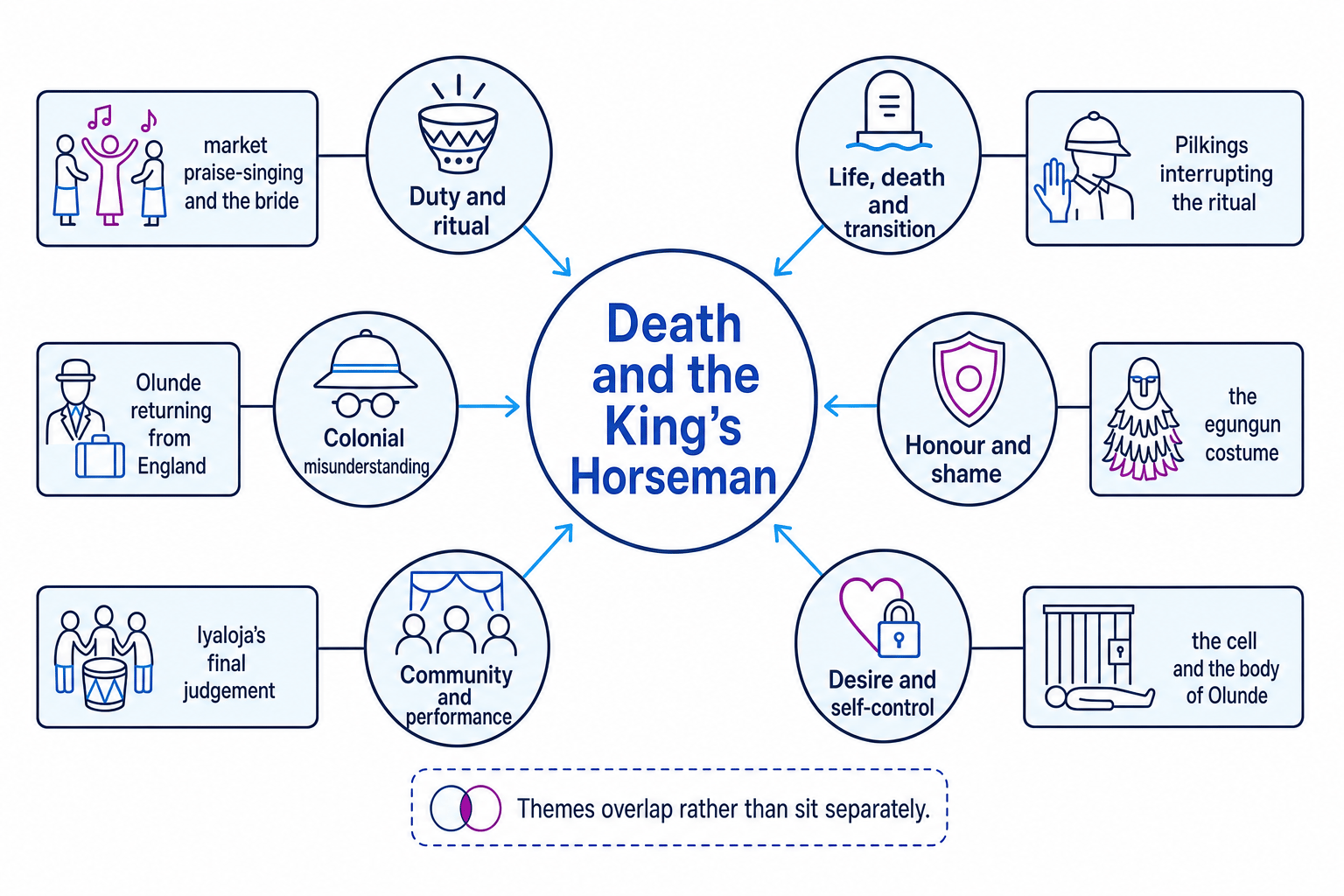
Themes overlap
The strongest essays do not treat themes as separate boxes. They show how Soyinka makes duty, death, colonial power, honour and desire collide in the same dramatic moments.
Turning a topic into a theme argument
-
Start with the broad topic: duty. This is too general on its own because it does not yet say what Soyinka suggests about duty.
-
Narrow it by asking what conflict the play creates: Elesin’s sacred duty to die is challenged by his love of life, his new bride, and Pilkings’ interference.
-
Turn that into an argument: Soyinka presents duty as both communal and spiritual, but he also shows that a public role can fail when private desire weakens self-control.
Duty, ritual and sacrifice
Ritual
A ritual is a formal action or ceremony that carries religious, social or cultural meaning.
The central ritual is Elesin’s expected death after the King’s death. Within the Yoruba worldview of the play, Elesin is not simply “committing suicide” in a modern individual sense. He is supposed to accompany the King into the afterlife and help maintain balance between the living, the dead and the unborn.
Elesin understands this duty in terms of honour. His statement, “Life is honour. It ends when honour ends,” uses a short, balanced structure to make honour sound absolute. The repetition of “honour” suggests that social identity matters more than physical survival.
However, Soyinka complicates this. Elesin also loves the pleasures of this world. His joyful claim that “The world is good and the women of the world are good” reveals his attachment to life, sensuality and praise. The audience sees the tension: the man who must leave the world is also deeply drawn to it.
Dramatic irony
Dramatic irony occurs when the audience understands something important that a character does not fully recognise.
There is dramatic irony in Elesin’s confidence. He speaks as if his transition is guaranteed, but the audience can sense warning signs in his self-indulgence and his sudden desire to marry.
Calling it just suicide
Avoid writing as if the play simply debates whether suicide is right or wrong. Soyinka presents Elesin’s death as a ritual duty within a specific Yoruba spiritual system, so you need to analyse what it means inside the world of the play.
Life, death and transition
Transition
A transition is a movement from one state to another. In this play, death is presented not only as an ending, but as a passage between worlds.
Soyinka’s play is deeply interested in boundaries: life and death, body and spirit, past and future. Elesin is meant to cross from the world of the living to the world of the ancestors. This is why his failure has consequences beyond himself: he disrupts a cosmic and communal order.
The ending makes this theme especially powerful. Olunde, who has returned from England, dies in Elesin’s place. Elesin then dies too late, after his son’s sacrifice has exposed his failure. Iyaloja’s final instruction — “Now forget the dead, forget even the living. Turn your mind only to the unborn” — shifts attention from individual grief to the future of the community.
Structure
Structure means how a text is organised: the order of scenes, turning points, contrasts and the movement from beginning to ending.
Structurally, the play moves from public celebration in the market to confinement, shame and death. That movement makes the failed transition visible: the ritual should have carried Elesin smoothly into honour, but instead the ending becomes broken and painful.
Tracing the theme of transition
-
In the opening market scenes, Elesin is preparing to move from life into death, so the atmosphere is ceremonial rather than purely tragic.
-
Pilkings’ intervention interrupts that movement, turning a sacred transition into a political and legal crisis controlled by colonial authority.
-
By the end, Olunde’s death and Iyaloja’s focus on “the unborn” show that transition is not only personal. It affects ancestors, the present community and future generations.
Colonial misunderstanding and power
Colonialism
Colonialism is a system in which one country or power controls another people’s land, law, resources or political life.
Pilkings and Jane represent British colonial authority in Nigeria. They often misunderstand Yoruba beliefs while assuming their own view is rational and superior. The most obvious symbol of this is the egungun costume: sacred ancestral dress is treated by Pilkings and Jane as fancy dress for a ball.
Symbolism
Symbolism is when an object, action or image represents a larger idea.
The costume symbolises colonial disrespect because Pilkings handles sacred meaning as if it were decoration. This is not just ignorance; it is ignorance backed by power. Pilkings can arrest Elesin, interrupt the ritual and decide what counts as “law”.
Olunde directly identifies this attitude when he tells Jane, “I discovered that you have no respect for what you do not understand.” The sentence is calm but devastating. Soyinka makes Olunde’s controlled speech expose the arrogance beneath Jane and Pilkings’ supposed civilisation.
Making Pilkings the only problem
Do not argue that Elesin fails only because Pilkings stops him. Soyinka called the colonial factor “catalytic”: Pilkings helps cause the disaster, but Elesin’s own weakness and delay also matter.
Avoiding a simple culture-clash reading
-
Begin with the colonial conflict: Pilkings interrupts a Yoruba ritual because he sees it through British law and his own assumptions.
-
Add the internal conflict: Elesin has already been delayed by desire, praise and his new marriage, so the ritual is vulnerable before Pilkings arrives.
-
Shape the interpretation: Soyinka does not present a neat battle between “British” and “Yoruba” values; he dramatises a metaphysical crisis made worse by colonial ignorance and by Elesin’s failure of will.
Honour, shame and identity
Honour in the play is not just private pride. It is public, communal and spiritual. Elesin’s identity depends on fulfilling the role of the King’s Horseman. If he fails, he does not merely disappoint himself; he damages the community’s trust in him.
This is why Olunde’s response is so severe. When he rejects Elesin as an “eater of leftovers”, the insult suggests that Elesin has accepted a degraded, second-hand existence instead of completing his noble duty. The image is humiliating because it reduces a prestigious figure to someone feeding on what remains.
Iyaloja also becomes crucial here. She speaks for the market community and judges Elesin’s failure with moral clarity. Soyinka uses her voice to show that honour is measured by responsibility, not status or masculine confidence.
Motif
A motif is a repeated image, idea or pattern that helps develop a theme.
Praise and public speech become a motif linked to honour. Elesin is repeatedly surrounded by praise-singing, ceremony and communal expectation. But when he fails, that public honour turns into public shame.
Desire, pleasure and self-control
Elesin is not presented as a cold religious symbol. He is full of appetite, charm and love of life. This makes him dramatically compelling, but it also creates danger. His desire for the young bride before his death becomes a key test of self-control.
Juxtaposition
Juxtaposition is when a writer places two contrasting things side by side to emphasise their difference.
Soyinka juxtaposes marriage and death. A wedding usually suggests fertility, continuity and new life; Elesin’s ritual death should mean departure from the world. By placing these together, Soyinka shows Elesin being pulled in opposite directions: towards sacred duty and towards bodily pleasure.
The bride herself should not be blamed as the cause of the tragedy. The real issue is Elesin’s inability to master his desire at the exact moment when he should be spiritually prepared to leave.
A sharper way to write about desire
Instead of saying “Elesin is distracted by women”, write: Soyinka presents desire as a force that reveals Elesin’s attachment to earthly life and weakens his readiness for ritual transition.
Community, voice and performance
Because this is a play, Soyinka develops themes through performance as well as words. The market women, the Praise-Singer, music, dance and ritual movement all create a sense that Elesin’s duty belongs to the whole community.
Chorus
A chorus is a group voice in drama that comments on events, represents communal feeling or shapes the audience’s response.
The market women often work like a chorus. They do not simply decorate the scene; they help define what the community values. Their songs, questions and reactions turn Elesin’s private choices into public drama.
This matters for AO2: in a drama essay, you should analyse stagecraft — the use of stage directions, costume, movement, music, silence and positioning on stage. For example, the contrast between the living ritual energy of the market and the controlled colonial space around Pilkings helps show two different ways of understanding order.
A concise analytical paragraph
Soyinka presents honour as a communal duty rather than a private feeling. Elesin’s claim that “Life is honour. It ends when honour ends” uses a balanced, aphoristic sentence, making honour sound like an absolute law. Yet the certainty of this line becomes ironic as Elesin delays his ritual death through his attachment to pleasure and status. By the ending, Olunde’s sacrifice exposes the gap between Elesin’s public language and his actions. Soyinka therefore suggests that honour depends not on performance or reputation, but on fulfilling one’s responsibility to the community and the spiritual order.
In the exam
-
Use the open-book text wisely: know the key scenes in advance so you are not wasting time searching for quotations in your clean copy.
-
Make each paragraph thematic and analytical: point → short evidence → method → effect → link back to the question.
-
Avoid oversimplifying the play as “traditional Africa versus modern Britain”; include Elesin’s personal responsibility as well as Pilkings’ colonial ignorance.
Check yourself
- How does Soyinka make Elesin’s love of life both attractive and dangerous?
- Why is Pilkings’ use of the egungun costume more than a simple misunderstanding?
- How does Olunde’s death change the audience’s view of honour and shame?