What you'll learn
- How Soyinka presents the main characters through dialogue, stage action, and contrast.
- Why Elesin is more complicated than “hero” or “coward”.
- How characters such as Olunde, Iyaloja, Pilkings, Amusa and the Praise-Singer shape the tragedy.
- How to write about character for Edexcel IGCSE Literature using precise quotations and methods.
First: what does “character” mean in drama?
In a play, there is usually no narrator explaining what everyone thinks. You learn about characters from what they say, what they do, what others say about them, and how the playwright places them on stage.
Characterisation
Characterisation means the methods a writer uses to create a character’s personality, values and role in the story. In drama, this often includes dialogue, stage directions, entrances and exits, costume, props, relationships and contrasts.
In Death and the King’s Horseman, Soyinka does not create characters simply as “good people” and “bad people”. Most characters have a dramatic function: a job they perform in the play’s structure. For example, Pilkings is not just an individual colonial officer; he also represents the power of British colonial law to interrupt Yoruba ritual life.
Dramatic function
A character’s dramatic function is the role they play in moving the plot forward, revealing themes, or creating conflict on stage.
The character web
The play is built around relationships: Elesin’s duty to the dead king, the market’s expectations, Olunde’s judgement, and Pilkings’ colonial interference.
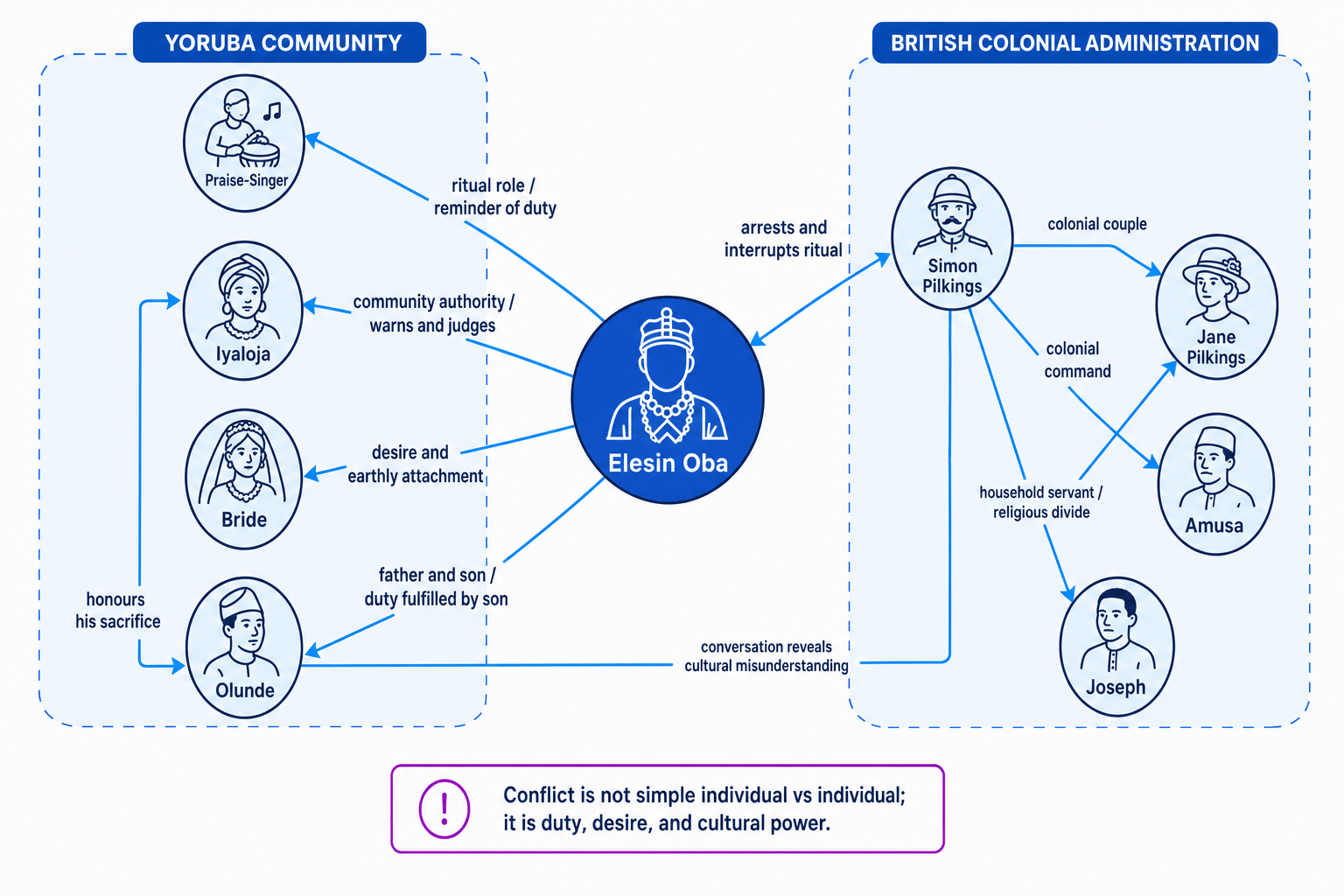
The big character idea
Soyinka’s characters are not isolated individuals. Each one is tied to a community, a ritual duty, or a system of power. Good analysis explains those relationships, not just personality traits.
Elesin Oba: honour, appetite and tragic failure
Elesin Oba, the King’s Horseman, is the central character. His duty is to die after the king so that he can accompany him into the afterlife. The title itself defines him by role: he is not just “Elesin”, but Elesin Oba, the king’s horseman.
At first, Soyinka presents Elesin as charismatic, confident and loved by the marketplace. He speaks in rich, poetic language and enjoys praise, music and attention. He declares, “Life is honour. It ends when honour ends,” which makes him sound absolutely committed to duty.
But Soyinka also shows Elesin’s attachment to earthly pleasures. His statement that “The world is not a constant honey-pot” reveals a man who has enjoyed life intensely. His desire to marry the young Bride just before his ritual death shows that his body and appetite still pull him towards the living world.
Tragic hero
A tragic hero is a central character whose downfall is serious and meaningful, often because a personal weakness clashes with a larger duty or social expectation.
Elesin’s tragedy is not simple cowardice. He knows what he should do, and he values honour. However, his self-dramatising confidence is not the same as spiritual readiness. The colonial interruption matters, but Soyinka also makes us question whether Elesin was already hesitating.
Reading Elesin’s self-definition
-
Elesin’s line “Life is honour. It ends when honour ends” sounds like a moral rule: honour is presented as more important than physical survival.
-
The short, balanced sentences make the statement feel certain and memorable, almost like a proverb.
-
Later, when Elesin fails to complete his duty in time, the line becomes dramatically ironic because his own behaviour does not match his public language.
-
This helps you argue that Soyinka presents Elesin as tragic: he understands the value of honour, but cannot fully live up to it when the moment comes.
Calling Elesin simply a coward
Do not reduce Elesin to “cowardly”. A stronger answer says he is divided between ritual duty and earthly desire, and that Soyinka makes his failure morally serious but psychologically complex.
The Praise-Singer: memory, warning and judgement
The Praise-Singer travels with Elesin and celebrates him, but he is not just a flatterer. He acts almost like a chorus.
Chorus
A chorus is a voice or group in drama that comments on the action, guides the audience’s response, or expresses communal values.
The Praise-Singer helps create the ceremonial atmosphere of the opening scene. His language reminds Elesin of his role and the greatness expected of him. Praise is powerful because it builds Elesin’s public identity.
However, praise can also become dangerous. It feeds Elesin’s ego and makes him perform confidence. By the end, the Praise-Singer’s role shifts towards judgement: he helps show the gap between Elesin’s glorious reputation and his failed action.
Iyaloja: communal authority and moral clarity
Iyaloja, the “Mother of the Market”, is one of the strongest moral voices in the play. She represents the marketplace, but also something larger: communal wisdom, practical authority and concern for future generations.
She allows Elesin to marry the Bride, but not because she is weak. She understands the danger of denying the man who is about to die his final wish. At the same time, she warns him that his actions affect others. This makes her a powerful contrast to Elesin: he is drawn towards personal desire, while she thinks in terms of communal consequence.
At the end, Iyaloja tells the Bride: “Now forget the dead, forget even the living. Turn your mind only to the unborn.” This closing line is crucial. It shifts attention away from individual shame and towards the future. The “unborn” may suggest literal future children, but it also symbolises the survival of the community after tragedy.
Iyaloja’s importance
Iyaloja is not a background character. She is the play’s clearest voice of communal judgement, and her final words give the tragedy its forward-looking meaning.
Olunde: foil, son and true fulfiller of duty
Olunde is Elesin’s son. He has been studying medicine in England, so characters like Pilkings expect him to reject Yoruba ritual as “backward”. Instead, Soyinka makes Olunde one of the most dignified and morally clear characters in the play.
Foil
A foil is a character who contrasts with another character, making that other character’s qualities clearer.
Olunde is a foil to several characters. He contrasts with Pilkings because he understands both British and Yoruba worlds, while Pilkings misunderstands what he does not control. He also contrasts painfully with Elesin: the son quietly fulfils the duty that the father fails to complete.
In his conversation with Jane Pilkings, Olunde says, “you have no respect for what you do not understand.” This directly challenges colonial arrogance. He is not shown as ignorant or trapped in tradition; he is educated, thoughtful and able to expose British hypocrisy.
When Olunde sees that Elesin is still alive, his rejection is devastating: “I have no father.” This is not just personal anger. It means Elesin has lost the honour and identity that made him worthy of being called father.
Using Olunde as a foil
-
Compare Olunde’s calm understanding with Pilkings’ rushed intervention. Olunde understands the ritual’s meaning, while Pilkings reduces it to a legal problem.
-
Use Olunde’s line “you have no respect for what you do not understand” to show that Soyinka gives him intellectual authority, not just emotional loyalty.
-
Contrast Olunde with Elesin: Elesin speaks proudly about honour, but Olunde acts decisively when honour is broken.
-
Link the contrast to dramatic structure: Olunde’s death makes Elesin’s later suicide feel too late, turning the ending into tragedy rather than triumph.
Simon Pilkings: colonial power and misunderstanding
Simon Pilkings is the British District Officer. He has legal authority, police power and confidence in his own judgement. He believes he is preventing a death, but he does not understand the spiritual and communal meaning of Elesin’s duty.
Soyinka presents Pilkings partly through contrast. His practical, impatient language clashes with the poetic, ritual language of the marketplace. He treats sacred things as costumes: he and Jane wear confiscated egungun masks, which are connected to ancestral spirits. This action characterises him before he even fully explains himself. It shows ignorance, casual disrespect and colonial entitlement.
Pilkings is not written as a cartoon villain. He thinks he is acting morally. That makes him more interesting: he causes damage not because he understands and hates Yoruba culture, but because he has the power to act without understanding it.
Blaming only Pilkings
It is too simple to say Pilkings “causes everything”. He interrupts the ritual, but Soyinka also shows Elesin’s weakness. The tragedy comes from both colonial interference and Elesin’s internal failure.
Jane Pilkings: curiosity limited by assumptions
Jane Pilkings is more open to conversation than Simon, especially in her dialogue with Olunde. However, she still carries colonial assumptions. She is shocked by Yoruba ritual death, yet Olunde forces her to think about British forms of sacrifice, especially during war.
Her function is important because she gives Olunde someone to challenge. Through their conversation, Soyinka exposes a double standard: British sacrifice can be called noble, while African sacrifice is dismissed as barbaric.
Jane’s character reminds you that politeness is not the same as understanding. She may be less aggressive than Simon, but she still needs Olunde to correct her perspective.
Amusa and Joseph: divided identities
Amusa is a Yoruba police sergeant working under British authority. He obeys Pilkings, but he is still deeply disturbed by the sacred egungun costume. This makes him a conflicted figure: he serves colonial power, yet he cannot entirely abandon Yoruba belief and fear.
Joseph, the Pilkings’ servant, is a Christian convert. His presence shows another kind of cultural division. He has been separated from some Yoruba traditions, but he is still used by the Pilkings as a translator of customs they do not really understand.
These minor characters matter because they show colonialism working through local people, not only through British officials. Soyinka presents identity as complicated: religion, employment, fear, loyalty and survival all pull characters in different directions.
The Bride: silence, desire and the future
The Bride has very few words, but she is dramatically important. Elesin’s desire for her delays and complicates his spiritual preparation. She represents earthly life, sexuality and the future that Elesin should be leaving behind.
Her silence can be uncomfortable for a modern audience because others decide her future. However, in the play’s structure, she becomes more than a personal object of desire. At the end, Iyaloja directs her towards “the unborn”, connecting her to continuity after loss.
Character contrasts to remember
| Contrast | Why it matters |
|---|---|
| Elesin and Olunde | The father speaks of honour; the son fulfils it. |
| Elesin and Iyaloja | Elesin is pulled by desire; Iyaloja thinks communally. |
| Pilkings and Olunde | Pilkings has power without understanding; Olunde has understanding across cultures. |
| Amusa and Pilkings | Amusa serves colonial authority but still fears sacred Yoruba symbols. |
| Praise-Singer and Elesin | Praise builds Elesin’s heroic image, but also exposes his failure. |
Writing about characters in Component 2
This is an open-book drama question, so a clean copy of the play is allowed. Do not waste time hunting for long quotations. Use short, precise phrases, then analyse Soyinka’s dramatic methods: dialogue, contrast, stage action, costume, entrances, exits and structure.
In the exam
-
Start each paragraph with an argument about the character’s role, not just a trait: for example, “Olunde functions as a foil to both Pilkings and Elesin.”
-
Use brief quotations accurately, then zoom in on method: proverb-like dialogue, dramatic irony, symbolism, contrast, stage action or structural timing.
-
Keep linking the character to the whole tragedy: duty, honour, desire, misunderstanding and communal consequence.
Check yourself
- Why is Elesin’s failure more complex than simple cowardice?
- How does Olunde challenge colonial assumptions in his conversation with Jane?
- What does Iyaloja’s final focus on “the unborn” suggest about the play’s ending?