Welcome to your study notes on the context of Wole Soyinka's Death and the King's Horseman.
Many students treat context as a list of historical facts to memorize and repeat in the exam. However, because this play is assessed under Component 2, Section A (Modern Drama), your focus is strictly on AO1 (informed personal response and thematic understanding) and AO2 (analysing language, form, and structure).
This means you will not get direct marks for dumping historical trivia into your essay. Instead, you must use contextual understanding as a tool to unlock the depth of Soyinka's themes, the motivations of his characters, and his dramatic choices.
What you'll learn
- The historical tension of Nigeria in 1943 under British colonial rule.
- The intricate system of Yoruba cosmology and why Elesin's ritual suicide is a cosmic necessity, not a personal tragedy.
- Wole Soyinka’s authorial intentions, specifically his warning against viewing the play simply as a "clash of cultures."
The Historical Setting: Colonial Nigeria (1943)
To understand the friction in the play, we must first look at where and when it is set. The play takes place in the ancient city of Oyo, in southwestern Nigeria, during World War II (1943).
Colonialism and Indirect Rule
By 1943, Nigeria had been under British colonial rule for decades. The British administration maintained control through a policy called indirect rule.
Indirect Rule
Indirect rule is a colonial administration system where the colonizing power governs the local population through their pre-existing traditional leadership structures (such as kings, chiefs, and traditional councils), rather than replacing them entirely.
In the play, this system is represented by the District Commissioner, Simon Pilkings. The British allowed the local king (the Alafin of Oyo) and his chiefs to maintain their traditional roles, but only as long as those customs did not clash with British colonial law or "civilized" values.
The Real-Life Incident
Soyinka based his play on a real historical event that occurred in Oyo in 1946. The Alafin (King) had died, and his horseman, Elesin Oba, was expected by tradition to commit ritual suicide to accompany his master to the spirit realm. The British colonial authorities intervened to stop the suicide, leading to a major cultural and political crisis.
Soyinka deliberately shifted the date of the play back to 1943, during the height of World War II. By setting the play during the war, Soyinka highlights the massive hypocrisy of the British:
- Simon Pilkings is outraged by the "barbaric" and "savage" ritual self-sacrifice of one man (Elesin) to save his community's soul.
- Meanwhile, the British Empire is actively sending millions of young men to their deaths in a global war—a massive, state-sanctioned sacrifice for "King and Country."
Yoruba Cosmology and the Metaphysical World
You cannot fully appreciate the tragedy of Death and the King's Horseman without understanding Yoruba cosmology. If you read Elesin's death through a modern Western lens, you might view it as an outdated or horrific custom. To the Yoruba characters in the play, however, it is a beautiful, necessary act of cosmic preservation.
Cosmology
Cosmology is a culture's philosophical or religious understanding of the origin, structure, and laws of the universe, particularly how different realms of existence relate to one another.
The Three Realms and the Abyss
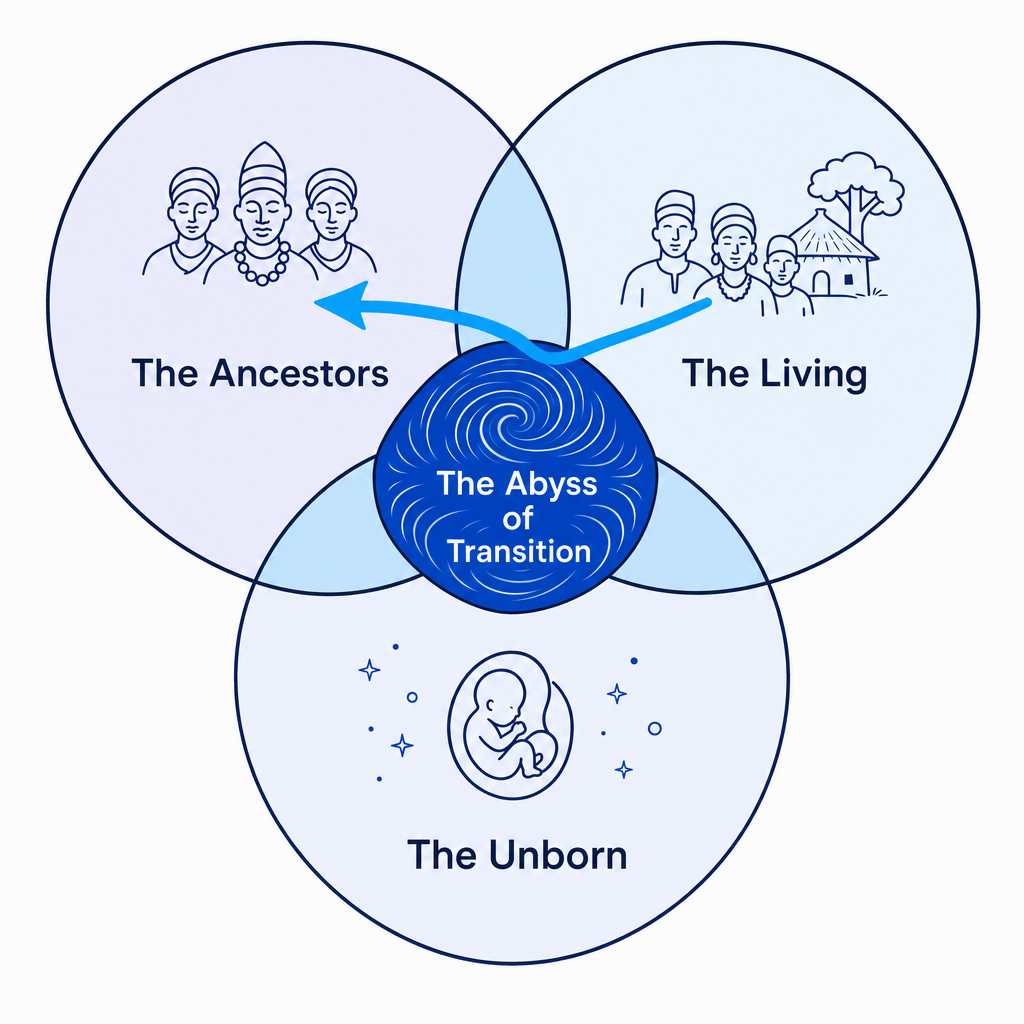
In Yoruba belief, existence is not linear (birth, life, death, end). Instead, it is a continuous, cyclic loop consisting of three distinct but interconnected realms:
- The World of the Living (where Elesin, Iyaloja, and the people of Oyo reside).
- The World of the Ancestors (the dead).
- The World of the Unborn (the future generations).
These three worlds are separated by a dangerous, chaotic void called the Abyss of Transition (sometimes called the Gulf of Transition).
The Horseman's Sacred Duty
When the Alafin (the King) dies, his spirit cannot enter the realm of the Ancestors on its own; it wanders lost on the edge of the Abyss. If the king’s spirit is stranded, the spiritual connection between the three realms is broken. The universe will spiral into chaos, and the future of the Unborn will be destroyed.
As the King's Horseman, Elesin’s soul is uniquely bound to the King's. His ritual suicide is a sacred, meditative transition. By willingly stepping into the Abyss of Transition, Elesin guides the King's spirit safely across the gulf, maintaining the cosmic balance and securing the future of his people.
Suicide vs. Ritual Transition
Elesin's act is not a "suicide" born of despair, depression, or hopelessness. It is a highly celebrated, active, and honorable physical transition designed to preserve the spiritual ecosystem of the universe. When Pilkings "saves" Elesin, he does not preserve life; he causes a spiritual apocalypse for the Yoruba people.
Soyinka’s Intent: Rejecting the "Clash of Cultures"
One of the biggest mistakes students make is writing that Death and the King's Horseman is simply a play about "colonial clash" or the "clash of cultures" (Africans vs. Europeans).
In his famous Prefatory Note to the play, Soyinka explicitly warns readers and directors against this reductive interpretation.
The Threnodic Essence
Soyinka states that the play is about the "threnodic essence" of the Yoruba world. A threnody is a song of lamentation for the dead. The play is fundamentally a metaphysical tragedy about the struggle of a human soul (Elesin) to fulfill its destiny when faced with the heavy, seductive distractions of physical life.
Soyinka argues that the colonial intervention of Pilkings is merely a catalyst—a historical accident that triggers the crisis. The true tragedy lies within Elesin himself.
Elesin is a man of immense physical appetite. He loves fine clothes, food, and the touch of women (seen when he demands a new bride on the very night of his death). His own hesitation, his lingering attachment to the physical world ("the world I know is fine"), is what truly dooms him. Pilkings' physical intervention merely gives Elesin an easy excuse to fail.
Integrating cosmological context into character analysis
Let's look at how you can weave this deep understanding of context into an analytical paragraph to hit the high marks for AO1 (insightful interpretation) and AO2 (writer's methods and themes).
Question: How does Soyinka present Elesin’s hesitation in Act I and Act II?
- Step 1: Make a conceptual point that links the character's behavior to Yoruba metaphysics.
- Drafting: Soyinka presents Elesin's delay not merely as personal weakness, but as a dangerous vulnerability that threatens the cosmic balance of the Yoruba universe.
- Step 2: Introduce precise textual evidence showing his attachment to the physical world.
- Drafting: In Act I, despite preparing for transition, Elesin is drawn back to earthly pleasures, demanding a new bride and declaring, "The world is not a hill of soles... My foot meets for the first time with a cake of common earth."
- Step 3: Analyze the literary methods Soyinka uses (AO2).
- Drafting: The sensory metaphor of the "cake of common earth" highlights Elesin’s intense, physical indulgence. His preoccupation with the tactile pleasures of the marketplace is structured dramatically as a stall in his spiritual journey, foreshadowing his later failure.
- Step 4: Integrate the context of the "Abyss of Transition" to explain the tragic consequences (AO1/AO2 link).
- Drafting: By lingering in the physical realm, Elesin fails to muster the absolute spiritual focus required to cross the "Abyss of Transition." Soyinka's use of this cosmological context shifts the tragedy away from a simple colonial intervention; the true dramatic tension lies in Elesin's internal struggle between his sacred duty to the Ancestors and his earthly desires.
The Metaphor of the Mask
Notice the stark contrast in how both cultures treat "masks." The British (the Pilkingses) wear the sacred Egungun costumes as trivial, fancy-dress outfits for a colonial ball, showing their complete spiritual emptiness and disrespect. In contrast, the Yoruba view the ritual masks as living vessels of ancestral spirits. This contrast is a brilliant way to analyze how Soyinka uses stagecraft to highlight colonial ignorance.
Context Dumping
Do not write long paragraphs explaining the history of the British Empire or Nigeria's independence. The examiners will not give you marks for history lessons. Always tie historical and cultural context directly back to thematic analysis and character motivation.
Do not villainize Pilkings too simplisticly
While Simon Pilkings is culturally blind and patronizing, Soyinka does not write him as an evil, mustache-twirling villain. Pilkings genuinely believes he is saving a human life. The tragedy is born of absolute mutual incomprehension, not pure malice. Presenting this nuance in your essays demonstrates a highly sophisticated critical voice.
In the exam
- Never treat context as a separate paragraph. Instead, weave it into your analysis using the formula: Evidence →\to→ Analysis of Method →\to→ Explaining the effect using Contextual Knowledge.
- Quote from Soyinka's Prefatory Note. Dropping terms like "threnodic essence" or referencing Soyinka's warning against the "clash of cultures" demonstrates an exceptional, high-level critical style.
- Use the correct terminology for Yoruba cosmology. Correctly refer to the Abyss of Transition, the world of the Ancestors, Living, and Unborn, and the Alafin to show authority and deep familiarity with the text.
Check yourself
- Can you explain why Elesin's delay in the market is highly dangerous to the "Unborn"?
- Why did Soyinka set the play in 1943 during WWII rather than keeping the historical 1946 date?
- What is the difference between how the British and the Yoruba view the Egungun masquerade costumes?