What you'll learn
- The main events of Death and the King’s Horseman in the correct order.
- How Soyinka structures the play across five scenes, not traditional acts.
- Why the plot is more than “British officer stops Yoruba ritual”.
- How to use plot knowledge for precise AO1 understanding and AO2 structure analysis.
The basic premise
Death and the King’s Horseman is set in Oyo, Nigeria, during British colonial rule. The Yoruba king has died, and Elesin Oba — the King’s Horseman — is expected to perform a ritual death so that he can accompany the king into the world of the ancestors.
Plot
Plot means the organised sequence of events in a text: not just what happens, but how events cause one another and how the writer arranges them for dramatic effect.
The play is divided into five scenes. A scene is a section of a play set in a particular place and time. Soyinka moves between Yoruba communal spaces, such as the marketplace, and British colonial spaces, such as Pilkings’ bungalow and the Residency ball.
The plot in one sentence
Elesin is meant to complete a sacred communal duty, but his own attachment to life and Pilkings’ colonial interference combine to produce a tragic catastrophe.
The timeline below gives you a clear overview before we slow down scene by scene.
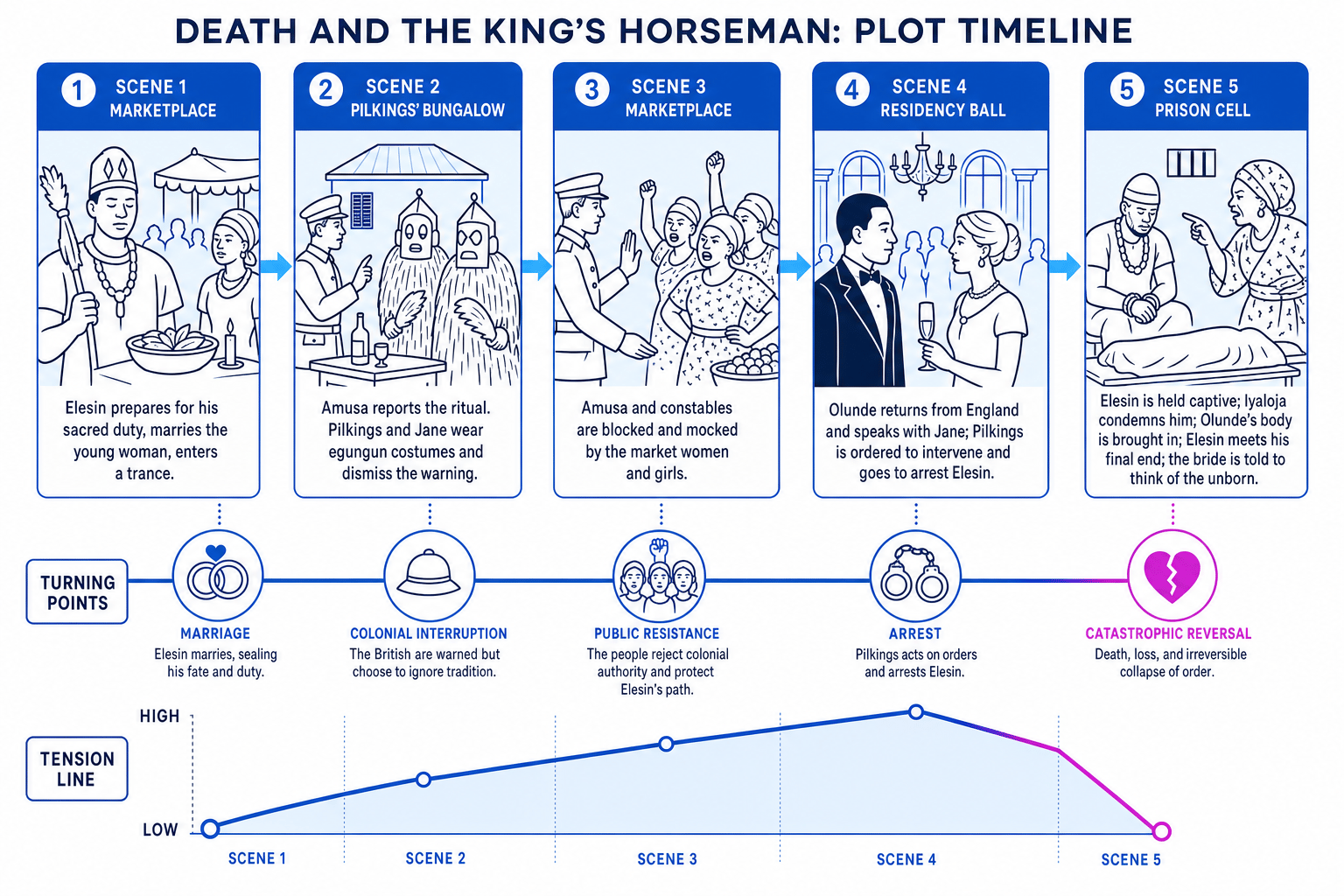
Scene 1: The marketplace — celebration, duty, and delay
The play opens in the marketplace, a space of music, dance, praise and communal life. Elesin enters with the Praise-Singer. A Praise-Singer is a performer whose songs preserve memory, reputation and social values.
Elesin is preparing for his ritual death, but he does not enter the play as gloomy or frightened. He is lively, sensual and full of appetite. His love of the marketplace is captured when he says, “This market is my roost,” and imagines himself as “a chicken with a hundred mothers”. This makes him charismatic, but it also plants a warning: he is deeply attached to the physical world.
The Praise-Singer reminds him that his duty must not fail. The warning that “the world is not a constant honey-pot” suggests that pleasure is temporary and can become dangerous if it distracts a person from responsibility.
The major turning point in Scene 1 is Elesin’s sudden desire to marry a young woman he sees in the market. She is already promised to Iyaloja’s son. Iyaloja is the “Mother of the Market”, a senior female authority figure. She allows the marriage because Elesin is on the edge of death and must not be denied, but she is uneasy.
The scene ends with Elesin moving towards a trance-like state as the ritual approaches. However, the wedding has delayed and complicated his spiritual transition.
Missing Elesin’s responsibility
Do not summarise the play as if Elesin is perfectly ready and Pilkings is the only cause of disaster. Soyinka shows that Elesin’s desire for the bride weakens his focus before Pilkings arrests him.
Scene 2: Pilkings’ bungalow — misunderstanding and interruption
Scene 2 shifts sharply from the Yoruba marketplace to the British District Officer’s bungalow. Simon Pilkings and his wife Jane are preparing for a fancy-dress ball. Shockingly, they are wearing egungun costumes.
Egungun
Egungun are sacred Yoruba masquerade garments associated with ancestral spirits. In the play, they are not “just costumes”; they carry religious and cultural meaning.
Amusa, a local police sergeant working for the British administration, arrives to warn Pilkings that Elesin is about to perform the ritual. He is horrified to see Pilkings and Jane wearing the egungun garments. His phrase “uniform of death” shows that he sees the clothing as spiritually serious, not decorative.
Pilkings dismisses Amusa’s fear and treats the ritual as something barbaric that must be stopped. This scene creates a clear contrast between two worlds: Pilkings thinks in terms of colonial law and public order, while the Yoruba characters understand the ritual as part of cosmic and communal balance.
Scene 3: The marketplace — comic resistance, rising tension
Scene 3 returns to the marketplace. Amusa and his constables arrive to intervene, but the market women block them. The girls mock Amusa and imitate British manners, turning colonial authority into comedy.
This scene can feel funny, but it still raises the tension. The community is trying to protect Elesin’s ritual from outside interference. At the same time, the audience knows Pilkings has already been warned, so danger is moving closer.
Rising action
Rising action is the part of a plot where complications increase and pressure builds towards the climax.
Scene 3 is part of the rising action because it delays the authorities but does not remove the threat. Soyinka uses humour to show resistance, but the wider direction of the plot is still tragic.
Memory shortcut
Remember the movement of the first three scenes as Market → Bungalow → Market. Soyinka keeps cutting between Yoruba communal space and British colonial space to build conflict.
Scene 4: The Residency ball — Olunde returns
Scene 4 takes place at the British Residency during a ball for a visiting Prince. The ball is itself a ritual: formal clothes, dancing, hierarchy and performance. Soyinka places this European ceremony beside the Yoruba ritual to expose Pilkings’ hypocrisy. He respects one kind of ceremony while mocking another.
Olunde, Elesin’s son, returns from England, where he has been studying medicine. He has come back because he knows the king has died and expects his father to fulfil his duty. Olunde’s conversation with Jane is important because he challenges her assumptions. His criticism that the British have “no respect for what you do not understand” is one of the clearest statements of the play’s conflict.
Dramatic irony
Dramatic irony happens when the audience understands more about a situation than one or more characters do.
There is dramatic irony in the ball scene because Pilkings believes he is preventing a death and restoring order, but the audience increasingly understands that his interference may produce a greater disorder.
Pilkings is ordered to act, partly because the colonial authorities do not want disturbance during the Prince’s visit. He leaves to arrest Elesin. The plot now reaches its point of maximum pressure.
Scene 5: The prison cell — catastrophe and reversal
The final scene takes place after Elesin has been arrested. He is now imprisoned, physically prevented from completing the ritual at the proper time.
Catastrophe
In tragedy, catastrophe means the final disastrous outcome, where the consequences of earlier choices and conflicts become irreversible.
Elesin tries to explain his failure, but the scene makes clear that the damage is already done. Iyaloja confronts him with the consequences of his broken duty. Her anger is not simply personal: she speaks for a community whose spiritual order has been disrupted.
The true tragic reversal comes when Olunde’s body is brought in. Olunde has taken on the shame and burden created by his father’s failure. This is devastating because the son, who was expected to continue the family line, dies before the father.
Elesin then kills himself, but it is too late to restore the proper order. Iyaloja’s final instruction to the young bride is: “Now forget the dead, forget even the living. Turn your mind only to the unborn.” The ending looks away from the failed men and towards the child the bride may carry — a fragile sign of future possibility after catastrophe.
How the plot works as a tragedy
Tragedy
A tragedy is a serious drama that ends in suffering or catastrophe, often because a central figure’s weakness collides with social, moral or political forces.
Elesin’s weakness is not simple cowardice. The plot makes it more complex. He loves life, honour, praise, women and pleasure. Those qualities make him attractive, but they also make it harder for him to let go of the world at the required moment.
Pilkings’ intervention is also crucial, but Soyinka does not let the audience see colonial interference as the only cause. The disaster happens because personal hesitation and political interference meet at the worst possible time.
Turning plot summary into analysis
-
Start with the plot fact: Elesin asks to marry the young woman on the very night he must complete his sacred duty.
-
Identify the consequence: the marriage delays him and ties him more strongly to the living world, especially through desire, pleasure and possible childbirth.
-
Connect this to structure: Soyinka places the wedding before Pilkings’ arrest, so Elesin’s inward weakness is established before the outward colonial interruption.
-
Compare the two pressures: Pilkings physically prevents the ritual, but Elesin’s attachment to life has already made the ritual vulnerable.
-
Form the analytical idea: the plot becomes tragic because public duty collapses through both internal failure and external interference.
Scene-by-scene quick summary
| Scene | Setting | Main plot event | Why it matters |
|---|---|---|---|
| 1 | Marketplace | Elesin prepares for ritual death but marries the young woman | Shows his honour and his dangerous attachment to life |
| 2 | Pilkings’ bungalow | Amusa warns Pilkings; Pilkings dismisses Yoruba beliefs | Begins colonial interference |
| 3 | Marketplace | Women and girls block Amusa | Shows communal resistance and increases tension |
| 4 | Residency ball | Olunde returns; Pilkings goes to stop Elesin | Contrasts British and Yoruba rituals |
| 5 | Prison cell | Olunde dies; Elesin dies too late | Completes the tragic catastrophe |
What to remember for essays
For Edexcel IGCSE Component 2, this is an open book text, meaning you may use a clean copy in the exam. However, you still need to know the plot securely. If you spend too long searching for basic events, you will lose time for analysis.
Strong plot knowledge helps AO1 because you can choose precise moments from the play. It also helps AO2 because you can discuss Soyinka’s dramatic structure: the shifts in setting, the rising tension, the delayed ritual, the contrast between ceremonies, and the catastrophic final reversal.
In the exam
-
Use plot details as evidence, not as a full retelling: choose the moment that proves your point.
-
Link events by cause and consequence: “because Elesin delays, Pilkings’ interruption becomes more disastrous.”
-
Refer to structure when relevant: mention Soyinka’s movement from marketplace to colonial spaces and finally to the prison cell.
Check yourself
- Why is Elesin’s marriage to the young woman such an important turning point?
- How does Scene 4 contrast British and Yoruba ideas of ceremony?
- Why is it too simple to say that Pilkings alone causes the tragedy?