What you'll learn
- How to separate language, form and structure in your analysis.
- How Soyinka uses ritual language, proverbs, song, dance and dramatic irony.
- How the five-scene structure builds from ceremony to tragic reversal.
- How to write about methods for Edexcel IGCSE AO2 without just “device spotting”.
First: what do “language, form and structure” mean?
Language, form and structure
Language means the writer’s word choices and imagery. Form means the type of text and how it is presented — here, a stage play shaped by Yoruba ritual theatre and tragedy. Structure means the order, pacing and arrangement of events, scenes and contrasts.
For Death and the King’s Horseman, AO2 is not about naming techniques in isolation. You need to explain how Soyinka’s dramatic choices shape meaning: how the audience hears ritual certainty, then sees delay, misunderstanding and collapse.
The main AO2 idea
Soyinka makes the tragedy theatrical: the audience does not just learn that Elesin fails in his duty — they experience the rhythm, ceremony, interruptions and reversals that make that failure feel catastrophic.
Language: ritual, praise and poetry
Soyinka’s language often sounds ceremonial rather than everyday. In Scene 1, Elesin is surrounded by the Praise-Singer, women, music and communal attention. The language is heightened because Elesin’s death is not treated as private suicide; within the Yoruba world of the play, it is a sacred transition.
Praise poetry
Praise poetry is ceremonial language that celebrates a person’s status, ancestry, courage or public role. In the play, the Praise-Singer’s language helps present Elesin as more than an individual: he is the King’s Horseman, carrying communal responsibility.
Elesin’s own language is rich and confident. His repeated celebration that “The world is good and the women of the world are good” shows his love of physical life. The repetition sounds joyful, but it also becomes structurally dangerous: the audience can sense that his attachment to pleasure may weaken his spiritual duty.
Analysing sensual language
- Start with the surface meaning: when Elesin says “The world is good”, he praises earthly life, especially beauty, food, women and social honour.
- Notice the method: the repetition of “good” creates a chant-like rhythm, making the line sound communal and celebratory rather than casual.
- Connect method to character: the same pleasure that makes Elesin charismatic also reveals his vulnerability, because he must leave the world behind.
- Link to the tragedy: Soyinka makes Elesin’s failure psychologically convincing; his downfall grows from his own desire, not only from Pilkings’ interference.
Proverbs and metaphor
Proverb
A proverb is a short, traditional saying that expresses shared wisdom. Proverbs often sound indirect, but they carry moral authority.
Yoruba speech in the play often works through proverbs and metaphor. A metaphor is a comparison that says one thing is another, usually to reveal a deeper meaning. This matters because characters such as Iyaloja and the Praise-Singer rarely speak in plain “instruction” language. They speak as representatives of communal memory.
For example, the play repeatedly imagines Elesin’s death as a journey, a crossing, or a movement along a prepared path. This makes death seem like passage rather than extinction. Elesin’s role is therefore not simply to die, but to complete a transition between the living, the dead and the unborn.
Write about meaning, not decoration
If you mention “metaphor” or “proverb”, immediately ask: what value system does this language reveal? In this play, figurative language often shows that the Yoruba community understands life and death as connected, not separate.
The “Not-I bird” and foreshadowing
Foreshadowing
Foreshadowing is when a writer plants hints about later events, creating anticipation or unease.
Elesin’s story of the “Not-I bird” is a crucial early warning. The bird represents avoidance: when death calls, everyone says “not I”. Elesin presents himself as the exception, the brave man who will not evade death. Dramatically, this is ironic, because the play later exposes his hesitation.
Dramatic irony
Dramatic irony happens when the audience understands something that a character does not fully understand.
The “Not-I bird” story makes the audience listen carefully. Elesin thinks he is proving his courage, but Soyinka is also planting doubt. His eloquence may be partly performance.
Treating Elesin as only a victim
Do not argue that Pilkings alone causes the tragedy. Soyinka’s structure shows colonial interference, but it also shows Elesin’s own delay, sensual attachment and failure of will.
Colonial language: comedy, bluntness and misunderstanding
The language of Pilkings and Jane is very different. Their speech is often brisk, dismissive and practical. Pilkings repeatedly reduces what he does not understand to “nonsense”. This contrast in register is important.
Register
Register means the level or style of language used in a situation — for example, ceremonial, comic, formal, intimate or dismissive.
When Pilkings treats the egungun costumes as fancy dress, Soyinka uses language and staging together to expose cultural blindness. The costumes are not neutral props: they are sacred ancestral masks. Amusa’s fear of speaking to Pilkings while he wears them is comic on stage, but the comedy has serious meaning. The colonial characters misread spiritual symbols as objects.
Olunde’s language is calmer and sharper than Pilkings’. His criticism that the English have “no respect for what you do not understand” directly identifies the problem: not simple ignorance, but arrogant ignorance.
Form: a play shaped by ritual tragedy
Drama and tragedy
Drama is literature written for performance by actors. Tragedy is a serious dramatic form in which choices, flaws and pressures lead to suffering, death or irreversible loss.
Death and the King’s Horseman is a modern drama, but it does not simply copy Western tragedy. Soyinka draws on Yoruba ritual, music, dance, chant and communal performance. The audience watches a society trying to complete a sacred action before the cosmic order is broken.
The Praise-Singer sometimes works like a chorus. A chorus is a voice or group in drama that comments on the action and helps guide the audience’s response. However, Soyinka’s chorus-like figure comes from Yoruba oral and ritual traditions, not just from Greek theatre.
Ritual is part of the form
The play’s songs, drums, dances and ceremonies are not background decoration. They are part of the dramatic action because they show a community trying to move Elesin towards his appointed death.
Stagecraft: symbols the audience can see
Symbolism
Symbolism is when an object, action or image carries a larger meaning beyond its literal role.
Because this is a play, Soyinka can make meaning visually. The egungun costumes symbolise ancestral presence and sacred tradition. When Pilkings and Jane wear them casually, the audience sees disrespect before any character explains it.
The cell in Scene 5 is another important stage image. Elesin, who should have crossed freely into the ancestral world, is physically confined. The setting turns spiritual failure into something visible.
Structure: five scenes moving towards reversal
Soyinka structures the play in five scenes. The movement is not random: it shifts from communal ceremony, to colonial interruption, to tragic consequence.
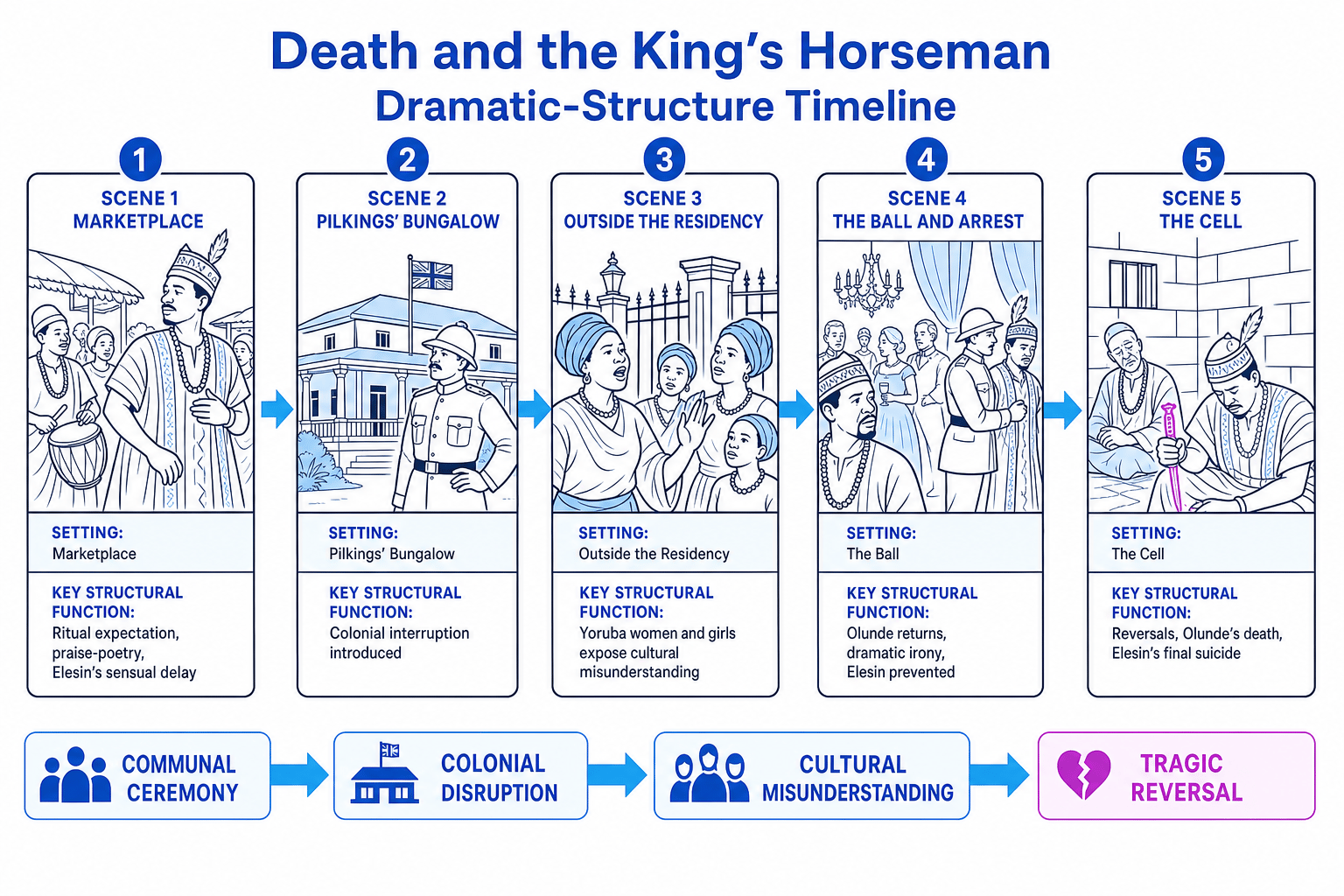
The structure depends on juxtaposition.
Juxtaposition
Juxtaposition is when a writer places two things side by side so that their differences become clearer.
Scene 1 places us inside the marketplace, where Elesin’s role is understood through ritual, praise and communal expectation. Scene 2 then cuts to Pilkings’ bungalow, where the same ritual is misunderstood as a law-and-order problem. This structural contrast makes the audience compare two worldviews.
Tracing a structural contrast
- Compare the settings: the marketplace is public, communal and ritualised, while Pilkings’ bungalow is private, colonial and administrative.
- Compare the language: Elesin’s world uses praise, proverb and song; Pilkings’ world uses orders, reports and dismissive judgements.
- Explain the effect: the audience sees that the conflict is not just between individuals, but between different ways of understanding death, duty and authority.
- Link to the whole play: this contrast prepares the final tragedy, because Pilkings acts decisively without understanding the ritual structure he interrupts.
Delay and pacing
Pacing
Pacing means the speed at which a writer lets events unfold.
Soyinka’s pacing is tense because the ritual must happen at the correct time. Scene 1 feels expansive: there is music, celebration, storytelling and Elesin’s desire for the young bride. This creates delay. The audience knows time matters, so the delay becomes troubling.
The later scenes become more urgent. Pilkings hears about the planned ritual and tries to stop it. Olunde arrives. Elesin is prevented. By Scene 5, the play has moved from expectation to aftermath.
This is why the ending feels so devastating. Olunde, not Elesin, has fulfilled the sacrificial logic. When Olunde rejects Elesin with “I have no father”, the family and ritual order have already been broken.
Reversal: the tragic structure of the ending
Reversal
A reversal is a sudden change in fortune or expectation. In tragedy, it often turns apparent control into helplessness.
The audience expects Elesin to die honourably. Instead, he lives too long, Olunde dies in his place, and Elesin’s final suicide becomes belated rather than heroic. Iyaloja’s judgement that “the world is set adrift and its inhabitants are lost” expresses the structural consequence: one man’s failure has cosmic and communal effects.
Calling the ending a simple restoration
Elesin’s final death does not neatly fix everything. Structurally, it comes too late. Soyinka makes the timing of action as important as the action itself.
How to write about language, form and structure together
A strong paragraph usually links all three. For example, you might argue that Soyinka presents Elesin’s tragedy through the contrast between his poetic confidence and the play’s tightening structure.
You could write:
Soyinka initially presents Elesin through ceremonial, sensual language, as his repeated claim that “The world is good” reveals both his vitality and his dangerous attachment to earthly pleasure. The chant-like repetition suits the ritual form of the play, where speech, music and communal performance prepare him for death. However, the structure turns this confidence into irony: the early expansiveness of the marketplace gives way to confinement in the final cell, showing that Elesin’s delay has trapped both himself and his community in disorder.
Notice the chain: point → evidence → method → effect → link. The quotation is short, the method is named, and the analysis explains why Soyinka uses it.
In the exam
- Use your clean copy actively: choose short quotations and stage moments that let you discuss method, not long plot summaries.
- Keep linking AO2 to meaning: explain how language, form or structure shapes the audience’s response to duty, delay, misunderstanding or tragedy.
- Avoid reducing the play to a simple “clash of cultures”; Soyinka’s form also explores metaphysical order, personal failure and ritual timing.
Check yourself
- How does Soyinka make Elesin’s love of life both attractive and dangerous?
- Why is the shift from marketplace to Pilkings’ bungalow structurally important?
- What makes Elesin’s final suicide tragic rather than fully heroic?