What you'll learn
- How to choose high-value quotations for Death and the King’s Horseman.
- How to link each quote to speaker, scene, method, and meaning.
- How to analyse quotations for AO1 and AO2 in Edexcel IGCSE.
- How to avoid common mistakes when writing about Soyinka’s language and drama.
Why key quotes matter
A key quote is a short piece of evidence that can support more than one important idea in the play. In Edexcel IGCSE Component 2, Death and the King’s Horseman is studied as modern drama, so your main focus is AO1 and AO2.
AO1 means showing clear knowledge and understanding of the text, using references. AO2 means analysing the writer’s methods — language, form, and structure — and their effects.
This is an open-book exam section, so you will have a clean copy of the play. But you still need to know where the best quotes are and why they matter. You do not want to waste time hunting through the whole text.
Before you learn individual quotes, it helps to see how they sit across the five-scene movement of the play.
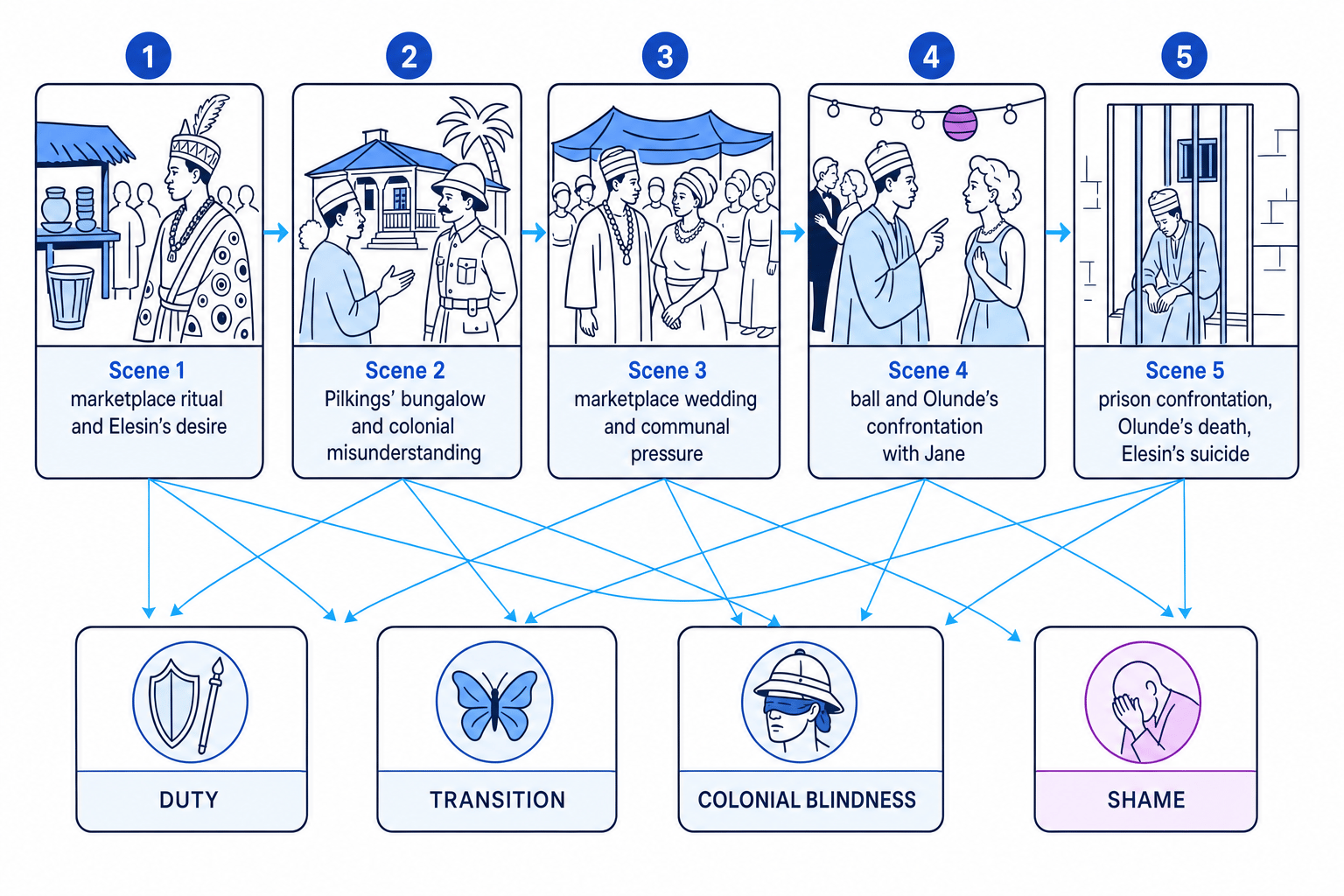
Best way to revise quotes
Learn each quotation as a cluster: short quote + speaker + scene + method + theme. That makes it much easier to adapt your evidence to different essay questions.
Useful method words
Soyinka’s writing is rich and layered, so you should avoid simply saying “this quote shows…” and stopping there.
Core literary terms
- A metaphor describes one thing as if it is another, creating a compressed comparison.
- Symbolism is when an object, action, costume, or image represents a larger idea.
- Dramatic irony is when the audience understands more than a character does.
- A motif is a repeated image, phrase, or idea that gathers meaning across a text.
- Antithesis is a sharp contrast between two opposing ideas or phrases.
Quotes about duty, ritual, and cosmic order
In the play, Elesin’s death is not presented simply as a personal suicide. It is part of a ritual duty connected to the king, the ancestors, the living community, and the unborn.
Cosmic order
In this play, cosmic order means the spiritual balance between the living, the dead ancestors, and the unborn. Elesin’s failure threatens this whole chain of continuity.
| Quotation | Speaker / place | How to use it |
|---|---|---|
| “The world was never tilted from its groove; it shall not be in mine.” | Elesin, Scene 1 | The metaphor of the world’s “groove” suggests a stable, ordered universe. It also becomes ironic because Elesin later fails to keep that order intact. |
| “There is only one world to the spirit of our race.” | Elesin, Scene 5 | Elesin presents the ritual as communal and spiritual, not merely individual. The phrase “one world” stresses unity and fragility. |
| “You did not save my life, District Officer. You destroyed it.” | Elesin, Scene 5 | The antithesis between “save” and “destroyed” reverses Pilkings’ view of himself as a rescuer. It shows that Pilkings misunderstands the meaning of life and death in the play. |
| “Now forget the dead, forget even the living. Turn your mind only to the unborn.” | Iyaloja, final lines | The repeated command “forget” shifts attention from tragedy to continuity. The final focus on “the unborn” makes the ending wider than Elesin alone. |
Flexible quote
“The world was never tilted from its groove” can be used for essays on duty, tradition, tragedy, dramatic irony, or Elesin’s confidence before his fall.
Quotes about Elesin’s vitality and weakness
Elesin is not a flat symbol of duty. Soyinka makes him charismatic, sensual, proud, poetic, and flawed. This complexity is important: his failure is dramatic because he understands his duty but is still attached to life.
| Quotation | Speaker / place | How to use it |
|---|---|---|
| “The world is good and the world is my home.” | Elesin, Scene 1 | The repetition of “world” shows Elesin’s deep love of earthly life. This makes him attractive, but it also foreshadows the attachment that helps delay his transition. |
| “Not I” | Elesin’s “Not-I” story, Scene 1 | The repeated phrase becomes a motif of courage and denial. Elesin claims he will not be like those who run from death, but the audience later sees the painful irony. |
| “What tryst is this the cockerel goes to keep with such haste / That he must leave his tail behind?” | Praise-Singer, Scene 1 | The comic image of the “cockerel” introduces Elesin as lively and theatrical. It also hints at masculinity, pride, and performance. |
Making Elesin too simple
Do not write that Elesin is only “selfish” or only “heroic”. The strongest answers show the tension: he speaks the language of duty, but Soyinka also shows his love of pleasure, status, and life.
Quotes about colonial misunderstanding
Pilkings’ mistake is not only that he does not know Yoruba ritual. It is that he assumes his own values are universal. Soyinka dramatises this through costume, dialogue, and contrast between characters.
Egungun
Egungun are Yoruba ancestral masquerades associated with the spirits of the dead. In the play, Pilkings and Jane wearing egungun costumes as party clothes is a powerful symbol of colonial disrespect.
| Quotation | Speaker / place | How to use it |
|---|---|---|
| “uniform of death” | Amusa, Scene 2 | Amusa’s phrase shows that the egungun costume is spiritually serious. Pilkings’ inability to understand this creates dramatic irony. |
| “fancy-dress” | Pilkings / colonial setting, Scenes 2 and 4 | The phrase reduces sacred costume to entertainment. This shows colonial trivialisation of another culture’s symbols. |
| “I discovered that you have no respect for what you do not understand.” | Olunde, Scene 4 | Olunde directly exposes the moral failure behind colonial ignorance. The abstract nouns “respect” and “understand” make the criticism precise. |
| “call it gallantry” / “call it barbarism” | Olunde, Scene 4 | The contrast exposes a double standard: British self-sacrifice is honoured, while Yoruba ritual duty is dismissed. |
Analysing Olunde’s challenge
-
Start with the dramatic situation: Olunde speaks to Jane after returning from Britain, so he understands both British and Yoruba perspectives.
-
Focus on the wording: “no respect” is absolute, suggesting the problem is not innocent confusion but a refusal to value what is unfamiliar.
-
Link method to meaning: Soyinka uses Olunde’s calm, educated voice to reverse colonial assumptions; the African character becomes the clearest moral judge on stage.
-
Connect to the wider play: this quote helps explain why Pilkings’ intervention is so destructive — he acts before he truly understands what Elesin’s death means.
Quotes about shame and consequence
By Scene 5, the language becomes harsher. The question is no longer whether Elesin will die, but what his delay has done to the community and to his son.
| Quotation | Speaker / place | How to use it |
|---|---|---|
| “the alien hand pollutes the source of will” | Elesin, Scene 5 | The metaphor of pollution suggests spiritual contamination. However, Elesin also uses this language to shift blame onto Pilkings. |
| “I have no father, eater of left-overs.” | Olunde, Scene 5 | The brutal noun phrase “eater of left-overs” expresses shame and rejection. Olunde sees survival after failed duty as disgrace. |
| “You have betrayed us.” | Iyaloja, Scene 5 | The direct accusation shows that Elesin’s failure is communal, not private. Iyaloja becomes the voice of social judgement. |
| “Turn your mind only to the unborn.” | Iyaloja, final line | The ending refuses to stay with personal grief. Soyinka closes on future generations and the broken-but-continuing chain of life. |
Do not blame only Pilkings
Pilkings is a catalyst, but Soyinka also makes Elesin responsible for his own hesitation. Strong essays usually balance colonial interference with Elesin’s inner weakness.
How to build a quote cluster
A quote cluster is a small group of quotations that work together to support an argument. This is often better than memorising many disconnected lines.
Choosing quotes for a question on responsibility
-
Begin with Elesin’s confidence in Scene 1: “The world was never tilted from its groove; it shall not be in mine.” This establishes his public commitment to duty.
-
Add a quote showing the pressure of colonial misunderstanding: Olunde says, “you have no respect for what you do not understand.” This widens the issue beyond Elesin’s personal failure.
-
Bring in the consequence: Olunde’s “I have no father, eater of left-overs” shows that failed responsibility creates shame within the family and community.
-
End with Iyaloja’s final instruction: “Turn your mind only to the unborn.” This lets you argue that responsibility in the play extends beyond the present generation.
Mini model of quote analysis
A strong sentence does not need a huge quotation. Often, a short embedded phrase is sharper.
For example:
Soyinka presents Pilkings’ intervention as destructive rather than heroic when Elesin tells him, “You did not save my life… You destroyed it.” The direct contrast between “save” and “destroyed” challenges Pilkings’ colonial confidence: he believes he has preserved life, but Elesin understands life through ritual duty and communal meaning. The line therefore exposes the gap between British legal thinking and the Yoruba spiritual order of the play.
Over-quoting
Do not copy out long speeches and then explain them vaguely. Use short, accurate fragments and spend more time analysing Soyinka’s choices.
In the exam
-
Use your clean copy strategically: know the scene and speaker of your best quotes before the exam begins.
-
Embed short quotation fragments into your own sentences, then zoom in on one method such as metaphor, symbolism, contrast, or dramatic irony.
-
Keep linking back to the question: explain how the quote shapes our understanding of duty, transition, shame, colonial misunderstanding, or the future.
Check yourself
- Which two quotes would you use to show that Elesin understands his ritual duty?
- How does Olunde’s language expose colonial double standards?
- Why is Iyaloja’s final focus on “the unborn” so important to the ending?