What you'll learn
- How the five scenes create the play’s tragic movement from confidence to catastrophe.
- Which moments are most useful for essays on duty, colonial power, honour, and community.
- How to analyse stage action, not just dialogue, for AO2.
- How to avoid reducing the play to a simple “clash of cultures”.
Why key scenes matter
A key scene is a moment in a drama where something essential changes: a character’s choices become clearer, a conflict intensifies, or the ending is made unavoidable.
In Death and the King’s Horseman, Soyinka structures the play in five scenes. The movement is not just “what happens next”; it is a carefully shaped tragic pattern. Structure means the order and arrangement of events. Form means the kind of text and how it works — here, a stage play using dialogue, stage directions, music, dance, ritual, comedy, and silence.
Because this is a Component 2 modern drama text, the exam is open book: you may use a clean copy of the play. But you still need strong scene knowledge. The best answers know where to go quickly and can explain how a scene works dramatically.
Tragedy
A tragedy is a serious drama in which choices, pressures, or flaws lead to suffering and irreversible loss. In Soyinka’s play, the tragedy is not only personal; Elesin’s failure threatens the spiritual order connecting the living, the dead, and the unborn.
The whole play in five scenes
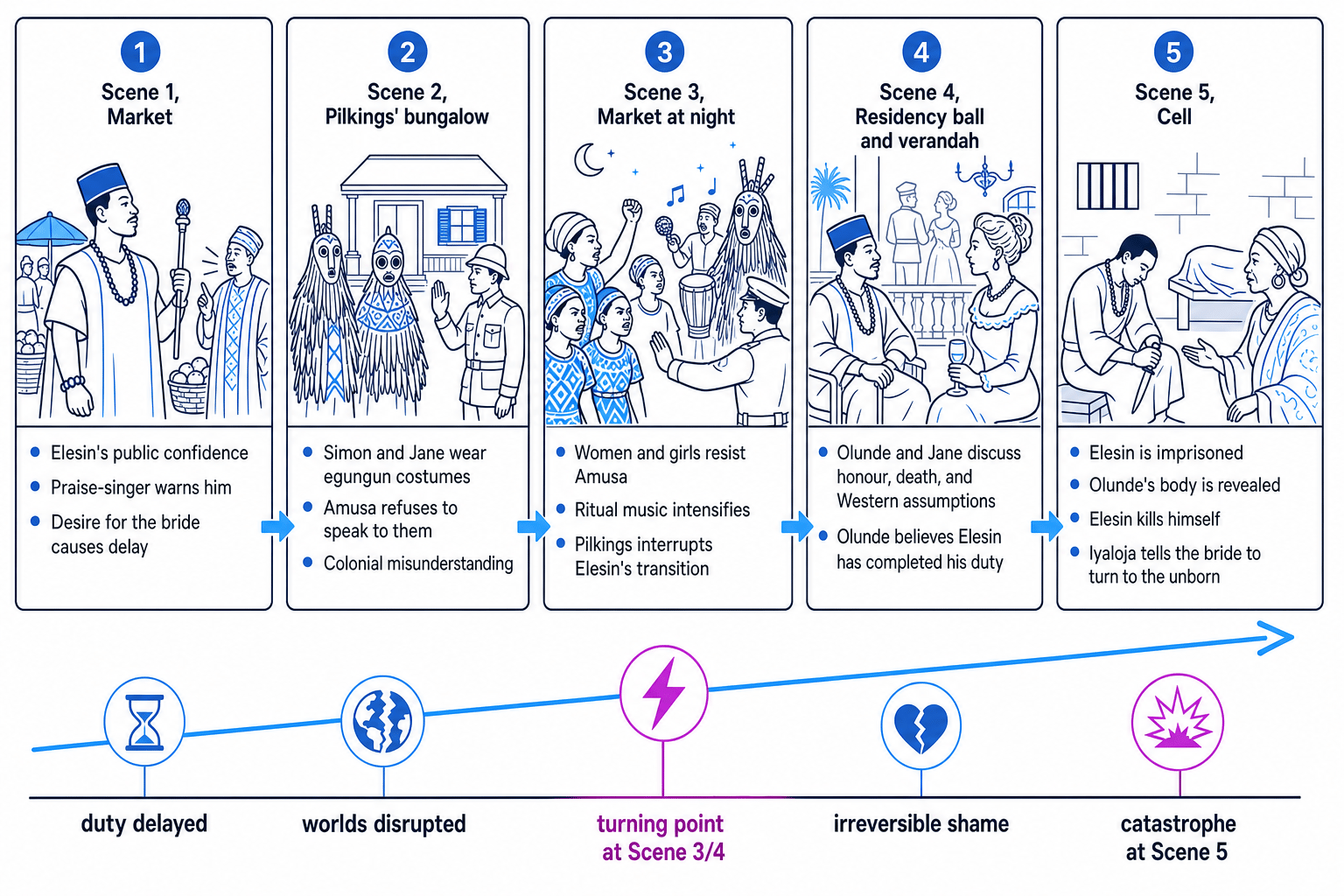
The play begins in the market with celebration and confidence, then moves towards interruption, shame, and death. A turning point is the moment after which events cannot return to their earlier state. A catastrophe is the final disastrous outcome of a tragedy.
This timeline helps you see how each scene pushes the drama closer to catastrophe.
The pattern to remember
The play’s key scenes show duty being delayed, misunderstood, interrupted, and finally replaced by shame. Soyinka makes the audience ask where responsibility lies: with colonial interference, Elesin’s weakness, or both.
Scene 1: The market — honour is public
The opening market scene establishes Elesin as a man admired by his community. The market is full of life, speech, music, and women’s presence. This matters because Elesin’s death is not treated as private despair; it is a public, ritual duty.
The Praise-Singer reminds Elesin of his role and tests his readiness. Elesin seems confident, especially through the story of the “Not-I bird”, which mocks those who refuse death. This becomes foreshadowing: foreshadowing is when an earlier detail hints at a later event. Elesin condemns avoidance, but later fails to complete his own passage at the right time.
Iyaloja’s warning that “The world is in your hands” makes the stakes huge. This is not just about one man’s reputation. It is about cosmic balance in the Yoruba world of the play.
The scene also introduces Elesin’s dangerous attachment to life. When he desires the young bride, the scene shifts from spiritual readiness to bodily appetite. Soyinka does not make desire simple or cartoonishly “bad”; Elesin is full of vitality. But structurally, this delay matters.
Linking the bride episode to Elesin’s fall
-
Identify the immediate conflict: Elesin is meant to move from the world of the living towards ritual death, but he asks to marry the bride first.
-
Compare his words with his action: the “Not-I bird” story presents him as fearless, yet his desire for the bride keeps him attached to earthly pleasure.
-
Analyse the method: Soyinka uses structural foreshadowing because the delay plants the possibility that Elesin’s will is not as strong as his public language suggests.
-
Link to meaning: the tragedy cannot be blamed only on Pilkings; Scene 1 has already shown Elesin’s divided nature.
Blaming only Pilkings
Do not write that the tragedy happens simply because Pilkings interrupts the ritual. Soyinka’s Author’s Note warns against the “facile” label of “clash of cultures”. Pilkings is crucial, but Elesin’s delay and self-indulgence are also part of the tragic structure.
Scene 2: Pilkings’ bungalow — sacred meaning becomes fancy dress
Scene 2 moves sharply from the Yoruba market to the British colonial bungalow. The setting itself creates contrast. Simon and Jane Pilkings wear egungun costumes, which belong to a sacred ancestral masquerade, as fancy dress for a ball.
A symbol is an object, costume, or action that carries a wider meaning. The egungun costume symbolises ancestral presence and spiritual power in Yoruba culture. Pilkings treats it as decoration. That visual stage image immediately shows colonial ignorance.
Amusa’s reaction is important. He asks, “How can man talk against death to person in uniform of death?” The line is partly comic because of his phrasing, but it is not foolish. He understands the sacred danger more than Pilkings does.
Pilkings’ dismissive language, including “mumbo-jumbo”, shows his refusal to understand what he governs. Soyinka uses comedy here, but the comedy has a serious edge: colonial authority is powerful and ignorant at the same time.
Scene 3: The market at night — ritual and interruption
Scene 3 returns to the market, but the atmosphere is different. Night, music, movement, and ritual create rising tension. Stagecraft means the practical dramatic methods used on stage: entrances, exits, costume, music, gesture, lighting, positioning, and silence.
The girls’ mocking of Amusa is more than a comic break. It reverses power for a moment. The colonial police officer is verbally defeated by young women who understand the community’s values better than he does.
As the ritual intensifies, Elesin enters a transitional state. This is where the play’s drama becomes physical, not just verbal. The audience watches whether he can complete the passage. Pilkings’ intervention then turns cultural misunderstanding into direct action.
The key question is: does Pilkings stop a completed ritual, or expose a failure already beginning inside Elesin? Strong answers keep both possibilities alive. Soyinka makes the moment ambiguous enough to be tragic.
Scene 4: The verandah — Olunde corrects Jane
Scene 4 is one of the most useful scenes for essays because Olunde challenges Western assumptions with calm authority. The scene is built on juxtaposition, which means placing two things side by side to create contrast. The British ball celebrates imperial ceremony, while Olunde discusses Yoruba duty and sacrificial death.
Jane assumes the ritual is barbaric. Olunde replies, “I discovered that you have no respect for what you do not understand.” This is a key line because it reverses the expected colonial hierarchy. Olunde has studied medicine in England, but he is not “converted” into Jane’s worldview. Instead, he sees the limits of it.
There is also dramatic irony. Dramatic irony happens when the audience understands more than a character does, or when a character’s belief is painfully incomplete. Olunde believes Elesin has fulfilled his duty, while the audience knows or suspects that the situation has gone wrong.
Comparing Jane and Olunde’s views of sacrifice
-
Establish the contrast: Jane sees ritual death as shocking and irrational, while Olunde treats it as part of a meaningful moral and spiritual order.
-
Use precise evidence: Olunde’s statement that Jane has “no respect for what you do not understand” attacks not only her opinion but the wider colonial habit of judging without knowledge.
-
Analyse the dramatic method: Soyinka uses dialogue and juxtaposition to make Olunde intellectually stronger than Jane, even though Jane belongs to the ruling colonial group.
-
Link to the play’s wider argument: the scene shows that “civilisation” and “barbarism” are not simple labels; Soyinka asks the audience to examine who truly understands honour, duty, and death.
Scene 5: The cell — shame, substitution, and the unborn
The final scene is the catastrophe. Elesin is imprisoned, and the visual image of confinement is crucial. A man who was supposed to move freely into the ancestral world is now physically trapped by colonial power and morally trapped by failure.
Olunde’s reaction is devastating. When he sees Elesin alive, he says, “I have no father.” This short sentence is powerful because it rejects Elesin not biologically but morally. Elesin has failed the identity that made him worthy of being called father.
Olunde’s death changes the meaning of the whole play. He has completed the duty in his father’s place. This makes Elesin’s later suicide painfully late. It is not the noble ritual death required at the correct time; it is an act of shame after the balance has already been disturbed.
Iyaloja’s final words to the bride — “Now forget the dead, forget even the living. Turn your mind only to the unborn” — shift the play’s focus from individual grief to future continuity. The ending is bleak, but not empty. The community must still think beyond the failed men towards what comes next.
Best scenes for common essay themes
Duty and honour
Use Scene 1 and Scene 5 together. Scene 1 shows Elesin publicly celebrated as the King’s Horseman; Scene 5 shows the collapse of that honour. The contrast gives you a strong structural argument.
Colonial power and misunderstanding
Use Scene 2 and Scene 3. The egungun costume scene shows symbolic ignorance; the interruption of the ritual shows that ignorance becoming force.
Women and community
Use Scene 1, Scene 3, and Scene 5. Iyaloja is not just a background figure. She understands the ritual stakes, challenges Elesin, and gives the final moral direction of the play.
Olunde as moral contrast
Use Scene 4 and Scene 5. Scene 4 gives his intellectual clarity; Scene 5 proves his commitment through action.
Quick scene choices
For most essays, pair an early scene with a later one. This lets you show development: confidence to shame, misunderstanding to damage, or public honour to public disgrace.
In the exam
-
Start with the scene’s dramatic function, not just its plot: explain what changes because of this moment.
-
Use short quotations and stage details together: dialogue such as “I have no father” is powerful, but costume, music, entrances, and setting also count for AO2.
-
Keep your argument balanced: show how colonial interference matters, but also how Soyinka presents Elesin’s own delay and weakness.
Check yourself
-
Which scene first suggests that Elesin may be too attached to the living world?
-
How does the egungun costume scene reveal Pilkings’ misunderstanding?
-
Why is Olunde’s “I have no father” more than a personal insult?