What you'll learn
- How to turn an essay question into a clear thesis for Death and the King’s Horseman.
- How to plan paragraphs that cover the whole play without retelling the plot.
- How to use short quotations and dramatic methods to hit AO1 and AO2.
- How to adapt flexible plans for common themes such as duty, colonial misunderstanding, Elesin, and community.
Why essay plans matter
For Edexcel IGCSE English Literature, Death and the King’s Horseman appears in Component 2: Modern Drama, which is open book. You may use a clean copy of the play, but you still need a plan: if you spend too long searching for quotations, your answer can become rushed or descriptive.
Essay plan
An essay plan is a short route-map for your argument. It decides your main answer, the order of your paragraphs, the moments you will use as evidence, and the dramatic methods you will analyse.
A strong plan helps you show AO1 through a clear, informed argument and precise references, and AO2 through analysis of Soyinka’s dramatic methods: dialogue, song, ritual, stage directions, symbolism, contrasts, entrances, exits, and structure.
The big aim
Do not plan “what happens”. Plan how Soyinka presents an idea and why that presentation matters to the audience.
Start with the question, not the plot
Most questions will ask something like:
- How does Soyinka present Elesin?
- How does Soyinka present duty?
- Explore the importance of colonial misunderstanding.
- How does Soyinka make the ending powerful?
Your first job is to identify the focus of the question.
Thesis
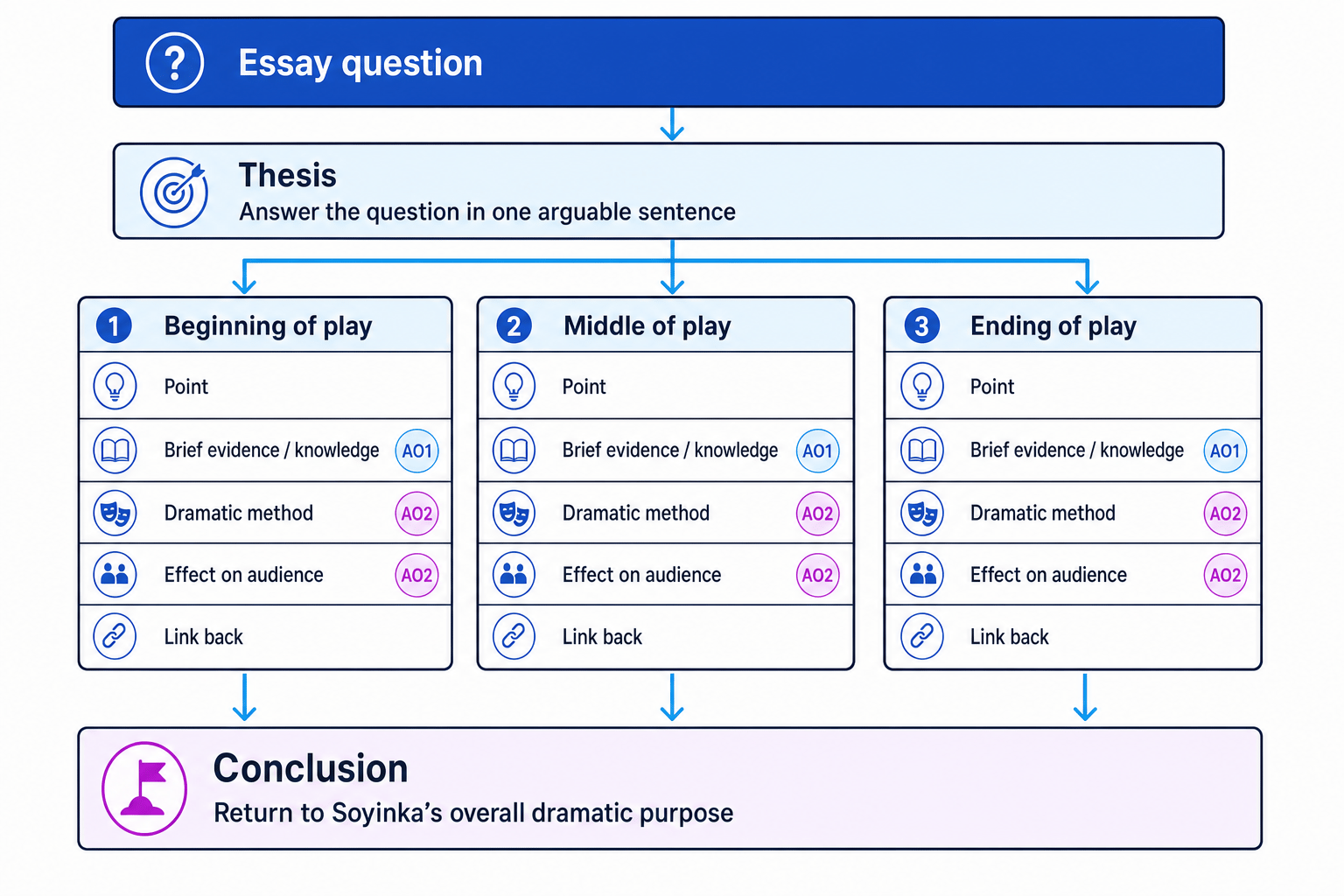
A thesis is your overall answer to the question in one arguable sentence. It should be specific enough to guide every paragraph.
A weak thesis says: “Soyinka presents duty in many ways.”
A stronger thesis says: “Soyinka presents duty as a sacred communal responsibility, but he makes the tragedy sharper by showing how Elesin’s personal weakness and Pilkings’ ignorance both disrupt that responsibility.”
Turning a question into a thesis
Question: How does Soyinka present Elesin as a tragic figure?
-
Decide what “tragic figure” means in this play: Elesin is not simply unlucky; he has honour and status, but his failure has terrible consequences for the community.
-
Choose a whole-play route: at the beginning he is celebrated by the Praise-Singer and the market; in the middle his desire for the young bride exposes self-indulgence; at the end Iyaloja condemns his failure and Olunde’s death intensifies his shame.
-
Turn that route into an argument: Soyinka presents Elesin as a tragic figure whose public honour and poetic confidence are undermined by appetite and hesitation, so that his private failure becomes a communal catastrophe.
Use a beginning–middle–ending structure
A reliable plan for this play uses three main paragraphs:
- Beginning of the play — how the idea is introduced.
- Middle of the play — how Soyinka complicates or challenges it.
- Ending of the play — how the idea reaches tragic consequences.
This works especially well because Soyinka’s drama depends on structure: the movement from market celebration, to colonial interruption, to the devastating final scene.
Dramatic structure
Dramatic structure means the way a play is organised for performance: the order of scenes, contrasts between settings, entrances and exits, moments of revelation, and the final image left with the audience.
Plot summary
A common mistake is writing: “First Elesin does this, then Pilkings does that, then Olunde dies.” Instead, make each paragraph prove part of your thesis.
The paragraph engine: point, evidence, method, effect, link
Each planned paragraph should contain five things.
| Part | What it does | Example for this play |
|---|---|---|
| Point | Answers the question directly | Soyinka first presents duty as communal and sacred. |
| Evidence | Gives a short quotation or precise moment | The opening market scene; Elesin’s “Not-I bird” story. |
| Method | Names Soyinka’s choice | Ritualised dialogue, storytelling, choric praise, dramatic irony. |
| Effect | Explains meaning for the audience | We see death as part of a spiritual order, not just personal suicide. |
| Link | Returns to the question | This makes Elesin’s later failure more tragic. |
Dramatic method
A dramatic method is a writer’s choice that creates meaning on stage. In this play, useful methods include symbolism, choric speech, song, ritual, costume, stage directions, contrasting settings, and dramatic irony.
Building one analytical paragraph
Focus: colonial misunderstanding
-
Make the point arguable: Soyinka presents Pilkings’ colonial world as dangerously shallow because it treats sacred Yoruba symbols as objects of entertainment.
-
Select brief evidence: Pilkings and Jane wear egungun costumes, while Amusa insists the costume belongs to a “dead cult” and is “not for human being”.
-
Name the method: Soyinka uses costume symbolism and dramatic irony. The audience can see the seriousness of the costume before Pilkings understands it.
-
Explain the effect: Pilkings’ ignorance becomes more than bad manners; it reveals a colonial attitude that refuses to recognise the spiritual meaning of another culture.
-
Link back: This misunderstanding helps drive the tragic disruption of Elesin’s ritual duty.
Plan 1: Elesin as a tragic figure
A good Elesin essay should avoid making him either a total hero or a simple villain. Soyinka presents him as charismatic, honoured, and spiritually important, but also flawed.
Possible thesis
Soyinka presents Elesin as a complex tragic figure: he understands the honour of his role, but his love of pleasure and his hesitation break the ritual order he is supposed to protect.
Paragraph route
Paragraph 1 — public honour and confidence
- Opening market scene.
- Elesin is surrounded by the Praise-Singer and community.
- His storytelling, especially the “Not-I bird” episode, shows his verbal power.
- Method: ritualised language, praise poetry, oral storytelling.
- Effect: the audience sees why Elesin matters before seeing him fail.
Paragraph 2 — appetite and distraction
- Elesin’s desire for the young bride interrupts the solemn movement towards death.
- Iyaloja allows the marriage, but the scene creates tension between duty and desire.
- Method: structural delay and dramatic irony.
- Effect: the audience senses that Elesin’s own weakness, not only Pilkings’ interference, is part of the tragedy.
Paragraph 3 — shame and judgement
- In the final scene, Iyaloja condemns Elesin for choosing “the world’s leftovers”.
- Olunde’s death exposes what Elesin failed to do.
- Method: reversal and tragic contrast between father and son.
- Effect: Elesin’s final suicide feels too late to restore the broken order.
A sharper Elesin argument
Use the phrase “tragic complexity”: Elesin is responsible for his failure, but Soyinka also shows how colonial interference worsens the catastrophe.
Plan 2: duty and honour
This is one of the most useful themes to prepare because it connects Elesin, Olunde, Iyaloja, and the community.
Possible thesis
Soyinka presents duty as a sacred responsibility that connects the living, the dead, and the unborn; the tragedy occurs when personal desire and colonial interference break that connection.
Planning an essay on duty
-
Begin with Elesin’s role: he is not dying for private reasons, but because his death is meant to accompany the dead king and preserve cosmic order.
-
Move to conflict: Pilkings misunderstands the ritual as only “suicide”, while Olunde recognises it as an “affirmative comment on life”.
-
End with consequences: Olunde fulfils the duty his father fails to complete, and Iyaloja’s final command to “forget the dead, forget even the living” turns attention towards “the unborn”.
Strong methods to mention
- Ritual: the play presents duty through communal ceremony, not private decision.
- Contrast: Olunde’s calm acceptance contrasts with Pilkings’ alarm and Elesin’s hesitation.
- Final image: the ending leaves the audience thinking about future generations, not only the deaths on stage.
Plan 3: colonial misunderstanding
Be careful with this topic. Soyinka does present colonial ignorance powerfully, but he did not want the play reduced to a simple “clash of cultures”. Pilkings is important, but Elesin’s own failure matters too.
Possible thesis
Soyinka presents colonial misunderstanding as destructive because Pilkings interferes without understanding, but the play’s tragedy also depends on Elesin’s internal weakness.
Paragraph route
Paragraph 1 — symbolic disrespect
- Pilkings and Jane wear the egungun costumes.
- Amusa’s horror shows the sacred meaning of what they treat as fancy dress.
- Method: costume symbolism and irony.
Paragraph 2 — Olunde’s challenge
- Olunde tells Jane, “You have no respect for what you do not understand.”
- Method: direct dialogue and contrast between Olunde’s dignity and Jane’s assumptions.
- Effect: Soyinka gives the sharpest criticism of colonial arrogance to a character who understands both worlds.
Paragraph 3 — tragic intervention
- Pilkings imprisons Elesin to “save” him, but this action helps produce greater disaster.
- Method: structural irony.
- Effect: the audience sees that interference without understanding can be more destructive than non-intervention.
The simple clash reading
Do not write as if the play is only “British people versus Yoruba people”. Soyinka also explores personal weakness, communal responsibility, spiritual transition, and the cost of failed duty.
Plan 4: women and communal authority
The women in the play are not background figures. Iyaloja and the market women help define the moral standards of the community.
Possible thesis
Soyinka presents women as guardians of communal values: they support Elesin’s honour at first, but Iyaloja becomes the clearest judge of his failure.
Paragraph route
- Opening: the market women create the communal space in which Elesin’s ritual identity matters.
- Middle: Iyaloja negotiates Elesin’s marriage to the young bride, showing both respect for him and anxiety about his desire.
- Ending: Iyaloja’s judgement is devastating; her final instruction to “turn your mind only to the unborn” shifts the play from shame to survival.
Methods to analyse
- Choric presence: the women often act as a collective voice.
- Dialogue: Iyaloja’s speech is controlled, authoritative, and morally direct.
- Structure: Iyaloja has major force at the end, so the audience’s final understanding is shaped by her judgement.
Choosing quotations in an open-book exam
Because Component 2 is open book, you can find quotations during the exam, but you should already know where the key moments are. Aim for short fragments, not long copied passages.
Useful short references include:
- Elesin’s “Not-I bird” story — useful for fear, avoidance, and self-justification.
- Amusa’s reaction to the “dead cult” costume — useful for sacred symbolism and colonial ignorance.
- Olunde’s “affirmative comment on life” — useful for duty, death, and cultural understanding.
- Olunde’s “You have no respect for what you do not understand” — useful for colonial attitudes.
- Iyaloja’s “world’s leftovers” — useful for Elesin’s failure and moral judgement.
- The final command to “turn your mind only to the unborn” — useful for endings, future generations, and communal survival.
Use quotations as evidence, not decoration
A quotation only helps if you analyse a method. For example, do not just quote “the unborn”; explain that Soyinka’s final structural focus moves beyond individual death towards the community’s future.
A quick planning template you can memorise
For almost any question on this play, try this:
- Thesis: Soyinka presents the idea as complex, linking personal responsibility with communal and spiritual consequences.
- Paragraph 1: Opening market world — ritual, song, praise, community.
- Paragraph 2: Disruption — Elesin’s desire, Pilkings’ misunderstanding, or cross-cultural conflict.
- Paragraph 3: Ending — Olunde’s sacrifice, Iyaloja’s judgement, future generations.
- Conclusion: Return to Soyinka’s dramatic purpose: he makes the audience confront the cost of failed understanding and failed duty.
In the exam
-
Spend about 5 minutes planning: write your thesis and three paragraph points before you begin.
-
Use the clean copy efficiently: find short phrases from key scenes rather than copying long speeches.
-
In every paragraph, move from evidence to method to effect: what Soyinka chooses, how it works on stage, and why it matters to the question.
Check yourself
-
Can you write a one-sentence thesis for a question on Elesin without retelling the plot?
-
Can you name three dramatic methods Soyinka uses, not just three themes?
-
Can you explain why the final focus on “the unborn” is important to the play’s overall meaning?