Writing high-scoring essays for Pearson Edexcel IGCSE English Literature Component 2, Section A (Modern Drama) requires more than just memorising plot points. Because this is an open-book exam, the examiner is not looking for basic plot recall; instead, they want to see a sophisticated, structured analysis of how Wole Soyinka uses dramatic techniques to explore complex cultural, philosophical, and political ideas.
In this guide, you will learn how to build an analytical essay that balances close textual analysis with a deep understanding of Soyinka’s theatrical methods and cultural context.
What you'll learn
- How to structure a sophisticated analytical paragraph using the "Analytical Loop"
- How to balance dramatic methods (AO2) with Yoruba cultural context (AO4)
- How to avoid common essay-writing pitfalls that limit your grade
The Prerequisites: Core Concepts
Before looking at model paragraphs, we must define the essential literary and cultural terms that will form the backbone of your essay analysis.
Yoruba Cosmology
The traditional spiritual system of the Yoruba people, which views existence not as a linear timeline, but as a continuous cycle of three interconnected realms: the world of the living, the world of the dead, and the world of the unborn. These realms are joined by a chaotic, transitional fourth space: the gulf of transition.
Soyinka’s play is not merely a political clash between Nigeria and the British Empire; it is a metaphysical drama about the threat of cosmic disruption. If Elesin Oba fails to complete his ritual suicide, the bridge between these worlds collapses, condemning his entire society to spiritual chaos.
Hamartia
The Greek tragic term for a protagonist's fatal flaw or error in judgment that leads to their inevitable downfall.
In classical tragedy, a hero's downfall is driven by their hamartia. In Death and the King's Horseman, Elesin’s tragic flaw is his lingering attachment to the material, sensory world—manifested in his desire for a new bride on the eve of his death—which makes him vulnerable to colonial intervention.
Dramatic Irony
A dramatic device where the audience understands the significance of a character's actions or words, but the characters themselves remain unaware.
Soyinka uses dramatic irony extensively. For example, when Simon and Jane Pilkings wear the sacred egungun costumes to a fancy-dress ball, the audience experiences a sense of dread and horror at their sacrilege, while the colonial couple remains blissfully, mockingly ignorant.
The "Analytical Loop" Essay Structure
To achieve a Level 5 (the highest mark band) in your Edexcel exam, every paragraph you write must function as a cohesive unit of argument. You cannot simply list literary devices ("feature spotting") or write a history essay about colonial Nigeria.
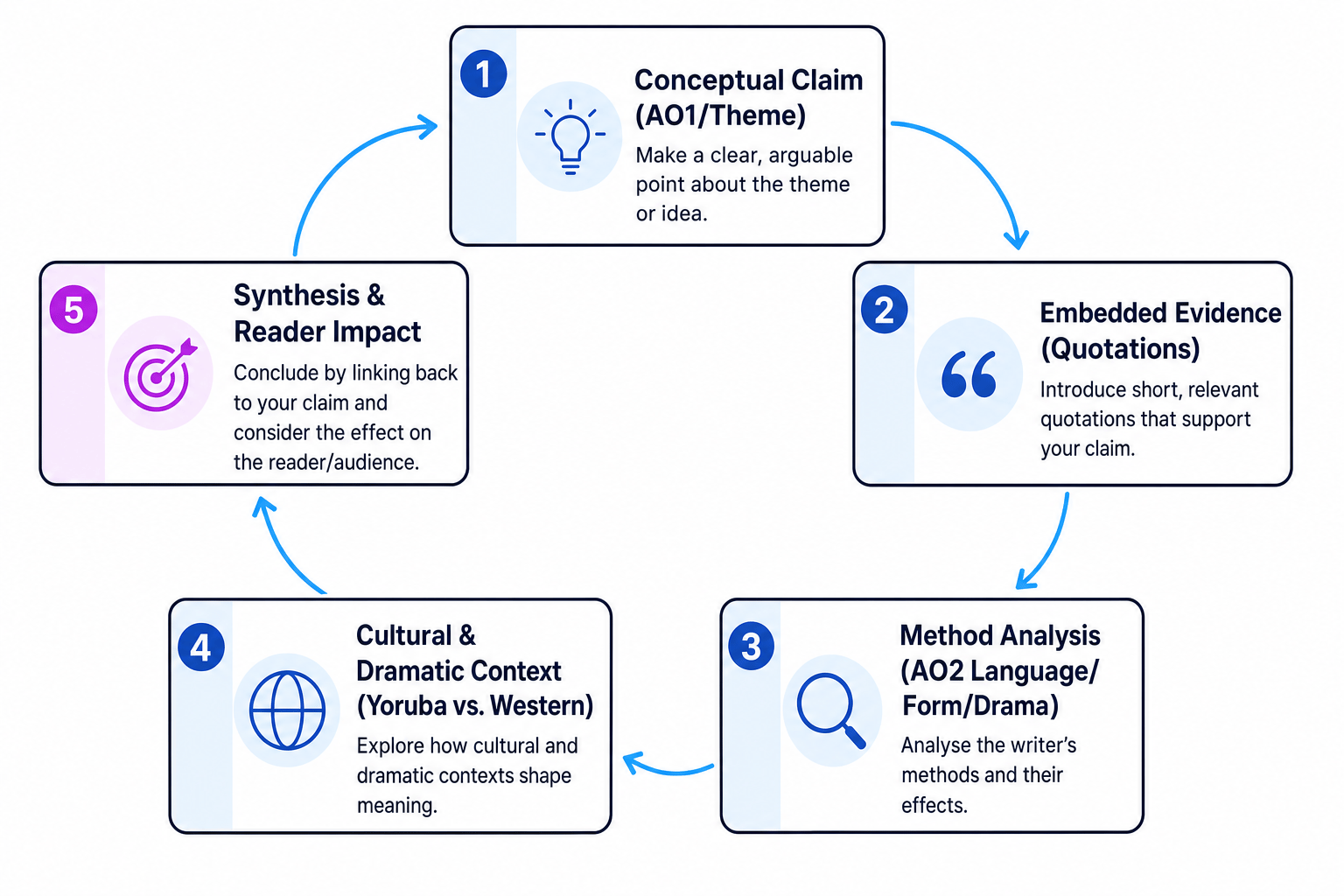
The diagram below outlines the five-step Analytical Loop that ensures you hit all key Assessment Objectives: AO1 (clear argument and textual reference), AO2 (analysis of language, structure, and dramatic form), and AO4 (contextual awareness).
The Open-Book Trap
Having a clean copy of the play in the exam is an advantage, but it is also a trap. Do not waste precious time searching for long quotations. Your quotes should be short (1–5 words), precise, and deeply integrated into your own sentences. Use your book only to check spelling or verify specific stage directions.
Writing a Model Paragraph: Step-by-Step
Let us walk through how to construct a high-scoring analytical paragraph. We will address the following exam-style prompt:
How does Soyinka present the conflict between the British colonial administration and Yoruba tradition?
Constructing an analytical paragraph on cultural conflict
Here is how to build your response step-by-step:
- Formulate a conceptual claim (AO1)
Begin with a thesis-driven topic sentence that directly answers the prompt. Avoid plots; focus on the characters as symbolic vehicles.
Drafting: Soyinka exposes the colonial administration’s profound spiritual blindness by presenting Simon Pilkings as a figure of secular, bureaucratic arrogance who is entirely detached from the metaphysical reality of Yoruba culture. - Seamlessly embed textual evidence (AO1)
Select a concise, high-impact quotation that supports your claim and build it directly into the grammatical flow of your sentence.
Drafting: This spiritual vacancy is made physically manifest in Act 2, when Pilkings and his wife Jane decide to wear the sacred egungun robes as "fancy dress," dismissing the spiritual relic as nothing more than a "piece of mouldy cloth." - Analyse Soyinka's dramatic and linguistic methods (AO2)
Deconstruct the language or theatrical devices in your quote. Identify specific techniques and discuss their dramatic effect on the audience.
Drafting: The noun phrase "mumbo-jumbo" and the adjective "mouldy" expose Pilkings’ reductionist, highly patronising register. By treating a sacred vessel of ancestral spirits as a mere costume, Pilkings commits a profound act of sacrilege. Soyinka utilizes the visual medium of theatre—specifically the shocking stage image of white colonialists dancing in desecrated spiritual vestments—to visually externalize the cultural and spiritual divide between the colonizer and the colonized. - Integrate historical and cultural context (AO4)
Explain why this conflict matters by linking it to the wider historical context or Yoruba cosmology. Do not just state a historical fact; tie it to the writer’s purpose.
Drafting: In the Yoruba worldview, the egungun is not a mask for entertainment, but a literal physical embodiment of the ancestors who maintain the cosmic equilibrium of the community. By reducing this sacred medium to a triviality, Pilkings demonstrates the typical British colonial mindset of the 1940s, which sought to civilise what they perceived as "barbaric" cultures, completely unaware that their secular rationalism threatens to tear the fabric of the universe Elesin is trying to protect. - Synthesize and evaluate the impact on the audience (AO1/AO2)
Conclude the paragraph by linking your analysis back to the overall prompt and evaluating how the audience is meant to respond.
Drafting: Ultimately, Soyinka uses this interaction to generate an intense sense of dramatic irony and unease in the audience, establishing that the primary conflict of the play is not merely a political disagreement, but a fundamental clash between Western superficiality and Yoruba spiritual depth.
Put it All Together: The Completed Model Paragraph
When you compile these five steps, the resulting paragraph flows logically, remains tightly focused on the prompt, and hits every assessment metric:
Soyinka exposes the colonial administration's profound spiritual blindness by presenting Simon Pilkings as a figure of secular, bureaucratic arrogance who is entirely detached from the metaphysical reality of Yoruba culture. This spiritual vacancy is made physically manifest in Act 2, when Pilkings and his wife Jane decide to wear the sacred egungun robes as "fancy dress," dismissing the spiritual relic as nothing more than a "piece of mouldy cloth." The noun phrase "mumbo-jumbo" and the adjective "mouldy" expose Pilkings' reductionist, highly patronising register. By treating a sacred vessel of ancestral spirits as a mere costume, Pilkings commits a profound act of sacrilege. Soyinka utilizes the visual medium of theatre—specifically the shocking stage image of white colonialists dancing in desecrated spiritual vestments—to visually externalize the cultural and spiritual divide between the colonizer and the colonized. In the Yoruba worldview, the egungun is not a mask for entertainment, but a literal physical embodiment of ancestral spirits who maintain the cosmic equilibrium of the community. By reducing this sacred medium to a triviality, Pilkings demonstrates the typical British colonial mindset of the 1940s, which sought to civilise what they perceived as "barbaric" cultures, completely unaware that their secular rationalism threatens to tear the fabric of the universe Elesin is trying to protect. Ultimately, Soyinka uses this interaction to generate an intense sense of dramatic irony and unease in the audience, establishing that the primary conflict of the play is not merely a political disagreement, but a fundamental clash between Western superficiality and Yoruba spiritual depth.
Avoiding Key Pitfalls
The 'History Essay' Trap
Because this play deals with British colonialism in Nigeria (1943), many students spend half their essay writing about the history of the British Empire or colonial administration. This is a literature exam, not a history exam. Your context (AO4) must always serve your analysis of Soyinka’s dramatic choices (AO2).
The Prefatory Note
Always remember that Soyinka included an introductory note to the play specifically warning against reducing it to a simple "clash of cultures." He insisted that the play's true heart is its "metaphysical" confrontation. Referencing Soyinka's own prefatory note in your essay is an excellent way to show top-tier critical engagement (AO1/AO4).
Stage Directions are Part of the Script
Do not ignore the stage directions! Soyinka is a master of theatricality. The music of the praise-singers, the beating of the drums, the changing lighting, and the physical movements on stage are just as important as the spoken dialogue. Analyse them as formal dramatic methods (AO2).
In the exam
- Unpack the question first: Spend the first 5 minutes highlighting the keywords in the prompt (e.g., "power," "duty," "conflict," "tragedy") and jotting down three distinct arguments that will form your body paragraphs.
- Anchor your essay in a strong thesis statement: Your introduction must outline your central argument clearly. Avoid vague openings like "In this play, Soyinka shows many different themes..."
- Vary your focus: Ensure you examine different aspects of the play. A strong essay on Death and the King's Horseman should analyze the lyrical, poetic Yoruba world (Acts 1, 3, 5) alongside the rigid, prose-driven colonial world (Acts 2, 4).
- Link methods to meaning: Whenever you identify a dramatic device (such as the praise-singer’s call-and-response or the drumming motif), immediately explain how it shapes the audience's understanding of the play's metaphysical themes.
Check yourself
- Can you explain why the British officers' use of the egungun costumes is deeply sacrilegious within traditional Yoruba cosmology?
- What is the dramatic function of Olunde's character in Act 4, and how does his language contrast with that of the British officials?
- How does the change in setting from the vibrant, organic marketplace (Act 1) to the sterile, enclosed colonial residency (Act 2) reflect the structural conflicts of the play?