To succeed in your Edexcel IGCSE English Literature exam, you must look beyond simply "what happens" in An Inspector Calls. You need to understand how J.B. Priestley constructs the narrative to deliver his powerful political message. Because the Pearson Edexcel Component 2 exam is open-book, you do not need to memorise every line, but you must know the sequence of events perfectly so you can locate evidence quickly and analyze how structural choices affect the audience (AO2).
What you'll learn:
- How Priestley uses and subverts the traditional "Well-Made Play" format.
- The chronological progression of the three acts and the "chain of events" that links the characters.
- How Priestley builds and releases dramatic tension to keep the audience on the edge of their seats.
1. The Structure: A Well-Made Play with a Twist
Before diving into the chronological acts, it is vital to understand the theatrical framework Priestley chose. Written in 1945 but set in 1912, An Inspector Calls is heavily influenced by classical dramatic structures, but it adapts them to challenge the audience's political views.
The Well-Made Play (Pièce Bien Faite)
A popular 19th-century French genre of drama characterized by a tight, logical plot that relies on a series of carefully timed secrets, sudden twists, and a logical denouement (resolution) where order is restored.
Priestley adopts the three unities of classical Greek drama—time (the play takes place in real-time over one evening), place (the entire play is set in the Birlings' dining room), and action (there are no distracting subplots). This creates an intense, claustrophobic atmosphere. However, while a traditional well-made play ends with secrets resolved and social order restored, Priestley subverts this by ending with a shocking cliffhanger that shatters the characters' comfortable reality.
The Claustrophobic Setting
By keeping the action restricted entirely to one room, Priestley forces both the characters and the audience to focus on their moral choices. There is no escape from the Inspector's gaze or his questions.
2. The Chain of Events: Act by Act
The plot of An Inspector Calls is driven by a retrospective narrative. Rather than showing the tragedy of Eva Smith as it happens, the play reconstructs her life through the testimonies of those who drove her to suicide.
Retrospective Narrative
A storytelling technique where the plot is reconstructed through characters looking back and recounting past events, rather than witnessing those events unfold live on stage.
Act 1: The Disruption of Complicity
The play opens in the dining room of the wealthy Birling family, who are celebrating the engagement of Sheila Birling to Gerald Croft. The mood is self-satisfied and prosperous. Mr. Birling delivers a series of dramatic speeches advocating capitalist self-reliance, declaring that "a man has to make his own way—has to look after himself."
This comfortable delusion is abruptly shattered by the arrival of Inspector Goole. He announces that a young working-class woman, Eva Smith, has died after drinking disinfectant. The Inspector systematically begins his investigation:
- Arthur Birling: Admits he sacked Eva Smith from his factory in 1910 for organizing a strike to demand higher wages (22s 6d22\text{s } 6\text{d}22s 6d a week instead of 22s22\text{s}22s). He defends his actions as sound business.
- Sheila Birling: Realizes she encountered Eva at the department store Milwards in 1911. Out of jealousy and vanity, Sheila used her family’s social influence to get Eva fired.
By the end of Act 1, Gerald Croft's reaction to the name "Daisy Renton" reveals his guilt to Sheila, setting up the first major cliffhanger.
Act 2: The Web Tightens
The focus shifts to the younger generation and the upper-class hypocrisy.
- Gerald Croft: Confesses that he kept Daisy Renton (Eva Smith) as his mistress in the spring and summer of 1912. While Sheila respects his honesty, their engagement is broken.
- Sybil Birling: The Inspector forces Mrs. Birling to admit that, as the head of the Brumley Women’s Charity Organization, she recently denied assistance to a pregnant, destitute Eva Smith. Sybil blames the father of the child, insisting he should be held publicly responsible—unaware that her own son, Eric, is the father.
Act 3: The Climax and the Double Twist
The final act begins with Eric's confession.
- Eric Birling: Admits he met Eva in a bar, forced his way into her lodgings, and got her pregnant. He stole money from his father's office to support her, which she refused when she realized it was stolen.
With the "chain of events" complete, the Inspector delivers a powerful, prophetic sermon on social responsibility:
"We don't live alone. We are members of one body. We are responsible for each other."
After the Inspector departs, the family’s unity collapses. Gerald returns with news that "Goole" is not a real police inspector. A quick phone call to the infirmary confirms that no suicide has been reported. Mr. and Mrs. Birling, along with Gerald, immediately celebrate their apparent escape from scandal, while Sheila and Eric remain deeply shaken by their moral guilt.
Just as the generational divide hardens, the telephone rings. Mr. Birling answers it and delivers the final, terrifying twist: a young girl has just died on her way to the infirmary after swallowing disinfectant, and an inspector is on his way to ask some questions.
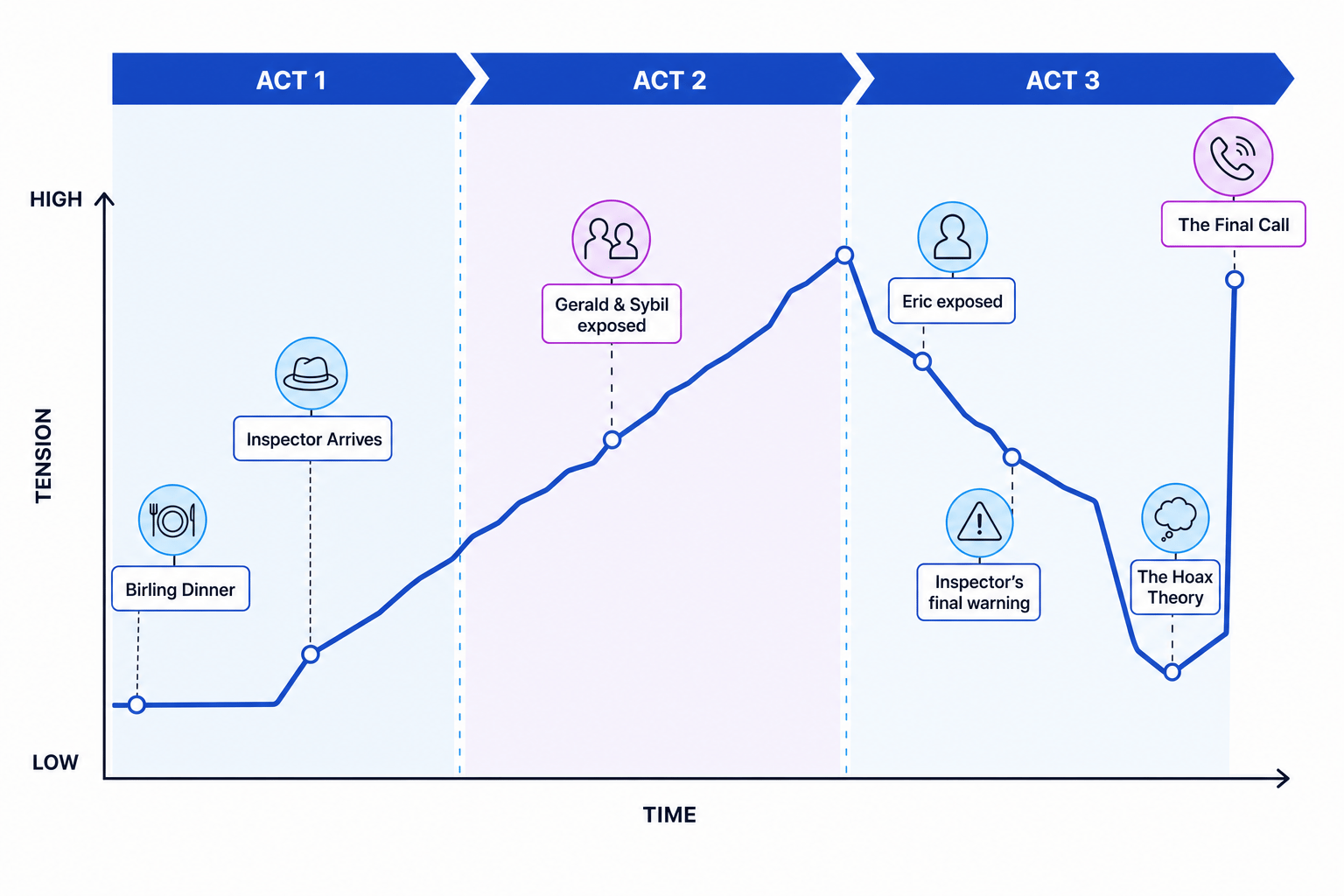
The Domino Effect
Think of the Birling family as a row of standing dominoes. They believe they are independent of one another and completely separate from the working class. Inspector Goole acts as the hand that pushes the first domino (Mr. Birling's dismissal of Eva), triggering a collapse that knocks down every member of the family in turn.
3. Structural Analysis: Managing the Tension
Priestley carefully manipulates tension across the three acts. In your exam (AO2), you must be able to analyze how the structural mechanisms of the play create suspense and reveal character.
Look for the Cliffhangers
Notice how Priestley structures the endings of Act 1 and Act 2. He deliberately cuts the action at moments of peak tension to keep the theatre audience engaged during the interval and to prompt immediate discussion.
Let's look at how to unpack a structural transition in an essay.
Analyzing a structural shift (The Transition from Act 1 to Act 2)
Analyze how Priestley uses structural techniques at the transition between Act 1 and Act 2 to build dramatic tension.
- Identify the structural pivot point. Locate the cliffhanger ending of Act 1. The Inspector simply looks at Gerald and says, "Well?", as Gerald realizes his affair with Daisy Renton is about to be exposed. Act 2 opens in the exact same moment, maintaining the real-time pressure of the classical unity of time.
- Examine the dramatic effect of the transition. Note how the opening of Act 2 subverts the audience's expectation of a delay. By resuming immediately, Priestley denies the audience relief. He uses Sheila’s presence as a structural catalyst—she refuses to leave, wanting to hear Gerald's confession because she wants to understand the truth, creating interpersonal conflict before the Inspector even speaks.
- Connect the structural device to Priestley’s message. Link this tension to the central theme of collective responsibility (AO4/AO1). Priestley uses the relentless pace of the interrogations to show that the "chain of events" cannot be broken or paused. The lack of a time-jump prevents the characters from rationalizing their behavior, forcing them—and the audience—to face the immediate consequences of their actions.
Treating the Plot as Real Life
When writing about the plot, never speak of the characters as if they are real people who just happen to be in this situation. Remember, Priestley is the puppet master. Every entrance, exit, and phone call is a deliberate choice designed to construct an allegory about capitalism and social duty. Refer to "Priestley's dramatic construction" or "the structural device" rather than just saying "Then Eric walks in."
In the exam
If you are writing about structure and plot in the Component 2 exam:
- Examine the stage directions: Look at how Priestley uses stage directions to signal plot shifts (e.g., the lighting changing from "pink and intimate" to "brighter and harder" when the Inspector arrives).
- Highlight the pacing: Mention how the Inspector controls the pace of the plot by dealing with "one line of inquiry at a time," preventing the characters from forming a united front.
- Contrast the reactions: Use the plot's resolution (the hoax reveal) to compare the younger generation (Sheila and Eric, who accept their moral guilt) with the older generation (Arthur and Sybil, who only care about avoiding legal consequences and social scandal).
Check yourself
- Why is it structurally significant that the play takes place in real-time, inside a single room, over the course of one evening?
- How does the structural concept of the "chain of events" directly counter Mr. Birling's capitalist philosophy?
- What is the dramatic purpose of the double twist at the end of Act 3, and how does it challenge the audience's reaction to the "hoax"?