Welcome to your study notes for J.B. Priestley's An Inspector Calls. As an Edexcel IGCSE English Literature student, masterfully understanding how this play functions as a piece of drama is your key to securing a top grade.
In this overview, we will explore the foundational dramatic genres Priestley blends together, how the physical and temporal structure of the play builds tension, and how to approach your analytical essays with the correct structural focus.
What you'll learn
- The three distinct dramatic genres Priestley blends to create this unique play.
- How the "Classical Unities" and the "Well-Made Play" format are used to entrap the characters on stage.
- The critical difference between the structural shifts of the younger and older generations.
- How to write a high-scoring structural analysis without falling into common exam traps.
The Dramatic Genres of the Play
At first glance, An Inspector Calls looks like a simple, realistic detective thriller. However, Priestley masterfully weaves three distinct theatrical genres together. Understanding these genres is vital for answering questions on form and structure (AO2).
1. The Well-Made Play
Popularized in the 19th century, the Well-Made Play (or pièce bien faite) features a highly logical, predictable plot structure. It relies on a tight sequence of cause and effect, secret information revealed at key moments, and a climactic twist that restores order.
Priestley adopts this structure but subverts it. Instead of resolving the mystery and restoring the comfortable social order at the end, he leaves the characters (and the audience) on a terrifying cliffhanger. The "order" restored is false, and the real reckoning is yet to come.
2. The Detective Thriller
A detective thriller traditionally features a brilliant detective who investigates a crime, pieces together clues, and exposes the single guilty party.
Priestley uses this familiar formula to hook his audience. However, he twists the genre: there is no single culprit. Instead, the "crime" is the collective moral failure of an entire social class, and the "detective" is more interested in their souls than a legal arrest.
3. The Morality Play
Originating in the Middle Ages, a morality play is an allegorical drama designed to teach the audience a moral lesson. The characters are often personifications of abstract virtues and vices (such as Pride, Greed, or Wrath).
Allegorical Drama
An allegorical drama is a play that can be interpreted to reveal a hidden moral, political, or spiritual meaning behind its literal surface.
Priestley uses the Inspector as a secular, moral guide who exposes the sins of the Birlings. Each family member represents a different societal sin:
- Mr. Birling: Greed and Pride (capitalist avarice)
- Sheila: Envy (ruining Eva out of jealousy)
- Gerald: Lust (exploiting Eva as a mistress)
- Mrs. Birling: Pride and Wrath (unfeeling arrogance and denial of help)
- Eric: Lust and Gluttony (drunkenly taking advantage of Eva)
Structural Mechanics: The Classical Unities
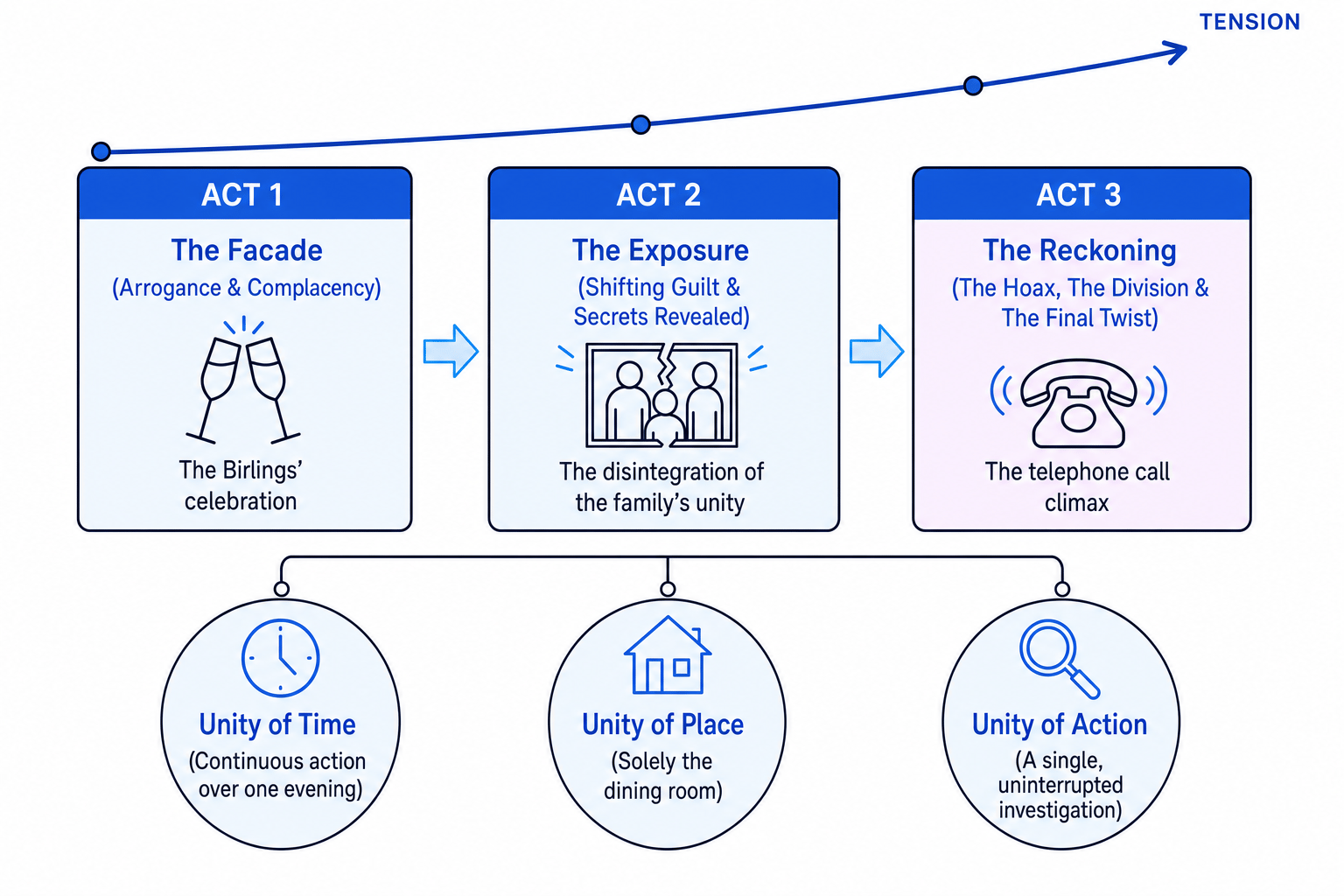
To understand why the play feels so intense, we must look at how Priestley structures time and space. He strictly observes the three Classical Unities, which date back to Aristotle’s theories of tragedy.
- Unity of Place: The entire play is set in a single room—the Birlings' dining room. This creates an intense, claustrophobic atmosphere. The characters cannot escape the Inspector's interrogation, symbolizing how they cannot escape their social responsibilities.
- Unity of Time: The action on stage takes place in "real-time." The three acts flow continuously over the course of one single evening in 1912. This continuous pressure prevents the characters from formulating a coherent cover-up.
- Unity of Action: There are no subplots. Every conversation, confrontation, and confession relates directly to one single event: the tragic suicide of Eva Smith.
The Claustrophobic Pressure Cooker
By keeping the characters trapped in one room, in real-time, focusing on one single victim, Priestley creates a metaphorical pressure cooker. The structural walls close in on the Birlings, mirroring how their private privileges are being stripped away by public accountability.
Tracing the Structural Arc
The structure of the play is not static; it is a dynamic battle of wills. It moves from complacency to chaotic fragmentation, before ending on a chilling cycle.
Act One: The Comfortable Facade
We begin with the Birlings celebrating Sheila and Gerald's engagement. The lighting is "pink and intimate," reflecting their self-absorbed, rose-tinted view of the world. Mr. Birling delivers long, patronizing speeches about individual self-reliance. The entry of the Inspector dramatically disrupts this. The lighting immediately shifts to "brighter and harder," signaling that a harsh, searching spotlight is being shone on their lives.
Act Two: The Disintegration of the Unit
As the Inspector systematically questions Gerald, Sheila, and Mrs. Birling, the family unit begins to splinter. The neat social boundaries they erected to protect themselves are demolished. Secrets are dragged into the light, and the physical stage directions show characters pacing, crying out, and turning on one another.
Act Three: The False Escape and the Final Twist
Once the Inspector departs, the tension drops briefly. The older Birlings and Gerald desperately search for loopholes, eventually realizing that "Goole" may not be a real police inspector. They instantly celebrate their escape, proving they have learned nothing.
However, Priestley structurally punishes this complacency. The play concludes with a sudden telephone call announcing that a girl has just died, and an inspector is on his way. The structure is cyclical; because they refused to learn the lesson the first time, they are condemned to repeat the interrogation.
The Danger of the Cliffhanger
Do not write that the play ends in a "happy resolution." The final telephone call is a devastating structural shock designed to leave the audience gasping. The cyclical ending forces the audience to consider their own moral choices before they leave the theatre.
Worked Example: Analyzing Structural Shifts
Let's look at how to write a top-tier paragraph analyzing how Priestley uses structural techniques to show the shifting power dynamics in the play.
Analyzing the shifting power dynamic in Act One
Compare how Mr. Birling's control over the dialogue shifts before and after the Inspector's arrival.
- Establish a clear, thesis-driven focus on the structural shift: Priestley structurally contrasts Mr. Birling's early dominance of the stage with his sudden loss of control upon the Inspector's arrival, highlighting the vulnerability of capitalist complacency.
- Examine the language and stage directions of the initial setup: Before the Inspector enters, Birling dominates the stage through long, uninterrupted monologues. He pompously claims that "a man has to make his own way," a speech punctuated by his confident assertions about the future. The stage directions show him lecturing the younger generation, establishing his absolute patriarchal and economic authority.
- Analyze the structural disruption of the Inspector's arrival: This dominance is abruptly shattered by the "sharp ring of a front door bell." The word "sharp" functions as a sonic intrusion that cuts through Birling's individualistic rhetoric. When the Inspector enters, Priestley shifts the dialogue into short, rapid-fire exchanges (stichomythia). The Inspector repeatedly "cuts in" and "interposes," structurally taking control of both the conversation and the physical space of the dining room.
- Link the shift to the play's wider moral purpose (AO1/AO2): This sudden structural displacement of Birling's voice forces the audience to witness the immediate collapse of capitalist authority when confronted by moral accountability. By silencing Birling structurally, Priestley prepares the audience for the systematic dismantling of the family's social standing.
The Context Trap (AO4)
On the Edexcel IGCSE paper, Component 2 Section A (Modern Drama) is assessed ONLY on AO1 and AO2. There are absolutely no marks awarded for context (AO4) in this essay!
Do not waste precious exam time writing paragraphs about the differences between 1912 and 1945, the World Wars, or Priestley's radio broadcasts. Keep your focus entirely on close textual analysis, character dynamics, dramatic techniques, and structural choices. Save your historical context for the Modern Prose and Literary Heritage sections!
Using your Open Book to your advantage
Since Component 2 is an open-book exam, you will have a clean copy of the play with you. Do not waste time reading long passages during the exam. Instead, use your copy to quickly double-check the exact phrasing of stage directions (such as the lighting shifts) and key structural transitions between acts.
In the exam
When writing your exam essay on An Inspector Calls, make sure to follow this strategy:
- Track the structural journey: Never treat a character or theme as static. Always explain how they develop from Act One, through Act Two, to the final chilling moments of Act Three.
- Incorporate stage directions: Priestley's stage directions (e.g., lighting, sound effects like the doorbell or phone, physical movements of characters) are rich sources of AO2 analysis. Treat them with the same analytical depth as spoken dialogue.
- Write about the audience's reaction: Remember that this is a play, not a novel. Always frame your analysis around how a live audience in a theatre would react to the unfolding tension and dramatic irony.
Check yourself
Before moving on to the character and theme guides, make sure you can answer these questions:
- Why does Priestley set the entire play in a single room (Unity of Place), and what impact does this have on the family?
- What is the difference between how the older generation (Mr. and Mrs. Birling) and the younger generation (Sheila and Eric) react to the structural revelation of the "hoax" in Act Three?
- How does the change in stage lighting from "pink and intimate" to "brighter and harder" serve as a structural metaphor for the entire play?