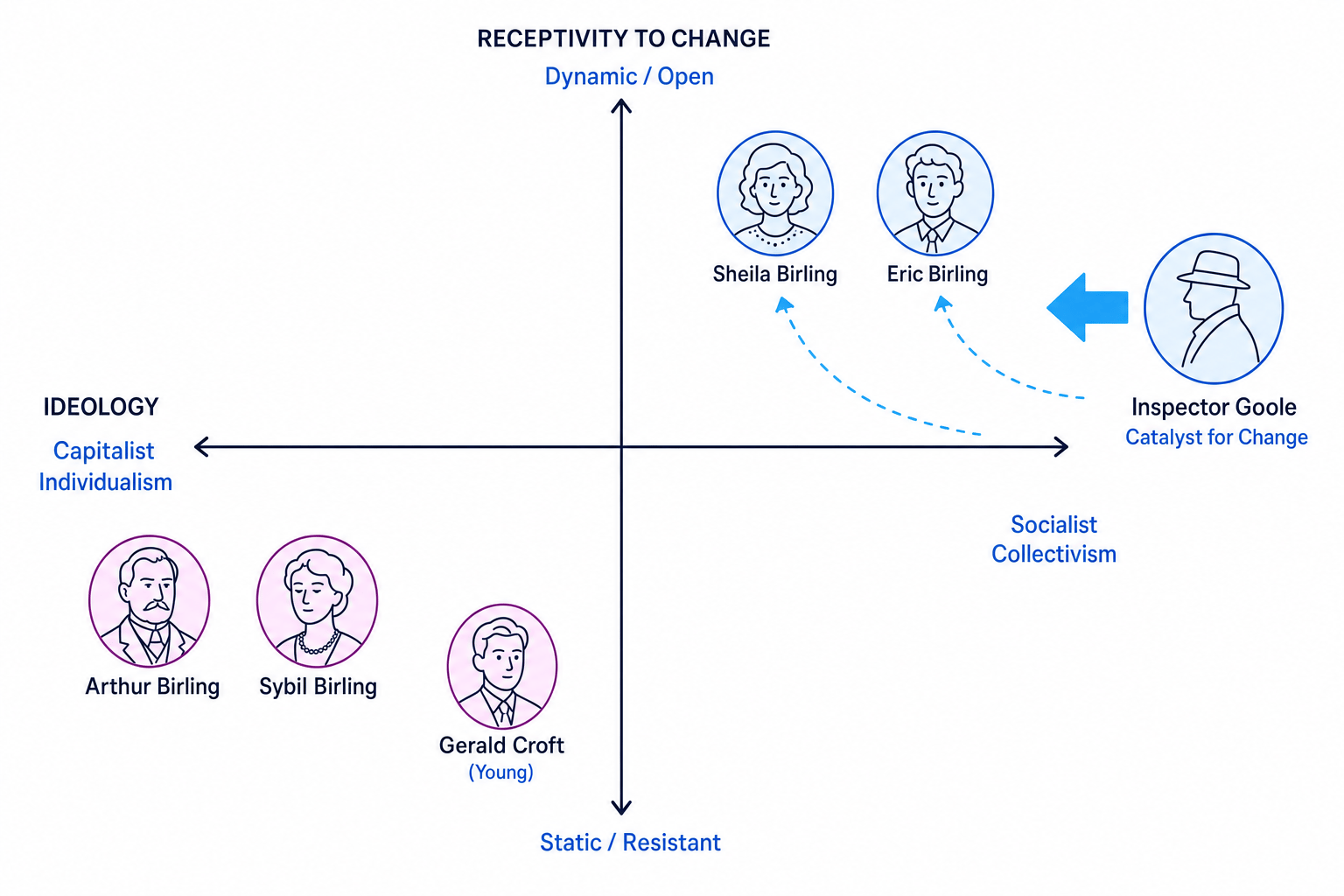
Detailed Character Profiles
1. Inspector Goole: The Moral Catalyst
Inspector Goole acts as Priestley's mouthpiece or proxy. He is a dramatic device designed to interrogate not just the Birlings, but the Edwardian social structure itself.
- The Voice of Socialism: He directly opposes Mr Birling's individualistic ideology. His final speech is a powerful sermon advocating for collectivism: "We are members of one body. We are responsible for each other."
- An Omniscient Presence: The name "Goole" is a homophone for "ghoul" (a ghost or spirit). This suggests a supernatural, omniscient quality. He is not a standard police officer; he is a moral force who already knows the answers to his own questions.
- Disruption of Order: Structurally, Goole controls the pace of the play. He uses a technique of one line of inquiry at a time, systematically breaking down the family's united front.
The Inspector's Purpose
Goole does not exist to arrest the Birlings for a legal crime, but to condemn them for their moral crimes against the vulnerable working class.
2. Arthur Birling: The Archetypal Capitalist
Mr Birling represents the wealthy, self-made middle class of Edwardian England. He is a static character who refuses to change his outlook, even when faced with the tragic consequences of his actions.
- Obsessed with Status: Birling repeatedly mentions his civic achievements, such as being "Lord Mayor" and expecting a knighthood, to assert dominance over the Inspector.
- Dramatic Irony: Priestley uses dramatic irony in Act One to undermine Birling’s credibility. Birling declares the Titanic "unsinkable, absolutely unsinkable" and dismisses the possibility of war as "nonsense". Because the audience in 1945 knew that the Titanic sank in 1912 and two World Wars had occurred, they immediately see Birling as foolish and untrustworthy.
- Mercenary Outlook: He views his daughter's marriage to Gerald Croft primarily as a business merger that will allow "Crofts and Birlings" to work together for "lower costs and higher prices."
Confusing Arthur's motives
Do not write that Mr Birling dislikes Gerald because Gerald is from a higher social class. Birling is desperate for the match because it elevates his own social standing and business prospects. He is intimidated by Gerald's mother (Lady Croft), but deeply eager to please Gerald.
3. Sybil Birling: Class Prejudice and Blind Denial
Mrs Birling represents the cold, unyielding aristocratic attitudes of the upper class. She is the most resistant to the Inspector's interrogation.
- Snobbery and Dehumanisation: She dismisses Eva Smith’s plight because of her social class, asserting that "girls of that class" would not refuse money or possess deep feelings.
- The Bromley Women's Charity: As the head of a charitable organisation, she possesses immense power over the poor, yet she uses it hypocritically to stroke her own ego and punish Eva for using the name "Birling".
- Blindness to Reality: Sybil is completely blind to her family’s vices. She is shocked to discover Eric's heavy drinking and Gerald's affair, showing how shielded she is by her class privileges.
4. Sheila Birling: The Hope for the Future
Sheila undergoes the most significant transformation in the play, acting as a foil to her parents.
Foil
A foil is a character who contrasts sharply with another character, thereby highlighting particular qualities of the other. Sheila's empathy and remorse make her a direct foil to her parents' cold denial.
- Initial Immaturity: At the start of the play, Sheila is presented as childish and superficial, calling her mother "Mummy" and obsessing over her engagement ring.
- Acceptance of Guilt: Once she learns of her role in Eva's dismissal from Milwards, she immediately accepts responsibility: "I’ll never, never do it again to anybody."
- Adopting the Inspector’s Voice: As the play progresses, Sheila begins to speak like Goole. She warns her family against building up a "wall" between themselves and the girl, noting that the Inspector will only knock it down. By Act Three, she sarcastically mimics her parents' relief when they think the Inspector was a hoax.
5. Eric Birling: The Disaffected Youth
Eric represents the fragile, damaged state of the younger wealthy generation. He is deeply flawed but ultimately redeemable.
- An Estranged Son: Eric is described in the stage directions as "half shy, half assertive." He is isolated within his family; he does not feel he can turn to his father when in trouble, which leads to his dependency on alcohol.
- Exploitation and Remorse: Eric's relationship with Eva is deeply problematic—he confesses that he was "in that state when a chap easily turns nasty," admitting to a highly coercive, alcohol-fuelled sexual relationship. However, unlike Gerald, Eric is devastated by the consequence (Eva's pregnancy and death) and accepts his guilt.
- Societal Critique: Through Eric, Priestley shows how capitalist pressures corrupt young men, turning them into predatory consumers of both goods and vulnerable people.
6. Gerald Croft: The Bridge Between Generations
Gerald is the most politically complex character. Though young, he represents the entrenched interests of the aristocracy.
- The Aristocratic Gentleman: Gerald is the son of Lord and Lady Croft. He is polite, charming, and socially secure.
- Exploitation Masked as Gallantry: Gerald rescues Daisy Renton from the predatory Alderman Meggarty and provides her with a rent-free apartment. While he treats her with more kindness than the others, he still exploits her vulnerability, keeping her as a mistress and discarding her when it becomes inconvenient.
- Alignment with the Older Generation: Ultimately, Gerald fails to learn the lesson. He is the one who goes out into the street to discover that Goole is not a real police inspector. He eagerly tries to prove the whole evening was a hoax so they can return to "normal".
7. Eva Smith / Daisy Renton: The Silent Victim
Eva Smith never appears on stage, but she is the central figure of the play.
- A Symbolic Name: "Eva" recalls the biblical Eve (the mother of all humanity), while "Smith" is the most common English surname. Together, they symbolise all ordinary, working-class women.
- Systemic Oppression: Eva's journey is a checklist of working-class exploitation:
- She is exploited as cheap labour by Mr Birling.
- She is exploited as a replaceable factory hand by industrial competition.
- She is exploited as a consumer scapegoat by Sheila’s insecurity.
- She is exploited as a sexual conquest by Gerald.
- She is exploited as an object of lust and theft by Eric.
- She is rejected as a charity seeker by Sybil Birling.
- The Voice of the Voiceless: By keeping Eva off-stage, Priestley ensures she remains a universal symbol of the silent, suffering working class.
Walkthrough: Analysing Characterisation in an Essay
To achieve high marks in your Edexcel IGCSE, you must write analytical paragraphs that follow a clear structure: Point →\to→ Evidence →\to→ Method →\to→ Effect →\to→ Link.
Let's walk through how to construct a high-scoring analytical paragraph investigating how Priestley presents the character of Sheila.
Analysing Sheila's development
Question: Explore how Priestley presents the change in Sheila's character during the course of the play.
-
Formulate a clear point linking character to Priestley's intent: Step: Identify why Priestley changes Sheila. He does it to show that the younger generation has the capacity to reject capitalist selfishness and embrace social responsibility. Drafting: Priestley presents Sheila's development as a moral awakening, transforming her from a naive, capitalist consumer into a passionate advocate for social justice who mirrors the Inspector's ideology.
-
Introduce precise textual evidence: Step: Select two contrasting quotations showing her shift in tone or language. Drafting: At the start of the play, Sheila’s language is immature and consumerist, as she obsessively focuses on material goods: "Now I really feel engaged." However, by Act Two, her language shifts to mimic the Inspector's urgent tone, warning her mother, "You mustn't try to build up a kind of wall between us and that girl."
-
Identify the writer's methods (AO2): Step: Look for literary and dramatic devices (such as metaphor, stage directions, or changes in syntax). Drafting: Priestley uses the metaphor of a "wall" to symbolise the rigid class barriers that the Birlings construct to isolate themselves from the suffering of the working class. The dramatic shift in her vocabulary—moving from infantile expressions like "mummy" to assertive, metaphorical language—highlights her cognitive and moral growth.
-
Analyse the effect on the audience and connect to social ideas: Step: Explain how this helps the audience understand Priestley’s message. Drafting: This linguistic transformation would have resonated strongly with a post-war 1945 audience, who were actively choosing a welfare state over Edwardian laissez-faire capitalism. By demonstrating that Sheila can dismantle her own prejudices, Priestley encourages the audience to do the same.
Quotation Integration
In an open-book exam, you have the text in front of you. Take advantage of this by ensuring your quotations are 100% accurate and short (usually 1–5 words). Instead of quoting a whole sentence, weave small fragments directly into your own prose.
In the exam
- Focus on "How" and "Why": Never treat characters as real people. Use the character's name as a tool to discuss Priestley's choices (e.g., instead of "Mr Birling is greedy," write "Priestley constructs Mr Birling as a caricature of capitalist greed to highlight...").
- Track the Dramatic Arc: Characters in drama are defined by how they react to structural shifts. Always comment on how a character acts in Act One versus how they act in Act Three.
- Embed Terminology Naturally: Do not list devices. Use terms like dramatic irony, foil, didacticism, and monologue as part of your natural explanation of how meaning is created.
- Link to the 1945/1912 Contrast: Remember the play was set in 1912 but written and performed in 1945. Address how different characters appeal to these two vastly different eras.
Check yourself
- Why does J.B. Priestley use dramatic irony specifically when characterizing Mr Birling in Act One?
- In what ways does Gerald Croft act as a "bridge" between the older and younger generations, and why does he ultimately align with the older one?
- What does the symbolic nature of Eva Smith's name tell us about her dramatic function in the play?