What you'll learn
- How to turn an essay question on A View from the Bridge into a clear argument.
- How to build strong analytical paragraphs using short, accurate quotations.
- How to write about Miller’s dramatic methods, not just the plot.
- How to use the open-book exam wisely without wasting time searching.
What a model essay is really for
A model essay is not something you memorise word-for-word. It is a guide to the kind of thinking, structure, evidence and analysis that a strong answer should contain.
In A View from the Bridge, the best essays usually track a change across the play: Eddie’s protective love becomes possessive; Catherine moves towards independence; Alfieri sees the tragedy coming; the idea of “law” becomes more complicated than simply right and wrong.
Model essay
A model essay is a sample answer that shows how to create a focused argument, support it with references, and analyse the writer’s methods.
Do not memorise essays
Memorised essays often miss the exact question. Instead, learn flexible arguments, key quotations and paragraph patterns that you can adapt.
What Edexcel is rewarding for this text
A View from the Bridge is assessed in Component 2, Section A: Modern Drama. This is open book, which means you may use a clean copy of the play in the exam.
For this section, you mainly need to show:
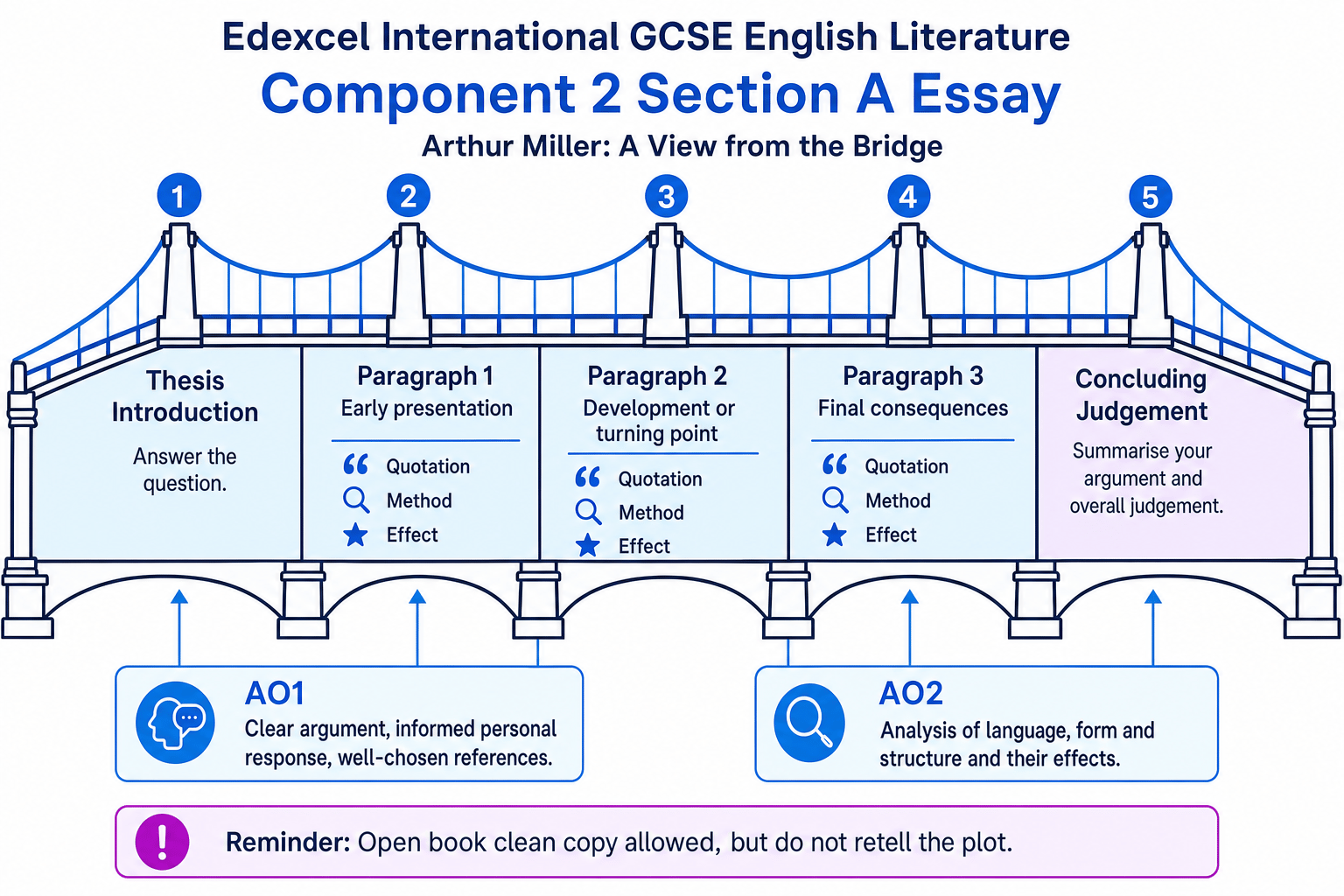
- AO1: a clear, personal argument with well-chosen textual references.
- AO2: analysis of Miller’s language, form and structure.
Assessment Objective
An Assessment Objective, often shortened to AO, is a skill the examiner is marking. For this drama essay, your answer needs strong knowledge of the play and close analysis of Miller’s methods.
Language, form and structure
Language means Miller’s word choices and imagery. Form means the type of text and dramatic features, such as dialogue, stage directions and Alfieri’s narration. Structure means how the play is organised, including beginnings, turning points, tension and the tragic ending.
The diagram below shows the “bridge” shape of a strong essay: introduction, developed paragraphs, and a final judgement.
Start with the question, not the plot
A common weaker approach is to retell the story: Eddie likes Catherine, Rodolpho arrives, Eddie becomes jealous, Eddie dies. That is knowledge, but it is not yet an essay.
A strong answer begins with a thesis.
Thesis
A thesis is your main argument in one or two sentences. It should answer the question directly and suggest how Miller develops the idea across the play.
For example, if the question is about Eddie as a tragic figure, your thesis should not just say “Eddie is tragic.” It should explain why: Miller presents Eddie as tragic because he is both responsible for his downfall and unable to understand the desire that destroys him.
Turning a question into an argument
Question focus: How does Miller present Eddie as a tragic character?
-
Identify the central character and key word: the question is about Eddie and the idea of being tragic, so your answer must judge how far he is sympathetic, flawed and doomed.
-
Choose a line of argument: Eddie is not simply a villain. Miller makes him tragic because his genuine care for Catherine becomes possessive and destructive.
-
Select moments from across the play: early family scenes show Eddie as protective; the arrival of Rodolpho exposes his jealousy; the final confrontation shows his obsession with “respect” and “name”.
-
Link to Miller’s methods: Alfieri’s narration gives the play a tragic shape because he says he “could see every step coming”, creating a sense of inevitability.
Build paragraphs that analyse, not narrate
A strong paragraph usually follows this pattern:
Point → Evidence → Method → Effect → Link
The point answers the question. The evidence is a short quotation or precise reference. The method names what Miller is doing as a dramatist. The effect explains how the audience responds or what the moment reveals. The link returns to the question.
Dramatic method
A dramatic method is a technique Miller uses on stage, such as dialogue, stage directions, symbolism, foreshadowing, entrances and exits, or Alfieri’s direct address to the audience.
Quoting without analysing
Do not drop in a quotation and then move on. The examiner needs to see what Miller’s words or dramatic choices reveal about character, theme or audience response.
Writing about Eddie’s need for respect
-
Make a focused point: Miller presents Eddie’s need for masculine respect as one of the forces that pushes the tragedy towards violence.
-
Choose precise evidence: near the end, Eddie insists, “I want my respect,” and complains that “Marco’s got my name.”
-
Analyse the method: the repeated possessive language, especially “my”, shows that Eddie treats reputation as personal property. The noun “name” becomes a motif, a repeated idea that represents honour in the community.
-
Explain the effect: the audience sees that Eddie is no longer mainly thinking about Catherine’s happiness or Beatrice’s pain. He is trapped by public shame and masculine pride.
-
Link to the question: this makes Eddie tragic because his final demand for dignity actually exposes how far he has lost control of himself.
A model paragraph could look like this:
Miller presents Eddie’s obsession with respect as a major part of his tragic downfall. By the final confrontation, Eddie declares, “I want my respect,” and says that “Marco’s got my name.” The repeated possessive “my” suggests that Eddie sees honour as something he owns and must violently recover. Miller turns the word “name” into a motif for public reputation, especially within the close Italian-American community of Red Hook. This makes Eddie’s downfall more painful because he is not only fighting Marco; he is fighting the shame he has created for himself.
Model essay plan: Eddie as a tragic figure
You can use this kind of plan for many character questions. Notice how it moves through the play instead of jumping randomly.
Tragic protagonist
A tragic protagonist is the central character in a tragedy whose flaws, choices or blindness contribute to their downfall.
Introduction
Miller presents Eddie Carbone as a tragic figure because he is ordinary but intense, loving but possessive, and increasingly unable to recognise the truth about himself. Through Alfieri’s narration, the play is structured as something almost inevitable: Eddie’s destruction seems to move “step after step” towards its end.
Paragraph 1: Eddie begins as protective but controlling
You could begin with Eddie’s role in the household. He has raised Catherine and feels responsible for her, but Miller quickly shows that this care has become controlling. Eddie objects to Catherine’s new job and worries about how she looks, even saying she looks like a “Madonna”. The religious image suggests idealisation: Eddie wants Catherine to remain pure, dependent and almost untouchable.
Paragraph 2: Rodolpho exposes Eddie’s hidden desire
Rodolpho’s arrival changes the family balance. Eddie claims he is worried that Rodolpho only wants American citizenship, but the audience can see deeper jealousy. This creates dramatic irony, where the audience understands more than a character does. Eddie’s language about Rodolpho — for example, mocking his singing and his blond hair — reveals insecurity rather than reasonable concern.
Paragraph 3: Alfieri shows that Eddie rejects lawful solutions
When Eddie goes to Alfieri, he wants the law to remove Rodolpho. Alfieri tells him, “You have no recourse in the law.” This matters because Miller contrasts legal justice with Eddie’s emotional sense of justice. Eddie cannot accept that Catherine has the right to choose Rodolpho, so he moves outside moral and family codes by informing Immigration.
Paragraph 4: The ending makes Eddie both guilty and pitiable
At the end, Eddie demands his “name” back, but the audience knows his betrayal has damaged it. His death is tragic because it is unnecessary, yet it grows out of his own choices. Alfieri’s final reflection that Eddie “allowed himself to be wholly known” suggests that Eddie’s intensity is both frightening and strangely admirable.
A flexible thesis phrase
For many A View from the Bridge essays, you can use this shape: Miller first presents X as…, but gradually reveals…, so that by the end… This helps you write about development rather than isolated moments.
Model paragraph: Alfieri and tragic structure
Alfieri is extremely useful in essays because he helps you write about structure. He is not just a character; he is also a narrator who frames the action.
At the start, Alfieri introduces Eddie as “This one’s name was Eddie Carbone,” which immediately makes Eddie sound like the subject of a remembered case or legend. The past tense “was” hints that Eddie’s story has already ended, creating foreshadowing, where a writer gives clues about future events. Later, Alfieri says he “could see every step coming,” which makes the tragedy feel inevitable. Miller therefore uses Alfieri to make the audience watch not to discover what happens, but to understand why it happens.
Using Alfieri in a tragedy essay
-
Decide what Alfieri adds: he gives the play a sense of fate because he repeatedly warns that disaster is coming.
-
Link quotation to structure: “I could see every step coming” suggests a sequence that cannot easily be stopped.
-
Explain the audience effect: the audience feels tension and helplessness because Alfieri understands the danger but cannot prevent it.
-
Connect to Eddie: this makes Eddie’s downfall more tragic because he is warned, but still cannot change his course.
How to make your essay sound more sophisticated
Sophistication does not mean using long, vague words. It means making precise connections.
Instead of writing:
“Eddie is angry and this makes the audience feel bad.”
Write:
“Miller presents Eddie’s anger as a form of wounded pride. His repeated focus on his ‘name’ shows that he values public honour more than private honesty, making the audience both judge and pity him.”
That second version is stronger because it connects character, quotation, method and audience response.
Open book does not mean easy
Because you have the text, examiners expect precise references. However, if you spend too long hunting for quotations, your argument will suffer. Learn key moments beforehand so the clean copy is a support, not a rescue plan.
Strong essay endings
Your conclusion should not repeat every paragraph. It should give a final judgement.
For example:
Overall, Miller presents Eddie as a tragic figure because his downfall grows from a recognisable human need: to be loved, respected and obeyed. However, the play becomes disturbing because Eddie cannot separate love from possession. By the end, his cry for his “name” shows that he has lost the very honour he tried to defend.
In the exam
-
Spend a few minutes planning a clear argument that covers the beginning, middle and end of the play.
-
Use short quotations and analyse Miller’s methods: dialogue, stage directions, Alfieri’s narration, symbolism and structure.
-
Keep returning to the exact wording of the question, especially at the end of each paragraph.
Check yourself
-
Can you write a thesis about Eddie, Catherine, Beatrice, Rodolpho, Marco or Alfieri without retelling the plot?
-
Can you explain how Alfieri shapes the audience’s view of the tragedy?
-
Can you turn one short quotation, such as “I want my respect,” into analysis of method and effect?