Planning is the single most important step in writing a high-scoring English Literature essay. When sitting Component 2, Section A (Modern Drama) of your Pearson Edexcel IGCSE, you have access to a clean copy of An Inspector Calls. This makes structural planning even more critical: with the book open, it is dangerously easy to drift into hunting for random quotes rather than constructing a coherent, powerful argument.
An essay plan acts as your road map. It ensures your writing remains structured, focused on the question, and driven by a central thesis that addresses J.B. Priestley’s dramatic intentions.
What you'll learn
- How to deconstruct an exam prompt and write a compelling, arguments-driven thesis statement.
- How to structure your essay chronologically to match the dramatic momentum of the play.
- How to plan for AO1 (textual knowledge and critical argument) and AO2 (analysis of language, structure, and form) without wasting time on unassessed skills.
The Core Foundations of an Essay Plan
Before putting pen to paper, you must understand exactly what the examiner is looking for. Under the Edexcel 4ET1 specification for Modern Drama, you are assessed on two key Assessment Objectives:
- AO1: Demonstrate a close knowledge and understanding of the text, maintaining a critical style and presenting an informed personal response.
- AO2: Analyse how language, form, and structure are used by the writer to create effects, using relevant literary terminology.
The Context Trap
Unlike the Literary Heritage or Modern Prose sections of your Edexcel course, Component 2 Section A (Modern Drama) does NOT assess AO4 (historical/social context). Do not spend valuable essay time detailing the differences between 1912 and 1945, or listing historical facts about the Titanic and world wars, unless it directly explains Priestley's dramatic methods (AO2) and structural choices. Keep your focus entirely on characterisation, dramatic structure, and thematic impact.
To master the essay plan, we must first define two crucial concepts:
Thesis Statement
A thesis statement is a one- or two-sentence summary of your central argument. It should directly answer the essay question and express what you believe J.B. Priestley is trying to teach his audience through his characters or themes.
Didactic
A text is didactic when its primary purpose is to teach, instruct, or moralise. An Inspector Calls is fundamentally a didactic play designed to promote Priestley's socialist ideology and challenge capitalistic greed.
Every essay plan must be built around a strong thesis statement and a three-step progression. Because An Inspector Calls is a "well-made play" that takes place in real-time, its structure is highly deliberate. Your plan should mirror this chronological momentum.
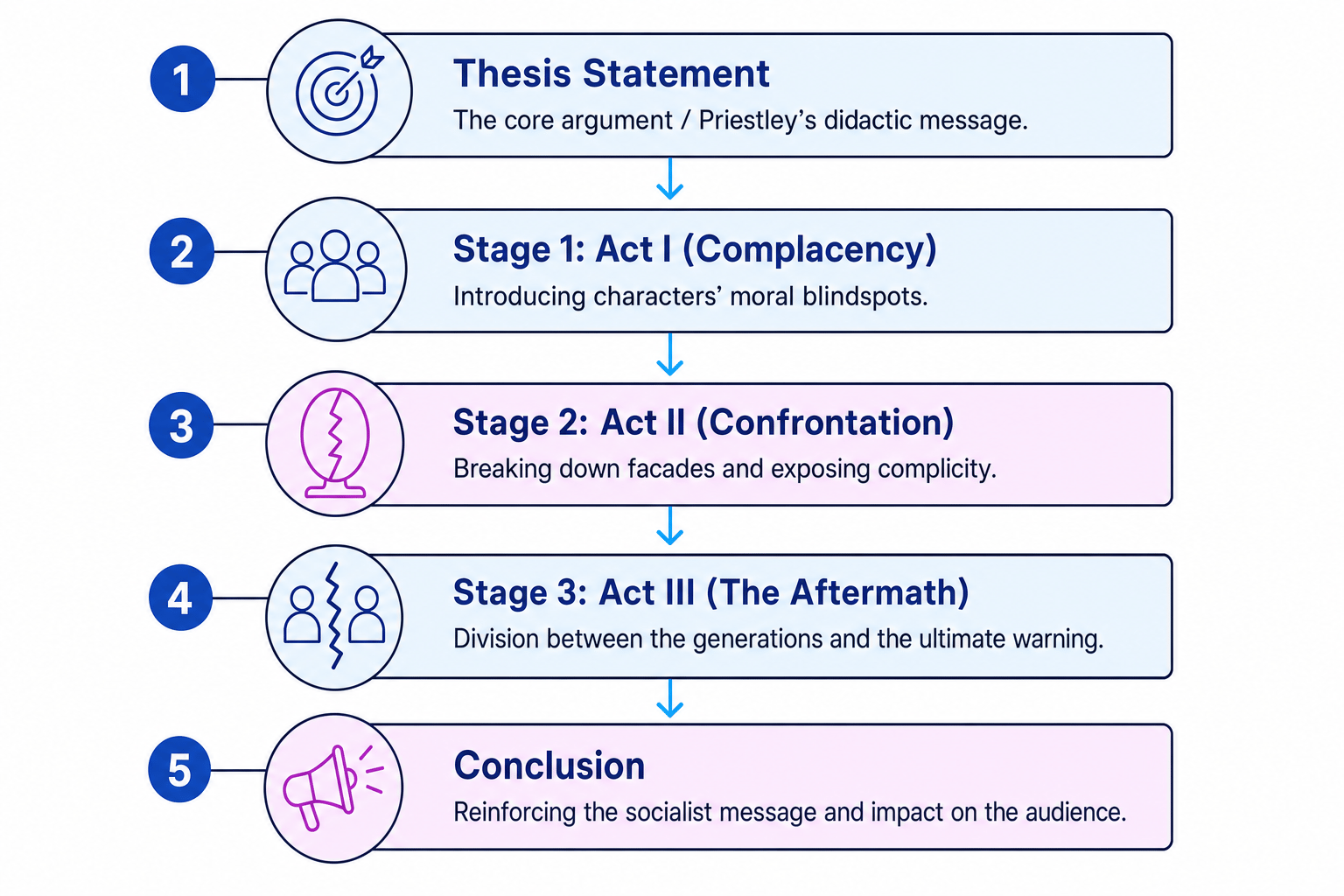
Designing a Three-Part Chronological Plan
The most effective way to structure an essay on An Inspector Calls is to follow the play’s timeline. This allows you to comment on the dramatic structure (AO2)—how Priestley systematically strips away the characters' facades.
- Part 1: The Exposition (Act I). Establish the initial state of the character or theme. Look at the stage directions, the initial atmosphere, and the complacency of the Birlings before the Inspector arrives.
- Part 2: The Climax and Confrontation (Act II/Early Act III). Examine how the Inspector's interrogation disrupts this complacency. Look at how characters react to pressure, blame each other, or begin to change.
- Part 3: The Resolution and Didactic Legacy (Late Act III). Analyse the ultimate outcome. Do the characters accept social responsibility (the younger generation) or reject it (the older generation)? How does Priestley use the final cliffhanger to leave a lasting impression on the audience?
The Golden Rule of Planning
Never write a plan that is simply a "character dump" (listing everything a character does in order). Your plan must track a thematic argument. Each paragraph must prove a specific part of your thesis statement.
Planning an essay on Sheila Birling's transformation
Question: Explore how J.B. Priestley presents the transformation of Sheila Birling in An Inspector Calls.
Here is a step-by-step walkthrough of how to construct a high-scoring plan.
-
Formulate your thesis statement.
- Drafting: Sheila's transformation is central to the play. She changes from a childish, self-centered capitalist product of her family to an independent, socially aware figure who adopts the Inspector's socialist message.
- Refining: "Priestley presents Sheila's transformation from a shallow, materialist archetype of the upper class into a passionate advocate for social justice. Through her evolution, Priestley demonstrates that the younger generation offers hope for a more compassionate, socially responsible future."
-
Plan Paragraph 1: Stage 1 (Act I — Shallow Beginnings).
- Focus: Sheila's initial complacency and materialism.
- Evidence: She is described in the opening stage directions as "excited" and "pleased with life." She calls her mother "Mummy" and is obsessed with the physical token of her engagement ("Now I really feel engaged"). Her involvement in Eva Smith's dismissal from Milwards is driven by petulance and jealousy.
- AO2 Methods: Stage directions, infantile language ("Mummy"), symbolic value of the ring as a commodity.
- Didactic Purpose: Priestley establishes her as a product of capitalist patriarchy to make her later transformation more dramatic and impactful.
-
Plan Paragraph 2: Stage 2 (Act II — The Interrogation and Awakening).
- Focus: The shift from ignorance to moral accountability.
- Evidence: She is the first to truly "see" the Inspector and recognize his power ("he's giving us the rope—so that we'll hang ourselves"). She refuses to look away, unlike Gerald and her parents, and actively challenges her family’s attempts to build up "walls" between themselves and the victim.
- AO2 Methods: Metaphor of the "rope" and "walls", dramatic irony (she warns her mother before Mrs Birling incriminates Eric).
- Didactic Purpose: Priestley uses Sheila as a bridge between the Inspector and the audience, showing how self-reflection can lead to genuine moral awakening.
-
Plan Paragraph 3: Stage 3 (Act III — The Generational Divide and Resolution).
- Focus: The permanent change in Sheila, contrasting with her parents' refusal to learn.
- Evidence: She rejects the ring ("No, not yet. It’s too soon") and is horrified by her parents' relief when they think the Inspector was a hoax ("it frightens me the way you talk"). She echoes the Inspector’s warning of "fire and blood and anguish".
- AO2 Methods: Repetition of the Inspector's apocalyptic imagery, symbolic rejection of the ring.
- Didactic Purpose: Priestley leaves the audience with a stark choice, using Sheila to champion the socialist perspective and warn against the stubbornness of old-guard capitalism.
-
Draft your conclusion outline.
- Focus: Revisit the thesis. Sheila is not just a character; she is a political symbol. Her transformation proves that change is possible, highlighting Priestley's optimism in the post-WWII era that society can move away from Edwardian selfishness.
Pitfalls to Avoid in Your Planning
When planning, students often lose focus or fall into habits that limit their marks. Keep these key warnings in mind:
The 'Shopping List' Plan
Many students write down a list of random quotes they remember, then try to write an essay around them. This results in a disjointed essay. Your plan should lead with arguments (topic sentences) first. Quotes should only be selected once you know exactly what point they are proving.
The Stage Direction Secret
Since this is a play, J.B. Priestley’s stage directions are just as important as the dialogue. When planning your AO2 analysis, always include at least one plan to analyse a stage direction (e.g., the lighting shift from "pink and intimate" to "brighter and harder" upon the Inspector's arrival, or Sheila's "triumphant" tone).
The Architectural Blueprint
Writing an essay without a plan is like trying to build a brick house without a blueprint. You might have excellent quality bricks (your quotes), but without a foundation and structural framing (your thesis and paragraph topics), the house will collapse under inspection. Spend 5 to 7 minutes on your blueprint; it will save you 15 minutes of rewriting later.
In the exam
- Deconstruct the prompt immediately: Underline the key terms (e.g., "power", "guilt", "responsibility", "the relationship between...").
- Write down your Thesis Statement first: Do not start planning paragraphs until you know exactly what your overall argument is. Write it at the top of your planning sheet.
- Map out exactly three body paragraphs: Group your thoughts chronologically (Beginning, Middle, End) or thematically (e.g., Paragraph 1: Mr Birling's individual greed; Paragraph 2: Mrs Birling's institutional coldness; Paragraph 3: Gerald's aristocratic hypocrisy).
- Select 2–3 short, precise quotes per paragraph: Do not copy out long chunks of text. Since the exam is open-book, write down key 2-to-4 word phrases in your plan to ensure you don't waste time flipping pages during the exam.
- Identify the 'how' (AO2): Next to each quotation in your plan, write down the literary/dramatic method you will analyse (e.g., "euphemism", "dramatic irony", "symbolism").
Check yourself
- Does your thesis statement directly answer the specific question, or is it just a general statement about the play?
- Have you organized your paragraphs in a chronological sequence that mirrors the dramatic structure of the play?
- For every quotation in your plan, have you identified a specific dramatic or linguistic method (AO2) to analyse?