What you'll learn
- How the most important scenes in An Inspector Calls shape the play’s tension and message.
- How Priestley uses dramatic structure, stage directions and dialogue to control the audience’s response.
- How to choose key scenes for Edexcel IGCSE Component 2, where An Inspector Calls is open book.
- How to write about scenes without simply retelling the plot.
Before we start: what counts as a “scene”?
An Inspector Calls is divided into three acts, not lots of named scenes. However, in revision, a scene means a significant unit of dramatic action: a moment where the mood shifts, a secret is revealed, or a character’s attitudes are exposed.
Dramatic structure
Dramatic structure means the way a playwright organises events to create tension, surprise and meaning for an audience.
Priestley keeps the action in one room, over one evening, but the investigation makes the play feel much bigger. Each confession opens up a different part of Eva Smith’s life and a different moral failure in the Birling family.
Key scenes are turning points
A key scene is not just “a bit where something happens”. It is a turning point: it changes what the audience knows, how characters see themselves, or how Priestley’s message develops.
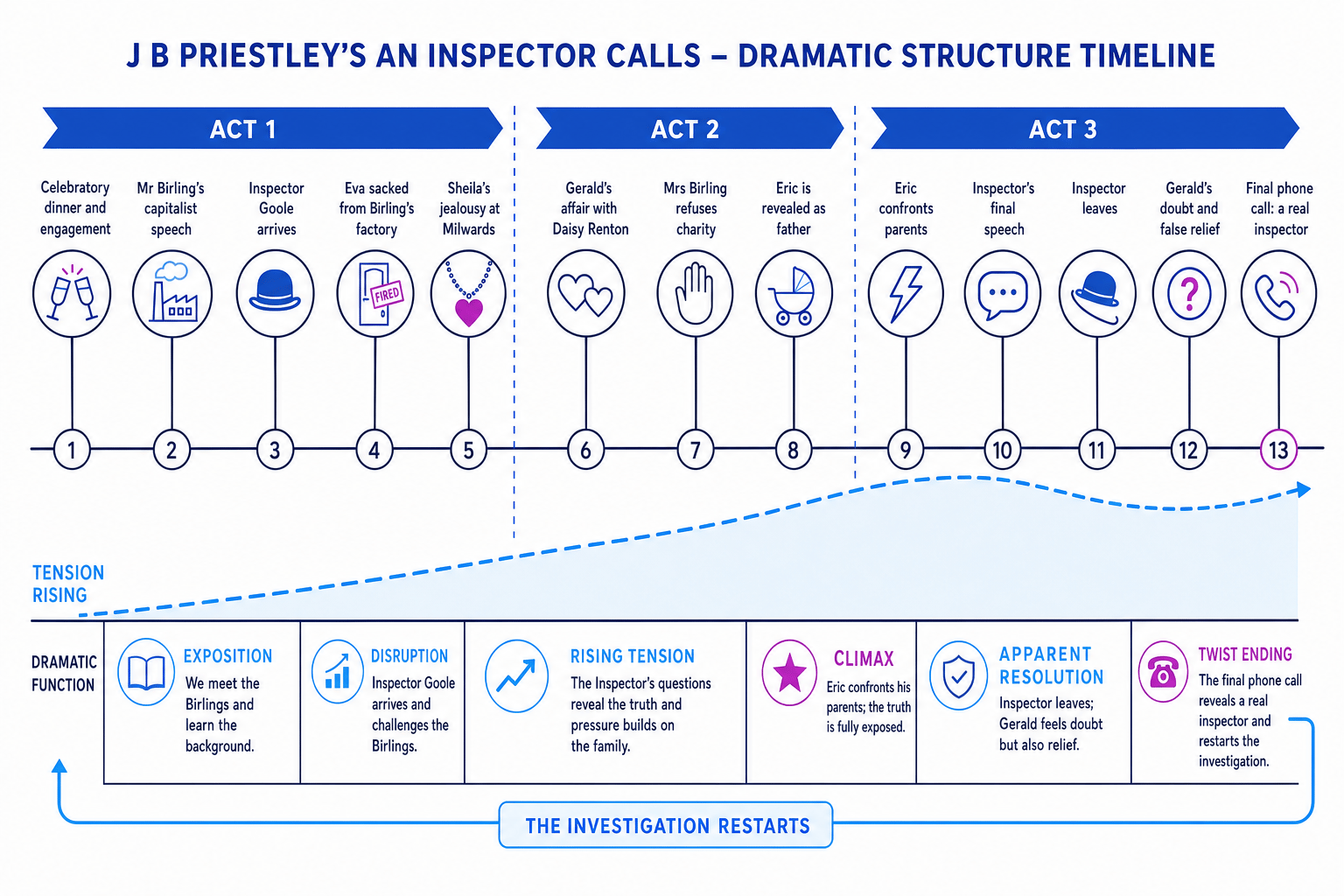
The opening dinner: comfort, confidence and dramatic irony
The play begins with the Birlings celebrating Sheila and Gerald’s engagement. Priestley’s stage directions present the family as wealthy and self-satisfied: the dining room is “fairly large” and “heavily comfortable”. The lighting is “pink and intimate”, suggesting warmth, privacy and complacency.
This matters because Priestley is setting up a world that will be disrupted. The Birlings feel safe inside their money and status, but the Inspector’s arrival will expose how fragile that safety is.
Dramatic irony
Dramatic irony happens when the audience knows more than the characters. Priestley uses it when Mr Birling confidently says things that the audience knows are wrong.
Mr Birling declares that “there isn’t a chance of war” and calls the Titanic “unsinkable, absolutely unsinkable”. A 1945 audience knows the First World War happened and the Titanic sank. This makes Birling look foolish and unreliable.
His political views are also exposed when he says “a man has to make his own way” and dismisses “community and all that nonsense”. Priestley makes the audience suspicious of Birling before the Inspector even appears.
Reading the opening scene as a turning point
-
Start with the mood Priestley creates: the “pink and intimate” lighting and engagement celebration make the family seem comfortable, private and secure.
-
Compare that comfort with Birling’s dialogue. His claims about war and the Titanic reveal his confidence, but dramatic irony makes that confidence look ridiculous.
-
Link the scene to the play’s later moral argument. Birling’s belief that each person should “make his own way” is exactly what the Inspector will challenge.
Only saying Birling is wrong
Do not just write, “Birling is wrong about the Titanic.” Explain why Priestley makes him wrong: it undermines his authority and prepares the audience to reject his selfish ideas.
The Inspector’s entrance: the disruption
The Inspector arrives immediately after Birling’s speech about individualism. The doorbell is a “sharp ring”, cutting through Birling’s confidence. This is a structural interruption: Priestley times the entrance so that the Inspector appears like a direct answer to Birling’s selfish worldview.
Stage directions
Stage directions are the playwright’s instructions about setting, movement, tone, lighting or action. In drama essays, they count as evidence just like dialogue.
When the Inspector arrives, the lighting becomes “brighter and harder”. This suggests exposure: the cosy private world of the Birlings is being placed under moral examination. The Inspector is described as creating “an impression of massiveness, solidity and purposefulness”, even though he “need not be a big man”. Priestley makes him feel powerful through presence rather than physical size.
The Inspector also controls the structure of the investigation: “one person and one line of enquiry at a time.” This creates suspense because each character is isolated and forced to face their own responsibility.
Analysing the Inspector's entrance
-
Choose a precise piece of evidence: the doorbell is a “sharp ring” and the lighting changes to “brighter and harder”.
-
Identify the method: Priestley uses stage directions and sound to interrupt the Birlings’ comfortable dinner.
-
Explain the effect: the audience senses that the private family celebration is becoming a public moral investigation.
-
Link to the wider play: the Inspector’s arrival challenges Birling’s claim that people are only responsible for themselves.
Sheila and Milwards: the first real moral change
Sheila’s confession about Milwards is crucial because she is the first character to accept responsibility. She admits she used her social power to punish Eva: “I was in a furious temper.” Her jealousy over the dress shows how casually the upper classes can damage working-class lives.
However, Sheila changes quickly. After hearing how Eva was treated at Birling’s factory, she says, “But these girls aren’t cheap labour — they’re people.” This line is important because it directly challenges capitalist language. “Cheap labour” reduces workers to economic value; “people” restores their humanity.
Sheila’s remorse is also sincere: “I’ll never, never do it again to anybody.” The repetition of “never” suggests genuine shame and a desire to change.
Sheila becomes the audience's learner
Sheila matters because she models the response Priestley wants: she listens, feels guilt and changes. Her scene shows that responsibility must lead to action, not just regret.
Gerald and Daisy Renton: romance, power and double standards
In Act 2, Gerald’s relationship with Daisy Renton shifts the investigation from employment to sexual and social exploitation. Gerald presents his actions as kindness: he “rescued” Daisy from Alderman Meggarty and gave her somewhere to stay.
But Priestley complicates this. Gerald had money, status and control; Daisy was vulnerable and dependent. His line “I didn’t feel about her as she felt about me” shows emotional inequality. He can leave the relationship behind, but Daisy cannot escape its consequences so easily.
This scene is also important for Sheila. She understands Gerald more clearly and returns the engagement ring. Unlike the older generation, she is willing to face uncomfortable truth.
Useful phrase for essays
You can say: Priestley presents Gerald’s relationship with Daisy as both apparently generous and deeply unequal, forcing the audience to question whether private “kindness” can still involve exploitation.
Mrs Birling’s charity scene: the trap closes
Mrs Birling’s interrogation is one of the most dramatically satisfying scenes because she condemns herself without realising it. She refused help to Eva, who came to her charity committee while pregnant and desperate.
Mrs Birling’s language is cold and class-based. She calls Eva “a girl of that sort” and assumes she is morally inferior. She also says the father should be made “entirely responsible”.
This becomes powerful dramatic irony because the audience soon realises the father is Eric, her own son. Sheila sees the danger first and cries, “Mother — stop — stop!” Mrs Birling, however, is too confident in her own respectability to understand.
Dramatic tension
Dramatic tension is the feeling of pressure, suspense or anxiety created for the audience as they wait to see what will happen next.
The tension here comes from a gap in understanding. Sheila and the audience begin to recognise the truth before Mrs Birling does. Priestley lets us watch her build the case against her own family.
Explaining Mrs Birling's self-condemnation
-
Notice Mrs Birling’s judgemental phrase “a girl of that sort”. This shows she sees Eva through class prejudice rather than compassion.
-
Connect her judgement to the plot. When she insists the father is responsible, she thinks she is protecting herself from blame.
-
Explain the dramatic irony. The audience realises her words will return to punish her because Eric is the father.
-
Link to Priestley’s message. The scene shows that refusing responsibility does not remove guilt; it often exposes it more clearly.
Eric’s revelation: family authority breaks down
Eric’s entrance and confession complete the chain of responsibility. He admits that he stole money and that Eva was pregnant with his child. His conflict with his parents reveals how damaged the family really is beneath its respectable surface.
Eric tells Birling, “You’re not the kind of father a chap could go to when he’s in trouble.” This line exposes the emotional failure inside the household. Birling has provided wealth and status, but not trust or moral guidance.
Eric’s anger at his mother is especially important: “You killed her — and the child she’d have had too — my child — your own grandchild.” The broken dashes create a sense of shock and emotional fragmentation. Priestley makes the family’s guilt painfully personal.
Climax
The climax is the point of highest tension in a play or story. In An Inspector Calls, Eric’s revelation and the family confrontation bring the investigation to its emotional peak.
The Inspector’s final speech: the moral centre
Before leaving, the Inspector gives the play’s clearest statement of Priestley’s message: “We are members of one body. We are responsible for each other.” The inclusive pronoun “we” widens the focus beyond the Birling family. The play is no longer only about Eva Smith; it is about society.
He also refers to “millions and millions and millions of Eva Smiths and John Smiths”. The repetition suggests scale: Eva is not a one-off tragedy but a symbol of many exploited people. The ordinary surnames “Smith” make the victims feel representative.
The warning that people will learn through “fire and blood and anguish” if they refuse responsibility is deliberately severe. For a post-war audience, this would echo the suffering of the world wars. Priestley uses the Inspector almost like a moral prophet.
Symbolism
Symbolism is when a person, object or event represents a larger idea. Eva Smith symbolises the vulnerable working classes and all the people harmed by selfish social systems.
The ending: false relief and the final phone call
After the Inspector leaves, the play seems to move towards resolution. Gerald suggests the Inspector may not have been real, and Mr and Mrs Birling become relieved. Birling calls him “probably a Socialist or some sort of crank”, showing that he has learned very little.
Resolution
A resolution is the point where a drama’s conflicts seem to be settled. Priestley creates a false resolution, then destroys it with the final phone call.
The younger generation respond differently. Sheila and Eric still feel guilty even if the Inspector was not official. This contrast is central to the ending: Priestley suggests that moral truth matters more than legal proof.
Then the phone rings. Birling announces: “A girl has just died — on her way to the infirmary — after swallowing some disinfectant. And a police inspector is on his way here — to ask — some questions —”. The dashes slow the line down and make the ending feel stunned and terrifying.
Twist ending
A twist ending is an unexpected final development that changes how the audience understands the story. Here, the final phone call restarts the investigation and punishes the older characters’ complacency.
Priestley leaves the audience with uncertainty. Was Inspector Goole supernatural? Was he a moral vision? Was he part of a circular structure? The point is not just to solve the mystery. The point is to force the audience to ask whether the characters will finally learn.
Making the ending only about who the Inspector is
It is fine to discuss the Inspector’s identity, but do not let that replace analysis of Priestley’s message. The bigger question is whether the characters accept responsibility.
How to use key scenes in an essay
Because Component 2 is open book, you can use a clean copy of the play. This means you do not need to memorise long passages. Instead, know where the key scenes are and practise selecting short, precise quotations.
A strong paragraph usually moves like this:
Point → evidence → method → effect → link
For example, if the question is about responsibility, you could use Sheila’s Milwards scene, Mrs Birling’s charity scene and the Inspector’s final speech. That gives you development across the play: personal guilt, social cruelty, then the moral lesson.
In the exam
-
Choose scenes that show development, not three moments that make exactly the same point.
-
Use stage directions as evidence, especially in the opening and the Inspector’s entrance: lighting, sound and movement are part of Priestley’s method.
-
Keep linking each scene to Priestley’s dramatic purpose: how the moment affects the audience and develops ideas about responsibility, class, gender or generational change.
Check yourself
-
Which scene best shows Mr Birling’s confidence being undermined by dramatic irony?
-
How does Mrs Birling accidentally condemn her own son before she knows the truth?
-
Why is the final phone call more than just a surprise ending?