What you'll learn
- How to choose short, flexible quotations for An Inspector Calls.
- The key quotations for responsibility, class, gender, capitalism and generational change.
- How to turn a quotation into clear AO1/AO2 analysis in the Edexcel IGCSE exam.
Why key quotes matter
An Inspector Calls is examined in Component 2, Section A: Modern Drama. This is open book, meaning you are allowed a clean copy of the play. However, you still need to know your key quotes because you will not have time to search randomly.
For this section, you mainly need AO1 — close knowledge of the text and a clear personal argument — and AO2 — analysis of Priestley’s language, form and structure. Form means the type of text and its conventions: here, a stage play built from dialogue, stage directions and dramatic entrances. Structure means the order and shape of the drama across the three acts.
Key quotation
A key quotation is a short, accurate phrase from the text that helps you prove an idea about character, theme or Priestley’s methods.
Memorise anchors, not whole speeches
The best quotations are usually small “anchors”: a phrase like “cheap labour”, “one body” or “fire and blood and anguish” can unlock a whole paragraph if you analyse it closely.
What makes a quotation useful?
A useful quote is:
- accurate — copied exactly, or embedded as a precise short fragment
- flexible — useful for more than one theme or character
- method-rich — containing a clear writer’s choice, such as metaphor, stage direction, contrast or dramatic irony
A method is a deliberate choice made by the writer. The effect is what that choice makes the audience think, feel or understand.
Choosing a flexible quotation
- Compare Birling’s “hard-headed business man” with “a man has to make his own way”. The first mainly shows how Birling sees himself; the second reveals a whole worldview.
- “A man has to make his own way” presents individualism: Birling believes people should look after themselves rather than society as a whole.
- This quote is more flexible because it can support paragraphs on capitalism, responsibility, selfishness, generational conflict and Priestley’s criticism of Edwardian attitudes.
A quote map for the whole play
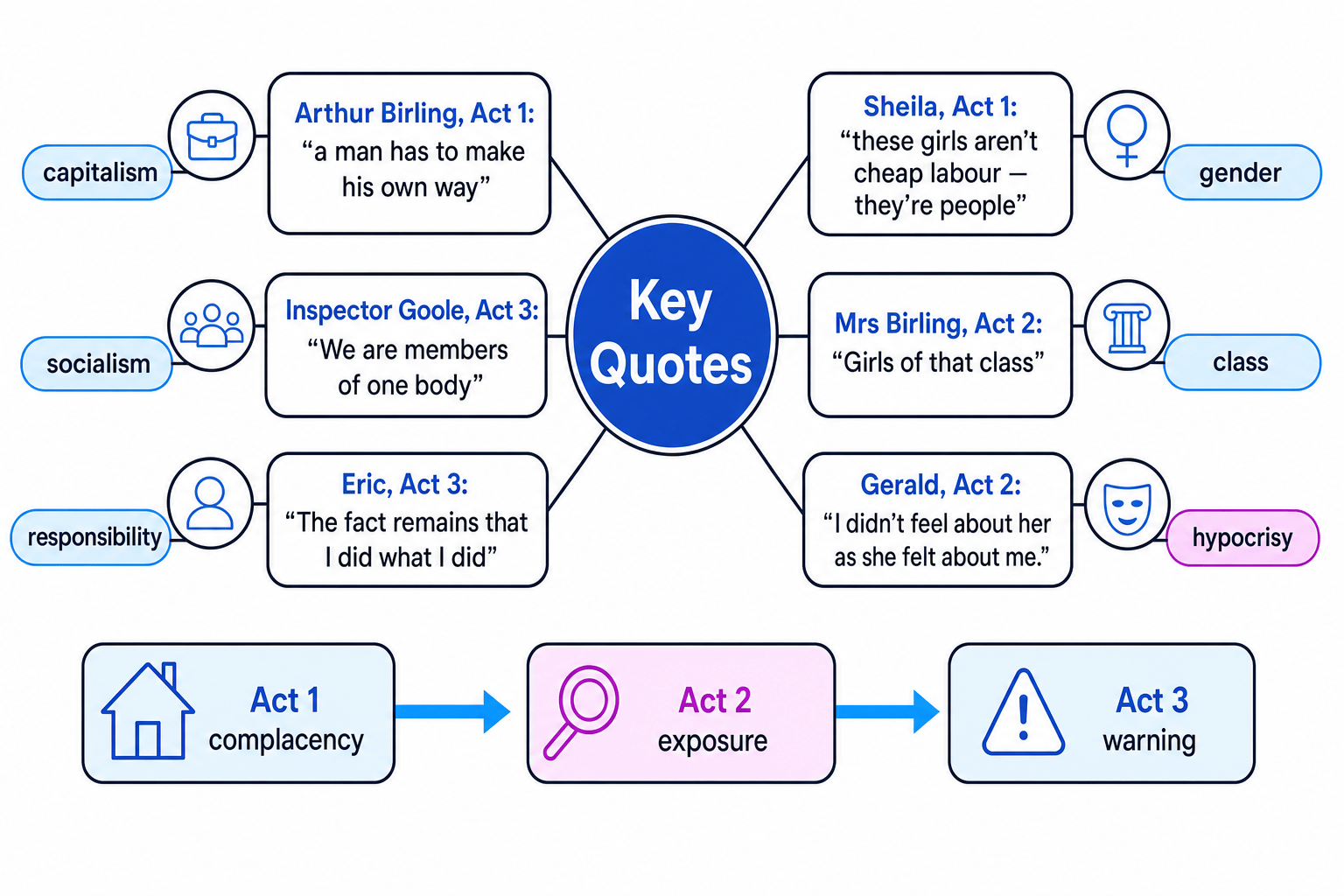
The map below shows how a small number of anchor quotations can connect to several essay routes, rather than being learned as isolated lines.
Core quotation bank
Act 1 — complacency, capitalism and disruption
A stage direction is an instruction in the script about acting, movement, sound or lighting.
| Quotation | Speaker / place | Why it matters |
|---|---|---|
| “pink and intimate” then “brighter and harder” | Opening stage directions | The lighting change symbolises the Inspector exposing uncomfortable truth. Priestley uses stagecraft before the dialogue even begins. |
| “a man has to make his own way” | Arthur Birling, Act 1 | Birling’s capitalist individualism is set up so that the Inspector can challenge it. |
| “unsinkable, absolutely unsinkable” | Arthur Birling, Act 1 | This creates dramatic irony, where the audience knows more than the character. Birling’s confidence looks foolish because the Titanic did sink. |
| “these girls aren’t cheap labour — they’re people” | Sheila, Act 1 | Sheila rejects her father’s language of profit. The contrast between “labour” and “people” shows her growing moral awareness. |
| “It’s better to ask for the earth than to take it” | Inspector Goole, Act 1 | The Inspector reverses Birling’s logic: demanding fair wages is less greedy than exploiting workers. |
Act 2 — exposure, class and gender
| Quotation | Speaker / place | Why it matters |
|---|---|---|
| “I didn’t feel about her as she felt about me” | Gerald, Act 2 | Gerald admits the emotional inequality in his relationship with Daisy Renton. Priestley exposes male privilege while keeping Gerald morally complicated. |
| “Girls of that class” | Mrs Birling, Act 2 | The phrase reduces Eva to a social category. Priestley presents Mrs Birling’s class prejudice as cold and dehumanising. |
| “As if a girl of that sort would ever refuse money!” | Mrs Birling, Act 2 | Her disbelief reveals assumptions about working-class women and morality. The audience sees her prejudice more clearly than she does. |
| “one line of inquiry at a time” | Inspector Goole, Act 2 | The Inspector controls the structure of the investigation, forcing each character to face responsibility in turn. |
Act 3 — responsibility, guilt and warning
| Quotation | Speaker / place | Why it matters |
|---|---|---|
| “The fact remains that I did what I did” | Eric, Act 3 | Eric accepts moral responsibility, even after doubts about the Inspector arise. |
| “I suppose we’re all nice people now” | Sheila, Act 3 | Sheila’s sarcasm shows she refuses to return to complacency. She has changed more than her parents. |
| “We don’t live alone. We are members of one body. We are responsible for each other.” | Inspector Goole, Act 3 | Priestley’s central message is expressed directly through the Inspector’s final speech. |
| “fire and blood and anguish” | Inspector Goole, Act 3 | The three-part phrase, or triplet, creates a severe warning. For a 1945 audience, it echoes the suffering of world wars after the play’s 1912 setting. |
| “millions and millions and millions of Eva Smiths and John Smiths” | Inspector Goole, Act 3 | The repetition expands Eva’s story into a national social problem. She becomes symbolic of the exploited working class. |
How to analyse a quotation
A metaphor is a comparison that says one thing is another. A collective pronoun is a pronoun such as “we” or “our” that groups people together.
Analysing collective responsibility
- Start with the argument: Priestley presents social responsibility as necessary, not optional.
- Use the evidence: the Inspector says, “We don’t live alone. We are members of one body.”
- Analyse the method: the collective pronoun “we” includes everyone in society, while the metaphor “one body” suggests that people are connected like parts of the same living organism.
- Link to effect: this challenges Birling’s earlier belief that “a man has to make his own way”, making the audience judge individualism as selfish and dangerous.
Building quote clusters
A quote cluster is a small group of quotations that work together. In essays, clusters help you show development across the play rather than making one isolated point.
For example, to write about class, you might move from Birling’s business language, to Mrs Birling’s prejudice, to the Inspector’s inclusive warning.
Pairing class prejudice with moral growth
- Use Mrs Birling’s “Girls of that class” to show how the older generation dehumanises Eva through class labels.
- Contrast it with Sheila’s “they’re people”, which restores Eva’s humanity and shows Sheila rejecting her parents’ attitudes.
- The contrast lets you argue that Priestley presents moral change as possible, especially in the younger generation, while criticising the older generation’s refusal to learn.
Accuracy and exam pitfalls
Quote-dropping
Do not just place a quotation into a sentence and move on. Every quote needs analysis of Priestley’s choice of words, dramatic method or structure, and a clear link back to the question.
Use short fragments
You do not need long quotations. A phrase such as “cheap labour”, “one body” or “fire and blood” is easier to embed and often gives you more room for close analysis.
Final reminders
Remember that the Inspector’s final speech is not the only important part of the play. The earlier quotations matter because Priestley builds a dramatic contrast: Act 1 begins with comfort and confidence, Act 2 exposes hidden guilt, and Act 3 ends with judgement and warning.
In the exam
- Choose two or three anchor quotations that directly fit the question before you begin writing.
- Use your clean copy to check accuracy quickly, but do not waste time hunting for every quote.
- For each quotation, move from point → evidence → method → effect → link back to the question.
Check yourself
- Which quotation best challenges Birling’s belief that individuals should only look after themselves?
- How could you use “Girls of that class” and “they’re people” in the same paragraph?
- Why is “fire and blood and anguish” especially powerful for a 1945 audience?