What you'll learn
- How to tell the difference between language, form and structure in An Inspector Calls.
- How Priestley uses stage directions, dialogue, dramatic irony and symbolism to shape meaning.
- How the three-act structure builds tension and makes the ending feel shocking.
- How to write about methods for Edexcel Component 2, where this play is open book but still needs precise analysis.
Start with the three big terms
Before you analyse, separate the three kinds of writer’s choice.
Language, form and structure
- Language means Priestley’s word choices: dialogue, stage directions, tone, imagery and patterns of speech.
- Form means the type of text and its conventions. Here, it is a three-act play with elements of a detective story, drawing-room drama and morality play.
- Structure means how the play is arranged: the order of revelations, entrances and exits, act endings, tension, climax and final twist.
For Edexcel modern drama, your strongest answers usually blend AO1 knowledge of the play with AO2 analysis of Priestley’s methods. Don’t just name techniques: explain how they affect the audience.
Method must lead to meaning
A good sentence does not stop at “Priestley uses dramatic irony.” It continues: what does that make the audience think, feel or judge?
Drama is written to be performed
A stage direction is an instruction in the script about setting, lighting, movement, tone or gesture. Priestley’s stage directions matter because the audience sees meaning before characters even speak.
The opening setting is the Birlings’ “substantial and heavily comfortable” dining room. The adjective “substantial” suggests wealth and status, while “heavily comfortable” hints that this comfort is excessive and morally weighty. The room becomes a symbol of upper-middle-class security.
The lighting is also important: it is “pink and intimate” until the Inspector arrives, then “brighter and harder”. The change makes the Inspector feel like a force of exposure.
Analysing the lighting change
- Start with the contrast: “pink and intimate” suggests warmth, privacy and a flattering atmosphere around the Birlings.
- Notice the shift in the comparative adjectives “brighter” and “harder”: the room becomes less cosy and more severe, as if the family is under examination.
- Link the stagecraft to Priestley’s message: the Inspector’s arrival strips away the family’s comfort and forces the audience to judge their behaviour.
Language: characters reveal themselves when they speak
Dialogue is the spoken conversation between characters. Priestley uses it to expose class attitudes, selfishness and change.
Arthur Birling’s language often sounds businesslike and complacent. He talks about “lower costs and higher prices”, reducing workers to profit. His phrase “community and all that nonsense” dismisses social responsibility, so the audience is encouraged to distrust his values.
Mrs Birling’s language reveals class prejudice. Her phrase “girls of that class” is dismissive and dehumanising. By contrast, Sheila increasingly challenges this attitude: “But these girls aren’t cheap labour — they’re people.” Her language moves towards empathy.
Semantic field
A semantic field is a group of words linked by meaning. For example, Birling’s language often belongs to a semantic field of business: costs, prices, money, profit and status.
Tracking Sheila’s change through language
- Compare Sheila’s early position with her later speech: at first she is protected by wealth, but after the Inspector questions her, she becomes more morally aware.
- Use her line “these girls aren’t cheap labour — they’re people”: she rejects Birling’s business language and replaces it with human language.
- Link this to structure: Sheila’s changing voice helps Priestley contrast the younger generation’s capacity to learn with the older generation’s resistance.
The Inspector’s language: moral pressure
The Inspector’s speech is often plain, direct and authoritative. He says, “Each of you helped to kill her,” making guilt collective rather than individual.
Near the end, his final speech becomes more symbolic and prophetic. A metaphor describes one thing as if it is another; “We are members of one body” presents society as a single living organism. A tricolon is a list of three; “fire and blood and anguish” gives his warning a powerful, memorable rhythm.
Priestley wrote the play in 1945 but set it in 1912. A post-war audience would hear “fire and blood and anguish” as a serious warning about what happens when societies ignore responsibility.
Form: a detective story with a moral purpose
A drawing-room drama is a play set mainly in a wealthy domestic room, often exposing tensions beneath respectability. Priestley traps the Birlings in one room, so their comfortable home becomes like an interrogation chamber.
A detective structure usually reveals clues gradually. Here, however, the “crime” is moral rather than simply legal. The question is not only “Who killed Eva Smith?” but “How is everyone responsible?”
A morality play is a drama designed to teach an ethical lesson. An Inspector Calls is not a medieval morality play, but it borrows the idea of a figure who judges human behaviour. Inspector Goole functions partly as detective, partly as conscience.
Over-solving the Inspector
Do not insist that Inspector Goole is definitely a ghost, angel or time-traveller. It is safer to say Priestley makes him mysterious so that he can represent moral judgement and social responsibility.
Dramatic irony and foreshadowing
Dramatic irony happens when the audience knows more than a character. Birling confidently says the Titanic is “unsinkable, absolutely unsinkable”, but the audience knows it sank in 1912. This makes his certainty look foolish.
Foreshadowing is when a writer hints at what will happen later. Birling’s wrong predictions prepare us to distrust his political and moral opinions too.
Using dramatic irony about the Titanic
- Select the precise detail: Birling’s “unsinkable, absolutely unsinkable” repeats his certainty.
- Apply audience knowledge: viewers after 1912 know the Titanic sank, so his confidence is exposed as ignorance.
- Connect to Priestley’s purpose: if Birling is wrong about history, the audience is less likely to trust his views on “community” and responsibility.
Structure: tension rises revelation by revelation
The play’s exposition is the opening situation: the engagement dinner, family status and Birling’s speeches. The rising action is the Inspector’s questioning, where each character’s connection to Eva Smith is revealed. The climax is the highest point of tension, especially Eric’s confession and the Inspector’s final warning. A twist ending suddenly changes how the audience understands events.
The timeline below shows how Priestley controls tension across the three acts.
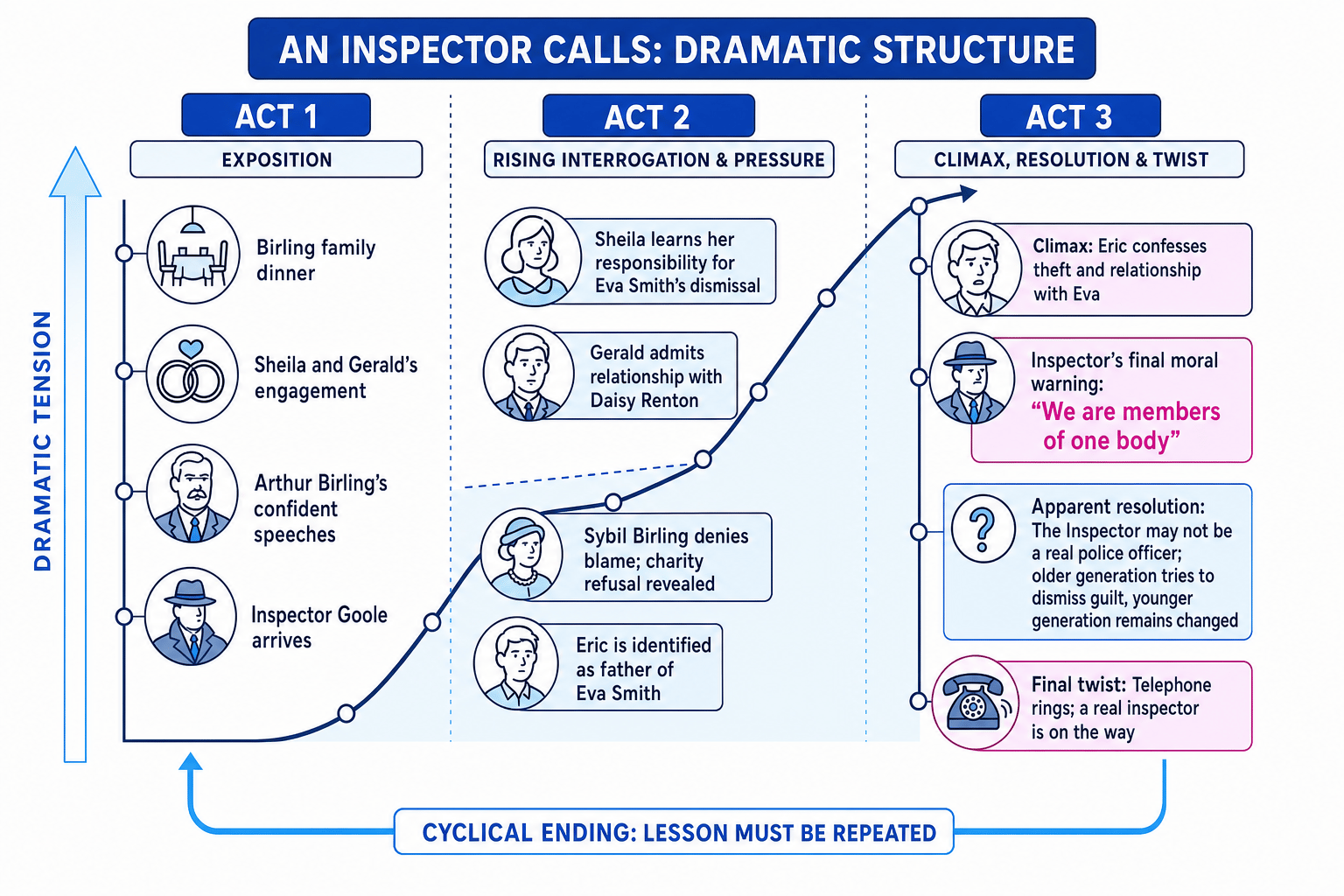
Priestley also uses cliffhangers, which are tense act endings that make the audience wait for the next revelation. Gerald’s connection to Daisy Renton and Eric’s responsibility are held back to increase suspense.
The ending is cyclical, meaning it returns to a situation similar to the beginning. After the family think the Inspector may not have been real, the telephone rings: “a police inspector is on his way here.” The lesson must begin again.
Explaining the final phone call
- Identify the apparent resolution: the older Birlings try to dismiss the Inspector’s visit as a hoax, which briefly lowers the tension.
- Notice the structural reversal: the phone call repeats the play’s starting situation, with another inspector about to arrive.
- Explain the effect: the audience leaves unsettled, because Priestley refuses a comfortable ending and insists that responsibility cannot be escaped.
Quick quotation-method-effect table
| Quotation | Method | Effect |
|---|---|---|
| “pink and intimate” / “brighter and harder” | Stage directions and lighting contrast | Shows comfort being replaced by exposure and judgement |
| “lower costs and higher prices” | Business semantic field | Reveals Birling’s capitalist priorities |
| “girls of that class” | Dismissive class language | Exposes Mrs Birling’s prejudice |
| “these girls aren’t cheap labour — they’re people” | Contrast in Sheila’s dialogue | Shows moral growth and empathy |
| “We are members of one body” | Metaphor | Presents society as interconnected |
| “fire and blood and anguish” | Tricolon and prophetic tone | Warns of suffering if responsibility is ignored |
A simple analysis chain
Use this order when writing: point → short quotation → method → effect on audience → link to Priestley’s message.
Mini model paragraph
Priestley uses stage directions to show the collapse of the Birlings’ comfortable world. At the start, the lighting is “pink and intimate”, creating a private, flattering atmosphere around their wealth. When the Inspector arrives, it becomes “brighter and harder”; this lighting contrast makes the stage feel like an interrogation space. The audience sees the family’s respectability being exposed, not simply described. Priestley therefore uses theatrical form to support his wider message: social comfort depends on ignoring people like Eva Smith, and the Inspector forces that hidden responsibility into the open.
In the exam
- Remember that Component 2 modern drama is open book, with a clean copy allowed, but you still need to know where key moments are.
- Do not write a list of devices. Analyse how Priestley’s language, form or structure shapes the audience’s judgement.
- Include at least one structural or dramatic point, such as lighting, act-ending cliffhangers, interrogation sequence or the final phone call.
Check yourself
- How does the lighting change when the Inspector arrives, and why does it matter?
- Which character’s language changes most clearly during the play?
- How does the final phone call affect the audience’s understanding of responsibility?