In J.B. Priestley’s An Inspector Calls, themes are not just abstract ideas—they are the driving force of the entire play. Priestley wrote this play with a clear, urgent purpose: to convince post-Second World War British audiences to reject the selfish individualism of the past and embrace a fairer, more cooperative society.
These study notes will guide you through the core themes of the play, helping you analyse how Priestley uses dramatic devices, characterisation, and language to construct his moral arguments.
What you'll learn
- How to contrast the competing ideologies of Capitalism and Socialism through the characters of Arthur Birling and Inspector Goole.
- How the generational divide operates as a symbol of political and moral hope.
- How class and gender inequality intersect to cause the destruction of Eva Smith.
- How to write top-tier analytical paragraphs without wasting time on unassessed skills.
Social Responsibility vs. Individualism
At its heart, the play is an ideological battleground. Priestley pits two opposing worldviews against one another: individual capitalism (represented by Mr Birling) and collective social responsibility (represented by Inspector Goole).
Capitalism
An economic and political system in which a country's trade and industry are controlled by private owners for profit, rather than by the state. In the play, this is associated with self-interest and the exploitation of the working classes.
Socialism
A political and economic theory of social organisation which advocates that the community as a whole should own, manage, or regulate the means of production, distribution, and exchange. In the play, this is represented as moral duty and community care.
At the start of Act One, Arthur Birling delivers a long monologue outlining his capitalist philosophy. He tells Eric and Gerald that:
"a man has to make his own way—has to look after himself—and his family too, of course"
Priestley intentionally structures the play so that this selfish philosophy is interrupted. The sharp, demanding ring of the doorbell—announcing the arrival of Inspector Goole—cuts directly through Mr Birling's speech. This sound cue is a structural device that signals the arrival of a moral challenger.
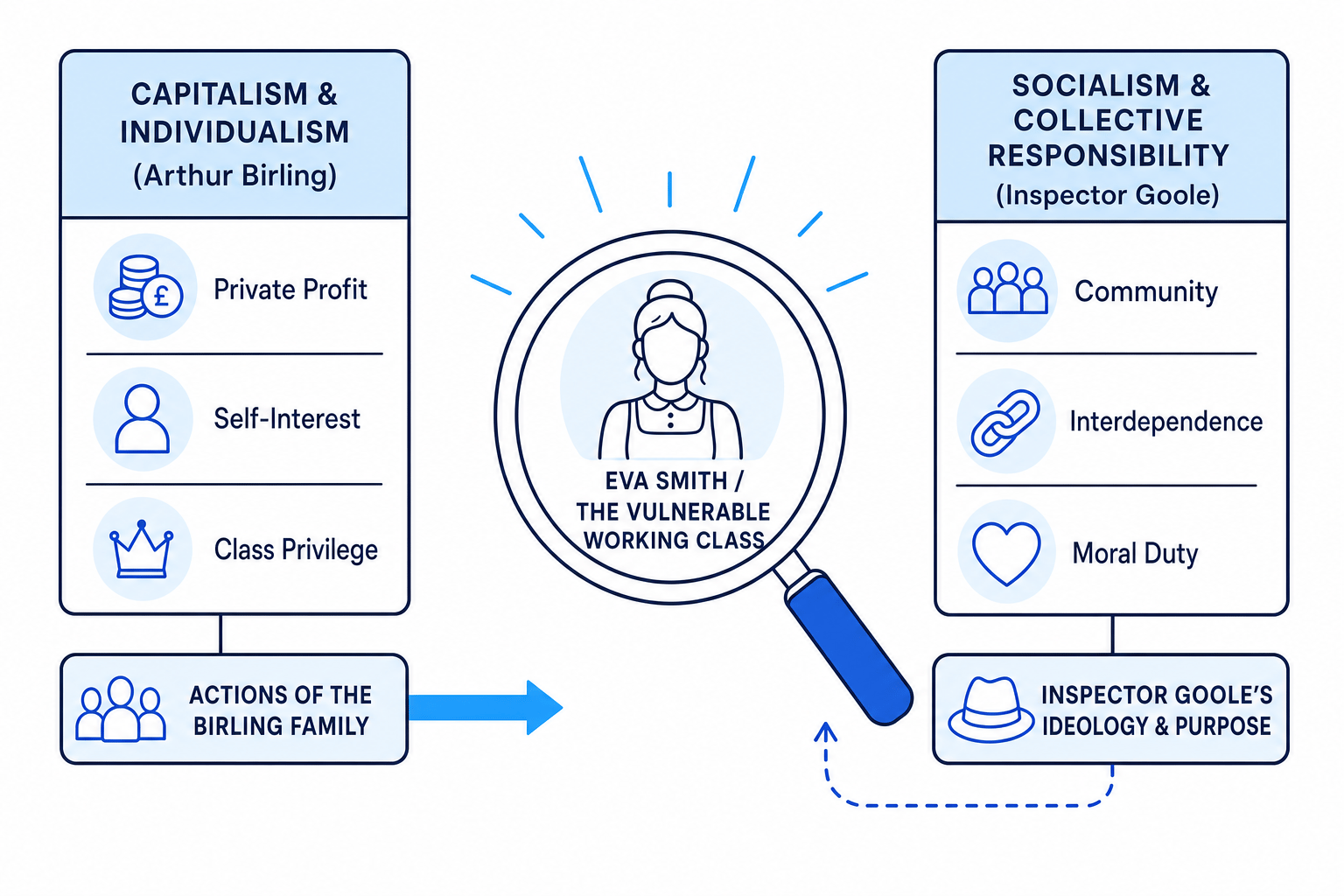
In contrast to Mr Birling's individualism, the Inspector acts as a mouthpiece for Priestley's socialist ideals. In his final, prophetic speech in Act Three, he declares:
"We don't live alone. We are members of one body. We are responsible for each other."
By using the collective plural pronouns ("we", "our", "us"), Priestley unites the characters on stage and the audience in the theatre under a single moral obligation.
The Didactic Purpose
An Inspector Calls is a didactic play—it is designed to teach a moral lesson. Priestley uses the tragic story of Eva Smith to prove that individual actions have collective consequences.
Didactic Drama
A play designed or intended to teach, particularly having moral instruction as an ulterior or secondary motive.
Social Class and Inequality
Priestley exposes the hypocrisy and moral decay of the Edwardian upper-middle class. The Birlings believe their wealth and social status shield them from the consequences of their actions. They view the working class not as individuals, but as cheap labour or sexual commodities.
The Commodity of Labour
Arthur Birling views his employees purely through financial metrics. When the Inspector questions his decision to sack Eva Smith for demanding higher wages, Birling defends himself by stating:
"it's my duty to keep labour costs down"
For Birling, "duty" does not mean a moral obligation to his fellow humans; it means a financial obligation to his bank balance and his shareholders.
The Commodity of Pleasure
For Gerald Croft and Eric Birling, working-class women like Eva Smith (under the alias Daisy Renton) are disposable objects to be used for physical pleasure and then discarded.
- Gerald houses Daisy as his mistress because she is "young and fresh and charming," but abandons her when it no longer suits his lifestyle.
- Eric, in a state of drunken aggression, forces his way into her lodgings, treating her as "an animal, a thing, not a person."
Through these interactions, Priestley demonstrates how class privilege allows the wealthy to exploit the vulnerabilities of the poor without immediate social consequence.
The Myth of Respectability
Be careful not to take the characters' outward "respectability" at face value. Priestley deliberately peels back their polite, bourgeois veneers to reveal the greed, lust, and cruelty underneath.
The Generational Divide
Priestley structures the play to create a stark contrast between the older generation (Arthur and Sybil Birling) and the younger generation (Sheila and Eric). This division represents the political choices facing post-war Britain.
       [ THE GENERATIONAL DIVIDE ]

   Older Generation       Younger Generation
 (Mr & Mrs Birling)        (Sheila & Eric)
         |                        |
  - Defensive              - Repentant
  - Fear of scandal        - Accept guilt
  - Static (unchanged)     - Dynamic (morphed)
         |                        |
[ Represents the Past ]  [ Represents the Future ]
The Unchanging Elders
Mr and Mrs Birling represent the old, stubborn Edwardian ruling class. When the Inspector leaves, they do not feel guilt for their actions; instead, they are consumed by a fear of "public scandal" and the loss of their social status.
- Mrs Birling remains utterly cold, insisting, "I did nothing I'm ashamed of."
- Mr Birling's primary relief at the end of the play is that there is "no epidemic" of scandal to threaten his knighthood.
The Repentant Youth
In contrast, Sheila and Eric are deeply affected by the Inspector's revelations. They experience a genuine moral awakening.
- Sheila quickly accepts her part in Eva's death, admitting, "I'll never, never do it again to anybody." She represents the capacity for change.
- Eric accepts his responsibility, shouting at his mother, "You killed her... and the child she'd have had too!"
By the end of the play, the younger generation has adopted the Inspector’s socialist values, while the older generation remains locked in their capitalist ways. Gerald Croft occupies a troubling middle ground: though young, he ultimately aligns himself with the older generation by trying to prove the Inspector is a "hoax" to preserve his privilege.
Look closely at the stage directions
At the start of the play, the lighting is described as "pink and intimate," symbolising the Birlings' warm, self-absorbed bubble. When the Inspector arrives, the lighting becomes "brighter and harder," indicating that the cold light of truth is about to expose their actions.
Gender and Exploitation
Eva Smith is doubly vulnerable because she is both working-class and female. In Edwardian Britain, women had no vote, very few legal rights, and limited paths to financial independence.
Double Standards
Priestley highlights the hypocrisy of the gender expectations of the time. Mr Birling tries to protect Sheila from hearing the sordid details of Gerald's affair because she is a "young unmarried girl" who should be spared from "unpleasant things." However, no such protection was offered to Daisy Renton.
                  [ GENDER EXPLOITATION ]

     Privileged Women               Working-Class Women
     (e.g., Sheila Birling)         (e.g., Eva Smith)
             |                              |
 - Protected from reality       - Exposed to harsh exploitation
 - Infantalised by men          - Treated as disposable commodities
Sheila’s Transformation
Sheila's journey is a feminist awakening. At the start, she is infantalised by her parents (called "mummy" and "childish") and acts as a passive consumer, obsessed with her engagement ring.
As she absorbs the Inspector's message, she finds her voice. She challenges Gerald’s infidelity, mocks her mother's blind arrogance, and takes over the Inspector’s role after he departs, warning her family:
"he's giving us the rope—so that we'll hang ourselves."
Analyzing how Priestley presents the theme of responsibility
Now let's walk through how to build a high-scoring analytical paragraph on the theme of social responsibility. We will analyze the Inspector’s final speech to demonstrate how to link language, structure, and writer's intent.
Analyzing the Inspector's final speech
-
Formulate a clear thesis point linking the character's actions to the theme.
Priestley uses Inspector Goole's final polemical speech to warn the characters—and the audience—of the apocalyptic consequences of ignoring collective social responsibility.
-
Introduce a precise, embedded quotation and identify the writer's methods.
The Inspector uses a stark, somatic metaphor to describe humanity’s interconnectedness, declaring that "We are members of one body," which is immediately followed by a tripartite warning of future violence: "if men will not learn that lesson, then they will be taught it in fire and blood and anguish."
-
Analyse the specific language and structural choices (AO2).
The collective pronoun "We" acts as a direct structural contrast to Mr Birling’s individualistic "I" from Act One, asserting that society is an interdependent system. Furthermore, the polysyndeton in the phrase "fire and blood and anguish" slows the pace of the sentence, adding weight to each noun. The biblical, apocalyptic imagery of "fire" and "blood" would have resonated deeply with a 1945 audience who had just survived two devastating world wars, reminding them that political selfishness leads directly to global conflict.
-
Link the analysis back to Priestley's overall purpose and the effect on the audience (AO1).
Through this dramatic climax, Priestley forces his audience to recognise that social responsibility is not just a moral preference, but an urgent societal necessity. By presenting this warning just before the Inspector exits, Priestley leaves the characters, and the audience, with an active moral choice.
Wasting time on unassessed skills (AO4)
On Edexcel Component 2, Section A (Modern Drama), there are no marks allocated for Assessment Objective 4 (Context).
Do not write long paragraphs about the history of the Labour Party, the sinking of the Titanic, or the details of the two World Wars unless you are directly using them to analyse Priestley’s dramatic methods and themes (AO2). Every mark you earn comes from your close analysis of language, form, and structure (AO2), and your understanding of the text (AO1).
In the exam
- Focus on the "How": When writing about themes, never just list what happens. Always focus on how Priestley uses dramatic devices (like lighting, sound cues, character contrasts, and structure) to communicate those themes.
- Track the character arc: Characters are constructs used to deliver themes. Show how a character's attitude to a theme (like responsibility) changes or hardens from Act One to Act Three.
- Use the play's structure: Remember that the play is structured as a series of confessions. Think about why Priestley chose this order: he moves from the capitalist workplace (Birling) to commercial exploitation (Sheila), sexual exploitation (Gerald and Eric), and finally institutional cruelty (Mrs Birling).
- Select precise quotations: Choose short, versatile quotations that can be used for multiple themes (for example, Mr Birling’s "hard-headed, practical man of business" speech works for capitalism, class, and the generational divide).
Check yourself
- How does the change in lighting from "pink and intimate" to "brighter and harder" mirror the thematic development of the play?
- Why is it significant that Gerald Croft ultimately sides with Mr and Mrs Birling in Act Three, despite being part of the younger generation?
- What linguistic methods does Priestley use in the Inspector’s final speech to make his message feel universal and urgent?