What you'll learn
- How to turn a broad topic into a sharp theme-based argument.
- The main themes in A View from the Bridge: love, honour, law, immigration, masculinity and fate.
- How Miller develops themes through dialogue, stage action and dramatic structure.
- How to write about themes for Edexcel IGCSE Component 2, where you have a clean copy of the play.
What is a theme?
A theme is not just a “thing that appears” in a text. It is an idea the writer explores and shapes across the whole play.
Theme
A theme is a recurring idea or concern in a text, developed through characters, plot, language, stage action and structure.
So, “love” is a topic. A stronger theme statement would be: Miller presents love as dangerous when it becomes possessive and controlling. That gives you something to argue.
Turning a topic into an argument
- Start with the broad topic: love.
- Ask what Miller shows about it: Eddie’s love for Catherine begins as protective, but becomes controlling and jealous.
- Link that idea to evidence and method: Eddie complains that Catherine is “walkin’ wavy”, using dialogue to reveal that he notices her sexuality in an uncomfortable way.
- Turn it into a theme sentence: Miller presents possessive love as destructive because Eddie cannot accept Catherine’s independence.
How the themes connect
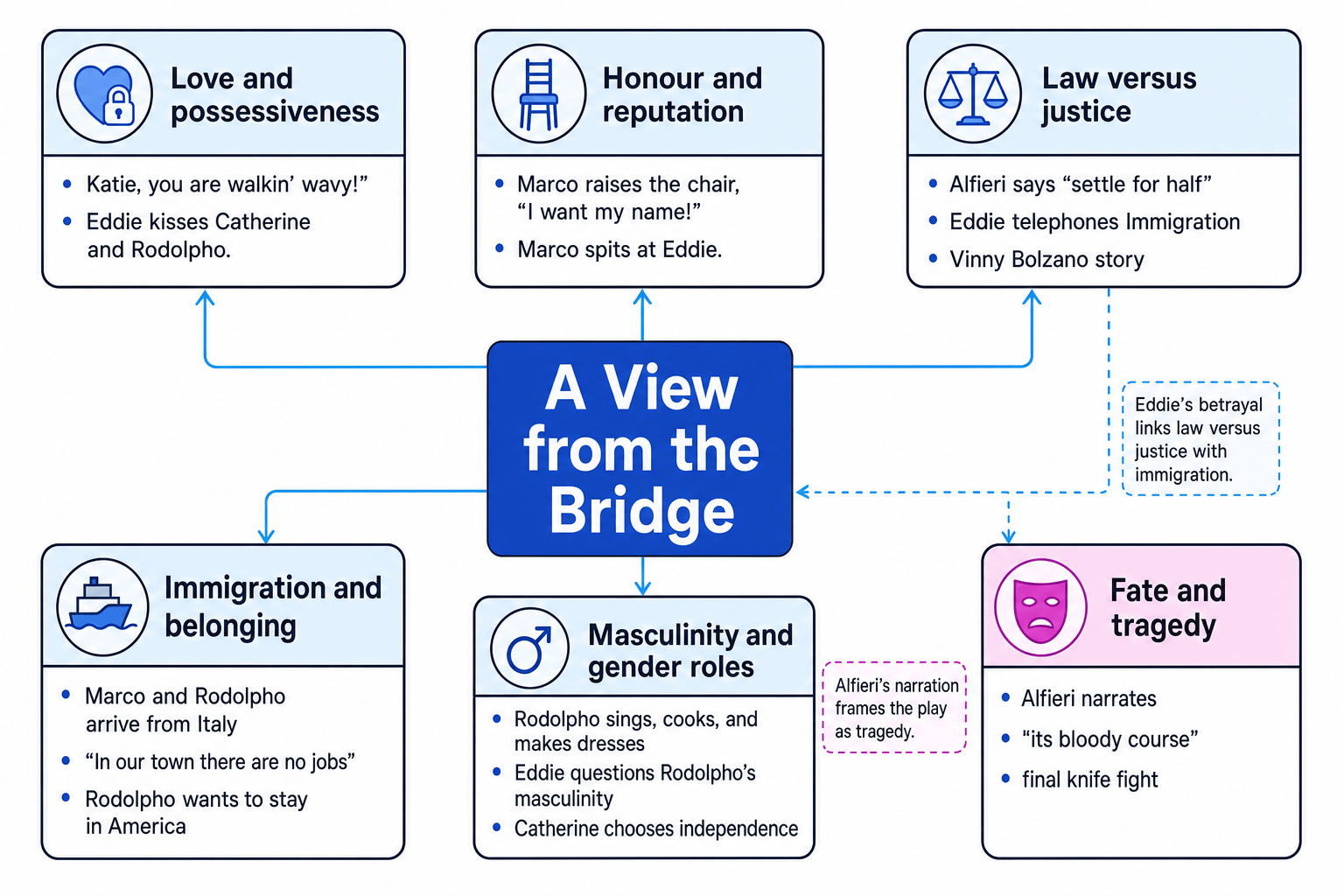
Miller’s themes are closely linked. Eddie’s possessive love affects his ideas about masculinity, damages his honour, and pushes him towards betrayal. Alfieri’s narration frames all of this as a tragedy that seems almost impossible to stop.
The big picture
In A View from the Bridge, private feelings become public disaster: Eddie’s hidden desire for Catherine leads him to break family loyalty, community honour and finally the law of kinship.
Love and possessiveness
At the start, Eddie appears to be a caring guardian. He has raised Catherine and wants to protect her. But Miller gradually reveals that Eddie’s affection has become possessive.
When Eddie says, “Katie, you are walkin’ wavy!”, he is not simply giving ordinary parental advice. The phrase shows that he is watching her body and worrying about how other men see her. His language makes Catherine’s growing maturity feel like a threat to him.
Beatrice understands this more clearly than Eddie does. Near the end, she tells him: “You want somethin’ else, Eddie, and you can never have her!” This is one of the play’s most direct statements of the forbidden desire at the centre of the tragedy.
Subtext
Subtext is the meaning underneath what a character says openly. In drama, characters may not fully admit their real motives, but the audience can infer them.
Eddie rarely says directly that he is jealous, but the subtext of his actions reveals it: he criticises Rodolpho, blocks Catherine’s marriage, and finally kisses both Catherine and Rodolpho in a disturbing attempt to prove control.
Analysing possessive love
- Choose a moment where Eddie’s behaviour seems protective on the surface: his complaint that Catherine is “walkin’ wavy”.
- Look beneath the surface: the phrase suggests Eddie is uncomfortably aware of Catherine’s sexuality.
- Connect to dramatic effect: the audience begins to sense that his “fatherly” concern is mixed with jealousy and control.
- Link to the theme: Miller presents love as destructive when it refuses to let another person grow up and become independent.
Calling Eddie simply loving
Do not write that Eddie “only wants the best for Catherine”. That is partly true at the start, but it ignores the darker possessiveness that Miller carefully exposes.
Honour and reputation
Honour is central to the world of Red Hook. Eddie cares deeply about his “name”: his public reputation as a man, provider and respected member of the community.
Honour
Honour means a person’s public sense of dignity, respect and moral standing, especially in the eyes of their community.
Eddie’s repeated cry, “I want my name!”, shows that he believes Marco has stolen his reputation. The word “name” becomes symbolic: it stands for Eddie’s masculinity, authority and place in the neighbourhood.
Marco’s chair-lifting moment is crucial. When Marco raises the chair “like a weapon” over Eddie’s head, Miller creates a silent contest of strength. Eddie has been teaching Rodolpho to box, but Marco’s action quietly defeats him. The audience sees Eddie’s authority being challenged before Eddie fully admits it.
Symbolism
Symbolism is when an object, action or image represents a larger idea. Marco’s raised chair symbolises strength, warning and moral judgement.
Later, Marco spits in Eddie’s face and accuses him publicly. In Eddie’s world, this is a terrible humiliation. His demand for his name drives the final confrontation.
Law versus justice
Alfieri represents official law. He is a lawyer, and he repeatedly explains what can and cannot be done legally. However, Miller contrasts legal law with moral justice.
Alfieri tells Eddie that “there is nothing illegal about a girl falling in love with an immigrant.” This matters because Eddie wants the law to solve an emotional problem. Catherine’s love for Rodolpho hurts Eddie, but it is not a crime.
Alfieri’s famous line, “Now we settle for half, and I like it better,” suggests that modern law often avoids revenge and extreme punishment. To “settle for half” means accepting compromise rather than demanding total justice or total satisfaction.
Dramatic conflict
Dramatic conflict is the struggle between opposing forces in a play. Here, one key conflict is between official law and the community’s moral code.
Eddie’s phone call to Immigration is legally possible, but morally shameful in Red Hook. The earlier story of Vinny Bolzano prepares us for this: informing on relatives is treated as a betrayal so severe that Vinny is rejected by his own family and community.
Explaining law versus justice
- Identify the legal fact: Eddie can report Marco and Rodolpho because they are illegal immigrants.
- Compare it with the community code: Red Hook sees informing as dishonourable, especially when the men are family guests.
- Analyse Miller’s structure: the Vinny Bolzano story foreshadows Eddie’s betrayal, so the audience understands how serious the act is before it happens.
- Link to theme: Miller shows that something can be legal and still morally destructive.
Immigration and belonging
Marco and Rodolpho come to America because poverty in Italy leaves them with few choices. Marco explains, “In our town there are no jobs.” This short sentence makes immigration a matter of survival, not adventure.
Rodolpho imagines America as a place of opportunity and freedom. Marco’s purpose is more urgent: he must earn money to feed his wife and children. This makes Eddie’s betrayal especially cruel, because Marco’s family depends on him.
Miller presents America as both hopeful and harsh. It offers work, but it also creates insecurity. The cousins belong inside Eddie’s home as family, but outside the home they are vulnerable because of their immigration status.
A precise way to phrase this theme
Instead of writing “immigration is important”, write: Miller presents immigration as a search for survival and belonging, but shows how easily immigrants can be exploited or betrayed.
Masculinity and gender roles
Eddie has a narrow idea of masculinity. He values physical strength, toughness, authority and control. This is why Rodolpho unsettles him: Rodolpho sings, cooks and makes dresses, which Eddie sees as suspicious rather than simply different.
Gender roles
Gender roles are the behaviours a society expects from men and women. Miller shows how damaging these expectations can become when characters treat them as fixed rules.
Eddie claims Rodolpho “ain’t right”, implying that Rodolpho does not fit Eddie’s version of manhood. But the audience can see that Eddie’s judgement is biased by jealousy. Rodolpho’s difference threatens Eddie because Catherine loves him.
Catherine’s growth also challenges Eddie’s authority. Beatrice tells her, “You gotta be your own self more,” encouraging her to separate from Eddie emotionally. Catherine’s movement towards independence is part of the play’s conflict: Eddie cannot bear losing control.
Fate and tragedy
From the beginning, Alfieri makes the play feel tragic. He speaks directly to the audience and looks back on events that have already happened. This creates a sense of inevitability.
Tragedy
A tragedy is a serious drama in which a central character’s flaw or error leads to suffering, destruction or death.
Eddie’s tragic flaw is not one simple thing. It includes jealousy, pride, self-deception and a desperate need for control. He cannot admit the truth about his feelings, so he blames Rodolpho instead.
Dramatic irony
Dramatic irony occurs when the audience understands something that a character does not. The audience can see Eddie’s jealousy more clearly than Eddie himself can.
Alfieri says he “watched it run its bloody course.” This image suggests a tragic process that cannot be stopped once it has begun. The word “bloody” also points towards the violent ending, where Eddie dies by his own knife.
Linking tragedy to structure
- Notice the structure: Alfieri narrates from a later point in time, so the audience feels that the ending is already fixed.
- Connect this to Eddie’s flaw: Eddie refuses to accept Catherine’s independence or recognise his own jealousy.
- Analyse the effect: the audience watches with tension because they can see the danger growing, while Eddie continues towards it.
- Link to theme: Miller presents tragedy as the result of hidden desire, pride and the refusal to compromise.
Writing about themes in essays
For Edexcel IGCSE Component 2, A View from the Bridge is in the open-book drama section, so you can use a clean copy of the play. But “open book” does not mean “copy lots of quotations”. You still need a clear argument and precise references.
A strong theme paragraph should move like this:
- Make a clear point about Miller’s presentation of the theme.
- Use a short quotation or specific stage moment.
- Analyse a method: dialogue, stage direction, symbolism, structure, dramatic irony, or contrast.
- Explain the effect on the audience.
- Link back to the theme and the question.
Here is a compact model:
Miller presents Eddie’s concern for honour as dangerously tied to masculine pride. When Eddie repeatedly demands, “I want my name!”, the noun “name” symbolises his public reputation in Red Hook. The repetition makes him sound desperate, as if social respect matters more to him than family loyalty or Catherine’s happiness. By turning reputation into the motive for violence, Miller shows how a rigid honour code can destroy a man who cannot “settle for half”.
In the exam
- Build your answer around an argument, not a list of themes: say what Miller shows about the theme.
- Use short, accurate quotations and stage moments; analyse how Miller’s dramatic methods shape the audience’s response.
- Keep linking Eddie’s private emotions to wider conflicts: family loyalty, honour, law, masculinity and tragedy.
Check yourself
- How does Eddie’s love for Catherine become possessive rather than protective?
- Why is Eddie’s phone call to Immigration legal but morally shameful?
- How does Alfieri’s narration make the play feel like a tragedy from the beginning?