What you'll learn
- How Arthur Miller presents the main characters in A View from the Bridge.
- How Eddie’s relationships with Catherine, Beatrice, Rodolpho, Marco and Alfieri drive the tragedy.
- How to analyse character using dialogue, stage directions and dramatic structure.
- How to write about characters for Edexcel IGCSE Component 2, where you have a clean copy of the play.
Characters in a play: the basics
In a novel, a narrator can tell us directly what a character thinks. In A View from the Bridge, Miller is writing drama, so character is mostly built through what the audience can see and hear on stage.
For Edexcel Component 2 Section A, this matters because you are rewarded for close knowledge of the text and for analysing Miller’s methods. The exam is open book: you may use a clean copy of the play, but you still need to know the important character moments so you can find precise evidence quickly.
Characterisation
Characterisation is the way a writer creates and develops a character. In a play, this happens through dialogue — the words characters speak — stage directions — instructions for movement, expression and action — relationships, contrasts, and structure — the order in which events unfold.
The character network
The play is not just “about Eddie”. It is about how Eddie’s desires collide with the people around him. Each character reveals a different pressure in Red Hook: family loyalty, reputation, masculinity, law, immigration and independence.
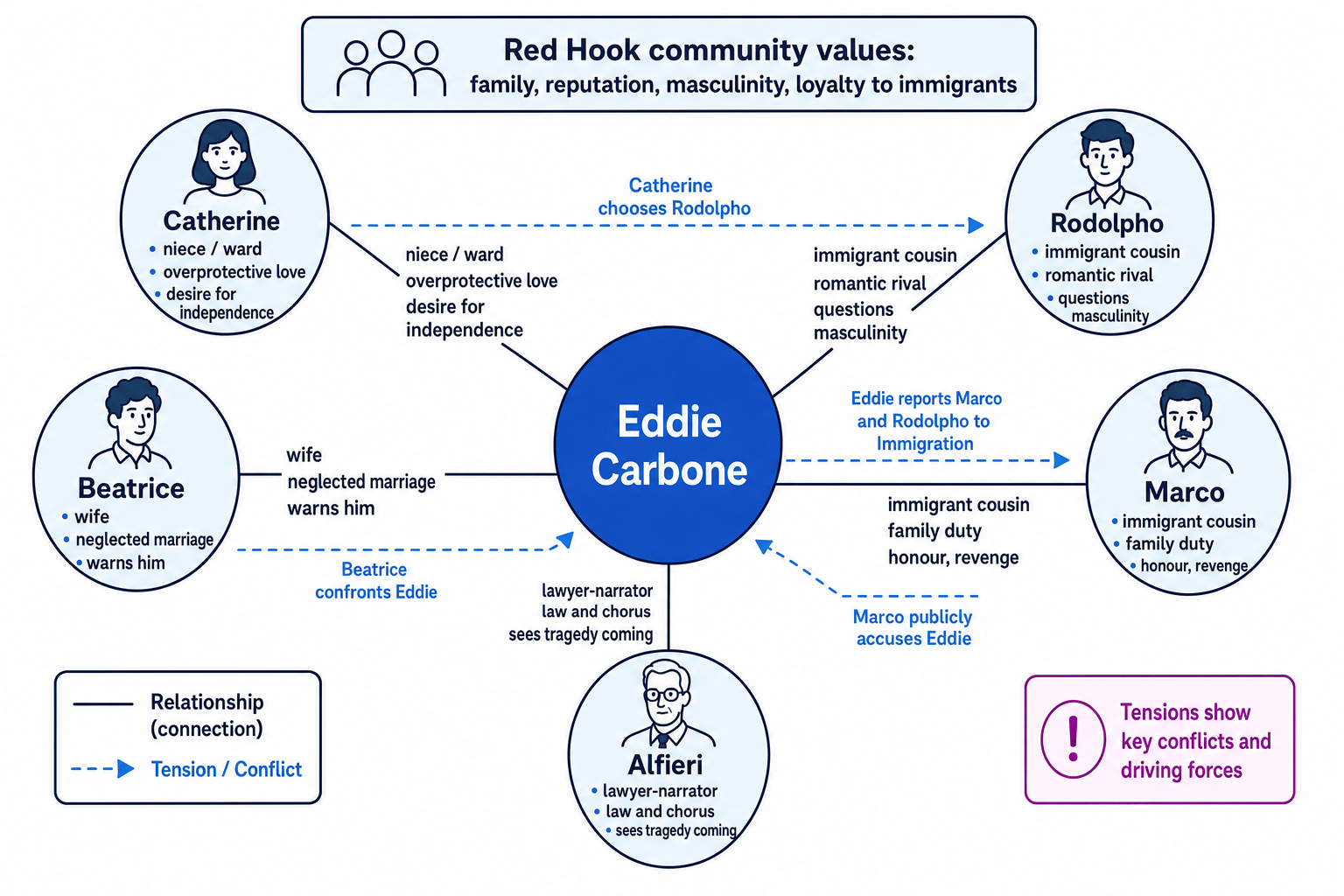
Quick overview of the main characters
| Character | Dramatic role | What to track |
|---|---|---|
| Eddie Carbone | Central figure whose choices lead to disaster | Possessiveness, masculinity, reputation, denial |
| Catherine | Young woman moving from dependence to independence | Her changing loyalty from Eddie to Rodolpho |
| Beatrice | Eddie’s wife and the clearest emotional truth-teller | Her warnings, patience and final confrontation |
| Rodolpho | Catherine’s lover and Eddie’s rival | Difference, freedom, non-traditional masculinity |
| Marco | Rodolpho’s brother and force of honour/revenge | Family duty, physical power, justice outside the law |
| Alfieri | Lawyer-narrator who frames the tragedy | Law, inevitability, judgement, pity |
Eddie Carbone: protector, provider, tragic protagonist
Eddie begins as a working-class longshoreman who has done genuinely good things. He has raised Catherine, provides for Beatrice, and agrees to shelter Marco and Rodolpho when they arrive illegally from Italy. Miller does not present him as evil from the start.
But Eddie’s protection of Catherine becomes possessive. When she wants to work and dress like other young women, he tells her, “You ain’t ‘all the girls’.” The line sounds protective, but it also separates Catherine from normal adult freedom. Eddie wants her to remain special, private and under his control.
Tragic protagonist
A tragic protagonist is the central character in a tragedy — a drama ending in suffering or downfall — whose own flaw, error or uncontrolled desire helps cause the catastrophe.
Eddie’s tragic flaw is not simply “love”. It is his refusal to understand the nature of his desire for Catherine. Alfieri describes “a passion that had moved into his body, like a stranger”. The simile suggests that Eddie is invaded by a force he cannot control or admit.
Eddie’s contradiction
Eddie is both caring and dangerous: he wants to protect Catherine, but his protection becomes control, jealousy and betrayal.
Reading Eddie’s possessiveness
- Start with the relationship: Eddie is Catherine’s uncle-figure and guardian, so his concern can initially seem reasonable.
- Focus on the wording of “You ain’t ‘all the girls’”: the colloquial phrase sounds like everyday family speech, but it also singles Catherine out as someone who must obey different rules.
- Connect the line to later structure: Eddie’s early warnings grow into hostility towards Rodolpho, a visit to Alfieri, and finally the phone call to Immigration.
- Build an interpretation: Miller makes the audience uneasy because Eddie’s fatherly language gradually reveals possessive desire.
Eddie and masculinity
Eddie’s idea of being a man is tied to providing money, controlling the household and being respected publicly. Rodolpho threatens this because he sings, cooks and sews, so Eddie complains that “he ain’t right”. The vague phrase shows that Eddie cannot prove Rodolpho has done anything wrong; he can only attack him for not fitting Eddie’s narrow model of masculinity.
Eddie’s repeated cry, “I want my name!”, shows how much he values reputation. His “name” means public honour, masculine identity and social standing in Red Hook. Ironically, he destroys that name himself by informing on Marco and Rodolpho.
Making Eddie one-dimensional
Do not write that Eddie is “just a villain”. A stronger answer explains the tension: Miller makes us recognise Eddie’s love and hard work, while also judging his possessiveness, prejudice and betrayal.
Catherine: growing into independence
Catherine’s main journey is from dependence to adulthood. At the start, she wants Eddie’s approval. Her excitement about her new job and clothes shows she is ready to enter the adult world, but Eddie still treats her like a child.
Beatrice sees the problem clearly, asking, “She’s seventeen years old, you gonna keep her in the house all her life?” This question frames Catherine’s independence as natural and necessary. Catherine’s love for Rodolpho is not just romance; it is part of her movement away from Eddie’s control.
Catherine is not always confident. She feels guilty because Eddie has been good to her, and Miller makes that emotional conflict believable. Her choice to marry Rodolpho becomes a direct challenge to Eddie’s authority.
Beatrice: wife, mediator, truth-teller
Beatrice is often calm and practical, but she is not weak. She understands the emotional reality of the household before Eddie does. Her question, “When am I gonna be a wife again, Eddie?”, reveals the damage Eddie’s obsession with Catherine has done to the marriage.
She also guides Catherine towards maturity, telling her, “You gotta be your own self more.” Beatrice recognises that Catherine’s childish closeness to Eddie is no longer healthy. This makes Beatrice a protective figure, but in a different way from Eddie: she protects Catherine by encouraging separation.
Her most important moment comes near the end when she tells Eddie, “You want somethin’ else, Eddie, and you can never have her!” This is devastating because it names the truth Eddie has been avoiding.
Beatrice’s role
Beatrice speaks the emotional truth of the play: she sees Eddie’s desire, Catherine’s need for independence, and the danger of silence.
Rodolpho: freedom, difference and Eddie’s rival
Rodolpho is bright, sociable and expressive. He sings, dances, cooks and wants a future in America. Catherine is drawn to his energy because he represents a life beyond Eddie’s apartment.
Eddie tries to discredit him by suggesting he only wants to marry Catherine for citizenship. Rodolpho’s line, “I would not marry you if I had to go back to Italy,” directly challenges that accusation. Miller makes Rodolpho more than a simple romantic hero: he is also a test of Eddie’s prejudice and insecurity.
Foil
A foil is a character whose differences make another character’s qualities clearer. Rodolpho acts as a foil to Eddie because his openness and difference expose Eddie’s narrow ideas about masculinity.
Using Rodolpho as a foil to Eddie
- Identify the contrast: Eddie values physical toughness and control, while Rodolpho is musical, cheerful and emotionally open.
- Analyse Eddie’s judgement, “he ain’t right”: the phrase is imprecise, so it reveals more about Eddie’s assumptions than about Rodolpho’s character.
- Add Rodolpho’s defence, “I would not marry you if I had to go back to Italy”: this weakens Eddie’s claim that Rodolpho is only using Catherine.
- Link to effect: Miller shifts suspicion back onto Eddie, making the audience question why Rodolpho’s difference provokes such intense hostility.
Marco: family duty, honour and revenge
Marco is quieter than Rodolpho, but his presence becomes increasingly powerful. He has come to America to earn money for his starving family, so his purpose is rooted in duty. This makes Eddie’s betrayal especially serious: Eddie is not only reporting illegal immigrants; he is endangering Marco’s children.
Marco’s physical strength is shown in the chair-lifting scene. Miller’s stage direction describes the chair as “raised like a weapon”, which is a moment of foreshadowing.
Foreshadowing
Foreshadowing is when a writer includes an early detail that hints at a later event. The chair scene hints that Marco and Eddie’s conflict may become violent.
After Eddie calls Immigration, Marco publicly cries, “That one! I accuse that one!” His language turns Eddie’s private betrayal into a public shame. Marco also says, “All the law is not in a book,” showing the clash between official American law and an older code of family honour.
Alfieri: lawyer, narrator and moral witness
Alfieri is both a character in the action and the narrator who frames it. As a lawyer, he represents official law. As an Italian-American man in Red Hook, he also understands the older ideas of honour and revenge.
He tells us, “Now we settle for half, and I like it better.” This means modern law usually avoids absolute justice or revenge; it compromises. Eddie, however, cannot accept “half”. He wants total control, total respect and total restoration of his “name”.
Alfieri’s role also affects the structure of the play. He warns us that he “watched it run its bloody course”, so the audience senses that the tragedy is moving towards an unavoidable end. This creates tension because we can see the danger before Eddie can.
Writing about Alfieri
Treat Alfieri as both a person and a dramatic device. He is a lawyer Eddie speaks to, but he also shapes the audience’s judgement by commenting on the action.
Minor characters and the Red Hook community
Characters like Louis, Mike, Tony and the Immigration officers help create the world around the main family. Red Hook is a close community where reputation matters intensely. The story of Vinny Bolzano, who informed on his own relatives, prepares us for how serious Eddie’s betrayal will be.
The community’s values put pressure on Eddie. He wants to appear honourable, masculine and loyal, but his actions break the very code he claims to defend. This is why Marco’s public accusation is so powerful: Eddie’s private desire becomes public disgrace.
Character writing: what strong answers do
A strong character paragraph does not just describe personality. It explains how Miller presents the character and why that matters dramatically.
Try building paragraphs like this:
- Make a clear point about the character’s role or conflict.
- Use a short, accurate quotation or stage direction.
- Analyse Miller’s method: dialogue, stage direction, contrast, foreshadowing or structure.
- Explain the effect on the audience.
- Link back to the question and to the play’s larger conflicts.
For example, if writing about Eddie, do not simply say he is jealous. Show how his jealousy is revealed through controlling speech, hostility to Rodolpho, and his obsession with his “name”.
In the exam
- Track each character across the play: beginning, turning point, ending. This helps you avoid vague description.
- Use your clean copy wisely: choose short quotations and stage directions, then analyse Miller’s methods rather than copying long chunks.
- Link characters to dramatic conflicts such as independence, reputation, masculinity, family loyalty and law.
Check yourself
- How does Miller show that Eddie’s protection of Catherine becomes possessive?
- Why is Rodolpho such a threat to Eddie’s idea of masculinity?
- What does Alfieri add to the play that no other character can?