To truly appreciate Arthur Miller’s A View from the Bridge, you must step back into the world that inspired it: the mid-twentieth-century docks of Brooklyn, New York.
For the Pearson Edexcel International GCSE (4ET1) specification, A View from the Bridge is assessed in Component 2, Section A (Modern Drama). The key assessment objectives here are AO1 (knowledge, understanding, and personal response) and AO2 (analysis of language, form, and structure).
The AO4 Context Trap
Unlike some other texts in your specification, Component 2 Section A does not have direct marks allocated for AO4 (Context). This means you should never write "historical context paragraphs" in your exam essay. Instead, you must use your knowledge of context to explain the characters' motivations (AO1) and Miller's dramatic choices (AO2). Context is your secret weapon to explain the "why" behind the drama.
What you'll learn
- How the 1950s Red Hook setting determines the characters' lives and struggles.
- The clash between written American Law and the unwritten Sicilian code of omertà.
- Arthur Miller’s biographical background, including his encounter with McCarthyism.
- How Miller uses the structure of Ancient Greek Tragedy to elevate a modern working-class story.
Red Hook, Brooklyn in the 1950s
The play is set in Red Hook, a slum area on the Brooklyn waterfront facing New York Bay. In the 1950s, this was a tough, insular, working-class neighborhood populated largely by Italian immigrants and their first-generation descendants.
The Docks and the Longshoremen
Most men in Red Hook worked on the docks as longshoremen.
Longshoreman
A longshoreman (or dockworker) is a laborer responsible for loading and unloading cargo from ships. In the 1950s, this work was physically grueling, highly unstable, and controlled by competitive, sometimes corrupt, union hiring bosses.
Eddie Carbone is a longshoreman. His identity is entirely tied to his physical strength and his ability to provide for his family: his wife Beatrice and his orphaned niece Catherine. Work on the docks was irregular; if no ships came in, the men did not get paid. This economic vulnerability makes the arrival of "submarine" immigrants a massive financial risk, but also an absolute moral duty.
The Post-War Immigrant Experience
Following the devastation of World War II, southern Italy and Sicily were plagued by extreme poverty, starvation, and unemployment. For young men like Marco and Rodolfo, coming to America—even illegally—was the only way to save their families back home from ruin.
The 'Submarines'
Illegal immigrants who entered the US by hiding on cargo ships were colloquially called submarines. Because they had no legal status, they were dependent on relatives already in America to hide them, find them work, and shield them from the authorities.
The Clash of Two Law Codes
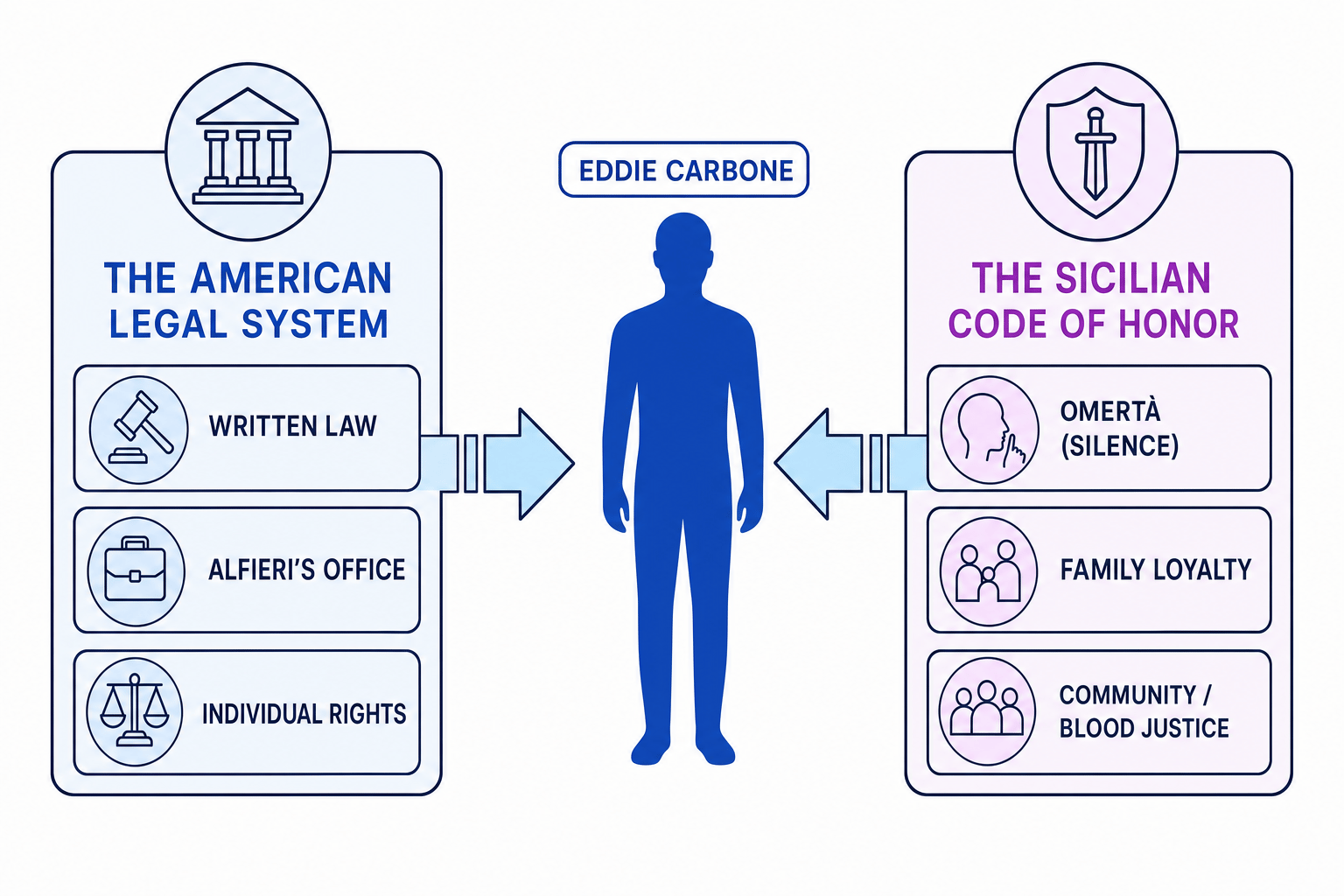
At the heart of A View from the Bridge is a fundamental conflict between two distinct systems of justice and social organization: the American Legal System and the Sicilian Code of Honor.
The Sicilian Code and Omertà
The Italian immigrant community of Red Hook brought with them deep-seated traditions from Southern Italy, where central government authority had historically been weak, corrupt, or oppressive. To survive, Sicilian communities relied on a strict, self-governing code of conduct.
Omertà
Omertà is a southern Italian code of honor and silence that forbids cooperation with state authorities or police. Disputes, betrayals, and crimes are resolved internally by the family or community, rather than through the formal legal system.
Under this code, informing on someone (especially family) to the state authorities is the ultimate sin. It is viewed as a form of social murder, punishable by complete exile from the community or even physical violence.
The American Law
In contrast to this tribal honor code is the written, institutionalized law of the United States. To the residents of Red Hook, the American legal system is seen as cold, sterile, and alien. It does not understand or protect their deep cultural values.
Alfieri, the lawyer who acts as the play’s narrator, represents the "bridge" between these two worlds. He is an American lawyer, but he was born in Italy. He knows that while the American law is supreme in the eyes of the state, it often fails to satisfy the human need for natural justice. As Alfieri notes in his opening monologue, in Red Hook they used to settle things with "sharks tooth" and "blood," but now they are civilized and "agree to settle for half."
Arthur Miller and the Red Hook Origins
Arthur Miller’s own life and political beliefs deeply informed the writing of the play, which premiered in its two-act version in 1956.
The True Story
While researching on the Brooklyn docks in the late 1940s, Miller heard a true story about a local longshoreman who had snitched to the Immigration Bureau about his own relatives. The man had done this to prevent a young girl in his care from marrying one of the illegal immigrants. The community reacted with instant, absolute disgust; the man was completely ostracized and eventually vanished, rumored to have been murdered by his own brother. Miller was haunted by this story and sought to understand what could drive a man to commit such a self-destructive act.
McCarthyism and "Naming Names"
The 1950s in America was the era of the Red Scare, led by Senator Joseph McCarthy. The US government set up the House Un-American Activities Committee (HUAC) to root out suspected communists.
To clear their own names, individuals were pressured to "name names"—meaning, to inform on friends, colleagues, and family members who had left-wing sympathies. Those who refused were blacklisted, losing their livelihoods.
Miller and the Informer
Miller’s close friend and collaborator, the director Elia Kazan, chose to cooperate with HUAC and "name names" to save his Hollywood career. Miller was deeply shocked by this betrayal. He refused to cooperate when he was called before the committee in 1956. A View from the Bridge is, in many ways, Miller’s artistic response to this political climate—an exploration of the intense shame, self-loathing, and social death that accompanies the act of informing.
The Literary Context: Greek Tragedy
Miller did not want to write a simple social realist melodrama about dockworkers. He wanted to prove that the ordinary, working-class man could be the subject of a grand tragedy, equal in stature to the kings and gods of Ancient Greek drama.
Tragic Hero
In dramatic literature, a tragic hero is a protagonist of noble stature (or, in Miller’s modern view, of intense passion) who possesses a fatal flaw that inevitably leads to their downfall.
To achieve this, Miller incorporated several key elements of classical Greek tragedy:
1. The Greek Chorus (Alfieri)
In ancient Greek plays, the Chorus was a group of actors who stood apart from the main action, commenting on the themes, providing historical context, and warning the protagonist of their impending doom.
In A View from the Bridge, Alfieri performs this exact function. He is both a character inside the play and an external narrator who talks directly to the audience. He cannot stop the tragedy; he can only watch it unfold "with powerless eyes," creating a powerful sense of inevitability and fatalism.
2. Hamartia and Hubris
Two vital concepts drive Eddie's tragic descent:
- Hamartia: Often translated as a "tragic flaw," it is a error in judgment or character trait that leads to the hero's ruin. Eddie's hamartia is his suppressed, incestuous desire for his niece Catherine, which he refuses to acknowledge or name.
- Hubris: Excessive pride or self-confidence that leads a character to defy the social or moral laws of their world. Eddie’s hubris is shown when he ignores Alfieri's legal and moral warnings, believing he can control the lives of those around him, ultimately leading him to call the Immigration Bureau.
3. Catharsis
By the end of the play, Eddie’s actions lead to his inevitable, violent death at the hands of Marco. The audience experiences catharsis—a purging of pity and fear—as Eddie dies in Beatrice's arms, having paid the ultimate price for his transgression of the community code.
Applying Context to Your Essay
Because you are assessed on AO1 and AO2 (not AO4), you must never just state historical facts. You must link context directly to Miller's language, characterization, and dramatic structure.
Let's look at how to construct an analytical paragraph that uses context to explain character motivation and dramatic choices.
Integrating context into text analysis
Analyze how Miller presents the conflict between the law and the community in the play.
- State your point clearly (AO1): Miller uses the character of Alfieri to establish the immediate ideological tension between written American law and the ancient Italian code of honor in Red Hook.
- Provide textual evidence (AO1): In his opening monologue, Alfieri describes how lawyers in his neighborhood used to be "distrusted," explaining that "now we are quite civilized, quite American. Now we settle for half."
- Analyze the writer's methods and language (AO2): The repetition of the adverb "now" combined with the adjective "civilized" suggests a forced transition from the old world to the new. However, the colloquial metaphor "settle for half" hints at a lingering compromise; the community reluctantly accepts the sterile American legal framework, but their deeper loyalties still lie with the ancient, absolute Sicilian code of justice.
- Integrate the contextual meaning (AO1/AO2 link): This reflects the 1950s immigrant reality of Red Hook, where residents feared the legal authorities, viewing them as an arm of a hostile state. By positioning Alfieri as a narrator who bridges these two opposing worlds, Miller structurally foreshadows Eddie's tragic downfall, which occurs precisely because Eddie violates the communal code of silence (omertà) in a desperate attempt to use the American law to his advantage.
In the exam
- Never "context-dump": Do not write paragraphs explaining the history of the HUAC or the poverty of post-war Sicily on their own. Only introduce these facts if they directly explain a character's dialogue or Miller's stage directions.
- Use Alfieri as your key tool: Whenever you discuss context, look at Alfieri’s monologues. He is literally Miller's structural device (AO2) designed to explain the cultural context (AO1) to the audience.
- Anchor analysis in key quotes: Ensure contextual points are anchored to specific, short quotes like "snitch" or "he bites his jaw to keep from crying out." This shows the examiner that your understanding of the context is fully integrated into your close-reading skills.
Check yourself
- Why did the Red Hook community consider informing on illegal immigrants to be such a heinous act?
- How does Arthur Miller’s experience with McCarthyism and the House Un-American Activities Committee relate to Eddie’s betrayal of Marco and Rodolfo?
- What classical Greek drama element does the character of Alfieri represent, and what is his dramatic function in the play?