To master A View from the Bridge for your Edexcel IGCSE English Literature exam, you must look beyond "what happens" and analyze how and why Arthur Miller structures the narrative. Because the Modern Drama exam (Component 2, Section A) is open-book, examiners do not just want a simple retelling of the storyline. They expect you to show how the plot functions as a vehicle for the play's themes, character development, and tragic structure.
This guide will break down the plot of A View from the Bridge structurally, tracing the rising and falling tension, the crucial turning points, and the dramatic mechanisms Miller uses to drive Eddie Carbone toward his inevitable doom.
What you'll learn
- The chronological sequence of events across Miller’s tight, two-act structure.
- How Alfieri functions as a modern Greek Chorus to frame and comment on the plot.
- The critical turning points that accelerate Eddie’s tragic downfall.
- How to analyze dramatic structure to secure top marks in AO1 (textual knowledge) and AO2 (writer’s craft).
Prerequisites: Understanding Tragedy and Structure
Before diving into the scene-by-scene progression, we must understand the dramatic framework Miller utilizes. Miller does not write a standard three-act drawing-room play; instead, he models A View from the Bridge on classical Greek tragedy, adapting it to a mid-20th-century working-class Italian-American setting.
Domestic Tragedy
A drama in which the protagonist is an ordinary, working-class individual rather than a person of noble birth. The character's downfall is caused by a personal flaw (hamartia) interacting with social pressures, leading to a disastrous, inevitable end.
Miller structures the play into two acts. This clean division creates a stark contrast:
- Act 1 establishes the baseline of the Carbone household and slowly seeds the domestic tension. It ends with a physical warning of violence.
- Act 2 represents a rapid, unchecked descent into betrayal, isolation, and death.
The Inevitability of the Plot
From the very first scene, the plot is designed to feel inescapable. By using the lawyer Alfieri as a narrator, Miller alerts us that we are watching a tragic path that has already been run. The plot is not a series of random accidents, but a runaway train of inevitable consequences.
To visualize this tragic momentum, look at how Miller paces the dramatic tension across the two-act arc:
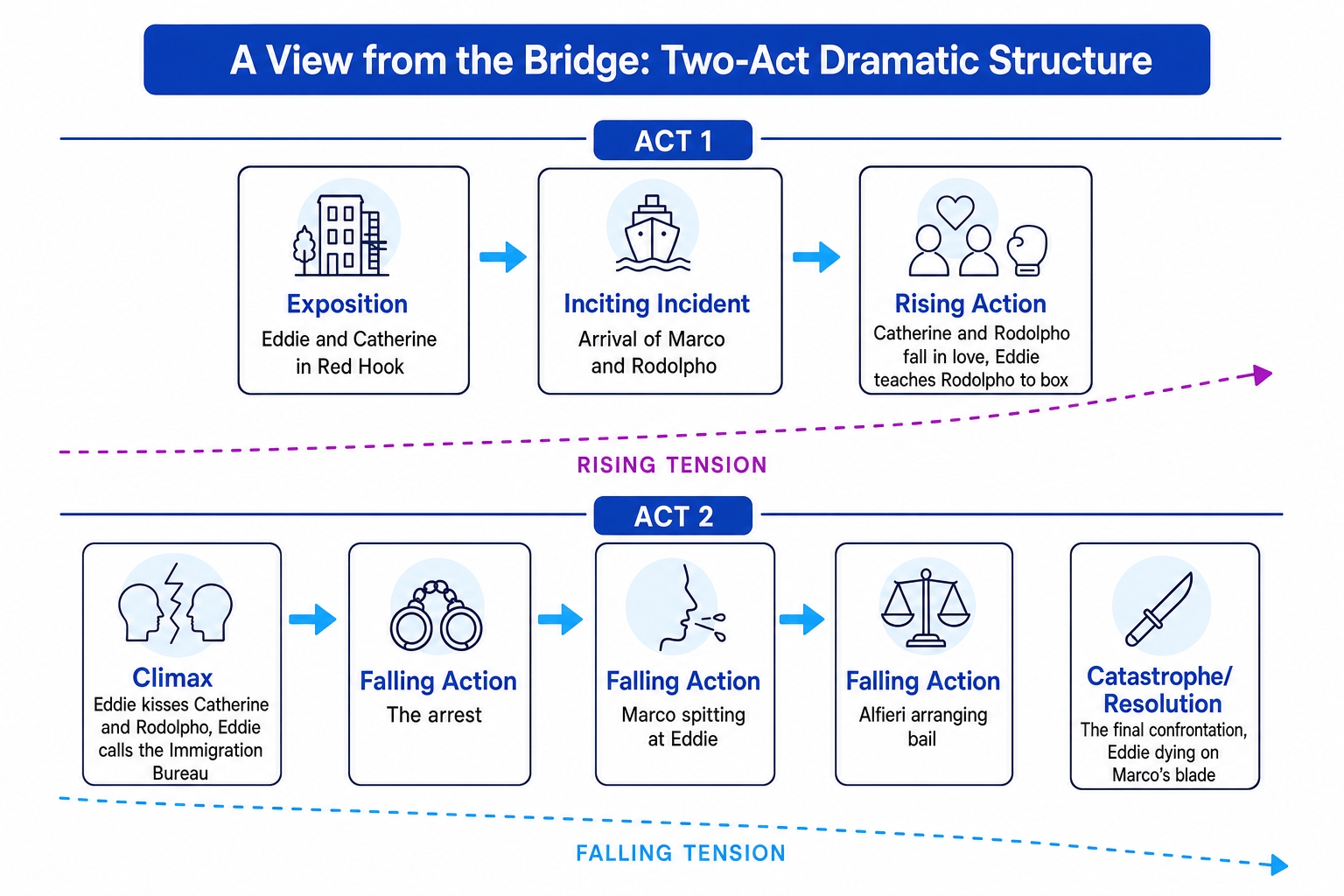
Act 1: The Inciting Incident and Rising Tension
1. The Exposition and Context
The play opens in Red Hook, a slum on the Brooklyn waterfront facing the suspension bridge. Alfieri, a lawyer, introduces himself and the neighborhood, establishing the tension between American written law and the ancient, Sicilian code of honor ("we settle for half").
We are introduced to Eddie Carbone, a longshoreman; his wife, Beatrice; and their orphaned seventeen-year-old niece, Catherine. Eddie’s overprotective nature is immediately evident. He criticizes Catherine’s new skirt, her walk, and her desire to take a well-paying job as a stenographer.
2. The Inciting Incident: The Submarines Arrive
Beatrice’s cousins, Marco and Rodolpho, arrive from Sicily as illegal immigrants ("submarines") to work on the docks and send money home.
- Marco is quiet, physically powerful, and deeply traditional, focused solely on earning money for his starving children in Italy.
- Rodolpho is young, blonde, expressive, and highly charismatic. He loves to sing ("Paper Doll"), cook, and buy high-fashion clothes with his earnings.
3. The Rising Action: Jealousy and Confrontation
A romance rapidly develops between Catherine and Rodolpho. Eddie’s affection for Catherine—which the audience and Beatrice recognize as unhealthy and covertly incestuous—fuels a bitter hatred for Rodolpho.
Eddie attempts to undermine Rodolpho by:
- Suggesting Rodolpho is effeminate and "not right" (hinting at homosexuality).
- Claiming Rodolpho is a gold-digger who only wants to marry Catherine to secure his US citizenship.
Desperate to stop the relationship, Eddie visits Alfieri. Alfieri warns him that the law has no power to prevent the marriage, advising Eddie: "there is too much love for the niece. Do you understand what I’m saying to you?" Eddie refuses to acknowledge his subconscious desires.
4. The Act 1 Climax: Domestic Power Plays
Tension boils over in the living room. Eddie subtly patronizes Rodolpho by offering to teach him how to box. This is a thinly veiled excuse to strike Rodolpho in front of Catherine.
Seeing this aggression, Marco steps in quietly but firmly. He challenges Eddie to a test of strength: lifting a heavy wooden chair by the foot of one leg with one hand. When Eddie fails, Marco easily lifts the chair above Eddie's head, holding it "like a weapon". This silent, physical warning closes Act 1.
Act 2: The Climax, Betrayal, and Catastrophe
1. The Point of No Return
Act 2 begins during the Christmas holidays. Eddie returns home drunk to find Catherine and Rodolpho alone in the apartment, having just consummated their relationship.
In a fit of rage, Eddie:
- Grabs Catherine and kisses her on the mouth.
- Grabs Rodolpho and pins him, kissing him as well to "prove" his claim that Rodolpho is not a "real man."
This double-kiss is a shocking, transgressive turning point. Eddie has completely broken domestic boundaries.
2. The Climax: The Ultimate Betrayal
Catherine decides to marry Rodolpho immediately to escape Eddie. Blinded by obsession, Eddie visits Alfieri again, who warns him that if he takes action against them, he will lose his community's respect.
Ignoring this, Eddie goes to a phone booth and calls the Immigration Bureau, reporting Marco and Rodolpho.
The Code of Honor
In the close-knit, Sicilian-dominated community of Red Hook, calling the state authorities on fellow immigrants is the ultimate sin. It is a total betrayal of the local code of silence and solidarity.
3. The Falling Action: Public Exposure and Shame
Immigration officers arrive and arrest Marco, Rodolpho, and two other illegal immigrants staying in the same building. As they are led away through the streets, Marco spits in Eddie's face and yells: "That one! He killed my children!" Eddie is instantly ostracized by his neighbors, who turn their backs on him.
Alfieri secures bail for Marco on the condition that Marco promises not to harm Eddie. Marco reluctantly agrees, but his concept of justice cannot be satisfied by American law.
4. The Catastrophe: The Final Duel
On the day of Catherine and Rodolpho’s wedding, Eddie refuses to let Beatrice attend unless Marco publicly apologizes to him and restores his "name" and "respect".
Marco arrives at the house, refusing to compromise. Eddie draws a knife on Marco. In the ensuing struggle, Marco turns the blade back onto Eddie's chest. Eddie dies in Beatrice's arms, crying out her name as his final words, leaving Alfieri to deliver the tragic elegy.
Worked Example: Analyzing a Plot Turning Point
In the exam, you must show how Miller structures the plot to create dramatic tension (AO2). Let us analyze how the climax of Act 1—the chair-lifting scene—foreshadows the tragic climax of Act 2.
Analyzing structural escalation in Act 1
Analyze how Miller uses the final scene of Act 1 to structure the play's tragic trajectory.
-
State the structural purpose of the scene: Identify that the chair-lifting scene is the transition point where the domestic conflict shifts from psychological tension to physical threat, foreshadowing the fatal confrontation in Act 2.
-
Select and analyze key stage directions and actions: Highlight the contrast between Eddie’s physical failure and Marco's silent victory. Use Miller's specific stage directions: "the chair hanging like a weapon over Eddie’s head". Note how the noun "weapon" directly anticipates the knife in Act 2.
-
Examine the change in power dynamics: Analyze how the action shifts the balance of power. While Eddie attempts to dominate Rodolpho through the "boxing lesson," Marco's intervention establishes him as the ultimate protector of his brother, setting up the direct clash between Eddie and Marco.
-
Link the scene to the tragic outcome (AO2): Explain how this moment creates dramatic irony. The audience knows Marco is capable of overpowering Eddie, making Eddie's later insistence on demanding "respect" from Marco in Act 2 an act of supreme hubris (tragic pride) that must end in his death.
Summarizing instead of Analyzing
A very common error in open-book exams is writing a narrative summary of what happens (e.g., "First Eddie gets angry, then he calls the immigration officers, and then..."). You must analyze why Miller structured it this way. Instead of "what Eddie does," write about "how Miller uses Eddie's actions to develop the theme of law versus justice."
Use Stage Directions in Your Plot Analysis
Since this is a play, the plot is not just driven by spoken words. Miller's detailed stage directions are vital plot developments. The lifting of the chair, the kissing of Rodolpho, the spitting on the street, and the turning of the knife are physical actions that drive the plot forward. Make sure you quote the stage directions!
In the exam
- Track the pacing of tension: When writing about any plot event, identify where it sits on the dramatic arc. Is it part of the slow-burning exposition of Act 1, or the rapid, high-stakes falling action of Act 2?
- Examine Alfieri's interruptions: Look at when Alfieri steps in to speak to the audience. Miller places these monologues at key plot transitions to pause the action and remind the audience of the larger, universal tragic forces at play.
- Connect plot to character motivation (AO1): Always explain why a plot development occurs. Eddie does not call immigration simply because he dislikes illegal immigrants; he does it because his psychological defense mechanisms have collapsed under the pressure of Catherine’s impending marriage.
Check yourself
- Why does Miller choose a two-act structure rather than the traditional three-act structure? How does this change the pacing of the tragedy?
- What is the difference in tone and speed between the plot developments in Act 1 and Act 2?
- How does the ending of Act 1 (the chair-lifting scene) prepare the audience for the final catastrophe in Act 2?